beyond income 128
| |

Beyond income, 12.8% of Filipinos are poor across multiple dimensions in 2024

MANILA, Philippines – The Philippines may have finally reached single-digit poverty by the government’s traditional income measure, but a new and broader official way of measuring poverty shows that 12.8% of Filipinos were considered multidimensionally poor in 2024.

The Philippine Statistics Authority’s (PSA) first official Multidimensional Poverty Index (MPI) looks beyond how much a family earns and asks whether Filipinos are poor or deprived across education, health and nutrition, housing and basic services, and employment.


Beyond income, 12.8% of Filipinos are poor across multiple dimensions in 2024

Based on preliminary results of the 2024 Community-Based Monitoring System (CBMS), 12.4% of households were classified as multidimensionally poor. At the individual level, the rate was slightly higher at 12.8%, or roughly one in eight Filipinos.

That is higher than the 9.7% official income poverty rate for 2025, the record-low figure announced by the PSA in August that meant around 11 million Filipinos were living below the national poverty threshold.
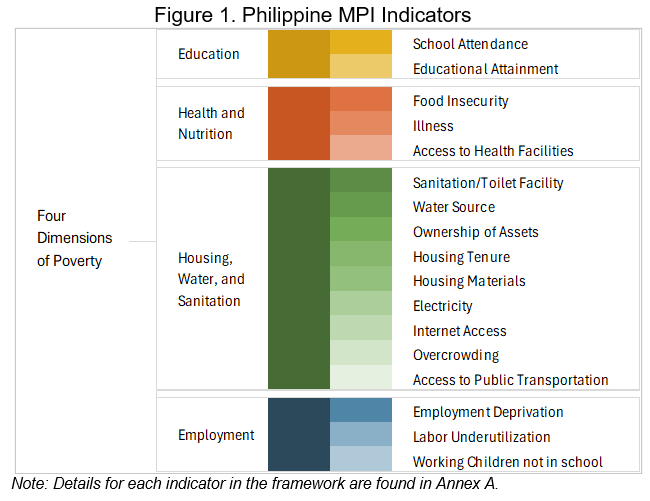
MULTIDIMENSIONAL. These are the 17 dimensions that the PSA now uses to measure multidimensional poverty. Image from PSA.

Note though that the figures measure different aspects of poverty and cover different years. The 9.7% poverty incidence for 2025 is based on whether Filipinos fall below the official income poverty threshold, while the new MPI uses 2024 data to measure deprivation across 17 different indicators. This new multidimensional measure of poverty should be seen as a complement to, rather than a substitute for, the country’s income-based poverty estimates, according to the PSA and Department of Economy, Planning, and Development (DEPDev).

Still, the MPI gives the government another official measure showing why crossing the income poverty line doesn’t necessarily capture the full extent of hardship.

What does being ‘multidimensionally poor’ mean?

The MPI gives equal weight to four broad dimensions: education; health and nutrition; housing, water, and sanitation; and employment.

Among the indicators are whether children attend school, whether an adult in the household finished high school, whether family members experience food insecurity, whether someone who needed medical care failed to get it, and whether the household has adequate water, sanitation, electricity, internet, housing, transport access, and employment.

A household is considered multidimensionally poor when its weighted deprivation score exceeds 25%

DEPRIVED. The dark bars show the share of all Filipinos deprived in each indicator, while the green bars show the share who are both deprived in that indicator and classified as multidimensionally poor. Image from PSA.

Education was the biggest contributor to multidimensional poverty, followed by housing, water, and sanitation. Health and nutrition as well as employment were also challenges identified.

Across the population, 38.7% of Filipinos lived in households deprived in housing materials, while 26.4% belonged to households without internet access. Another 24.1% lived in households deprived in sanitation or toilet facilities, 21.8% in household assets, and 20.2% in educational attainment.

Why many Filipinos still feel poor

The broader measure also provides context for the skepticism that followed the announcement that Philippine income poverty had fallen to 9.7%.

Under the official 2025 poverty threshold, a family of five needed around P14,634 a month to meet basic food and non-food needs. Earning even slightly more is enough to be classified as non-poor.

Filipinos’ own perceptions remain markedly different. In a Social Weather Stations survey conducted in June, 49% of Filipino families described themselves as poor. Self-rated poverty is subjective and cannot be directly compared with PSA statistics, but the gap illustrates the difference between statistical poverty and a household’s own assessment of their living conditions.
Must Read

Filipino family income grew 16.5% since 2023. So why doesn’t it feel like it?


Filipino family income grew 16.5% since 2023. So why doesn’t it feel like it?

At the Development Budget Coordination Committee hearing on Thursday, August 27, Balisacan said reaching upper-middle-income status was “not the end in itself,” adding that the greater challenge was translating economic progress into “better jobs, higher incomes, and improved living standards for Filipinos.”

He also warned that recent poverty gains remain vulnerable as prices stay elevated.

“If inflation remains elevated, it could slow or even reverse our recent advances in poverty reduction,” Balisacan said.

DEPDev said the MPI should allow government to better target programs such as adult literacy, affordable housing, healthcare, food security, and improvements in basic services. – Rappler.com

Must Read

[In This Economy] Less than 10% of Filipinos are now poor? Not so fast


[In This Economy] Less than 10% of Filipinos are now poor? Not so fast

Similar Posts

  • | | | |

    Pakistan repays $1.4bn China loan

    Pakistan has repaid a $1.4 billion commercial loan to China, with refinancing expected within the next few weeks, State Bank of Pakistan (SBP) Governor Jameel Ahmad said on Wednesday. Speaking to reporters after attending a meeting of the Senate Standing Committee on Finance at Parliament House, the SBP governor said the country had made external debt repayments worth $2.2 billion during July 2026. The repayments included the $1.4 billion commercial loan to Chinese banks, while the remaining $800 million was used to settle other external liabilities. Ahmad said the refinancing from Chinese banks had not yet been received but was expected shortly, adding that the funds would be made available to Pakistan after a brief delay. The central bank governor also revealed that the SBP had purchased $28 billion over the past three years to strengthen the country’s foreign exchange reserves. He said Pakistan’s external debt repayment requirement had declined from $26.5 billion to $21.5 billion, easing pressure on the country’s finances during the current fiscal year. According to Ahmad, around $3.5 billion of the remaining repayments will be used to service interest obligations. He said the government would continue its strategy of increasing foreign exchange reserves while maintaining external financial stability. The SBP governor further noted that Pakistan would require the rollover of nearly $12 billion in deposits from Saudi Arabia and China to support its external financing position. He expressed confidence that the country’s debt repayment burden would remain lower this year compared with previous years, helping improve Pakistan’s overall economic outlook.

  • Major Fuel Smuggling Ring Exposed at Chiang Rai-Myanmar Border

    CHIANG RAI – Thai law enforcement officials have exposed a massive fuel smuggling operation operating along the Mekong River. Smugglers have successfully bypassed a national export ban by using falsified shipping documents. The illegal operation has rerouted tens of millions of liters of fuel directly into Myanmar. National Police Deputy Chief General Thatchai Pitaneelaboot led […]

  • |

    PSX opens higher as KSE-100 index gains over 500 points

    KARACHI: Buying activity dominated trading at the Pakistan Stock Exchange (PSX) on Thursday, with the benchmark KSE-100 Index rising more than 500 points during the early session. At around 9:45am, the benchmark index was trading at 180,864.26 points, recording an increase of 553.05 points, or 0.31%, from the previous close. The positive trend reflected renewed investor interest in several major sectors. Strong activity was witnessed in cement, commercial banking, fertiliser, oil marketing companies (OMCs) and power generation stocks. Several index-heavy companies also contributed to the upward movement. HUBCO, Fauji Fertilizer Company (FFC), MCB Bank, National Bank of Pakistan (NBP) and United Bank Limited (UBL) were among the stocks trading in positive territory during the early hours. The latest gains come after the stock market staged a recovery in the previous session. On Wednesday, the PSX rebounded as investors returned to buying after two consecutive sessions of profit-taking. Market sentiment also improved toward the end of Wednesday’s trading session following reports regarding an extension of the US-Iran ceasefire, which helped ease some concerns among investors about geopolitical developments and their potential impact on regional markets. The KSE-100 Index ultimately closed Wednesday’s session at 180,311.22 points. Global markets provide positive cues The positive momentum at the domestic bourse was also supported by a broadly upbeat trend in Asian equity markets. Asian stocks advanced on Thursday after fresh US inflation data broadly matched market expectations. The figures reduced some expectations of an immediate tightening move by the US Federal Reserve and provided support to investor sentiment. MSCI’s broadest index of Asia-Pacific shares outside Japan rose 0.97%, while South Korea’s benchmark market climbed sharply, gaining 4.4%. Japan’s Nikkei index also advanced 1.86%. US stock futures remained relatively stable, with S&P 500 E-mini futures up 0.02% during the Asian trading session. US inflation remains in focus According to data released on Wednesday, US consumer prices increased by 0.1% in July, broadly matching economists’ expectations. The modest increase in consumer prices has lowered expectations of an immediate interest-rate hike by the Federal Reserve. Market participants are closely monitoring inflation figures as they assess the central bank’s next policy move. According to CME Group’s FedWatch tool, financial markets were pricing in around a 40% probability of a rate hike next month, down from approximately 54% a week earlier. Oil prices remain near $80 Meanwhile, international oil prices remained close to the $80-per-barrel level, as diplomatic efforts between Washington and Tehran remained unresolved. Developments in oil prices remain important for Pakistan’s economy and financial markets because changes in global crude prices can influence the country’s import bill, inflation outlook, exchange-rate pressures and corporate earnings. Investors at the PSX are expected to closely monitor both domestic economic developments and international market cues as trading progresses on Thursday.

Leave a Reply

Your email address will not be published. Required fields are marked *