two years billions
| | | | |

Two years and billions later, has NAIA finally leveled up?

For decades, fixing NAIA was almost a national punchline. Administration after administration touted rehabilitation plans, terminals broke down anyway, and passengers suffered everything from power outages and busted baggage systems to tanim-bala.

Now, serious money is finally being poured into its make-over. 

By its first anniversary, New NAIA Infra Corp. (NNIC) had already spent around P3.5 billion on upgrading the Ninoy Aquino International Airport, part of a much larger five-year, P72-billion rehabilitation program.

Rappler recently went inside Terminal 3 with NNIC officials and former transportation secretary Jaime Bautista to see what billions of pesos — and nearly two years of private management — have actually changed.

Welcome to the Philippines

Start at arrivals, where a new commercially important passenger or CIP lounge sits near the VIP parking area. The lounge, with its posh interiors and conference rooms, was finished in time for the Philippines’ packed year as ASEAN chair, which has brought a steady stream of foreign ministers, finance officials, diplomats, and heads of government through the country for high-level meetings and summits.

By next year, NNIC is looking to further develop the leftmost side of Terminal 3 as a hub for all public utility vehicles like buses and taxis to use. It’s also where the Metro Manila Subway will eventually connect to the airport, though that’s likely years down the line.

Move deeper into the terminal and formerly boarded-up spaces have been brought back to life. There’s an activity center, meeting rooms, and a food court — with, fittingly, a San Miguel bar.

Head one level higher and you’ll see familiar restaurants and cafés such as Estrel’s, Chili’s, UCC, and Nanyang.

While NNIC’s renovation moved with impressive speed, some of these were quick wins. NNIC officials told Rappler that the foundation of what now looks like a new mall in the airport was there all along, just unused and undeveloped.

“It was really a commercial plan, pero hindi lang naayos (it just wasn’t fixed),” an NNIC official told Rappler.

Even some escalators leading into these spaces had already been installed years ago, officials said. The areas around them were simply boarded up and eventually used for storage.

ESCALATORS. A quiet afternoon at the food court in the ground level of the Trminal 3 arrivals area. Lance Spencer Yu/Rappler.

Renovating NAIA involved a little airport archaelogy too. NNIC officials said proper “as-built” plans were sometimes incomplete or missing altogether. Contractors would open a wall or floor only to suddenly find an unexpected pipe in the way.

Check yourself in

At the Level 3 departure hall, there’s now a Dignitaries Lounge, while OFWs have their own pre-departure lounge nearby offering complimentary meals.

But before getting airside, passengers will encounter some of NNIC’s less Instagrammable, but arguably more important, upgrades.

Terminal 3 now has around 40 self-check-in kiosks, alongside automated bag-drop facilities, allowing passengers on participating airlines to print their own boarding passes and baggage tags without waiting for a staffed counter to open.

That is especially useful in the Philippines, where travelers have a tendency to arrive very, very early.

“The Philippines has the earliest show-up profile in the world,” an NNIC official said. “Meaning, passengers come here very early, which is what most airlines like. Ang problema, the airlines only open three or four hours before. So nag-aantay ‘yung mga pasahero (The problem is airlines only open three or four hours before, so passengers are left waiting).”

SELF CHECK-IN. Newly-installed machines now allow passengers to check in even before airline counters open. Lance Spencer Yu/Rappler.

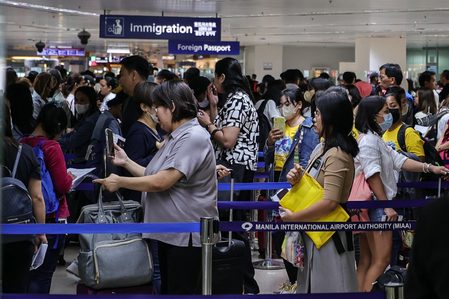
From there, passengers scan their boarding passes at automated reconciliation gates before proceeding to security and immigration.

NNIC officials said the company spent nearly P1 billion on immigration-related automation, including 78 biometric e-gates and around 130 visa and document examination systems.

“The government asked us for an SLA [service level agreement] of 10 minutes per passenger,” an official said. “The average processing time is 16 seconds.”

For now, however, not everybody gets the 16-second treatment. Use of the automated immigration gates remains limited to OFWs and foreigners for departure, and Filipinos and OFWs for arrival.

NNIC officials told Rappler that they’ve asked the Bureau of Immigration to widen that to everyone, but they’ve received pushback due to human trafficking concerns.

Must Read

A peek at NAIA T3’s swanky First Meridian — and the coming lounge shake-up


A peek at NAIA T3’s swanky First Meridian — and the coming lounge shake-up

Time to unwind

Clear immigration, and the upgrades become considerably more indulgent.

Up on Level 4, business-class and other eligible premium passengers can retreat to First Meridian, a sprawling new lounge complete with a golf simulator, wine cellar, buffet, private dining rooms, and quiet areas overlooking the airside.

And if a lounge isn’t your cup of coffee, there’s a Starbucks Reserve opposite First Meridian, serving specialty brews and Philippine-themed merchandise. 

COFFEE? A newly-opened Starbucks Reserve in the airside international departures area of Terminal 3. Lance Spencer Yu/Rappler.

The problem with fixing NAIA is that NAIA never stops being NAIA. An endless throng of passengers still hurries along the corriders with flights to catch. Airlines still have schedules to keep. Immigration queues still snake along. 

“It’s so difficult to be constructing and operating at the same time,” an NNIC official said. “So we only work during lull times.”

NAIA is already carrying far more passengers than it was built for. The airport was designed to accommodate roughly 35 million passengers a year. In 2025, it handled around 52 million. Terminal 3 alone was designed for about 14 million passengers but handled roughly 27 million.

To do that, it’s trying to squeeze more out of NAIA’s two runways.

One step was removing most turboprop operations from the airport. A turboprop may carry only around 70 passengers while occupying a runway slot that could be used by a jet carrying several hundred. Mixing turboprops and jets can also require greater aircraft separation because of wake turbulence. 

NNIC estimates NAIA can now handle around 40 to 42 aircraft movements per hour, up from roughly 38. Its eventual target is 48.

NAIA: Government’s new money-maker

NNIC officials say around P78 billion has already been remitted to government as of July 2026, including the consortium’s P30-billion upfront payment.

For government, privatizing NAIA is also proving more lucrative than operating the airport itself. In 2023, the last full year before privatization, the Manila International Airport Authority (MIAA) remitted P8.17 billion to the National Government through dividends, taxes, the government’s share of airport income, and other statutory payments.

Under the new concession, the Department of Finance estimates government could collect roughly P900 billion over 25 years, or about P36 billion a year on average, while NNIC shoulders the cost of operating and modernizing the airport.

PREMIUM LOUNGE. Rows of chairs in the quiet area of First Meridian. Lance Spencer Yu/Rappler.

That hefty contribution traces back to the bid that won San Miguel’s group the airport concession in the first place. NNIC offered government 82.16% of gross revenues, excluding passenger service charges, far above the 33.3% offered by the GMR Airports Consortium and 25.91% from the Manila International Airport Consortium. (READ: NAIA rehab: Consortium led by San Miguel, Incheon Airport outbids everyone)

For another sense of how lucrative NAIA has become for government, the Manila International Airport Authority’s latest remittance hit P7.59 billion in dividends from its 2025 earnings, higher than the P5.67 billion paid by gambling regulator PAGCOR.

Terminal reassignments and NAIA’s future

And there are bigger changes still ahead.

Most of the visible upgrades so far have been concentrated in Terminal 3, partly because NNIC eventually wants it to become one of NAIA’s two international terminals.

NNIC officials told Rappler that Philippine Airlines could move both its international and domestic flights to Terminal 3 as early as February 2027, consolidating there temporarily while more work is completed.

Here’s the long-term plan, though this is very much on the drawing board:

  • Terminal 1 will handle international flights from low-cost carriers, led by Cebu Pacific
  • Terminal 2 will handle domestic Cebu Pacific and AirAsia flights
  • Terminal 3 will handle full-service international flights, led by Philippine Airlines
  • Terminal 5, which will rise on the former Philippine Village Hotel site, will handle PAL’s domestic flights
Must Read

NAIA Terminal 5? Ramon Ang bares plans for Philippines’ main airport


NAIA Terminal 5? Ramon Ang bares plans for Philippines’ main airport

Under its concession agreement, NNIC is required to expand the airport’s capacity to as much as 62 million passengers annually.

If Ramon Ang is able to pull this off, it would be a dramatic turnaround for an airport with a troubled history. (READ: Ramon Ang wants an even bigger NAIA terminal than promised. Can he deliver?)

NAIA, long derided as one of the world’s worst airports, became notorious for tanim-bala, bedbugs, failing baggage systems, broken air-conditioning, and repeated power interruptions. On January 1, 2023, a failure in the country’s air traffic management system effectively shut Philippine airspace for hours, disrupting hundreds of flights and affecting tens of thousands of passengers.

For years, successive administrations tried and failed to rehabilitate or privatize NAIA. The breakthrough finally came in 2024, when the Department of Transportation under then-secretary Jaime Bautista awarded the concession to the San Miguel-led consortium.

Bautista, now an independent director of San Miguel Corporation, told Rappler he was “very happy” to see how much had changed. But even he acknowledged that there’s much still left to do. Terminal 5 still has to be built, the terminals still have to be reshuffled, and all of it has to happen while NAIA remains open, crowded, and very much in use. – Rappler.com

Must Read

NAIA: ‘Still a third world airport’


NAIA: ‘Still a third world airport’

Similar Posts

  • | |

    Shein turns to China as Hong Kong IPO nears

    Fast-fashion giant Shein is preparing to make its stock market debut in Hong Kong after years of efforts to list in the United States and Britain, marking a significant shift in how the company presents its relationship with China. The company is expected to raise around $1.7 billion through its Hong Kong initial public offering, with a valuation of about $26.5 billion. That figure is considerably below the company’s valuation in 2022. Shein had previously sought to establish itself as a global company. It moved its headquarters to Singapore in 2021 and promoted plans to expand manufacturing and operations in countries including Brazil, Türkiye and parts of Europe. However, its attempts to secure a Western listing faced regulatory and political obstacles. Chinese authorities were also reportedly involved in blocking earlier efforts to list in New York and London. After shifting its focus to Hong Kong in 2025, Shein founder Sky Xu increased his engagement with Chinese officials and became more involved in regulatory and capital-market discussions inside the country, according to people familiar with the matter. Xu also made a rare public appearance at a business forum in Guangdong earlier this year, where he announced plans for Shein to invest $1.5 billion in the province. He said the company would deepen its presence in Guangdong and develop its smart supply-chain system while contributing to the region’s fashion industry. Shein also opened a research and development centre in Nanjing, the eastern Chinese city where the company was founded in 2012. These moves helped reinforce the company’s economic links with China at a time when Beijing has been paying close attention to companies with major overseas operations. Officials in Guangdong also reportedly highlighted Shein’s contribution to employment and domestic economic activity when engaging with central authorities. The company has sought to emphasise that its main business is overseas rather than in China. Shein does not market its extremely low-priced products to Chinese consumers, allowing it to distance itself from the intense competition among domestic e-commerce platforms. Shein has instead argued that its international operations benefit China by generating foreign currency and supporting Chinese manufacturing and supply chains. The company’s Hong Kong prospectus describes China as the foundation of its global logistics and fulfilment network. Nearly 80 per cent of Shein’s workforce is based in mainland China. The shift comes after growing difficulties in Western markets. In the United States, lawmakers raised concerns over Shein’s supply chains and called for stronger assurances that its products were not linked to forced labour. The company has also faced scrutiny in Europe over competition, product safety and items offered through its online marketplace. At the same time, changes to low-value import rules in the US and Europe have created additional challenges for Shein’s business model, which relies heavily on inexpensive shipments directly to consumers. Analysts say the company’s experience demonstrates how geopolitical tensions are increasingly influencing corporate decisions and stock-market listings.

  • |

    Goods transport strike threatens Pakistan’s industry

    KARACHI: A nationwide strike by goods transporters has triggered growing concern among industrialists, who fear that a prolonged disruption in cargo movement could disrupt factory operations, delay export shipments and add further pressure to Pakistan’s already fragile economy. Business leaders have warned that the continued suspension of freight services could create serious bottlenecks in the supply chain, particularly for industries that rely on the regular movement of raw materials and intermediate goods. Any prolonged shortage of essential inputs could force factories to slow down production or temporarily shut operations. The industrial sector is also facing the risk of delays in the delivery of finished products to domestic markets and international buyers. Export-oriented industries, in particular, could suffer if consignments fail to reach ports or overseas customers within agreed timelines. President of the SITE Association of Industry (SAI) Abdul Rehman Fudda said the transporters’ strike had created a critical situation for the manufacturing sector, as industries could not maintain uninterrupted production without a reliable logistics network. He said factories depended on the timely arrival of raw materials and the smooth transportation of finished goods. Any disruption in freight movement, he added, could interrupt production schedules and increase costs for manufacturers. Fudda warned that the impact of the strike could extend beyond factories, affecting workers, suppliers, exporters, retailers and other businesses linked to the industrial supply chain. He pointed out that Pakistan’s export sector was already operating under significant pressure because of high production costs and other economic challenges. A disruption in transportation, he said, would further increase the difficulties faced by exporters. The SAI president cautioned that delays in export shipments could have financial as well as reputational consequences. International buyers may impose penalties, demand price reductions or seek compensation when shipments fail to arrive within agreed deadlines. According to him, exporters operate under strict delivery schedules, and even a temporary disruption in logistics can affect production planning, container bookings and shipment arrangements. Fudda stressed that the consequences of the strike should be assessed from a broader economic perspective rather than being viewed solely as a dispute between transporters and other stakeholders. He said an interruption in the movement of goods could affect the entire supply chain, from the procurement of raw materials to the manufacturing process and eventual delivery of products to customers. The industrialist further warned that repeated delays in fulfilling export orders could undermine the confidence of foreign buyers and make it more difficult for Pakistani businesses to retain existing international contracts or secure new orders. Industrialists have therefore urged the relevant authorities and representatives of goods transporters to resolve their differences at the earliest and restore the movement of cargo across the country. They maintained that an uninterrupted logistics system was essential for keeping factories operational, protecting jobs, meeting export commitments and supporting economic activity. Business leaders also called for a sustainable resolution to the issues behind the transporters’ strike so that similar disruptions could be avoided in the future. They said uncertainty in the movement of goods not only affects individual industries but can also have wider implications for investment, exports, government revenue and overall economic growth. With industries already facing a challenging business environment, manufacturers fear that a prolonged transport shutdown could further increase operational costs and compound supply-chain problems. They urged the authorities to prioritise negotiations and ensure the resumption of freight services without further delay.

  • | | |

    Cabinet clears Rs1.8bn bureaucrats’ allowanc…

    The federal cabinet has approved a new Rs1.8 billion special allowance for senior bureaucrats despite continuing austerity measures and limiting the salary increase for government employees to 7% in the 2026-27 federal budget. The decision was taken during the cabinet meeting that approved the federal budget in June. The new benefit is the second special allowance granted to top civil servants in the past four years. It comes at a time when the government is urging public institutions to reduce spending and maintain fiscal discipline. The newly approved incentive has been named the All Pakistan Services Provincial Governments’ Cadre Posts’ Parity Allowance. It will be effective from July 1, 2026. The approved allocation of Rs1.8 billion indicates that the allowance could be close to 100% of an officer’s basic salary, although the government has yet to announce the final rate and eligibility criteria. Officials have not publicly explained why the allowance was introduced or whether any formal study was conducted before approving it. Government departments also did not clarify the exact structure of the benefit. According to officials familiar with the matter, the allowance is intended to reduce differences in salaries and benefits between officers serving in the federal government and those working in provincial governments. Authorities believe many senior officers prefer provincial postings because they receive better financial incentives and additional privileges. The government also wants to encourage members of the Pakistan Administrative Service and the Police Service of Pakistan to continue serving in federal institutions by offering competitive compensation. However, the decision has drawn criticism from observers who argue that the move increases inequality within the public sector. While senior bureaucrats continue to receive additional financial benefits, the majority of government employees have received only a modest salary increase despite rising inflation and increasing living costs. Analysts believe the decision could encourage other civil service groups to demand similar allowances, putting additional pressure on the government’s finances and complicating future pay reforms. The cabinet also approved a major revision to the 150% executive allowance introduced in 2022. Instead of calculating the allowance on the 2017 basic pay scale, it will now be based on officers’ current basic salary as of June 30, 2026. This change will substantially increase payments for officers serving in grades 17 to 22 across key federal institutions. At the same meeting, the government extended austerity measures for another fiscal year. The restrictions include a ban on purchasing new vehicles and non-essential equipment, creating new posts, unnecessary foreign visits, and other non-priority expenditures. Government meetings and official events will continue to follow a simple catering policy.

Leave a Reply

Your email address will not be published. Required fields are marked *