major fuel smuggling

Major Fuel Smuggling Ring Exposed at Chiang Rai-Myanmar Border

CHIANG RAI – Thai law enforcement officials have exposed a massive fuel smuggling operation operating along the Mekong River. Smugglers have successfully bypassed a national export ban by using falsified shipping documents. The illegal operation has rerouted tens of millions of liters of fuel directly into Myanmar.

National Police Deputy Chief General Thatchai Pitaneelaboot led a special task force to inspect the Golden Triangle border area in Chiang Saen. Investigators discovered that traders claimed their fuel shipments were headed to Laos. Instead, the cargo ships turned around and unloaded the fuel at Myanmar ports.

Key Takeaways

  • Bypassing the Ban: Smugglers bypassed a strict Thai fuel export ban to Myanmar by falsifying shipping documents for Laos.
  • Massive Volume: Officials estimate that tens of millions of liters of fuel have been illegally diverted via the Mekong River.
  • Economic Damage: The large-scale smuggling operation has caused substantial tax revenue losses for the Thai government.

The Thai government originally banned fuel exports to Myanmar on February 5, 2025. This restriction targeted regional call center scams, online gambling rings, and modern slavery syndicates. Authorities cut off electricity, internet services, and energy supplies at major land checkpoints like Mae Sot and Mae Sai.

However, criminal networks quickly adapted by moving their operations away from heavily monitored land borders. They chose the Mekong River because the open water border makes cargo tracking highly complex. The unique geography of the Golden Triangle allowed cargo vessels to easily misdeclare their final destinations.

According to the official report by Manager Online, local police and customs officials tracked these vessels for nearly a year. A single modified cargo boat can carry up to 400,000 liters of fuel per trip. Authorities intercepted a major smuggling vessel on July 13, 2026, to gather critical financial evidence.

Tax Evasion and Crackdown Actions

The illegal fuel trade has caused massive financial losses for Thailand through severe tax evasion. Diesel fuel represents the second-largest export product passing through the Chiang Saen customs checkpoint. The total official value of this energy trade exceeded 14 billion baht during the previous year.

Pol. Gen. Thatchai stated that the task force is currently expanding its investigation to identify every network accomplice. The police are cooperating with international agencies to dismantle the financial systems supporting these illegal trade routes. Authorities plan to implement stricter vessel tracking systems along the river borders to prevent future smuggling.

Stricter shipping inspections will soon be enforced at all northern ports to protect national economic interests. Government agencies are also working to improve communication and share real-time cargo data across the border. These combined efforts aim to close the transport loopholes created by dishonest regional traders.

Trending News:

Tragedy Claims Young Police Officer: Chiang Rai Family Recovers Body After Deadly Pub Fire

Inside Thailand’s $50 Billion Tourism Empire and the Hidden Economy


Similar Posts

  • | | |

    Pakistan stock exchange slides over 1,100 points 

      KARACHI: The Pakistan Stock Exchange (PSX) experienced a volatile trading session on Tuesday as strong gains recorded in early trading quickly disappeared, with the benchmark KSE-100 Index ending the day more than 1,100 points lower. Widespread profit-taking in major sectors, combined with cautious investor sentiment influenced by global market uncertainty, weighed heavily on the market. The benchmark KSE-100 Index initially climbed to an intraday high of 178,768.83 points, reflecting optimism among investors during the opening hours. However, the momentum proved short-lived as selling pressure gradually intensified across the market. By the close of trading, the index had fallen to 177,083.22 points, registering a decline of 1,116.80 points, or 0.63%, after touching an intraday low of 177,043.10 points. Market participants attributed the sharp reversal to extensive profit-booking in several heavyweight sectors. Commercial banks, oil and gas exploration companies, cement manufacturers, investment firms, and fertiliser stocks all came under significant selling pressure, dragging the benchmark index into negative territory despite its promising start. Investor confidence also remained subdued due to mixed developments in international financial markets. Asian stock markets traded without a clear direction as investors balanced encouraging corporate earnings from the United States against continuing geopolitical tensions. At the same time, international oil prices climbed by more than two percent as uncertainty surrounding diplomatic efforts to ease tensions between the United States and Iran persisted. Concerns over potential disruptions to global oil supplies through major shipping routes also contributed to market caution. Commenting on the day’s performance, Ahmed Sheraz, an equity trader at KTrade Securities, said the KSE-100 Index remained under pressure throughout the session because the market lacked fresh positive catalysts capable of sustaining its recent upward momentum. According to him, the absence of encouraging economic or corporate developments prompted investors to lock in profits after recent gains. Sheraz noted that selling activity was widespread across key sectors, particularly banking, oil and gas, cement, investment companies, and fertilisers. He added that despite Brent crude oil trading between $84 and $86 per barrel, investors largely preferred to stay on the sidelines while waiting for stronger economic indicators and corporate earnings announcements before making new investment decisions. Looking ahead, Sheraz believes the stock market is likely to remain highly sensitive to news flow. Upcoming corporate earnings reports, macroeconomic indicators, and foreign investment activity are expected to play a decisive role in shaping market sentiment over the coming weeks. He also identified the 176,500 to 177,000-point range as an important technical support level for the benchmark index, suggesting that maintaining this level could help stabilise the market. Trading activity slowed compared with the previous session. Total market volume declined to 711.2 million shares, down from 785.3 million shares recorded on Monday. Meanwhile, the total value of traded shares stood at Rs25.8 billion. A total of 495 companiesparticipated in trading during the session. Among them, 161 stocks closed higher, 295 stocks ended in negative territory, while 39 stocks remained unchanged. Pakistan International Bulk Terminal emerged as the session’s most actively traded stock, with approximately 89.8 million shares changing hands. The company’s share price declined by Rs0.34, closing the session at Rs16.74.

  • |

    Gold prices jump Rs3,000 per tola in Pakistan

    Gold prices continued their upward trend in Pakistan on Friday, with the price of the precious metal increasing by Rs3,000 per tola in line with gains in the international market. According to the All Pakistan Gems and Jewellers Association (APGJA), the latest increase pushed the price of one tola of gold to Rs430,436, marking another sharp rise in the local bullion market. The increase comes amid continued strength in global gold prices and growing demand for safe-haven assets. The association also reported an increase in the price of 10 grams of gold. Following a rise of Rs2,572, the price of 10 grams reached Rs369,029. Bullion dealers said local gold prices generally move in line with international market trends and are also influenced by fluctuations in the value of the Pakistani rupee against the US dollar. Any increase in global prices is usually reflected in domestic rates. In the international market, gold prices also recorded a significant gain. The price of the precious metal rose by $30 per ounce, taking it to $4,080 per ounce. The global increase provided further support to rising prices in Pakistan. Gold is widely regarded as a safe investment during periods of economic uncertainty and market volatility. As international prices continue to strengthen, local buyers and jewellers are closely monitoring market movements for further changes in bullion rates. Market analysts believe domestic gold prices will continue to follow international trends, with future movements depending on global economic conditions, investor demand and currency fluctuations. Buyers are expected to remain cautious as higher prices increase the cost of jewellery and investment purchases

  • |

    CDA launches Rs5.07bn Six-Lane Road project from Faizabad to Koral Chowk

    The Capital Development Authority (CDA) has accelerated plans to construct a new six-lane carriageway along Service Road East, approving a project worth Rs5.072 billion aimed at easing chronic traffic congestion on the Islamabad Expressway and improving connectivity between Faizabad and Koral Chowk. The 9.25-kilometre road will run parallel to the Islamabad Expressway, extending from Faizabad to Koral Chowk near Gulberg Housing Society. Once completed, the new corridor is expected to provide motorists with an alternative route, reducing travel time on one of the capital’s busiest transport arteries while facilitating smoother traffic movement for commuters travelling to Islamabad and Rawalpindi. Officials said the project forms part of the CDA’s broader strategy to upgrade the capital’s road infrastructure in response to increasing traffic volumes and rapid urban expansion in surrounding residential and commercial areas. According to official sources, the new carriageway is expected to improve access to several housing societies and neighbourhoods located along the eastern side of the Islamabad Expressway. Authorities believe the project will not only ease traffic bottlenecks but also stimulate commercial development by increasing the value of properties and attracting new businesses along the corridor. To facilitate construction, the CDA has earmarked approximately Rs500 million for the relocation of critical utility infrastructure. This includes fibre-optic networks operated by the Islamabad Police Safe City Project, the Strategic Plans Division (SPD), Sui Northern Gas Pipelines Limited (SNGPL), and the Islamabad Electric Supply Company (IESCO). Sources said extensive utility shifting will be required before the main construction work can proceed at full pace. The project involves relocating 11kV electricity distribution lines, shifting 242 electricity poles, and relocating 248 graves that fall within the road alignment. Earthwork activities have already begun at selected locations. The road project also incorporates environmental protection measures. Officials said engineers have planned the preservation of 22 underground water channels, natural streams, and stormwater drains located along the proposed route to minimise environmental disruption and maintain the area’s natural drainage system. A breakdown of utility relocation costs shows that around Rs406 million has been allocated for IESCO infrastructure, Rs87.3 million for shifting Safe City fibre-optic networks, and approximately Rs6 million for relocating SPD facilities. Work on these utility relocation components is expected to commence after the completion of technical and administrative formalities. A senior CDA official said the authority has revised the project’s completion timeline, reducing the original target of 12 months to between six and eight months. However, the official acknowledged that the timely relocation of utilities remains the biggest hurdle and will largely determine whether the revised deadline can be achieved.

  • | |

    Pakistan exports rise 13.1% to $3.94 billion in Ju…

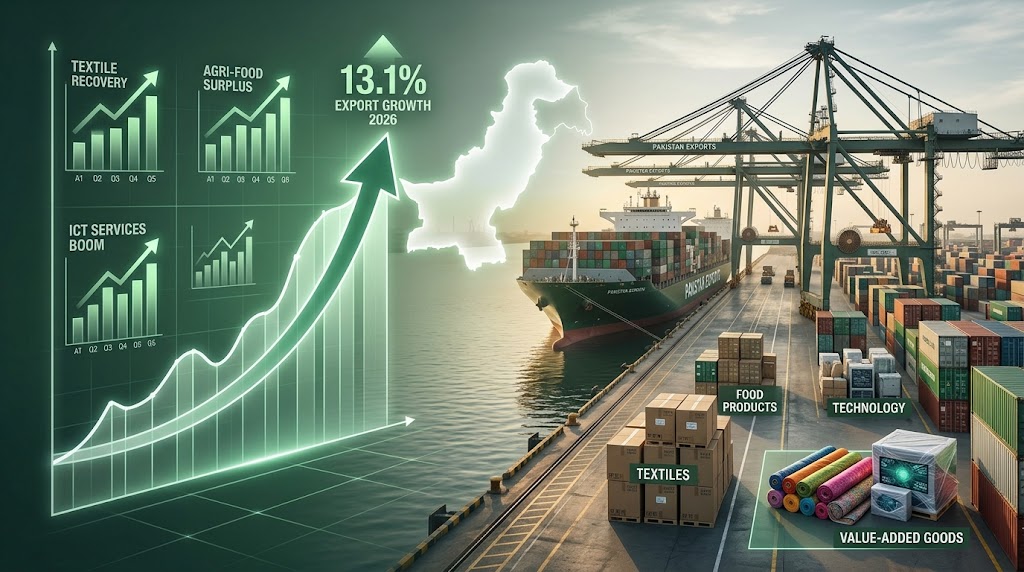
    ISLAMABAD: Pakistan’s exports of goods and services rose by 13.1 percent year-on-year to $3.94 billion in July 2026, providing an encouraging start to the new fiscal year and signalling continued improvement in the country’s external sector. Federal Minister for Planning, Development and Special Initiatives Ahsan Iqbal shared the figures on Saturday while presenting the Monthly Development Update for August 2026. He said exports stood at $3.48 billion in July 2025, meaning the latest increase reflects stronger performance across several major export categories. According to the minister, merchandise exports increased by 9.4 percent to around $3 billion in July 2026 from $2.8 billion a year earlier. When services exports are included, the combined figure reached approximately $3.9 billion, compared with $3.5 billion in July last year. Key export sectors show growth Ahsan Iqbal said the improvement in exports was supported by higher shipments across several important sectors. Surgical goods recorded the strongest growth among the highlighted export groups, increasing by 16.3 percent. Food exports rose by 8 percent, while leather goods registered growth of 7.8 percent. Textile exports, one of Pakistan’s largest sources of foreign exchange, also increased by 3.9 percent during the month. The minister said the figures indicated that Pakistan’s external sector had started the new fiscal year on a positive trajectory, although maintaining this momentum would require continued reforms, improved competitiveness and greater diversification of export products and markets. Manufacturing sector stages strong recovery The positive external-sector performance coincided with a broad-based recovery in domestic industrial activity. According to Ahsan, Large-Scale Manufacturing (LSM) expanded by 5 percent during fiscal year 2025-26, reversing a 0.74 percent contraction recorded in the preceding fiscal year. He said the recovery was spread across the industrial sector, with 16 of the 22 LSM sectors registering positive growth. The automobile sector posted the highest increase at 57.8 percent, followed by transport equipment at 42.4 percent. Electrical equipment production grew by 14.3 percent, tobacco by 12.6 percent and food manufacturing by 7 percent. The figures, he said, reflected an improvement in industrial activity and could provide support to investment, employment and overall economic growth if the recovery remains sustained. FBR collection, remittances improve The government also reported improvement in tax revenues at the beginning of FY2026-27. Federal Board of Revenue tax collection increased by 8.4 percent to Rs820.9 billion in July 2026, according to the minister. He said stronger revenue mobilisation, together with fiscal discipline, was helping improve the country’s overall financial position. Workers’ remittances also remained a major source of support for Pakistan’s external account. Remittance inflows reached $3.63 billion in July 2026, up 13 percent from approximately $3.2 billion in the same month of 2025. Ahsan said the latest increase followed record remittances of $41.6 billion received during the previous fiscal year. He noted that remittances not only strengthened Pakistan’s foreign exchange position but also provided direct financial support to millions of households across the country. Current account deficit remains contained Despite continued pressure on the external account, the current account deficit remained relatively contained. The deficit stood at $328 million in July 2026, compared with $529 million during the same month of the previous year. The minister described the development as another indication of improved external-sector stability. He also highlighted the growing contribution of Pakistan’s technology sector. Information and Communication Technology exports reached $417 million in July 2026, underlining the increasing role of digital services in generating foreign exchange. The government has been seeking to expand technology exports as part of a broader strategy to diversify Pakistan’s sources of external earnings beyond traditional sectors such as textiles and agricultural products. Inflation moderates Ahsan Iqbal also pointed to a moderation in consumer price pressures at the start of the new fiscal year. Consumer Price Index inflation eased to 9.2 percent in July 2026, compared with 11.7 percent in May 2026. The minister said the decline suggested that inflationary pressures were beginning to moderate. He added that changes in the year-on-year inflation rate were also influenced by base effects as well as the impact of international food and energy prices. The government is aiming to maintain price stability while supporting economic activity and protecting the purchasing power of households. Fiscal position strengthens The planning minister said Pakistan’s fiscal position had also improved significantly during FY2025-26. The fiscal deficit narrowed to 2.6 percent of GDP from 5.4 percent in FY2024-25. According to Ahsan, this represented the lowest fiscal deficit recorded in two decades. He said stronger fiscal management would remain essential during FY2026-27 as the government seeks to maintain macroeconomic stability while creating room for development spending and economic expansion. Development spending and job creation Public investment is another major component of the government’s economic strategy. Projects approved during July 2026 are expected to create around 7,851 direct jobs and 14,053 indirect employment opportunities across different sectors. The minister said employment generation would remain an important objective of development planning, particularly as the country seeks to create greater opportunities for its young population. He said Pakistan had undergone a difficult period of economic adjustment and that the stability achieved in recent years had required significant effort. Under the government’s URAAN Pakistan initiative, the next phase would focus on converting macroeconomic stability into long-term economic transformation, with exports positioned as a key driver of growth. According to Ahsan, higher exports could help generate employment, increase household incomes, expand opportunities for young people and improve living standards. Rs211.3 billion authorised for development projects The Ministry of Planning authorised Rs211.327 billion, equivalent to 21.1 percent of the relevant allocation, during July 2026 to facilitate timely financing for priority development projects. The minister said the move was aimed at ensuring that strategically important schemes received funding without unnecessary delays. During July, the Central Development Working Party (CDWP) also reviewed a number of development proposals. It approved nine projects, three position papers and one concept clearance proposal, while nine projects were recommended for consideration by the Executive Committee of the National Economic Council (ECNEC). Three projects were deferred, while


  • | | |

    KP Cabinet increases Ehsaas Naujawan programme to …

    PESHAWAR: The Khyber Pakhtunkhwa cabinet has approved an increase of Rs2 billion in the size of the Ehsaas Naujawan Programme, taking its total allocation from Rs3 billion to Rs5 billion. The decisions were taken during a cabinet meeting chaired by Chief Minister Sohail Afridi in Peshawar. Officials said the additional funding would strengthen the provincial government’s youth-focused initiatives and provide greater support to young people. The cabinet also approved a grant-in-aid for Langlands School and College in Chitral. A separate grant was approved for model schools in the merged districts. The meeting also focused on improving access to education. The cabinet approved an interdepartmental memorandum of understanding aimed at reducing the number of children who remain out of school. Another major decision was taken regarding textbooks. From the financial year 2027-28, students from grades six to eight across the province will receive textbooks free of cost. The cabinet also approved financial assistance for the treatment of 21 patients. The move is aimed at helping patients facing difficulties in meeting medical expenses. In another important decision, the provincial cabinet approved the Khyber Pakhtunkhwa Public-Private Partnership Authority Bill 2026. The legislation is intended to strengthen the framework for public-private cooperation in development projects. The cabinet also approved stipend slots for house jobs in government hospitals. It further approved an increase in stipends for doctors completing their house jobs, along with additional grants for the programme.

  • | | | | |

    [Puso at Diwa] Foreign currency deposit secrecy: Time for a constitutional rethink

    The uncertainty surrounding the interaction between constitutional impeachment powers and statutory bank secrecy is itself a weakness in the country’s accountability framework

Leave a Reply

Your email address will not be published. Required fields are marked *