thailand initiate process

Thailand to Initiate Process to Cancel Maritime MoU with Cambodia, PM Announces

BANGKOK – Prime Minister Anutin Charnvirakul announced today that his government has instructed relevant agencies to begin the process of canceling a long-standing maritime memorandum of understanding (MoU 44) with Cambodia, citing a lack of progress and diminished utility.

Rescued Thai Scam Victim in Cambodia Warns of Beatings, Organ Sales

During a Cabinet meeting on Tuesday, Anutin confirmed he had directed officials to prepare for the annulment of the agreement, signed in 2001, which establishes a framework for negotiating overlapping claims to the continental shelf and its resources in the Gulf of Thailand.

“The cancellation will not happen immediately under this administration, but we are taking the necessary preparatory steps,” Anutin stated. He emphasized that the MoU had yielded no tangible progress and that maintaining it no longer served Thailand’s interests.

When questioned about the legal authority to cancel the agreement, the Prime Minister asserted, “Everything will be done according to the law.”

The move fulfills a campaign pledge Anutin made ahead of the February 8 general election, during which he told supporters that a returned Bhumjaithai-led government would “immediately cancel MoU 44.” He also indicated that a previously discussed 50-50 profit-sharing arrangement for maritime resources would no longer be considered.

Following the election, unofficial results show Bhumjaithai securing a dominant position with approximately 194 parliamentary seats, placing the party at the core of the incoming coalition government. Incumbent Foreign Minister Sihasak Phuangketkeow is expected to resume his role as deputy prime minister overseeing foreign affairs.

Calls from civil society groups and the public to annul the MoU have grown louder, particularly after two rounds of deadly border clashes between Thai and Cambodian forces last year.

The Thai Foreign Ministry has previously clarified that MoU 44 serves solely as a mechanism for dialogue over maritime boundaries and resource-sharing and does not constitute a concession of territorial claims. Any final agreement reached under its framework would require parliamentary approval to take effect.

Thai Navy Detains Cambodian Vessel for Illegal Fishing in Trat

The impending cancellation process signals a significant shift in Thailand’s approach to a sensitive and long-stalled bilateral issue.

-Thailand News (TN)
Similar Posts

  • | |

    Oil prices tumble after US and Iran halt strikes, …

    Oil prices fell sharply on Monday after the United States and Iran paused military strikes over the weekend, ending two weeks of attacks and raising hopes that diplomacy could de escalate the conflict and allow shipping through the Strait of Hormuz to resume. Brent crude futures dropped by around 5.9 percent to just above 91 dollars a barrel, briefly slipping below the closely watched 90 dollar mark earlier in the session. US West Texas Intermediate crude fell roughly 5.4 percent to settle near 84.50 dollars a barrel. Both benchmarks touched their lowest levels in almost a week, reversing three straight weeks of gains driven by the conflict. Brent had climbed as high as 100 dollars a barrel as fighting disrupted oil shipments through the Strait of Hormuz and spread to the Red Sea, complicating exports from Saudi Arabia, the world’s largest oil exporter, through the Bab el Mandeb strait toward Asian markets. US Ambassador to the United Nations Mike Waltz said President Donald Trump had opted to pause American strikes to give diplomatic efforts more room to work, a message he delivered across several US television appearances Sunday. Market analysts remained cautious despite the price drop. PVM analyst John Evans said markets continue to search for encouraging signals from a region that has offered little reassurance so far, and cautioned that a pause in strikes carries no guarantee that oil shipments will resume quickly. He said prices are more likely to keep falling if elevated costs curb demand rather than because of a fragile ceasefire. Shipping data from Kpler showed fewer than ten commodity vessels passed through the Strait of Hormuz per day over the weekend. MST Marquee analyst Saul Kavonic said any recovery in traffic through the strait will likely be gradual and incomplete, since many shipping operators remain cautious and will want stronger safety assurances before sending empty vessels back into the waterway. Traffic through the Bab el Mandeb strait also declined Sunday after Yemen’s Houthi movement struck Saudi oil facilities along the Red Sea coast, though one additional Chinese supertanker managed to exit through the strait. Analysts at Societe Generale estimate that every month the Red Sea situation remains unresolved could add at least 10 dollars to the price of a barrel. Some analysts expect prices to stay supported if supply disruptions continue across the Middle East and in connection with Russia’s war in Ukraine. Analysts at UOB noted that the widening Middle East conflict, combined with Ukrainian drone strikes on Russian ships and refineries, could sustain supply disruptions that keep oil prices elevated and add upward pressure to global inflation. Ukraine said it struck several Russian oil facilities over the weekend as part of that ongoing campaign. The volatility underscores how closely global energy markets remain tied to geopolitical developments in the Middle East, where even temporary pauses in fighting can trigger significant price swings as traders weigh the likelihood of a lasting resolution against the risk of renewed escalation.

  • | | | |

    Israeli raids, settlement plans deepen West Bank t…

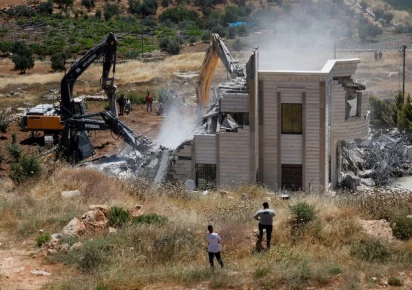
    RAMALLAH: Tensions across the occupied West Bank intensified on Monday as Israeli forces reportedly destroyed water pipelines, detained Palestinians and ordered families to leave their homes ahead of a planned demolition. While a new settlement plan near Jerusalem raised fresh concerns over the expansion of Israeli settlements. The latest developments have added to growing pressure on Palestinian communities already facing restrictions on movement, damage to agricultural land and disruptions to basic services. Palestinian human rights activist Aref Daraghmeh said Israeli forces destroyed water pipelines in the Atouf and Ras al-Ahmar areas of Tubas governorate. The areas, located in the northern Jordan Valley, have experienced repeated military operations in recent months. According to Daraghmeh, agricultural land has been cleared, water networks damaged and artesian wells filled in, causing significant losses for farmers who depend on the land and water supplies for their livelihoods. The destruction of water infrastructure has particular significance in the Jordan Valley, where Palestinian farming communities rely heavily on limited water resources. Brothers detained during raid In another operation in the northern Jordan Valley, Israeli forces detained two Palestinian brothers in the Ein al-Hilweh area, according to local sources cited by Anadolu. Meanwhile, Israeli troops raided the village of Tell, southwest of Nablus, and ordered residents to leave several homes ahead of the planned demolition of a house belonging to Palestinian Farouq Ramadan. Ramadan was killed on July 24 during an attack in the village, according to Palestinian sources. They said he had disarmed and killed one of the attackers before being shot dead. Three other members of his family were also killed and four Palestinians were injured during the incident, the sources said. Near Ramallah, agricultural land east of Jaljaliya village was also set on fire, Palestinian official news agency Wafa reported. Palestinian civil defence crews later brought the blaze under control. Village council head Osama Nazmi said an Israeli outpost had been established in the area about a year ago and that Palestinian homes belonging to residents from nearby Al-Mazraa Al-Sharqiya had subsequently been seized. New settlement plan raises alarm At the same time, Palestinian officials said Israel had advanced plans for a new settlement containing approximately 650 housing units south of Jerusalem. The Palestinian Jerusalem Governorate said Israel’s District Planning and Building Committee had deposited the plan for the proposed “Nofei Rachel” settlement. The project would cover approximately 27 dunams, or 6.7 acres, near Palestinian homes, according to the governorate. Palestinian authorities warned that the consequences would extend beyond the construction of the housing units, arguing that the development could affect Palestinian movement, urban growth and the ability of local communities to expand. They described the plan as part of a broader Israeli policy of expanding settlements and restricting Palestinian development. Israeli rights organisation Ir Amim separately said Israel had advanced three major settlement projects involving more than 3,400 housing units in East Jerusalem in recent weeks. The developments have renewed international concerns about settlement expansion. The United Nations and most countries regard Israeli settlements established in territory occupied since 1967 as illegal under international law. Critics say continued settlement construction threatens the possibility of establishing a viable Palestinian state alongside Israel. West Bank caught in wider conflict The latest events come as the Israeli-Palestinian conflict continues to reverberate across the region. According to figures cited by Palestinian authorities, violence in the West Bank has intensified alongside the wider war that began after the October 2023 Hamas attack on Israel. The situation has also drawn attention to the issue of Palestinian remains held by Israel. Report: Israel holds 1,700 Palestinian bodies Israel is holding the remains of around 1,700 Palestinians for possible use in future exchanges, Israeli newspaper Haaretz reported, citing two unnamed sources familiar with recent discussions within Israel’s security establishment. According to the report, Shin Bet chief David Zini supports retaining the bodies in case Israeli citizens are captured or disappear in the future. The Israeli military is also reportedly supportive of the position. Haaretz reported that most of the remains are believed to belong to Palestinians from Gaza who participated in the October 7, 2023 attack on Israel or subsequent fighting. However, the newspaper also reported that some of the bodies belong to Palestinians who were not involved in combat. The issue has raised legal questions inside Israel. Legal experts cited by Haaretz questioned whether authorities have the power to retain the remains of Palestinians who have not been proven to have taken part in fighting. The Palestinian National Campaign for the Retrieval of Martyrs’ Bodies and Disclosure of the Fate of the Missing said in October 2025 that Israel was holding around 1,500 bodies of Palestinians from Gaza at the Sde Teiman military facility in southern Israel. A crisis extending beyond borders The developments in the West Bank are unfolding against the backdrop of the devastating Gaza conflict. Palestinian health authorities say tens of thousands of Palestinians have been killed and injured since October 2023, while much of Gaza’s infrastructure has been destroyed or severely damaged. The reported destruction of water pipelines in the West Bank, the proposed settlement expansion and the continued disputes over Palestinian remains highlight how the conflict affects not only major political centres but also ordinary families, farmers and communities. For Palestinians living in areas such as Tubas, Nablus and the outskirts of Jerusalem, the immediate concerns are often deeply personal: access to water, the safety of their homes, the ability to farm their land and the uncertainty of what another military raid may bring. As settlement plans move forward and military operations continue, hopes for a reduction in tensions remain overshadowed by developments that are reshaping the landscape of the occupied West Bank.

  • Oil prices hold above one-week highs as US-Iran te…

    Global oil prices remained largely steady on Tuesday near their highest level in more than a week as uncertainty over a possible ceasefire agreement between the United States and Iran continued to weigh on market sentiment. Brent crude futures were little changed at $87.81 per barrel by 0013 GMT, while US West Texas Intermediate (WTI) crude futures stood at $82.20 per barrel. Both international benchmarks had climbed more than 5% during Monday’s trading session, reaching their highest levels since July 31. The sharp increase came after US President Donald Trump issued fresh demands in response to Iran’s conditions for a potential peace agreement, raising concerns that diplomatic efforts to end the conflict could face further obstacles. Trump has demanded compensation from Iran for deaths and damage linked to wars, attacks and protests, a position that analysts say could make negotiations more difficult. His comments have also increased uncertainty over the future of the Strait of Hormuz, one of the world’s most important oil shipping routes. Later, Trump said the United States was in control of the strategic waterway and had carried out operations to clear Iranian mines from the strait. The remarks added to concerns among energy traders about the security of commercial shipping in the region. “There appears to be a gulf, no pun intended, between the U.S. and Iran over what any agreement would actually look like,” said Tim Waterer, chief market analyst at KCM Trade. According to Waterer, the lack of progress has caused some of the optimism that had supported oil prices in the previous week to fade. The possibility of prolonged disruption to crude shipments has instead provided additional support to prices. Hormuz and Bab el-Mandeb Remain Key Risks The Strait of Hormuz remains a major focus for global energy markets because of its importance to international crude and petroleum-product shipments. Any prolonged disruption in the waterway could tighten global supplies and push up transportation and insurance costs. Market concerns have also extended to the Bab el-Mandeb, another critical maritime route connecting the Red Sea with the Gulf of Aden. Waterer said the risks surrounding both waterways remained significant, warning that even temporary restrictions or the threat of further attacks could raise insurance premiums and force shipping companies to take longer routes. Such disruptions could reduce the volume of energy supplies reaching international markets in the near term, adding further volatility to crude prices. Data cited by Barclays showed that crude oil and refined petroleum product net exports through the Strait of Hormuz averaged around 3 million barrels per day in the week ending August 7. That was significantly below the 4.4 million barrels per day recorded during the previous week. The decline highlights the potential impact of regional security risks on energy flows and has heightened concerns about supply availability if disruptions continue. Jazan Refinery Restart Delayed Supply concerns were also reinforced by developments in Saudi Arabia, where state oil giant Saudi Aramco has postponed the restart of its Jazan refinery. The refinery, which has a processing capacity of around 400,000 barrels per day, is now expected to resume operations on August 30 after the Iran-aligned Houthis claimed responsibility for two attacks on the facility on Sunday. The delay could further complicate regional fuel supply conditions at a time when traders are already closely monitoring disruptions to shipping routes. Iraq Raises Basra Medium Price Meanwhile, Iraq has increased the official selling price for its Basra Medium crude for Asian buyers for September. The price was raised by $2.50 to a discount of $4 per barrel against the average of Oman and Dubai crude benchmarks. The adjustment comes as Asian refiners and international traders continue to assess supply risks arising from tensions in the Middle East. With diplomatic uncertainty between Washington and Tehran, disruptions around major shipping routes and refinery-related setbacks continuing to influence the market, oil prices are likely to remain sensitive to developments in the region.

  • |

    Gull Feroza stars as Pakistan beat Sri Lanka in OD…

    Gull Feroza and Sidra Amin’s half-centuries helped Pakistan beat Sri Lanka in the first ODI of the three-match series at the Mahinda Rajapaksa International Cricket Stadium on Thursday. The Green Shirts comprehensively chased down 211 in 43 overs, losing only five wickets in the process. Sadaf Shams and Gull Feroza added 58 runs for the opening wicket partnership at the end of the first powerplay, with Shams contributing 20 off 27 balls, including three fours. The highlight of Pakistan’s innings was the second-wicket stand of 90 runs off 114 balls, which made light work of the chase, taking the total to 148 in 28.5 overs. Feroza eventually departed after scoring a free-flowing 78 off 77 balls, including 11 fours. Sidra Amin continued and raised her half-century before getting castled by Inoka Ranaweera on 57, hitting five fours in her measured knock. The visitors eventually reached home in the 43rd over. For Sri Lanka, Kavisha Dilhari picked up two wickets. With their fifth ODI win in a row, Pakistan moved up to second position in the ICC Women’s Championship Points table. Earlier, Sri Lanka could not capitalise on the decision to bat first as they were limited to 210-9 in 50 overs despite a strong opening foundation. Skipper Chamari Athapaththu and Vishmi Gunaratne stitched a 56-run stand in 11 overs, with Gunaratne contributing 28 off 34 balls, hitting four boundaries. Despite the wicket, Sri Lanka carried on as Athapaththu and Hasini Perera stitched a 53-run partnership to take the total over the 100-run mark. However, once Pakistan introduced spinners, the momentum quickly shifted in their favour. The visitors removed well-set Athapaththu (46) and Perera (35) in quick succession to make a comeback. The home side could not recover after the quick wickets, losing wickets in clusters and eventually being limited to a below-par total. For Pakistan, Nashra Sandhu starred with the ball, scalping three wickets in her 10 overs. The victory gives Pakistan a 1-0 lead in the three-match series, with the second ODI scheduled to take place in the coming days. The team will be looking to build on this momentum and secure a series win, while Sri Lanka will aim to bounce back and level the series. Pakistan’s batting depth and bowling attack were on full display, highlighting their potential as a formidable side in the ICC Women’s Championship. The series continues to provide exciting cricketing action, with fans eagerly awaiting the next fixtures as both teams battle for supremacy in the ODI format. The win also boosts Pakistan’s position in the championship standings, keeping them in contention for a top spot as they continue their campaign. The Green Shirts will be hoping to carry this form into the remaining matches and secure a comprehensive series victory.

  • | | |

    Iran, Oman move toward temporary Hormuz shipping c…

    TEHRAN: Iran and Oman have agreed on a framework for establishing a temporary maritime corridor through the strategically vital Strait of Hormuz, in a move aimed at restoring safer shipping and reducing risks in one of the world’s most important waterways. The understanding emerged during talks between Iranian Foreign Minister Abbas Araghchi and his Omani counterpart, Sayyid Badr bin Hamad Al Busaidi, in Tehran on Tuesday. The two sides discussed measures to resume safe navigation while protecting the sovereignty and maritime rights of both countries. According to a joint statement, the proposed framework includes the creation of a joint temporary navigational corridor and a coordinated project to clear possible mines from the waterway. The initiative is intended to provide a practical mechanism for ships to move through the strait while longer-term arrangements are negotiated. The Strait of Hormuz has remained heavily disrupted since the outbreak of the wider Iran war in February. Before the conflict, the waterway handled roughly one-fifth of global oil and liquefied natural gas shipments, making any prolonged disruption a major concern for energy markets and international shipping. The latest agreement, however, is being viewed as an interim measure rather than a final settlement. Iranian and Omani officials are expected to continue technical discussions on establishing a permanent navigational corridor, managing vessel traffic and sharing information about maritime movements. The two countries also intend to examine future arrangements for administering the strait and providing navigation and security services. They have stressed that any long-term mechanism should take into account the rights and interests of other Gulf states bordering the waterway. Iranian officials have also indicated that further technical negotiations could continue over the coming weeks. The proposed arrangement is particularly significant because the strait connects the energy-rich Persian Gulf with the Gulf of Oman and the wider Arabian Sea. Araghchi said discussions with regional partners had focused on diplomatic and regional solutions, while emphasizing continued technical-level contacts over navigation and the future management of the waterway. For Oman, which has traditionally played a mediating role in regional disputes, the initiative offers another opportunity to promote dialogue and maritime stability. For Iran, reopening a controlled shipping route could ease economic pressure while maintaining its position on sovereignty and security in the strait. The success of the temporary corridor will ultimately depend on security conditions, mine-clearing efforts and agreement over how commercial vessels will be guided. Still, the latest Iran-Oman talks provide a potentially important opening for restoring maritime traffic and creating a pathway toward a more permanent solution.

  • |

    Indonesia quake kills 48, thousands left desperate…

    RUTENG: Thousands of frightened residents on Indonesia’s Flores island remained in temporary shelters on Sunday as rescue teams raced to deliver food, water and medical supplies following a powerful magnitude-7.7 earthquake that killed dozens and left widespread destruction across the region. The earthquake struck off the northern coast of Flores early Saturday, triggering landslides, damaging homes and public buildings and cutting electricity and communications in several areas. The latest reports put the death toll at more than 50, with at least 100 people injured, while thousands of residents have been displaced. The disaster was followed by hundreds of aftershocks, deepening fears among residents who were already reluctant to return to damaged homes. Authorities said around 5,000 people initially fled their houses, while the number sheltering in evacuation centres later rose to more than 9,000. For many survivors, the immediate concern is basic necessities. “We need food, drink, medicines, and diapers for the children,” resident Umri told AFP, describing how he and others spent the night on a hill because they were too afraid to return home. Another resident, Nurhidayati, said memories of the devastating 1992 Flores earthquake had made the latest disaster even more terrifying. She said she remained traumatised by the previous tragedy and did not dare go back home. Rescue Efforts Face Major Obstacles Emergency crews have been working through collapsed structures and rubble while heavy machinery clears roads blocked by landslides. Some of the hardest-hit communities remain difficult to reach because of damaged roads, power failures and disrupted telecommunications. Indonesia has deployed military and police personnel, helicopters, aircraft and rescue vessels to support the emergency response. Authorities are also sending large quantities of food and other relief supplies to affected communities. The destruction has extended beyond residential areas. Hundreds of houses have been badly damaged, while schools, health facilities and government buildings have also suffered. In Ruteng, damaged hospital facilities forced patients to be moved into tents outside the building. Despite the difficult conditions, medical workers have continued treating patients. In one particularly dramatic case, doctors performed an emergency Caesarean section in a storage room after parts of the hospital were damaged. Both the mother and baby were reported safe. Tsunami Warning Lifted The earthquake briefly triggered fears of a tsunami after residents reported the sea retreating from parts of the coastline. Authorities issued a tsunami warning, but it was later lifted after monitoring showed no major destructive wave threat. Waves of around 1.6 metres were nevertheless recorded in some coastal areas. Officials have urged residents to remain vigilant and avoid entering damaged buildings because continuing aftershocks could cause weakened structures to collapse. A Region Used to Earthquake Tragedies Flores lies within Indonesia’s highly active seismic zone, part of the Pacific “Ring of Fire”, where several tectonic plates meet and powerful earthquakes are common. The island has painful memories of the past. A major earthquake in 1992 triggered a tsunami that killed roughly 2,500 people. The latest disaster has once again exposed the vulnerability of communities living in earthquake-prone areas, particularly where roads, hospitals and communication networks are limited. International assistance is also being prepared. The European Union has offered its Copernicus satellite system to help authorities map affected areas and support search-and-rescue operations. For now, the priority remains simple: finding survivors, reaching isolated communities and keeping thousands of displaced families safe as Flores waits for the ground to finally settle.

Leave a Reply

Your email address will not be published. Required fields are marked *