indonesia quake kills
|

Indonesia quake kills 48, thousands left desperate…

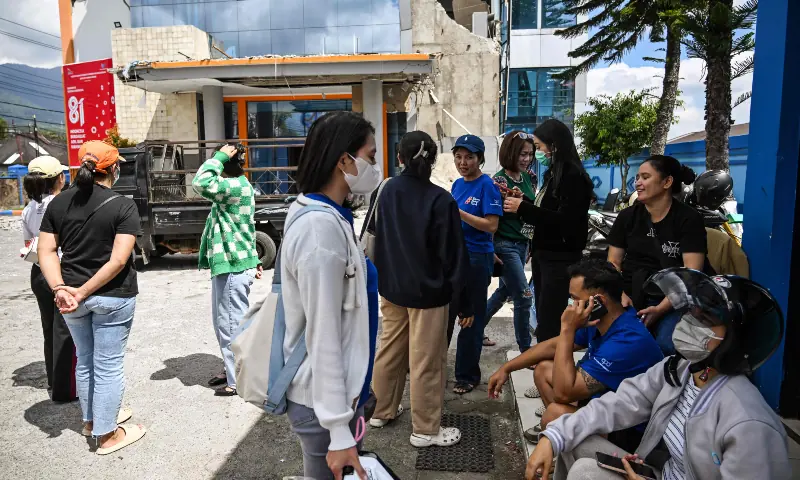
RUTENG: Thousands of frightened residents on Indonesia’s Flores island remained in temporary shelters on Sunday as rescue teams raced to deliver food, water and medical supplies following a powerful magnitude-7.7 earthquake that killed dozens and left widespread destruction across the region.

The earthquake struck off the northern coast of Flores early Saturday, triggering landslides, damaging homes and public buildings and cutting electricity and communications in several areas. The latest reports put the death toll at more than 50, with at least 100 people injured, while thousands of residents have been displaced.

The disaster was followed by hundreds of aftershocks, deepening fears among residents who were already reluctant to return to damaged homes. Authorities said around 5,000 people initially fled their houses, while the number sheltering in evacuation centres later rose to more than 9,000.

For many survivors, the immediate concern is basic necessities.

“We need food, drink, medicines, and diapers for the children,” resident Umri told AFP, describing how he and others spent the night on a hill because they were too afraid to return home.

Another resident, Nurhidayati, said memories of the devastating 1992 Flores earthquake had made the latest disaster even more terrifying. She said she remained traumatised by the previous tragedy and did not dare go back home.

Rescue Efforts Face Major Obstacles

Emergency crews have been working through collapsed structures and rubble while heavy machinery clears roads blocked by landslides. Some of the hardest-hit communities remain difficult to reach because of damaged roads, power failures and disrupted telecommunications.

Indonesia has deployed military and police personnel, helicopters, aircraft and rescue vessels to support the emergency response. Authorities are also sending large quantities of food and other relief supplies to affected communities.

The destruction has extended beyond residential areas. Hundreds of houses have been badly damaged, while schools, health facilities and government buildings have also suffered. In Ruteng, damaged hospital facilities forced patients to be moved into tents outside the building.

Despite the difficult conditions, medical workers have continued treating patients. In one particularly dramatic case, doctors performed an emergency Caesarean section in a storage room after parts of the hospital were damaged. Both the mother and baby were reported safe.

Tsunami Warning Lifted

The earthquake briefly triggered fears of a tsunami after residents reported the sea retreating from parts of the coastline. Authorities issued a tsunami warning, but it was later lifted after monitoring showed no major destructive wave threat. Waves of around 1.6 metres were nevertheless recorded in some coastal areas.

Officials have urged residents to remain vigilant and avoid entering damaged buildings because continuing aftershocks could cause weakened structures to collapse.

A Region Used to Earthquake Tragedies

Flores lies within Indonesia’s highly active seismic zone, part of the Pacific “Ring of Fire”, where several tectonic plates meet and powerful earthquakes are common.

The island has painful memories of the past. A major earthquake in 1992 triggered a tsunami that killed roughly 2,500 people.

The latest disaster has once again exposed the vulnerability of communities living in earthquake-prone areas, particularly where roads, hospitals and communication networks are limited.

International assistance is also being prepared. The European Union has offered its Copernicus satellite system to help authorities map affected areas and support search-and-rescue operations.

For now, the priority remains simple: finding survivors, reaching isolated communities and keeping thousands of displaced families safe as Flores waits for the ground to finally settle.

Similar Posts

  • | | |

    New committee to review Mir Raza case today

    A new investigation committee will hold an important meeting today to review the Mir Raza Ali murder case. The meeting will be chaired by DIG Aamir Farooqi. The committee will conduct a fresh and impartial investigation into the case. It will examine all aspects of the incident. Investigators will identify and collect any new evidence linked to the case. The evidence will be properly preserved and examined. Physical, technical, circumstantial and forensic evidence will also be reviewed. The committee will closely examine the victim’s injuries and clothes. It will also compare the two conflicting post-mortem reports. Investigators have been directed to take all possible steps to reach a conclusion. The team will submit its findings to the relevant court within the given timeframe. Daily progress reports will also be prepared. Additional officers may be included in the investigation if required. The committee will also record statements from members of the medical board involved in the first post-mortem. Doctors and experts who conducted the first post-mortem are expected to be questioned. They may also be given a detailed questionnaire. Investigators will try to determine the evidence behind the first post-mortem findings. The report had stated that the bullet entered through the chest and exited through the back. The team will also examine how forensic evidence was documented and preserved during the initial investigation. The second post-mortem report gave a different assessment of the bullet’s direction. Investigators will therefore compare both reports in detail. They will also examine the injuries, clothing and other forensic material. Meanwhile, investigators have obtained details about Mir Raza Ali’s movements on the night of July 28. Details of his final phone calls and messages have also been collected. According to the investigation, Mir Raza spoke to two people through three phone calls that night. He reportedly spoke to a person named Ali at 2:13am and again at 2:16am. His final call was answered by his friend Abdullah. The two spoke for more than three minutes.

  • | | |

    Israeli lawyer calls Silwan demolitions ‘ethnic …

    JERUSALEM: A new British media report has renewed international attention on the disputed East Jerusalem neighbourhood of Silwan, where the demolition of Palestinian homes and land disputes continue to fuel tensions between Israeli authorities and Palestinian residents. According to the report, a prominent Israeli lawyer described Israel’s policy of removing Palestinians from their ancestral homes in Silwan as comparable to “ethnic cleansing,” adding to the growing debate over housing rights and displacement in the occupied territory. The report states that the continued threat of home demolitions has left many Palestinian families living in constant uncertainty, affecting their daily lives, financial stability and emotional well-being. Residents say they fear losing homes that have been in their families for generations. Palestinians living in Silwan argue that Israeli authorities frequently classify their properties as unauthorised constructions, leading to demolition orders that they consider unfair and discriminatory. Many residents say obtaining building permits is extremely difficult, leaving families vulnerable to eviction and the destruction of their homes. The issue of demolitions in East Jerusalem has remained one of the most contentious aspects of the Israeli-Palestinian conflict, drawing criticism from international human rights organisations and foreign governments. Rights groups have repeatedly expressed concern that such actions contribute to the displacement of Palestinian communities and alter the demographic balance of the area. The latest report also comes amid continued regional tensions, with accusations of ceasefire violations and ongoing diplomatic efforts to prevent further escalation in the conflict. Israeli authorities have consistently maintained that demolitions are carried out in accordance with municipal planning and building regulations, arguing that structures built without the required permits are subject to legal enforcement regardless of the owners’ identity. Silwan, located just south of Jerusalem’s Old City, remains one of the most sensitive areas in the decades-long conflict, with competing historical, religious and political claims. As international scrutiny grows, the situation in Silwan continues to highlight the broader challenges surrounding housing rights, land ownership and the future of Palestinian communities in East Jerusalem.

  • | | |

    12 militants killed in Balochistan intelligence op…

    Pakistan’s security forces killed 12 suspected militants during two intelligence-based operations carried out in separate districts of Balochistan as part of the ongoing counterterrorism campaign, the Inter-Services Public Relations (ISPR) said on Thursday. According to the military’s media wing, the operations were conducted on August 5 and 6 in Washuk and Mastung districts under the third phase of Operation Rad-ul-Fitna, which targets militant groups allegedly backed by hostile foreign elements. The ISPR said the first operation was launched on August 5 after intelligence agencies detected the movement of six suspected militants in Washuk district. Security forces swiftly moved to the area and engaged the suspects in a targeted operation. Following an exchange of fire, all six militants were killed. A second intelligence-based operation was conducted on August 6 in Mastung district after security forces received information about the presence of armed militants. The ISPR said another six suspected militants were killed during an intense firefight. Security personnel also destroyed a militant hideout during the operation. The military stated that both operations were based on credible intelligence and were part of continuous efforts to eliminate militant networks operating in Balochistan. It added that security forces carried out the missions with precision, preventing the militants from escaping. According to the ISPR, the operations form part of Pakistan’s broader counterterrorism strategy being implemented under Azm-e-Istehkam, the national security initiative approved by the Federal Apex Committee under the National Action Plan. The military reaffirmed that Pakistan’s armed forces, together with law enforcement agencies, will continue intelligence-led operations across the country to eliminate terrorism and dismantle militant infrastructure.

  • | |

    Tank assault ends in militants’ deadly defeat

    Security forces have foiled an attack on a joint check post in Tank district. All the militants involved in the attack were killed during the security operation. The attack took place at a joint check post of the Pakistan Army and police in the Manjhi Khel area of Tank. According to reports, militants belonging to Fitna al-Khawarij attempted to target the security post. Security forces responded immediately after the attack began. They effectively engaged the attackers and prevented them from achieving their objective. The timely response brought the attack to an end. All the militants involved in the assault were killed, according to the report. The bodies of the slain attackers were later brought to a local market in Tank. Their presence triggered a strong reaction from local residents. People expressed anger and disgust towards the militants. Residents strongly condemned those involved in violence and terrorism. The Tank district has faced the impact of prolonged unrest and violence. The latest incident has once again highlighted the security challenges faced by communities in the region. Local residents have increasingly expressed their opposition to militant groups and activities that threaten peace. Their reaction reflects growing public frustration with violence and instability. The strong response from the local population also sends a message against elements attempting to disturb peace in the area. Residents have rejected violence and terrorism and expressed support for efforts aimed at restoring lasting peace.

  • | |

    Youth dialogue calls for climate action in Punjab

      A youth-led dialogue on climate action and greater youth participation in policymaking brought together parliamentarians, policymakers, environmental experts, civil society representatives and young people in Punjab. Pak Mission Society and Forman Christian College University jointly organised the event, where participants discussed climate policy, legislation and the role of young people in shaping environmental decisions. Parliamentary Secretary for Environment Kanwal Liaqat said Punjab Chief Minister Maryam Nawaz had identified climate change as a major priority after assuming office. She said the provincial government had since introduced several measures to address environmental challenges. Liaqat said brick kilns across Punjab must use zigzag technology to operate, while women environmental inspectors were helping strengthen monitoring and enforcement. She added that authorities were taking action against industries that pollute the air and water and were working to improve the condition of canals, streams and rivers. The dialogue also examined gaps in Punjab’s climate laws and policies. Members of Green Clubs presented five climate demands developed by children and young people, urging the government to give youth a stronger role in climate governance and policymaking. The event also featured a session titled “From Dreams to Reality: Advancing Youth-Led Climate Action in Pakistan,” moderated by environmental law expert Ahmed Rafi Alam. The concluding discussion focused on practical measures to address young people’s concerns and develop a roadmap for youth-led climate action in Pakistan. Participants included Rabia Chaudhry, Waqil Ahmed Khan, Dur-e-Shahwar, Dr Younas Zahid, Ahmed Rafi Alam, Hafiz Usman, Dr Abdul Qadir, Khurram Tauqeer and Shakeela Firdous.

Leave a Reply

Your email address will not be published. Required fields are marked *