mqmp pushes grand
| | |

MQM-P pushes for grand national dialogue on new pr…

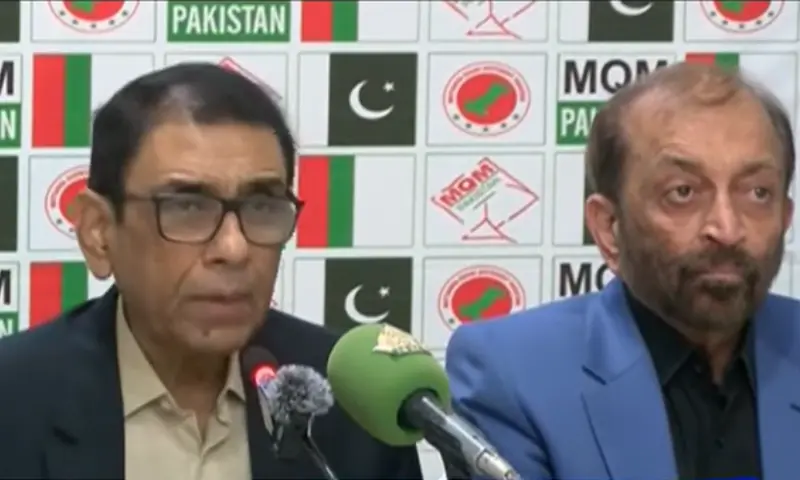
KARACHI: The Muttahida Qaumi Movement-Pakistan (MQM-P) has announced plans to approach political parties across the country to launch a “grand national dialogue” on the creation of new provinces and administrative units.

Speaking at a press conference on Sunday, MQM-P Chairman Dr Khalid Maqbool Siddiqui said Pakistan needed a serious national discussion on restructuring its administrative system, arguing that the country’s growing population had increased the need for additional provinces.

Siddiqui said MQM-P had been advocating the creation of more provinces for decades, maintaining that Pakistan’s existing provincial structure was largely shaped by linguistic considerations rather than purely administrative requirements. He stressed that the party’s demand was not limited to Sindh and that it would support calls for new provinces wherever there was public and political backing.

The MQM-P leader urged political parties to sit together and discuss their proposals and reservations instead of treating the issue as a source of political confrontation. He said his party was prepared to take the lead in initiating such a dialogue.

Siddiqui also linked the debate over new provinces with the need to strengthen local governments. Referring to Article 140-A of the Constitution, he said provinces were constitutionally required to devolve political, administrative and financial powers to elected local representatives. He criticised the failure to fully implement the provision and recalled that MQM-P had previously approached the Supreme Court over the issue.

He argued that creating additional provinces was not unconstitutional and said Parliament could debate the appropriate mechanism for establishing them. He also questioned whether existing provinces should have the sole authority to decide on their own division.

MQM-P leader and Health Minister Mustafa Kamal said the party’s proposal was aimed at administrative restructuring rather than dividing communities or territories. He argued that people should have greater control over local leadership and governance, particularly when their cities face serious problems in living standards and public services.

The MQM-P campaign follows recent remarks by Interior Minister Syed Mohsin Naqvi, who called for political parties to address major national issues, including the creation of new provinces. His proposal has since generated debate among government figures, lawyers and political circles, giving fresh momentum to the long-running discussion over Pakistan’s provincial structure.

The MQM-P leadership said it would also engage legal experts and explore further legal avenues regarding the implementation of constitutional provisions related to local governance.


Similar Posts

  • | | |

    Fatima Zahra secures Pakistan’s first Commonweal…

      Pakistan received its first major success at the Commonwealth Games as national boxer Fatima Zahra secured a place in the women’s boxing semifinals, guaranteeing the country’s first medal of the tournament. Competing in the women’s 60kg weight category, Fatima Zahra delivered a dominant performance in the quarterfinals, defeating New Zealand’s Jordan Wilson by a unanimous 5-0 decision. With the victory, the Pakistani boxer advanced to the semifinals and ensured at least a bronze medal for her country under the competition’s boxing format. The quarterfinal bout took place at the SEC Hall Five in Glasgow, where Fatima Zahra displayed confidence, composure, and technical superiority throughout the contest. She controlled all three rounds with disciplined boxing, combining effective footwork, accurate punches, and strong defensive skills to keep her opponent under pressure from the opening bell until the final round. Her impressive display left no room for doubt among the judges. All five judges scored the contest in her favor, awarding her a comprehensive unanimous decision victory over Jordan Wilson. The result marked one of Pakistan’s most significant achievements at the ongoing Commonwealth Games and provided an early boost to the country’s medal hopes. According to the boxing competition rules, every athlete who reaches the semifinals is guaranteed at least a bronze medal, as there is no third-place playoff. By advancing to the last four, Fatima Zahra officially secured Pakistan’s first medal of the Games, regardless of the outcome of her semifinal contest. The achievement is another milestone in Fatima Zahra’s growing international career. She has consistently represented Pakistan on the global stage and has already established herself as one of the country’s leading female boxers. Her latest success reflects both her dedication and the steady progress she has made through years of hard work and international competition. This is not the first time Fatima Zahra has won a medal for Pakistan at a major sporting event. She previously claimed a bronze medal at the Islamic Solidarity Games, where her performances earned widespread praise and highlighted her potential to compete against some of the best boxers in the region. That experience has helped strengthen her confidence and prepared her for bigger challenges on the international stage. Following her convincing victory in the quarterfinals, Fatima Zahra has now set her sights on the semifinal, where she will aim to continue her winning run and secure a place in the gold medal match. A victory in the next round would guarantee Pakistan either a silver or gold medal, making it one of the country’s most notable boxing achievements in recent years. Her qualification for the semifinals has been welcomed as an encouraging moment for Pakistan’s sporting community, particularly for women’s boxing, which continues to grow despite facing limited resources and opportunities. Fatima Zahra’s success is expected to inspire aspiring female athletes across the country and demonstrate that Pakistani women can compete successfully at the highest levels of international sport. With a guaranteed bronze medal already secured, all eyes will now be on Fatima Zahra as she prepares for the semifinal showdown. Pakistani fans will be hoping she can maintain her outstanding form, overcome her next opponent, and move one step closer to winning the Commonwealth Games title, adding another memorable chapter to Pakistan’s sporting history.

  • | | | |

    Iran rules out US talks until demands are met

    Iran has ruled out direct negotiations with the United States for now, saying Washington must first comply with the terms of an interim agreement reached in June. Iranian Foreign Minister Abbas Araghchi said on Sunday that Tehran and Washington were not holding direct talks. He said messages were still being exchanged through intermediaries. Araghchi also reiterated Iran’s position on the Strait of Hormuz. He said the strategic waterway would not reopen simply because Iran and Oman reached an agreement on shipping arrangements. According to Iranian reports, Tehran and Muscat are close to finalising an understanding on a temporary shipping route. However, Iran says the route can only be used after other conditions are met. The Strait of Hormuz has remained at the centre of the wider conflict. Iran has repeatedly linked its reopening to demands directed at Washington. Iranian officials have called for an end to US threats and military action. They have also demanded the lifting of sanctions and blockades and the release of Iranian assets. Iran’s Revolutionary Guard has separately warned that the strait will remain closed until Tehran’s conditions are accepted. The force accused its opponents of shifting their focus toward reopening the vital waterway. The strait is one of the world’s most important energy routes. A significant share of global oil and gas shipments normally passes through it. Oman, meanwhile, said discussions with Iran over arrangements for shipping through the waterway had been positive and constructive. Muscat also urged all sides to avoid actions that could undermine the negotiations. Iranian President Masoud Pezeshkian has suggested that the current situation could provide an opportunity for an agreement. He said Iran remained united and strong despite the ongoing conflict. The diplomatic uncertainty comes as tensions continue to affect commercial shipping in the region. The United Arab Emirates said Iran had attacked a vessel linked to its state-owned oil company while it was travelling through the Strait of Hormuz. No injuries were reported. The United Kingdom Maritime Trade Operations agency also reported that a vessel caught fire after being struck by an unidentified projectile. The fire was later brought under control, with no environmental damage reported. Iranian authorities have not immediately commented on the individual incident. Saudi Arabia reports fires at energy facilities Tensions have also spread across the Gulf. Saudi Arabia said firefighters had extinguished a blaze at an Aramco facility in Jizan. The Saudi Energy Ministry said there were no fatalities. Yemen’s Houthi movement claimed responsibility for an attack on the site, saying it had used a drone in response to alleged Saudi strikes in Yemen. A separate explosion was also reported in the industrial area of Jubail. Regional sources said gas facilities were targeted and that a fire broke out. The exact cause remained unclear. It was not immediately established whether the incidents in Jizan and Jubail were connected. US defence industry ordered to increase weapons production Meanwhile, the United States has asked its defence industry to accelerate weapons production amid shortages linked to the war with Iran. US Deputy Defence Secretary Steve Feinberg reportedly instructed defence companies to submit plans aimed at speeding up deliveries and increasing production of critical military equipment. The demand comes amid reports of pressure on US ammunition supplies, including stocks of Patriot missile interceptors. The Trump administration has maintained that the United States has substantial weapons reserves and that additional supplies are being manufactured and delivered. The conflict has also triggered threats from armed groups in the region. The leader of Iraq’s Harakat Hezbollah al-Nujaba, Akram al-Kaabi, has threatened retaliation for US-Saudi strikes on sites belonging to Iraq’s Popular Mobilisation Forces. The group has warned that further military action could lead to a response. Iranian military officials, meanwhile, have claimed that the United States and Israel failed to achieve their objectives against Iran. They have praised the country’s military preparedness and vowed to continue resisting pressure. With the Strait of Hormuz still closed and negotiations remaining indirect, the prospect of restoring normal shipping remains uncertain. Iran insists that reopening the waterway depends on Washington accepting its conditions. The United States, meanwhile, has linked the lifting of its blockade to Iran fulfilling commitments under any future agreement.

  • | |

    Bank operation manager, accomplice arrested over K…

    KARACHI: Police have arrested two suspects in connection with the theft of cash from a private bank’s ATM on Aram Bagh Road. According to police officials, the suspects include the bank’s operations manager and one of his associates. The arrests were made during an investigation into the ATM robbery. Police said they recovered Rs29.74 million from the suspects. The recovered amount is believed to be part of the cash stolen from the ATM. Investigators said the suspects allegedly gained access to the ATM by opening its lock. They then attempted to prevent the security cameras from recording their activities. According to officials, the suspects placed chewing gum over the CCTV camera. This was allegedly done to obstruct the camera’s view and conceal the theft. Police said the suspects subsequently took around Rs53.7 million from the ATM. The involvement of the bank’s operations manager has emerged as a key development in the case. Investigators are examining how the suspects obtained access to the ATM and whether anyone else assisted them. Police are also reviewing available CCTV footage and other evidence to establish the sequence of events. The recovered cash has been taken into custody as the investigation continues. Authorities said further investigation would determine the exact role of each suspect and help identify any additional individuals who may have been involved in the theft.

  • | |

    US unable to verify Israeli claims of Iranian plot…

    The United States has been unable to independently confirm several warnings from Israel alleging that Iran was planning to assassinate President Donald Trump, according to current and former US officials familiar with the intelligence. The warnings were reportedly shared with US intelligence agencies over the past year and, in some cases, communicated directly by Israeli officials to senior members of the White House. The alleged plots included plans to target Trump with a sniper or recruit an attacker to use a knife during a major public gathering. According to the officials, the warnings began emerging before the 12-day Israel-Iran war in June 2025 and became more frequent ahead of the US military campaign against Iran in February. One of the most detailed warnings reportedly came before the NATO summit in Ankara in July. Israeli officials informed the White House that Iran might attempt to target Trump while he was travelling aboard Air Force One, potentially using a shoulder-launched missile. However, US intelligence agencies were unable to independently corroborate several of the specific threats. A Turkish official also said that Turkey’s intelligence services found no evidence supporting the Israeli warning concerning a possible attack on Trump during his visit. Despite the lack of confirmation, US authorities took additional security precautions. Among the measures was an unusual deception operation during Trump’s Turkey trip, in which he was reportedly transferred from Air Force One to another aircraft for his return journey. The episode highlights the growing importance of Israeli intelligence in the Trump administration’s assessment of threats from Iran, while also revealing differences between American, Israeli and Turkish intelligence assessments. US intelligence agencies have long assessed that Iran has an interest in retaliating against Trump over the 2020 killing of Iranian military commander Qassem Soleimani. However, officials said the CIA has not been able to verify some of the specific assassination claims attributed to Iranian operatives. During the recent US military operations against Iran, some American intelligence assessments reportedly assigned low confidence to Israeli intelligence concerning Iranian threats, including alleged plans to assassinate Trump. The Israeli Embassy rejected the suggestion that Israel was using intelligence sharing to influence US policy toward Iran, arguing that intelligence exchanges were part of the countries’ security relationship. The White House and CIA declined to comment on the reports, while the US Secret Service said it continuously evaluates intelligence and other information to protect the president. The revelations come amid broader concerns over coordination within the US intelligence community. Former officials said cooperation between the CIA and the National Intelligence Council had declined, while staff reductions at the Office of the Director of National Intelligence had also contributed to fewer recent assessments concerning Iran. The conflicting intelligence assessments underline the challenges facing Washington as it balances threats from Tehran with intelligence supplied by its closest regional ally, Israel.

  • | | |

    PM Shehbaz says Pak-Saudi-Turkiye defence pact is …

    Prime Minister Shehbaz Sharif has said the newly signed defence agreement between Pakistan, Saudi Arabia and Turkiye is strictly defensive in nature. He said the pact is not intended to promote aggression or create tensions in the region. The prime minister made the remarks while addressing a meeting of the federal cabinet on Monday. Pakistan, Saudi Arabia and Turkiye signed the Makkah Joint Defence Agreement on August 7 in Makkah. The agreement aims to strengthen cooperation among the three countries in the field of defence and security. Under the pact, an attack against any one of the three signatories would be treated as an attack against all three. The arrangement is intended to strengthen collective deterrence and improve coordination among the countries. PM Shehbaz said the main objective of the agreement was to promote peace, stability, progress and prosperity across the region. He stressed that the agreement should not be viewed as a preparation for military aggression. The prime minister described the pact as a source of strength for Pakistan, Saudi Arabia and Turkiye. He also said its benefits could extend to the wider Muslim world. Shehbaz Sharif congratulated Deputy Prime Minister Ishaq Dar and Chief of Defence Forces and Chief of Army Staff Field Marshal Asim Munir for their role in the agreement. He said discussions on stronger defence cooperation between the countries had continued for several years before the latest agreement was finalised. Pakistan and Saudi Arabia had already signed a Strategic Mutual Defence Agreement in September 2025. The prime minister said Pakistan and Turkiye had also maintained defence and security arrangements for decades. Shehbaz highlighted Pakistan’s long-standing defence cooperation with Saudi Arabia. He recalled that Pakistani personnel had served alongside Saudi forces in protecting the holy cities of Makkah and Madina. He said the latest trilateral agreement builds on those longstanding ties and provides a broader framework for cooperation. The agreement has also received attention across the Muslim world. The Organisation of Islamic Cooperation described it as an important strategic development. Several countries, including Kuwait, Bahrain and Somalia, have welcomed the agreement. Iran has also responded in a relatively positive tone. Tehran reiterated its preference for regional security arrangements based on cooperation among countries in the region. The agreement comes amid growing security concerns across the Middle East and wider region. Its signatories have presented the pact as a mechanism for collective defence rather than an offensive alliance. The Pakistani government has maintained that the arrangement is aimed at strengthening regional stability and protecting the sovereignty and security of its members.

  • |

    Pakistani mountaineers successfully cross historic phargam An Pass 

      A team of Pakistani mountaineers has successfully crossed the historic Phargam An Pass in the Hindu Kush mountain range for the first time in 27 years, marking a significant milestone in the country’s mountaineering history. Standing at an altitude of 5,100 meters (16,732 feet), the challenging pass was successfully summited by the expedition team after navigating some of the region’s most demanding terrain. The expedition also made history by becoming the first to include female mountaineers who successfully reached the summit of Phargam An Pass. Their achievement represents a major step forward for women’s participation in Pakistan’s adventure tourism and mountaineering community, highlighting the growing presence of female athletes in high-altitude expeditions. The expedition was organized with the support of the Khyber Pakhtunkhwa Culture and Tourism Authority and took place in Upper Chitral, an area renowned for its spectacular mountains, glaciers, and remote landscapes. The mission aimed not only to revive a historic route but also to promote adventure tourism in the region while showcasing Pakistan’s rich natural beauty. During the expedition, the team made another remarkable discovery by locating the memorial of Austrian mountaineer George Kronberger, who tragically lost his life in the area in 1975. Finding the memorial added historical significance to the expedition, connecting the modern-day climbers with an important chapter in the history of mountaineering in the Hindu Kush. The journey to Phargam An Pass was far from easy. Team members crossed vast glaciers, climbed steep snow-covered slopes, traversed rocky mountain trails, and carefully navigated areas threatened by avalanches. Despite these hazardous conditions, the climbers successfully completed the expedition through careful planning, teamwork, and determination. Expedition guide Zamrud Khan noted that climate change has significantly altered the route to Phargam An Pass over the years. According to him, melting glaciers, changing snow conditions, and shifting mountain landscapes have made the route considerably different and more challenging compared to previous decades. His observations underline the visible impact of global climate change on Pakistan’s high-altitude regions and the increasing challenges faced by mountaineers. A particularly inspiring aspect of the expedition was the participation of three sisters from Chitral—Mahrosh Akhtar, Ismeel Roz, and Madhu Shala Akhtar—who became part of this historic journey and set a new example for aspiring female adventurers across Pakistan. Their achievement demonstrates that women are increasingly breaking barriers in fields traditionally dominated by men and encouraging future generations to pursue outdoor sports and exploration. The expedition team included Kamran Khan, Mahrosh Akhtar, Samar Khan, Nauman Khan, Noorul Rahman, Zohaib Khan, Umar Khattab Sherani, Sahnia Babar, Amina Shabbir, and Madiha Syed. Their successful completion of this demanding mission not only revived a historic mountain pass after nearly three decades but also highlighted Pakistan’s immense potential for adventure tourism. The expedition serves as a testament to the resilience, courage, and teamwork of Pakistani mountaineers while drawing attention to the need for preserving the fragile mountain environment in the face of climate change.

Leave a Reply

Your email address will not be published. Required fields are marked *