israeli raids settlement
| | | |

Israeli raids, settlement plans deepen West Bank t…

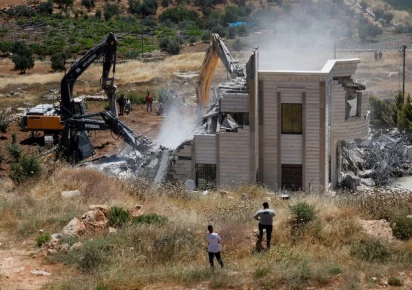
RAMALLAH: Tensions across the occupied West Bank intensified on Monday as Israeli forces reportedly destroyed water pipelines, detained Palestinians and ordered families to leave their homes ahead of a planned demolition. While a new settlement plan near Jerusalem raised fresh concerns over the expansion of Israeli settlements.

The latest developments have added to growing pressure on Palestinian communities already facing restrictions on movement, damage to agricultural land and disruptions to basic services.

Palestinian human rights activist Aref Daraghmeh said Israeli forces destroyed water pipelines in the Atouf and Ras al-Ahmar areas of Tubas governorate. The areas, located in the northern Jordan Valley, have experienced repeated military operations in recent months.

According to Daraghmeh, agricultural land has been cleared, water networks damaged and artesian wells filled in, causing significant losses for farmers who depend on the land and water supplies for their livelihoods.

The destruction of water infrastructure has particular significance in the Jordan Valley, where Palestinian farming communities rely heavily on limited water resources.

Brothers detained during raid

In another operation in the northern Jordan Valley, Israeli forces detained two Palestinian brothers in the Ein al-Hilweh area, according to local sources cited by Anadolu.

Meanwhile, Israeli troops raided the village of Tell, southwest of Nablus, and ordered residents to leave several homes ahead of the planned demolition of a house belonging to Palestinian Farouq Ramadan.

Ramadan was killed on July 24 during an attack in the village, according to Palestinian sources. They said he had disarmed and killed one of the attackers before being shot dead.

Three other members of his family were also killed and four Palestinians were injured during the incident, the sources said.

Near Ramallah, agricultural land east of Jaljaliya village was also set on fire, Palestinian official news agency Wafa reported. Palestinian civil defence crews later brought the blaze under control.

Village council head Osama Nazmi said an Israeli outpost had been established in the area about a year ago and that Palestinian homes belonging to residents from nearby Al-Mazraa Al-Sharqiya had subsequently been seized.

New settlement plan raises alarm

At the same time, Palestinian officials said Israel had advanced plans for a new settlement containing approximately 650 housing units south of Jerusalem.

The Palestinian Jerusalem Governorate said Israel’s District Planning and Building Committee had deposited the plan for the proposed “Nofei Rachel” settlement.

The project would cover approximately 27 dunams, or 6.7 acres, near Palestinian homes, according to the governorate.

Palestinian authorities warned that the consequences would extend beyond the construction of the housing units, arguing that the development could affect Palestinian movement, urban growth and the ability of local communities to expand.

They described the plan as part of a broader Israeli policy of expanding settlements and restricting Palestinian development.

Israeli rights organisation Ir Amim separately said Israel had advanced three major settlement projects involving more than 3,400 housing units in East Jerusalem in recent weeks.

The developments have renewed international concerns about settlement expansion.

The United Nations and most countries regard Israeli settlements established in territory occupied since 1967 as illegal under international law. Critics say continued settlement construction threatens the possibility of establishing a viable Palestinian state alongside Israel.

West Bank caught in wider conflict

The latest events come as the Israeli-Palestinian conflict continues to reverberate across the region.

According to figures cited by Palestinian authorities, violence in the West Bank has intensified alongside the wider war that began after the October 2023 Hamas attack on Israel.

The situation has also drawn attention to the issue of Palestinian remains held by Israel.

Report: Israel holds 1,700 Palestinian bodies

Israel is holding the remains of around 1,700 Palestinians for possible use in future exchanges, Israeli newspaper Haaretz reported, citing two unnamed sources familiar with recent discussions within Israel’s security establishment.

According to the report, Shin Bet chief David Zini supports retaining the bodies in case Israeli citizens are captured or disappear in the future. The Israeli military is also reportedly supportive of the position.

Haaretz reported that most of the remains are believed to belong to Palestinians from Gaza who participated in the October 7, 2023 attack on Israel or subsequent fighting.

However, the newspaper also reported that some of the bodies belong to Palestinians who were not involved in combat.

The issue has raised legal questions inside Israel. Legal experts cited by Haaretz questioned whether authorities have the power to retain the remains of Palestinians who have not been proven to have taken part in fighting.

The Palestinian National Campaign for the Retrieval of Martyrs’ Bodies and Disclosure of the Fate of the Missing said in October 2025 that Israel was holding around 1,500 bodies of Palestinians from Gaza at the Sde Teiman military facility in southern Israel.

A crisis extending beyond borders

The developments in the West Bank are unfolding against the backdrop of the devastating Gaza conflict.

Palestinian health authorities say tens of thousands of Palestinians have been killed and injured since October 2023, while much of Gaza’s infrastructure has been destroyed or severely damaged.

The reported destruction of water pipelines in the West Bank, the proposed settlement expansion and the continued disputes over Palestinian remains highlight how the conflict affects not only major political centres but also ordinary families, farmers and communities.

For Palestinians living in areas such as Tubas, Nablus and the outskirts of Jerusalem, the immediate concerns are often deeply personal: access to water, the safety of their homes, the ability to farm their land and the uncertainty of what another military raid may bring.

As settlement plans move forward and military operations continue, hopes for a reduction in tensions remain overshadowed by developments that are reshaping the landscape of the occupied West Bank.

Similar Posts

  • | |

    Sindh Governor Nihal Hashmi calls for hard work an…

      Sindh Governor Nihal Hashmi has said that Pakistan has become militarily invincible and stressed that “work, work and work” should remain the nation’s guiding principle for the country’s progress and prosperity. The governor made these remarks while addressing an Independence Day ceremony at the Governor House, where he hoisted the national flag and offered prayers for the security, stability and prosperity of Pakistan. Speaking on the occasion, Nihal Hashmi said that Independence Day was an opportunity to remember the people who struggled and made sacrifices for the creation of Pakistan. He emphasized that the nation should honour their efforts by working sincerely for the development of the country. “Work, work and work should be our motto,” the governor said, calling on citizens to contribute actively to the country’s progress. He stressed that Pakistan’s future depends not only on government institutions but also on the commitment and responsibility of every citizen. The Sindh governor also spoke about Pakistan’s defence capabilities, saying that the country had become militarily invincible. He said that when India challenged Pakistan’s defence, Field Marshal Asim Munir gave India a “befitting response,” adding that the response demonstrated Pakistan’s strength and resilience. Hashmi said Pakistan’s defence capabilities had earned recognition internationally. He maintained that the country had shown that it was capable of protecting its sovereignty and responding effectively to any threat. The Independence Day ceremony at Governor House was attended by officials and other guests. The national flag was hoisted as part of the celebrations, while prayers were offered for the country’s security, peace and prosperity. The governor also highlighted the importance of cleanliness and civic responsibility. He said that keeping homes, schools, neighbourhoods and cities clean was the responsibility of every citizen. He urged people to play their part in improving their surroundings instead of relying solely on government institutions to address cleanliness and sanitation issues. According to Hashmi, national development begins at the individual and community levels. If citizens take responsibility for maintaining clean streets and public spaces, it can contribute to a healthier and more organized society. He further called on every Pakistani to play a constructive role in the country’s development and prosperity. He said that citizens should perform their responsibilities honestly and work collectively to strengthen the country. The governor’s message on Independence Day centred on three major themes: national unity, hard work and civic responsibility. He said that remembering the sacrifices made for Pakistan should inspire citizens to work for its future rather than merely celebrate Independence Day as a national occasion. He also emphasized that Pakistan’s continued progress requires collective efforts from people across the country. From maintaining cleanliness in local communities to contributing to economic and social development, every citizen can play a role in strengthening the nation. Concluding his message, Nihal Hashmi urged citizens to remain committed to Pakistan’s progress and prosperity. He said that the country’s future could be strengthened when individuals, communities and institutions work together with a sense of responsibility and dedication.

  • |

    Gold prices rise for third straight session, hit two-month high

    Gold prices extended their upward momentum on Tuesday, climbing for a third consecutive session as investors turned their attention to key US inflation figures that could influence expectations for the Federal Reserve’s next interest-rate decision. The precious metal continued to attract buying interest amid renewed safe-haven demand and growing expectations that US monetary policy could become less restrictive if economic data point to a cooling economy. Spot gold gained around 1% to reach $4,432.74 per ounce by 0217 GMT, its highest level since June 5. US gold futures also advanced, rising 1.7% to $4,492.60 per ounce. Market analysts said several factors were contributing to the latest rally, including investors who had stayed on the sidelines during gold’s earlier decline and are now returning to the market as prices recover. IG market analyst Tony Sycamore said the move was partly being driven by a fear of missing out among investors who had failed to take advantage of the previous decline toward the $4,000 level. He also pointed to short-covering by speculative traders and renewed demand for gold as a safe-haven asset. Sycamore added that gold could have further room to advance over the medium term, potentially opening the way for a stronger recovery toward the $5,000-per-ounce mark. US inflation data in focus Investors are now closely watching the latest US inflation figures, with the consumer price index (CPI) scheduled for release on Wednesday and producer price data due on Thursday. The reports are expected to provide important clues about the future direction of US interest rates. Markets have already reduced expectations for further monetary tightening following weaker-than-expected US employment data released last week. The latest jobs figures raised concerns about the strength of the US economy and encouraged traders to reassess expectations for the Federal Reserve’s policy path. At its July meeting, the Federal Reserve left interest rates unchanged, although three policymakers dissented and supported an increase. The split among officials highlighted uncertainty over the appropriate direction of monetary policy as the central bank continues to balance inflation risks against signs of economic weakness. Gold generally benefits from a lower-interest-rate environment because the metal does not provide interest or other regular income. When bond yields and interest rates decline, the opportunity cost of holding non-yielding bullion becomes less significant, potentially increasing its appeal among investors. Fawad Razaqzada said that if incoming economic data continue to indicate a slowing US economy without a significant acceleration in inflation, financial markets could further reduce expectations for tighter monetary policy. Such a development could weigh on the US dollar while creating a more supportive environment for gold, he said. Geopolitical tensions add to safe-haven demand Geopolitical developments also remained an important factor in precious-metals markets. US President Donald Trump responded to Iran’s conditions for a potential peace agreement with demands of his own, including calls for compensation over people killed during wars, attacks and protests. The exchange has added uncertainty to diplomatic efforts aimed at resolving the conflict and reopening the Strait of Hormuz, a strategically important waterway for global energy shipments. Any prolonged disruption or renewed tensions around the Strait could increase concerns over global energy supplies and economic stability. Such uncertainty often encourages investors to seek traditional safe-haven assets, including gold. Analysts are therefore watching both economic indicators and geopolitical developments for signs that could influence bullion prices in the coming sessions. Other precious metals also gain Gold was not the only precious metal to advance during Tuesday’s trading. Spot silver increased by 0.9% to $66.30 per ounce, maintaining its recent strength. Platinum also moved higher, gaining 0.7% to $1,765.26 per ounce. Meanwhile, palladium rose 0.8% to $1,394.00 per ounce. With US inflation figures due later in the week, traders are expected to remain cautious while assessing whether the latest economic data will reinforce expectations for a shift toward easier monetary policy. For gold, a combination of softer US economic indicators, a potentially weaker dollar, lower interest-rate expectations and continued geopolitical uncertainty could provide additional support to prices in the near term.

  • |

    Antarctic cold blast grips New Zealand’s South Island

      A powerful cold wave sweeping north from Antarctica has engulfed New Zealand’s South Island, bringing freezing temperatures, fierce winds, and unusually heavy snowfall that has severely disrupted daily life across the region. The city of Dunedin has been among the hardest hit, experiencing strong icy winds accompanied by significant snowfall. Residents woke up to streets, rooftops, and vehicles covered in several inches of snow, creating hazardous conditions for both pedestrians and motorists. The unusual weather has transformed the city into a winter landscape, while also causing widespread travel disruptions. Authorities reported that the heavy snowfall has blanketed roads, making many routes dangerous and, in some areas, impassable. Snowplows and emergency crews have been deployed to clear major highways and ensure safe access for emergency services. However, officials have urged residents to stay indoors unless travel is absolutely necessary, warning that icy roads and reduced visibility could lead to accidents. Public transportation has also been significantly affected. All bus services in Dunedin were suspended due to unsafe road conditions, leaving commuters stranded and forcing many schools, businesses, and public institutions to adjust their schedules. Local authorities continue to monitor the weather closely before deciding when transportation services can safely resume. The severe weather has also disrupted travel between New Zealand’s North and South Islands. Ferry services connecting the two islands have been suspended because of dangerous sea conditions caused by the powerful Antarctic storm system. Strong winds and rough waves have made navigation unsafe, affecting both passenger and freight transport. The suspension of ferry operations is expected to delay the movement of goods and impact travel plans for thousands of people. Meteorologists say the cold outbreak originated from Antarctica and pushed unusually frigid air across southern New Zealand. Such weather systems are capable of producing intense snowfall, especially when cold Antarctic air interacts with moisture over the surrounding oceans. While snowfall is common during winter in parts of the South Island, the intensity of this storm has been described as exceptional for several areas. Emergency management agencies have advised residents to prepare for continued freezing conditions. People have been encouraged to keep emergency supplies at home, avoid unnecessary travel, dress warmly, and check on elderly neighbors or vulnerable family members who may require assistance during the cold spell. The harsh weather has also raised concerns for farmers, who are working to protect livestock from freezing temperatures and strong winds. Agricultural authorities have urged farmers to provide adequate shelter and food for animals until conditions improve. Forecasters predict that the Antarctic cold blast may continue to affect parts of the South Island over the coming days, with additional snowfall and icy conditions possible in higher elevations. Officials remain on high alert as they assess the impact of the storm and work to restore essential services. Residents are advised to stay informed through official weather updates and follow safety instructions until the severe weather subsides.

  • | |

    Two officials martyred in Kohat terror attack

    Two government officials were martyred and another was seriously injured after terrorists attacked a government vehicle at a joint security check post near the Kohat Toll Plaza on the Indus Highway late Thursday night, officials said. According to police, unidentified armed men opened fire on a customs enforcement vehicle that was carrying out routine anti-smuggling duties at the joint check post. The intense firing caused the vehicle to catch fire, resulting in heavy damage. The officials martyred in the attack were identified as Assistant Sub-Inspector (ASI) Sajjad-ul-Islam of the Kohat Excise Office and Customs Enforcement Constable Jawad Ahmed of the Peshawar Collectorate. Both officers lost their lives while performing their official duties. Another Customs official, Basirullah, suffered serious injuries during the attack. Rescue teams reached the scene shortly after receiving an emergency call, provided first aid and shifted the injured official to the District Headquarters Hospital in Kohat for further treatment. Rescue personnel also recovered the body of the customs constable from the burnt government vehicle, while firefighters extinguished the blaze to prevent it from spreading further. Soon after the incident, police and security forces cordoned off the area and launched a search operation to trace the attackers. Authorities have started an investigation to determine how the attack was carried out and identify those responsible. Officials said the attack created panic in the area, prompting additional security measures along the highway and surrounding locations. Funeral prayers for ASI Sajjad-ul-Islam were offered near his residence in Kohat. Senior officials from the Excise Department, law enforcement agencies and other government institutions attended the funeral and paid tribute to his services. The Excise Department described him as a dedicated and professional officer who served the department with commitment and courage. Officials expressed solidarity with his family and prayed for the elevation of his rank. Funeral prayers for Customs Constable Jawad Ahmed were also offered at the Custom House in Peshawar. Customs officials, colleagues and family members attended the funeral to pay their final respects. The Customs Department expressed deep sorrow over the loss of its officer, stating that he embraced martyrdom while carrying out his national duty. The department honoured his sacrifice and extended condolences to his family. Prime Minister Shehbaz Sharif strongly condemned the terrorist attack and expressed deep grief over the martyrdom of the two officials. He offered condolences to their families, prayed for the speedy recovery of the injured officer and directed the relevant authorities to arrest those behind the attack. The prime minister reaffirmed the government’s commitment to eliminating terrorism, saying operations against militant groups would continue until peace and stability are fully restored across the country.

  • Typhoon Dolphin Will Not Directly Hit Thailand

    BANGKOK, Thailand – The Thai Meteorological Department (TMD) has reassured the public that Typhoon Dolphin, currently situated far out in the Pacific Ocean, will not directly strike Thailand. The storm system is tracking toward Japan and China, dispelling recent online rumors suggesting an imminent direct threat to the kingdom. Super Typhoon Fung-won Set to Strike […]

  • |

    China proposes stringent cyberbullying legislation targeting AI abuse and platform accountability

    The Cyberspace Administration of China has released a draft law aimed at curbing cyberbullying, specifically addressing artificial intelligence-enabled harassment, deepfakes, and automated online abuse across the country’s digital platforms. The proposed legislation, which is open for public consultation until late August, introduces strict identity verification requirements for internet users before they can post content or access messaging services. Additionally, the measures place direct legal and operational responsibility on technology firms and artificial intelligence service providers, requiring them to actively trace, moderate, and remove harmful synthetic content or face severe administrative penalties, including fines reaching up to ten million yuan, platform suspensions, or license revocations. Under the proposed legal framework, judicial and law enforcement authorities will enforce criminal liability for individuals and entities using automated tools, coordinated troll networks, or synthetic media to conduct doxxing, defamation, or targeted harassment campaigns. The scope of the law extends to overseas organisations targeting individuals within China, whilst also mandating compulsory anti-cyberbullying education across schools and educational institutions. By targeting AI-driven psychological harm and emotional manipulation, regulators aim to establish robust emergency intervention mechanisms to protect minors and vulnerable demographics from emerging forms of digital harassment.

Leave a Reply

Your email address will not be published. Required fields are marked *