
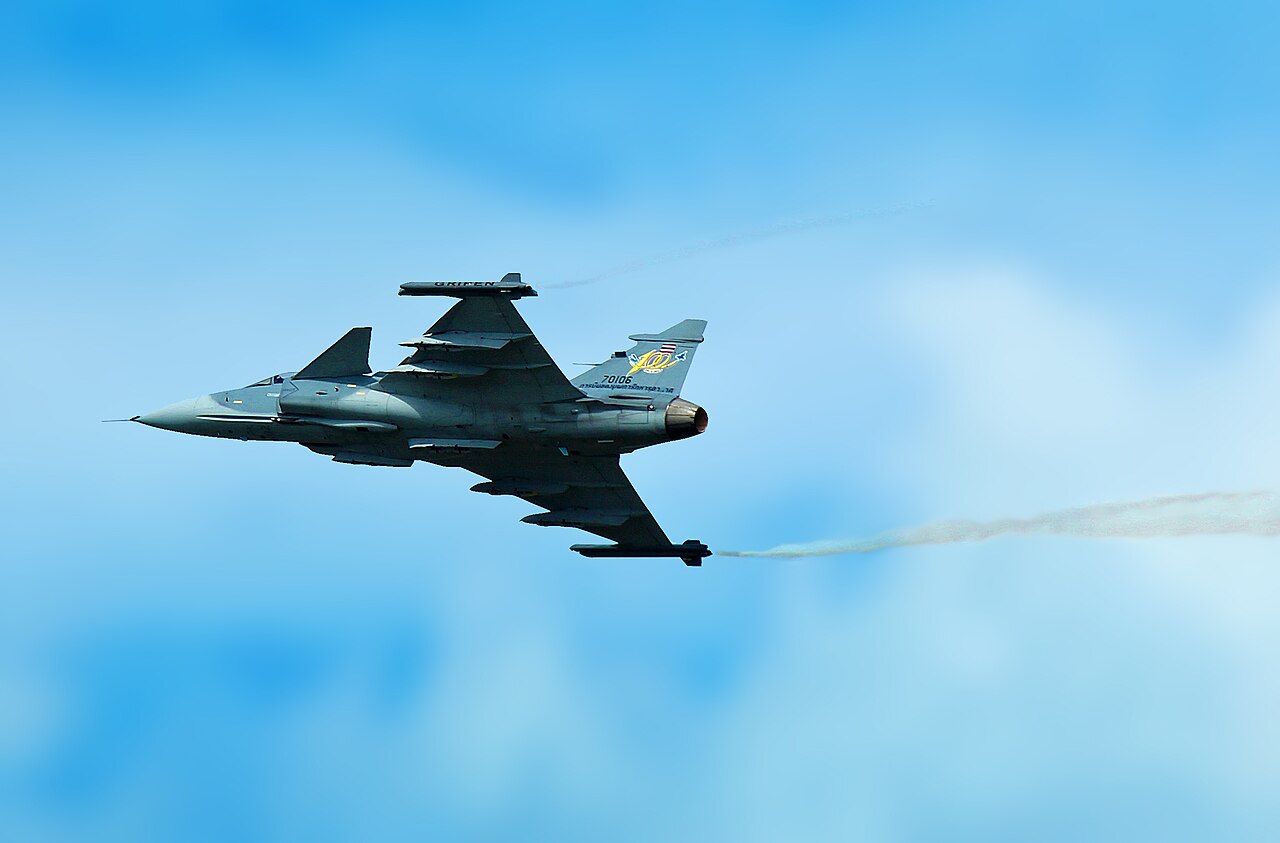
thai gripen f16

Thai Gripen and F-16 Jets Strike Cambodian Military Targets Ahead of Ceasefire

BANGKOK – Thai Air Force Gripen and F-16 fighter jets carried out a joint airstrike on Cambodian military targets on the morning of December 27, just hours before a scheduled ceasefire was set to take effect along the border. The operation targeted a weapons depot and military bases on Phnom Dong Rak hill in Cambodia’s Odor Meanchey province, near the Chong Sa-ngam border crossing opposite Thailand’s Si Sa Ket province.

Three Thai Soldiers Killed Reclaiming Border Villages in Sa Kaeo

The strike occurred at approximately 8:25 a.m., with video footage later posted on the Army Military Force Facebook page showing the aircraft in action. The released clips highlighted coordinated sorties by Gripen and F-16 jets, though no official casualty figures or detailed damage assessments were immediately provided.

The targeted facilities were located in the Trapeang Prasat area of Anlong Veng district. Initial reports indicated direct hits on the identified military installations. The public disclosure of the operation shortly after it occurred underscores the heightened tension in the final hours before the agreed ceasefire.

The timing of the strike, on the same day the ceasefire was due to begin, has drawn attention to the fragility of the truce agreement signed earlier by defence ministers from both sides. Authorities have not yet issued detailed statements regarding the strategic implications of the operation. Security officials and the public are closely monitoring developments as the ceasefire observation period approaches.

Four Cambodian Men Charged in South Korea for Assault on Thai Nationals

The situation remains fluid, with further updates anticipated as both sides evaluate the impact of the airstrike. Ongoing surveillance of border areas continues, and official briefings are expected to provide greater clarity on subsequent diplomatic and security measures.

-Thailand News (TN)
Similar Posts

  • | |

    Pinky’s account received Rs300m in one year: Sin…

    Sindh Additional Inspector General (AIG) Azad Khan has told the Senate Standing Committee on Interior that a bank account allegedly linked to drug case suspect Anmol alias Pinky received around Rs300 million within a year. Briefing the committee, Azad Khan said one transaction involving the account amounted to Rs290 million. He added that financial data involving transactions worth around Rs1 billion had so far emerged during the investigation. The briefing was given at a meeting of the Senate Sub-Committee on Interior, chaired by Senator Saifullah Abro. According to the Sindh police official, 10 people have been challaned in connection with the Anmol alias Pinky case. He said two individuals were allegedly operating accounts linked to the suspect and were running their activities from Lahore. The AIG also identified a suspect named Sameer as an alleged associate of Anmol. Azad Khan said another suspect, identified as Aqib, was allegedly running the network in Karachi. He added that two women were also allegedly part of the network and worked as riders for Pinky. According to the briefing, some African nationals allegedly supplied cocaine to the network. The Sindh police official further said investigators had identified 25 riders allegedly associated with the network. He said investigations were continuing into accounts allegedly held in the names of other individuals but believed to be linked to Anmol. Azad Khan also commented on the scale of the alleged drug network. He said media attention had created significant public discussion around the case, but claimed that Anmol was not among the largest drug suppliers. During the meeting, Senator Saifullah Abro questioned the AIG about statements made by Minister of State for Interior Talal Chaudhry regarding the case. Abro asked whether the minister had contacted the Sindh police in connection with Anmol alias Pinky. Azad Khan replied that the Minister of State for Interior had not contacted the police regarding the matter. The committee also discussed other issues related to law enforcement and ongoing investigations in Sindh. Senator Abro raised concerns over alleged corruption involving provincial ministers and referred to several major development projects, including the Yellow Line and Blue Line projects. He also mentioned the arrest of Zameer Abbasi during the discussion.

  • | |

    Fuego volcano forces evacuations in Guatemala as l…

    Guatemalan authorities have ordered residents in at least two villages to evacuate after the Fuego volcano erupted, sending lava and ash shooting into the air. Fuego, regarded as one of the most active volcanoes in the Western Hemisphere, began erupting on Monday. The country’s volcanic monitoring agency reported that pyroclastic flows, fast moving currents made up of hot gas, volcanic ash and rock fragments, continued rushing down the volcano’s south eastern slope into early Tuesday. Guatemala’s disaster management agency, known as Conred, raised a nationwide orange alert, the second highest level on its warning scale, and cautioned residents to remain prepared as further eruptions could generate additional pyroclastic flows and large ash clouds. The agency advised people living nearby to keep their doors and windows shut, and officials canceled classes at schools located close to the volcano. Fuego sits roughly 16 kilometers, or about 10 miles, west of Antigua, a city that draws large numbers of tourists each year for its well preserved colonial era architecture and status as a UNESCO World Heritage Site. The volcano itself has also become a popular destination for hikers in recent years, drawing visitors who trek its slopes for views of the surrounding region. Conred urged both tourists and local residents to avoid approaching the volcano or lingering in areas considered at risk, particularly along its slopes, as the situation continues to develop. The eruption has revived memories of a far deadlier event in 2018, when a sudden eruption of Fuego killed more than 200 people. Many of the victims were overtaken by fast moving pyroclastic flows that swept down the Las Lajas ravine with little warning, a disaster that remains one of the deadliest volcanic events in the country’s recent history. Fuego’s frequent activity has long made it one of Central America’s most closely monitored volcanoes, with authorities maintaining routine surveillance given its proximity to populated areas and popular tourist destinations.

  • | |

    Mir Raza’s mysterious death exposes crores d…

    Investigators have uncovered new evidence in the mysterious death of Karachi resident Mir Raza Ali, whose body was found in Gulistan-e-Jauhar, as police continue to investigate whether he was murdered or died by suicide. According to investigation sources, CCTV footage obtained by police shows Mir Raza leaving his shop near Bahadurabad at around 3:30am on July 29 after taking a security guard’s pistol from a drawer. He then drove to his home, where he left behind his car, smartwatch, house keys, and Rs39,000 before booking an online taxi. Police said Mir Raza departed his home at 4:08am and headed toward Gulistan-e-Jauhar alone. CCTV footage also captured him walking by himself in the area. His mobile phone was switched off at around 4:22am near Johar Mor Hilltop, and he was dropped off in Block 2 of Gulistan-e-Jauhar at approximately 4:28am. Authorities are still trying to determine whether Mir Raza was killed or took his own life. Investigation sources said Mir Raza was involved in the digital currency business in addition to his other commercial ventures. He had reportedly managed investments for several people and regularly paid profits to investors. However, officials said his digital currency business began suffering losses in December 2025, with financial difficulties worsening significantly in April 2026. To cover the losses, he allegedly started borrowing money and eventually accumulated debts estimated between Rs50 million and Rs80 million. Sources further claimed that an overseas friend invested Rs7.5 million in his business but did not receive the promised returns. Police have also recorded the statement of Mir Raza’s fiancée. According to investigators, the two remained in contact until around 11:30pm on July 28. She attempted to contact him again at around 3:00am, making more than 40 calls and sending numerous messages within 20 minutes, but received no response. Investigators also revealed that Mir Raza had deleted all of his social media accounts before leaving home. He reportedly transferred Rs250,000 to his father’s bank account and carried the shop security guard’s .30-bore pistol with him. While police recovered the pistol holster from the scene, the firearm itself has not yet been found. Another CCTV recording from the area where Mir Raza’s body was discovered has provided a new lead. The footage shows a motorcycle arriving at the deserted location at 3:36am on July 29 and remaining there for approximately 22 seconds before leaving. Based on preliminary evidence, investigators suspect the body may have been dumped at the site during the early hours of July 29. They believe those involved may also have discarded the pistol holster at the scene, which could become a crucial piece of evidence. Police have expanded their investigation, using CCTV footage and other forensic evidence to identify and arrest those responsible while examining every possible angle of the case. Investigation sources also disclosed that Mir Raza had thrown away his mobile phone along University Road. The device was later found by three labourers working in the area. Police tracked down the workers and recovered the phone as part of the ongoing investigation.

  • Former Thai PM Thaksin Freed on Parole After Eight Months in Prison

    BANGKOK — Former Prime Minister Thaksin Shinawatra walked free from Bangkok Remand Prison early this morning after serving eight months behind bars, emerging to cheers from hundreds of supporters and an emotional reunion with members of the influential Shinawatra family. The 78-year-old political patriarch was released on parole under strict conditions that include wearing an […]

  • | |

    Academy mafia behind MDCAT controversy, minister t…

    Islamabad: Federal Health Minister Mustafa Kamal on Tuesday blamed an organised academy mafia for creating controversy over MDCAT, while a Senate panel questioned why thousands of students were being pushed towards expensive coaching centres for medical college admission. During a heated meeting at Parliament House, Senator Anusha Rahman said private medical colleges in Pakistan were ripping off students by charging around Rs18 lakh every year. She compared these charges with medical education in China, where Pakistani students told her they were paying around Rs5 lakh a year and nearly Rs50 lakh for their complete medical degree. Anusha Rahman said she asked a Chinese provincial governor how they provided medical education at such a low cost. She said the governor replied, “We do not penalise the future.” The meeting of the Senate Health Committee Sub Committee was chaired by Senator Anusha Rahman. Senators Agha Shahzaib Durrani and Samina Mumtaz Zehri also attended. Senator Zehri joined the meeting online. Committee members expressed anger over the federal health minister’s late arrival. Senator Agha Shahzaib Durrani said the meeting had already been rescheduled three times at the minister’s request. Anusha Rahman warned that another meeting would be called the next day if the minister failed to attend. After joining the meeting, Mustafa Kamal said the MDCAT system could be improved but claimed that, in his view, the current system was perfect. He said coordinated text messages were being sent to senators to pressure them and delay the medical admission test. “Do not become emotional over these messages. This is the season of messages and there is a mafia behind them,” the minister told the committee. He also claimed that students sometimes demanded delays by citing floods and other emergencies as reasons. The minister said students from Khyber Pakhtunkhwa sometimes called for postponement even before floods reached Balochistan. He said some students later claimed that their books had been washed away in floods. Senator Samina Mumtaz Zehri rejected the idea that all complaints were organised. She said the committee was receiving around 50 messages from students every day and asked why their problems had not been addressed. She also raised concerns that FSc, A Level and MDCAT examination dates were overlapping. The minister said the MDCAT would be held around three weeks after the final board examination. He said the last board examination was expected to end on July 20 and MDCAT would be conducted three weeks later. The Pakistan Medical and Dental Council told the committee that around 135,000 students would appear in MDCAT. The test will be conducted in 36 cities, including 35 cities in Pakistan and Riyadh in Saudi Arabia. PMDC officials said medical colleges previously conducted separate entry tests, but the system was later changed to a national MDCAT. They said several problems had been reported in earlier years, especially regarding examination papers. To solve these problems, PMDC formed committees and prepared a nationally uniform syllabus. Officials said the syllabus was displayed on different public platforms and around 1,000 people submitted complaints. Anusha Rahman told PMDC officials that students had suffered because of weaknesses in the system. She said FSc students complained that they were asked questions linked to the A Level system, while A Level students were forced to study FSc books. She questioned why students were going to private academies and paying up to Rs1 lakh for MDCAT preparation. “Every year, academies make huge profits from these tests,” she said. She added that students were placed under heavy pressure to complete MDCAT preparation within three months. Senator Agha Shahzaib Durrani said the FSc system mainly focused on detailed knowledge, while the A Level system gave greater importance to analysis and reasoning. PMDC officials said MDCAT had been designed around common learning points included in both systems. They said the aim was to provide a fair test for FSc and A Level students. The health minister agreed to review the issue and asked the committee to send students with genuine complaints directly to the ministry and PMDC. He said officials would sit with the students, listen to their concerns and try to solve their problems. The committee also raised serious concerns about fees charged by private medical colleges. Members said many seats remained vacant because deserving students could not afford the fees. They said Pakistani students were choosing foreign universities because medical education abroad was cheaper. The committee called for a review of the fee structure of private medical colleges to make medical education more affordable. Senator Agha Shahzaib Durrani proposed giving 40 percent weight to MDCAT, 50 percent to academic results and 10 percent to interviews during medical college admissions. PMDC officials warned that reducing MDCAT marks could weaken the importance and credibility of the national test. The committee also recommended conducting MDCAT twice a year so students could get another chance instead of losing a complete academic year. Members appreciated some reforms introduced by PMDC but asked the council to improve public awareness. They recommended issuing brochures and running information campaigns about foreign medical colleges that are not recognised in Pakistan. The committee said students must be warned before spending money on institutions whose medical degrees will not be accepted by Pakistani authorities. It also recommended providing more house job and professional training opportunities to Pakistani medical graduates returning from foreign countries. The minister directed officials to provide complete MDCAT data from the last five years. The information will include the total number of students who appeared in the test and a comparison of FSc and A Level candidates. Committee members also sought details about the members of the MDCAT assessment committee. The health minister promised to provide those details within 24 hours. The committee decided to continue discussions on MDCAT, medical college fees and admission policies in its next meeting.

  • |

    Pakistan men’s team to make historic FIFA ASEAN …

    Pakistan’s men’s football team is set to make its debut at the FIFA ASEAN Cup, to be held in Indonesia from 21 September to 6 October, marking a significant milestone for the country’s footballing ambitions. Pakistan are among the 14 teams taking part in the tournament and one of eight teams competing in Indonesia. The Shaheens are one of three invited teams, with the remaining 11 sides representing Southeast Asia. Following the announcement, Pakistan Football Federation (PFF) President Syed Mohsen Gilani thanked FIFA President Gianni Infantino for the opportunity. “The Pakistan Football Federation is extremely thankful to FIFA President Gianni Infantino for presenting us with the opportunity to participate in our second-ever FIFA event,” he said. “After the women’s national team participated in the FIFA Series, it is now the turn of our men’s national team to take part in their maiden FIFA tournaments.” “It is time to dream big. We are not content with playing development competitions. Pakistan is not just with the big boys. Pakistan football truly arrived at the global stage,” said Gilani. “The ASEAN Cup aims to provide high-quality football, strengthen regional ties, and create new opportunities for fans to enjoy the game.” The tournament will feature two tiers of competition. The top-tier FIFA ASEAN Cup, hosted by Indonesia, will include Pakistan, Malaysia, India, the Philippines, Singapore and Thailand. The second-tier FIFA ASEAN Challenge Cup will feature hosts Hong Kong, along with Brunei Darussalam, Cambodia, Laos, Myanmar, and Timor-Leste. Teams will be allocated to groups based on the FIFA Men’s World Ranking to ensure competitive balance throughout the tournament. Each competition will be divided into two groups, with teams playing each other once in a round-robin format. The group winners will advance to their respective finals to compete for the title, while the runners-up will face off in the third-place playoff. The historic debut marks a new chapter for Pakistani football on the international stage.

Leave a Reply

Your email address will not be published. Required fields are marked *