new security architecture

A New Security Architecture’: Global Analysts As…

Pakistan, Saudi Arabia and Türkiye’s landmark defence agreement draws international attention; Shehbaz Sharif and Field Marshal Asim Munir play pivotal roles in historic strategic breakthrough

The landmark Makkah Joint Defence Agreement between Pakistan, Saudi Arabia and Türkiye has triggered intense international interest, with analysts viewing the accord as a potentially significant development in the evolving security architecture of the Middle East and wider Muslim world.

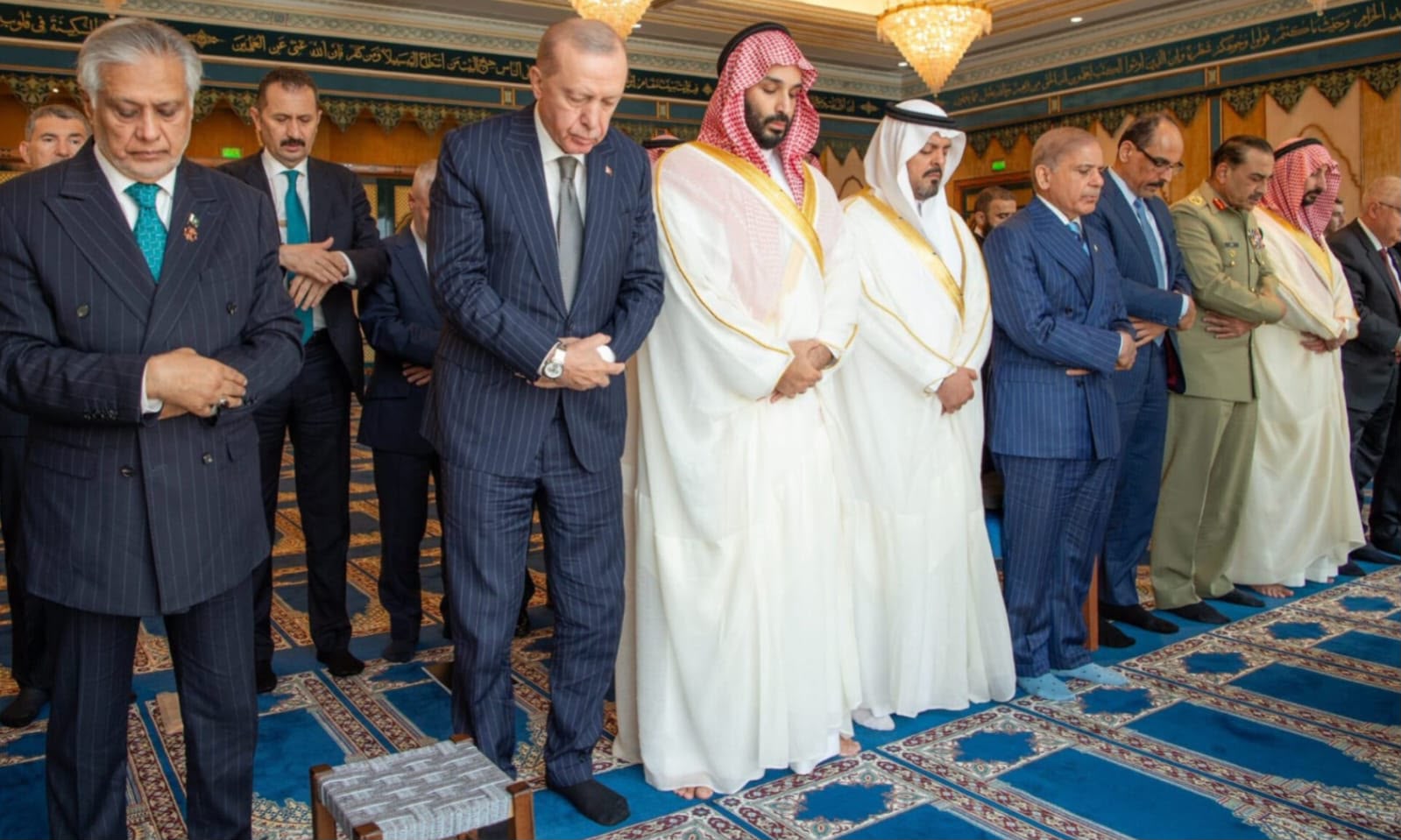
Signed in Makkah by Prime Minister Shehbaz Sharif, Saudi Crown Prince and Prime Minister Mohammed bin Salman and Turkish President Recep Tayyip Erdoğan, the agreement establishes a collective-defence principle under which an armed attack against any one of the three countries will be regarded as an attack against all three.

The pact brings together three strategically important states with highly complementary capabilities: Saudi Arabia’s economic and energy weight, Türkiye’s powerful conventional military and expanding defence industry, and Pakistan’s extensive military experience and strategic deterrent.

The combination has prompted international analysts to examine whether the Makkah agreement could become the foundation of a more autonomous, regionally driven security framework.

Ishaq Dar: agreement is defensive, not directed against any country

Pakistan’s Deputy Prime Minister and Foreign Minister Senator Ishaq Dar has sought to clarify the scope and purpose of the agreement amid growing international interest.

Dar described the Makkah Accord as “purely defensive in nature” and “not targeted against any country”, stressing that its purpose is to strengthen collective security and promote peace and stability.

He said the agreement does not replace or undermine existing bilateral or multilateral arrangements maintained by the three countries with each other, other states or international organisations.

Under the accord, Dar explained, an external armed attack against any one of the three countries would be considered an attack against all, consistent with the inherent right of individual and collective self-defence under Article 51 of the UN Charter.

Dar also said the framework remains open to other countries that share its principles and are prepared to resolve differences through mutual respect, cooperation and peaceful means.

His clarification is strategically important because it positions the Makkah framework as a mechanism of deterrence rather than confrontation, without identifying Iran, Israel or any other state as a permanent adversary.

Hakan Fidan compares mutual-defence provision with NATO Article 5

The most significant international description of the agreement’s collective-defence provision has come from Turkish Foreign Minister Hakan Fidan.

Fidan said the provision is technically comparable to NATO’s Article 5, under which an attack against one member is treated as an attack against all.

The comparison does not mean that the Makkah framework has NATO’s integrated command structure or institutional architecture. The practical response to any attack would be determined according to the circumstances.

Fidan said a ministerial committee would be established and a general secretariat based in Saudi Arabia would oversee the framework, with further operational details to be developed.

He also indicated that Türkiye wants the framework to expand, identifying Egypt as a potential future member.

The prospect of expansion is potentially significant because it could transform a trilateral arrangement into a wider regional security mechanism.

OIC welcomes agreement as an ‘important strategic step’

The Organisation of Islamic Cooperation has welcomed the agreement, with Secretary General Hissein Brahim Taha expressing strong support and describing the pact as an “important strategic step” reflecting the commitment of Pakistan, Saudi Arabia and Türkiye to strengthening cooperation.

The OIC response gives the agreement significance beyond the three signatories and places it within the wider context of cooperation among Muslim-majority countries.

The development comes at a time when several regional states are reassessing existing security arrangements and seeking greater strategic autonomy.

Saudi Arabia: strengthening security without abandoning existing partnerships

Riyadh has emphasised that the new defence framework does not replace its existing security arrangements.

Saudi Deputy Minister for Public Diplomacy Rayed Krimly said the agreement does not supersede or replace existing bilateral or multilateral agreements involving the three countries.

The position reflects Saudi Arabia’s broader foreign-policy strategy of strategic diversification.

The Kingdom continues to maintain a major relationship with the United States while simultaneously deepening strategic, economic and defence ties with Türkiye, Pakistan, China and other powers.

The Makkah pact therefore appears less a replacement for existing alliances than an additional layer of regional deterrence.

Chatham House: Türkiye pursuing strategic ‘hedging’

The Makkah agreement has also given renewed significance to earlier analysis by Chatham House.

Tim Chattell of the International Security Programme at Chatham House examined the prospect of a Turkish strategic arrangement with Saudi Arabia and Pakistan before the trilateral agreement was signed.

He argued that such cooperation formed part of Ankara’s wider strategy of “hedging” — developing alternative strategic partnerships while retaining its NATO commitments.

Chattell also identified potential synergy between the three countries, particularly because Türkiye and Pakistan possess complementary defence capabilities while Saudi Arabia has significant financial resources that could support defence cooperation and industrial development.

What had previously been examined as an emerging strategic alignment has now become a formal defence commitment.

Atlantic Council: a ‘double deterrence tool’

The Atlantic Council has also examined the evolving Saudi-Pakistan security relationship.

Analyst Eleonora Ardemagni described the Saudi-Pakistan defence pact as a “double deterrence tool”, arguing that the relationship reflected both immediate security concerns and Saudi Arabia’s longer-term drive towards greater defence autonomy.

Her analysis highlighted military training, capacity building, defence-industry cooperation, technology transfer and potential co-production as important elements of the emerging partnership.

The inclusion of Türkiye adds another major military and defence-industrial dimension to that relationship.

A strategic triangle of complementary power

The significance of the Makkah pact lies partly in the capabilities each country brings to the partnership.

Saudi Arabia contributes enormous economic and energy influence, strategic geography and financial resources.

Türkiye contributes a major conventional military, NATO experience and an increasingly sophisticated indigenous defence industry.

Pakistan contributes one of the region’s largest and most experienced armed forces, longstanding military cooperation with Saudi Arabia and Türkiye, and a nuclear deterrent.

The three-way combination therefore creates a strategic partnership in which each member contributes capabilities that complement those of the others.

That is why analysts are examining whether the agreement could eventually develop into a permanent regional security institution.

Shehbaz Sharif’s pivotal diplomatic role

For Pakistan, the agreement represents a major diplomatic achievement and the culmination of sustained engagement with both Riyadh and Ankara.

Prime Minister Shehbaz Sharif’s participation in the Makkah summit places Pakistan at the centre of a strategic framework connecting South Asia, the Gulf and the wider Muslim world.

The diplomatic challenge for Islamabad has been to deepen its defence relationships while avoiding becoming part of a confrontation between rival regional powers.

The defensive language of the agreement provides Pakistan with room to pursue that balance.

Sharif’s role has therefore been pivotal in helping create the political environment in which Pakistan’s longstanding relationships with Saudi Arabia and Türkiye could be brought together under a formal trilateral framework.

Field Marshal Asim Munir and the military dimension

The political significance of the agreement is reinforced by the military relationship underpinning it.

Field Marshal Syed Asim Munir, Chief of Army Staff and Chief of Defence Forces of Pakistan, has played a pivotal role in strengthening Pakistan’s strategic and defence relationships with Saudi Arabia and Türkiye.

Pakistan and Saudi Arabia have decades of military cooperation, including training, professional exchanges and defence coordination.

Pakistan-Türkiye defence relations have also expanded substantially, covering military technology, naval cooperation, training and defence production.

The Makkah framework provides an opportunity to bring these strands of cooperation into a broader strategic structure.

Its future credibility will depend on military interoperability, intelligence cooperation, joint exercises, defence technology, institutional coordination and contingency planning.

Field Marshal Munir’s role will consequently be central to translating the political commitment made in Makkah into practical military cooperation.

Iran: deterrence without confrontation

Iran is likely to remain one of the most important considerations in international assessments of the agreement, although Tehran is not identified as an adversary.

The pact was signed against the backdrop of heightened regional tensions, making its potential implications for the Gulf particularly significant.

However, both Türkiye and Pakistan have stressed that the agreement is not directed against Iran.

Saudi Arabia has also pursued diplomatic engagement with Tehran, while Pakistan shares a border with Iran and has consistently sought regional stability.

Türkiye maintains its own complex relationship with Iran, combining competition, economic engagement and cooperation in selected areas.

The strategic objective therefore appears to be deterrence without formally designating an enemy.

India watching the development closely

India is another major regional power assessing the implications of the agreement.

The emergence of a formal defence framework linking Pakistan, Türkiye and Saudi Arabia introduces a new variable into India’s strategic calculations.

Türkiye has close defence relations with Pakistan, while Saudi Arabia remains an important economic and strategic partner for India.

New Delhi is therefore likely to maintain its engagement with Riyadh while closely monitoring how the trilateral defence framework develops.

The immediate Indian response has been cautious, reflecting the complexity of its relationship with Saudi Arabia and the wider Gulf.

Israel faces a new strategic calculation

Israel also faces a more complicated regional environment.

Türkiye and Pakistan have adopted strong positions on the Gaza conflict, while Saudi Arabia remains one of the most influential Arab and Muslim states.

The immediate military implications of the Makkah agreement for Israel remain uncertain.

Much will depend on whether the framework remains focused on territorial defence or develops into broader political, intelligence and military coordination.

The possibility of additional countries joining could make the arrangement considerably more significant.

Egypt could transform the framework

The possibility of Egyptian participation is among the most consequential developments surrounding the agreement.

Egypt is one of the Arab world’s major military powers and occupies a strategically vital position linking the Mediterranean, Red Sea and Africa.

Türkiye has indicated that Egypt could potentially join the framework once technical issues are resolved.

Pakistan, Saudi Arabia, Türkiye and Egypt already cooperate through the R4 mechanism, creating an existing platform for strategic consultation.

If Egypt joins the defence framework, the geographical and military significance of the arrangement would increase substantially, potentially connecting major powers across South Asia, the Gulf, Anatolia, the eastern Mediterranean and North Africa.

Not NATO — but potentially the beginning of something bigger

International analysts caution against describing the Makkah agreement as a new NATO.

NATO has decades of institutional development, an integrated military command and established operational mechanisms.

The Makkah framework is at an early stage.

Its strategic significance, however, does not depend solely on whether it immediately develops NATO-style institutions.

Collective-defence agreements alter strategic calculations by increasing the potential cost of aggression.

If an adversary believes that an attack against one country could trigger military, intelligence, economic and diplomatic consequences involving two additional major powers, the calculation changes.

That is the essence of deterrence.

The United States factor

The agreement also raises questions about the future role of the United States in regional security.

The Makkah pact should not automatically be interpreted as Saudi Arabia, Türkiye or Pakistan turning away from Washington.

Türkiye remains a NATO member.

Saudi Arabia maintains a major strategic relationship with the United States.

Pakistan also has a long history of engagement with Washington.

The more accurate interpretation is strategic diversification.

Regional powers increasingly want multiple security partnerships rather than dependence on a single external guarantor.

The Makkah framework fits within that broader transformation.

Pakistan’s strategic importance rises

For Pakistan, the agreement represents a significant expansion of its role in regional security.

Islamabad now finds itself at the intersection of South Asian, Gulf and wider Muslim-world strategic affairs.

Its longstanding defence relationship with Saudi Arabia provides historical depth, while its growing partnership with Türkiye offers access to an increasingly sophisticated defence-industrial ecosystem.

The political leadership of Prime Minister Shehbaz Sharif and the strategic and military leadership of Field Marshal Syed Asim Munir have been central to positioning Pakistan within this emerging framework.

The agreement could also create opportunities for expanded joint exercises, intelligence cooperation, defence production and military technology partnerships.

The nuclear dimension

Pakistan’s nuclear capability inevitably adds another dimension to international assessments of the pact.

However, the publicly described terms of the Makkah agreement do not establish a formal Pakistani nuclear guarantee to Saudi Arabia.

It would therefore be premature to describe the agreement as creating a nuclear umbrella.

Pakistan’s nuclear capability nevertheless contributes to the overall strategic weight of its participation and inevitably forms part of the deterrence calculations surrounding the agreement.

The real test begins now

The signing in Makkah is only the beginning.

The credibility of the agreement will ultimately depend on implementation.

The three countries will need to establish practical mechanisms for military coordination, intelligence sharing, joint exercises, defence-industrial cooperation and crisis consultation.

The proposed ministerial committee and Saudi-based secretariat will be important first steps.

The future direction of the framework will also depend on whether Egypt or other regional states eventually join.

Why Makkah matters

The significance of the agreement lies in the convergence of political will, military capability and strategic geography.

For the first time, Pakistan, Saudi Arabia and Türkiye have placed their collective security relationship within a formal trilateral defence framework.

The location of the signing adds exceptional symbolic importance.

The agreement was concluded in Makkah, Islam’s holiest city, at a time when the wider region is facing profound geopolitical uncertainty.

But the significance is not merely symbolic.

The three countries possess substantial economic, military and diplomatic weight, and their cooperation could influence strategic calculations well beyond their borders.

A new era of strategic autonomy

The Makkah Joint Defence Agreement should therefore be viewed as part of a broader transformation in regional geopolitics.

Saudi Arabia is seeking greater strategic autonomy.

Türkiye is expanding its independent regional influence while retaining its NATO membership.

Pakistan is seeking a stronger role in regional security and Muslim-world diplomacy while maintaining its wider international relationships.

All three increasingly recognise that the international system is becoming more fragmented and that regional powers must develop greater capacity to protect their own interests.

The Makkah pact is therefore potentially the beginning of a new regional security architecture.

Its ultimate success will depend on implementation, political cohesion and the ability of the three countries to reconcile their different threat perceptions.

But the strategic message from Makkah is already clear:

Pakistan, Saudi Arabia and Türkiye are signalling their determination to strengthen collective deterrence, increase strategic autonomy and assume a greater role in shaping the security future of the region and the wider Muslim world.

For Pakistan, the diplomatic leadership of Prime Minister Shehbaz Sharif, reinforced by the strategic and military role of Field Marshal Syed Asim Munir, has been pivotal in bringing the country to the centre of this emerging geopolitical equation.

What began in Makkah as a trilateral defence commitment could, if successfully institutionalised and expanded, become one of the most consequential new security frameworks in the wider region.

Similar Posts

  • Gulf in the Crossfire

    There is a particular kind of exhaustion that sets in when a war refuses to end on schedule. Five months into the conflict between the United States and Iran, we are living through it. Ceasefires are announced and collapse within weeks. Strikes are billed as decisive and are followed, days later, by more strikes. Each side insists the other will soon come to its senses, and each side is wrong. What we are watching is not a war moving toward resolution. It is a war that has become self-sustaining, and the longer it runs, the more countries get pulled into its logic whether they wanted a role in it or not. Saudi Arabia is the clearest example. For nearly four years, Riyadh had quietly extracted itself from the Yemen war, treating the 2022 ceasefire with the Houthis as one of the few unambiguous foreign policy wins of Crown Prince Mohammed bin Salman’s tenure. That restraint is now gone. When the Houthis resumed missile fire at Israel in solidarity with Tehran, and then began striking Saudi oil infrastructure directly, Riyadh had no real choice but to respond. It bombed Hodeidah. The Houthis retaliated against Aramco facilities in Yanbu and Jizan. A conflict Saudi Arabia spent years trying to bury is now, again, live on its border, not because Riyadh chose it but because a war between Washington and Tehran left no room for neutrality. This is the pattern worth naming plainly: nobody in this conflict is fighting the war they intended to fight. Washington launched its campaign framed around Iran’s nuclear program, wagering that decisive strikes would force capitulation or collapse. Instead it has strikes running past the two-week mark with no clear terminus, American service members killed in Jordan and Iraq, and a president publicly conceding that the exit could be “diplomatic or military” — which is another way of saying nobody currently knows how this ends. Iran, for its part, has responded to devastating strikes on its cities not with capitulation but with exactly the kind of asymmetric, proxy-driven defiance its doctrine was built for, activating fronts in Iraq, the Gulf, and now Yemen that cost it little and cost everyone else a great deal. The Strait of Hormuz tells the same story in economic terms. Daily vessel traffic through one of the world’s most important oil chokepoints has fallen to a small fraction of its prewar level. That is not an abstraction. It shows up in tanker insurance premiums in Piraeus and London, in fuel costs in Mumbai and Rotterdam, in the balance sheets of countries that have precisely nothing to do with this fight. War aims that once seemed narrowly bilateral — Washington versus Tehran, over centrifuges and missile stockpiles — have metastasized into a tax on global trade that nobody voted for and nobody can opt out of. It is tempting, watching this unfold, to look for a single culprit. Commentators sympathetic to Washington will point to Iran’s decades of proxy warfare, its nuclear ambiguity, its crackdown on its own protesters, and argue the current campaign is simply overdue accountability. Commentators sympathetic to Tehran will point to a US-Israeli strike that killed Iran’s Supreme Leader and ask what state, faced with the assassination of its head of state, would not treat that as an act of war demanding a response. Both arguments contain real grievances. Neither survives contact with what has actually happened since: a conflict that both sides insist is about narrow, defensible aims but that neither side has been able to keep narrow. Wars rarely stay the size their architects intend. What should worry observers most is not any single strike or retaliation but the absence of an exit ramp anyone believes in. Ceasefires here have not functioned as steps toward peace; they have functioned as pauses for rearmament, evidenced by how quickly each one has collapsed back into nightly bombing. That is the signature of a conflict without a theory of victory — one where both governments can inflict real pain on the other indefinitely, but where neither can convert that pain into a settlement it can sell to its own public. In that kind of war, the fighting does not stop because someone wins. It stops, if it stops, because the costs finally exceed what either government’s domestic politics can absorb — and on the evidence of the past five months, that threshold keeps receding rather than approaching. Saudi Arabia’s reluctant return to the Yemen battlefield should be read as an early warning rather than a footnote. It shows how a conflict that both Washington and Tehran describe as fundamentally about themselves keeps finding new participants who never agreed to join. If this war continues on its current trajectory, the question worth asking is not which superpower prevails, but how many other countries, currencies, and shipping lanes get quietly conscripted before it does.

  • Whose Lives Count on Primetime? From Mir Raza Ali …

    Let me begin where every honest sentence on this subject must begin: I condemn, without reservation, the murder of Mir Raza Ali, the 25-year-old founder of Karachi’s beloved dessert brand Wafflix. He left his home before dawn on July 28, 2026, telling his mother he would return in ten minutes. He never did. His body was found the next day in the bushes of Gulistan-e-Jauhar, bearing torture marks and a gunshot wound. Eighteen days later, his family still waits for the truth, and I appeal — as every citizen should — for a swift, transparent investigation and justice for his killers. Nothing that follows in this essay is meant to diminish that grief. It is meant to sit beside it, uneasily, and ask why our grief is so selective. Because for eighteen days now, Pakistan’s television screens have offered something close to a live tribunal. Home Minister Zia Ul Hassan Lanjar and Inspector General of Police Javed Alam Odho face anchors nightly. Forensic reports are dissected line by line. Postmortem findings, CCTV timelines, taxi records — every fragment of evidence is turned over on air with a rigor that would not embarrass The Hague. I do not begrudge this scrutiny; a young man is dead and the public deserves answers. But I confess, with something between astonishment and despair, that I cannot recall our media applying this same forensic hunger to the killing of the country’s economy. Even the assassination of former Prime Minister Benazir Bhutto in 2007 — an event that reshaped this nation’s political history — did not receive this level of daily, granular dissection. Nor, in truth, did the world’s own gold standard for high-profile scrutiny, the 2018 murder of journalist Jamal Khashoggi inside the Saudi consulate in Istanbul, sustain eighteen straight days of forensic-audit-level coverage in the country that lost him. So where is that same appetite for NEPRA and CPPA? Here is what nobody puts on a talk show: over the past three years, dozens of Pakistanis — an elderly widow in Gujranwala, a mother of four in Jahanian, a young man in Faisalabad, a payphone operator in Peshawar — have taken their own lives after receiving electricity bills they could not pay. These were not abstractions. They were documented, named, buried. And yet no anchor has spent eighteen consecutive nights asking the chairman of NEPRA why. No panel has summoned the CEO of the Central Power Purchasing Agency to explain, plainly, in language a shopkeeper in Bahadurabad could understand, why this country of 260 million people pays some of the region’s highest power tariffs while its own regulator’s reports describe capacity sitting idle. Where is the media trial of the men who told us, from 2014 to 2018, that imported coal would be Pakistan’s “game changer,” and of the former prime minister who made the same promise about LNG-fired plants? Those promises are now line items in a debt-trapped economy, in a nation reduced, again and again, to a global begging bowl. But no one is asked to answer for them on camera. They sit, as it were, behind a veil — while the Director General of ISPR and the Chief of Defence Forces routinely stand before microphones and take hard questions. Why can Pakistan’s military spokesmen face the public, but not the men who set the price of electricity for every household in the country? I want to be precise, not merely aggrieved, so let me offer what I found when I went looking myself. CPPA-G’s own energy purchase data for May–June 2026 shows three nearly identical imported-coal plants — Huaneng Shandong Ruyi at Sahiwal (1,244 MW), China Power Hub in Balochistan (1,249 MW), and Port Qasim in Karachi (1,243 MW) — dispatched at wildly different rates. Huaneng ran at roughly 73 percent of capacity; Port Qasim at only 36 percent; China Power Hub at a mere 24 percent — this despite Huaneng being, by current fuel charges, the most expensive of the three at roughly Rs. 20.38 per unit, against Rs. 15.12 for Port Qasim and Rs. 16.09 for Hub. If Pakistan’s Economic Merit Order genuinely governed dispatch, the cheaper southern plants should be running harder, not idling at a quarter of their design capacity. Something else is deciding who generates and who doesn’t — transmission bottlenecks, take-or-pay contract terms that favor Sahiwal, or simple operational failure at Hub, whose output fell 37 percent in a single month. Whatever the cause, Pakistani consumers are still paying full capacity charges for roughly 760 to 940 idle megawatts at each underused plant — fixed costs for electricity that was never produced, quietly folded into tariffs nobody explains on air. This is not a call to relent on Mir Raza Ali. It is a plea that the same courage be extended elsewhere. I am not asking media to abandon one grieving family; I am asking whether this nation’s curiosity has been rationed, aimed carefully at the stories that move ratings but never at the ledgers that move our poverty. Who decides that a private tragedy in Gulistan-e-Jauhar deserves eighteen days of forensic television, while a public catastrophe costing every household thousands of rupees a month deserves none? Is there a veil, a ghost hand, guiding our screens away from NEPRA’s boardroom and toward whatever is easier to sell? My request to Pakistan’s media is respectful, not accusatory: summon the chairman and members of NEPRA and the CEO of CPPA, and ask them, on camera, to explain the dispatch logic behind May and June’s generation data, to quantify what idle capacity is costing consumers per unit, to say plainly whether transmission constraints are forcing reliance on costlier northern plants while cheaper southern capacity sits dark, and to commit to passing any findings transparently through the Fuel Charges Adjustment mechanism, as the NEPRA Act itself demands. Pakistan is the fifth most populous nation on earth, and yet the men who preside over its power sector — the chairmen and members of NEPRA and OGRA, the leadership

  • We Grew the Wheat. We Chose to Import It.

    In early April the grain stood stacked by the roadside in Sahiwal, DG Khan and Bahawalnagar, harvested and bagged, waiting for a buyer the system had promised but never delivered. Three months later the buyer arrived. Not the state purchasing from Pakistani farmers, but the state purchasing from foreign suppliers, paying in scarce dollars. Pakistan’s 2025-26 wheat production is estimated at 29.31 million tonnes against consumption of roughly 31.9 million. The gap is real. This import, however, is not the product of a harvest failure. It is the product of a procurement failure. The wheat existed. What did not exist was the institutional will to buy it at a price that reflected its value while it was still in the farmer’s hands. Private intermediaries bought at Rs 2,900-3,200 per 40 kilograms from farmers who had loans falling due and no storage. Those intermediaries held the grain and watched the open-market price climb to Rs 4,600 by July. The middleman’s profit was the farmer’s loss. The state, having refused to spend rupees in April, must now spend dollars in August. The invoice, compiled from months of evasion, comes due all at once. The cycle was predictable. After the 2022 floods the administrative reflex became “import.” In 2023-24 the country allowed large duty-free private imports into a market already carrying record stocks. That was 3.44 million tonnes at a cost of $1.005 billion. In 2024 and 2025 the Minimum Support Price was first ignored and then abolished under IMF conditionality linked to a $7.1 billion Extended Fund Facility. This happened years ahead of the phased timeline the Fund had allowed until FY2026. In October 2025 the government reversed course and restored the price, but the supporting machinery never materialised. In January 2026 the aggregator model collapsed. Punjab set a procurement target of three million tonnes, but by late May, with partial procurement continuing into June, total procurement fell far short of the target. Three seasons, three frameworks, one recurring failure: the system arrives after the price has already been set. The old procurement system was deeply flawed. It captured only about a quarter of production and skewed toward large landholders and politically influential actors. According to a Competition Commission of Pakistan analysis, the top 40 per cent of farmers in Punjab sold 84 per cent of their wheat to official buyers, while the bottom 40 per cent sold only 6.4 per cent, forced to accept below-benchmark prices from private traders. Abolishing it overnight without private storage, warehouse-receipt financing or functioning commodity exchanges did not liberate the small farmer. It exposed him to cartels he could not match. The state was weak when farmers needed a floor. It is assertive now that consumers need a ceiling. That is not food security. It is political timing. The cost will be paid in November. Punjab’s wheat acreage has already fallen sharply. It fell by roughly 5.5 per cent between 2023-24 and 2024-25, a reduction of close to a million acres, according to official crop reporting data corroborated by independent assessments. The decline has continued into 2025-26. Farmers are not abandoning wheat out of ideology. They are doing arithmetic after three years of suppressed returns, delayed buyers and policy uncertainty. Many are moving into canola and mustard. These are thinner markets with less infrastructure, no public benchmarks and highly concentrated private buyers. Unlike wheat, which benefits from a massive state-backed consumption floor and established procurement infrastructure, edible oils face different demand elasticities and lack the same strategic reserve backing. If oilseed acreage expands faster than processing capacity, the same distress-sale pattern will simply be exported to a new crop. Climate stress amplifies the risk. The 2025 floods were the worst in Punjab in four decades, and the 2026 harvest lost further volume to heat and storms. Rising temperatures and erratic rainfall are no longer background noise; they are actively cutting yields. Yet the deeper threat remains institutional. A farmer who repeatedly experiences losses without protection responds rationally. He reduces acreage. He shifts crops. He exits. And once he exits, he does not return. Sovereignty does not lie only in borders or foreign reserves. It also lies in the ability to buy, store and release grain when the market fails. By that measure the import announcement is not a solution. It is the price of a failure we chose. The 2027 harvest window opens in November. Not in April when the crop arrives. Not in July when the state panics, but in November when the farmer stands in his field and decides what to plant. On that morning he will not be thinking about policy frameworks or export targets or buffer stocks. He will be thinking about what the last three seasons cost him and whether the state that failed him in April, imported in July and abandoned him after harvest has given him any reason to trust it again. That is the only question that matters now. That is the question that must be answered before he plants.

  • Mental Health and Elite Universities: The Mounting…

    Bio: Hamza Tareen is a student at LUMS majoring in Political Science, with a keen interest in philosophy and theology. ‘I am utterly overwhelmed; the deluge of quizzes is beyond my capacity,’ my friend slowly sighed as his head drooped in exhaustion. Students across the country nurse dreams of pursuing higher education in premier institutes such as the likes of LUMS or IBA. They navigate the rigorous selection process, pay exorbitant fees and, when they finally clinch admission, little do they anticipate the stringently demanding atmosphere that would exact a heavy toll on their mental health. Those who get into these prestigious universities are students who have already demonstrated exceptional academic excellence, and, unsurprisingly, they formulate a highly ambitious criterion for defining success, i.e., consistently acing their courses. However, since the assessment follows a bell-curve distribution which evaluates performance relative to peers, the grading is highly competitive and only a small proportion land in the A/A- categories. This not only fails their expectations but plunges them into depression as they call into question their academic capabilities and self-worth. And, to top it off, peer pressure, which is ever pervasive in the culture, further complicates the problem. It would be tempting to label setting unrealistic expectations as the sole culprit; but the elephant in the room is something else. It is the culture that continuously pushes students to the brink of burnout and brands it as ‘academic rigor.’ From having interminable quizzes, assignments and mid/final exams to being expected to excel in four/five different courses simultaneously, the pressure is intense. And students are expected to somehow manage it all—along with carving out time for extracurriculars and social life. University is not all about academics, and there are a multitude of other problems that students steer through during the semester. But, to their dismay, they are assumed to carry through it all. Justified it would be to say that by the end of the term, they are sapped of all strength, teetering on the precipice of collapse. It is a well-researched—and unfortunate—fact that depression and mental health problems abound in elite universities. The aforementioned factors, coupled with other personal and social challenges that characterize this phase of students’ academic journeys, become a crucible of pressure for them. They stumble, totter, and fall into a shroud of uncertainty. And, lamentably, the stigma associated with seeking help or counselling multiplies the problem. Mental health is stigmatized as something alien, suited for the ‘feeble.’ Amidst these circumstances, the onus falls upon the administration. Supportive counselling sessions which help students in threading their way through university life and academics are crucial; dedicated mental wellness centers need to be introduced, encouraged and endorsed; and students should be empowered to zoom in more on learning than deriving their self-worth from grades alone. This does not mean exhibiting apathy towards academic performance, but a reorientation of priorities which do not impede their growth and self-esteem. Finally, a reconsideration and reassessment of balancing academic rigor with students’ well-being is indispensable on the part of the administration. Mental well-being will naturally translate into more productivity.

  • Beyond Public Finance: Towards  Constitutional Po…

    The second part of this series explained why public finance and Constitutional Political Economy (CPE) ask different questions. Public finance ordinarily examines what taxes governments should impose and how revenue should be spent. CPE asks who makes those choices, under what rules, for whose benefit and subject to what restraints. That distinction leads to an important conclusion: there is no politically neutral tax system. Tax policy is often presented as a technical exercise. Economists compare direct and indirect taxes, estimate elasticity, calculate effective rates and recommend reforms intended to improve efficiency. Governments describe exemptions as incentives, withholding provisions as enforcement mechanisms and consumption taxes as instruments of broad-based revenue mobilisation. Such terminology creates the impression that taxation operates independently of political power. It does not. Every tax decision identifies those who will pay, those who will collect, those who will receive concessions and those whose activities will remain beyond effective enforcement. A tax may be neutral between two products in an economic model, but the process through which it is enacted and administered can rarely be neutral between organised interests, social classes or political constituencies. The Organisation of Economic Cooperation and Development (OECD) itself recognises that taxes affect taxpayers differently according to their income and other socio-economic characteristics. They alter behaviour and influence the distribution of income both directly and through the public expenditure they finance. Taxation is, thus, not merely a device for transferring money to the treasury. It changes economic opportunities and affects the relationship between citizen and state. The celebrated Mirrlees Review sought to design a coherent tax system in which similar activities were treated consistently, and economic choices were not distorted without good reason. This is a valuable objective. Neutrality can reduce arbitrary discrimination and prevent tax considerations from dominating productive decisions. Nevertheless, even the most carefully designed system must decide which activities are alike, which differences justify special treatment and how equity should be balanced against efficiency. Those choices necessarily embody judgments about society. The idea of neutrality becomes more problematic when it is transferred from theory to a state characterised by unequal political influence. Consider a general sales tax (GST). In theory, a broad-based value added tax (VAT) imposed at a uniform rate minimises distortions and preserves the chain of documentation. In practice, exemptions, reduced rates, special schedules, fixed taxes, withholding taxes (unique in Pakistan even for VAT/GST!) and sector-specific arrangements are introduced during the political process. The final statute may bear little resemblance to the neutral instrument initially proposed. The same is true of income tax. Horizontal equity requires persons with similar ability to pay to bear comparable burdens. Vertical equity requires those possessing greater capacity to contribute more. In Pakistan, however, the legal character assigned to income often determines the burden more decisively than the taxpayer’s actual economic capacity. Salary, business income, capital gains, dividends, property income and agricultural income may all be subjected to different regimes, rates or jurisdictions. These distinctions are not always indefensible. Different types of income may require different collection methods. The constitutional distribution of taxing powers must also be respected. However, a CPE analysis asks why particular differences survive, who benefits from them and whether their stated rationale corresponds to their actual effect. Tax exemptions provide the clearest illustration. Governments describe them as instruments for attracting investment, supporting industries, protecting vulnerable groups or promoting exports. Some concessions may serve legitimate public purposes. Others constitute expenditure conducted through the tax system without the scrutiny ordinarily applied to direct spending. Pakistan’s official Tax Expenditure Report 2026 estimated revenue forgone during fiscal year 2024–25 through income tax, sales tax and customs concessions at approximately Rs. 2.353 trillion (excluding sales tax on POL products to deprive provinces of their constitutional right, replacing it with petroleum levy). Of this amount, sales tax concessions accounted for about Rs. 1.274 trillion, income tax concessions for Rs. 579.70 billion and customs concessions for Rs. 499.14 billion. These are not accounting curiosities. They represent choices about which persons, sectors and transactions receive preferential treatment, and which taxpayers must bear the resulting revenue burden. A concession granted through the tax law is economically similar to public expenditure. If the state collects Rs. 100 from a citizen and transfers it to an industry, the transaction appears in the budget. If the state allows that industry to retain Rs. 100 that would otherwise have been payable, the distributive effect may be comparable, but the benefit is less visible. This opacity is politically useful. Direct subsidies attract public attention and legislative scrutiny. Tax concessions are buried in schedules, exemptions and statutory notifications. Their beneficiaries are often concentrated and organised, while the cost is dispersed across millions of taxpayers and consumers. Constitutional Political Economy explains why such arrangements persist. A concentrated group has a strong incentive to lobby for a benefit worth billions of rupees. Each member of the general public, bearing only a fraction of the cost, has little incentive or capacity to oppose it. What appears to be an anomaly in tax design may be the predictable result of unequal political organisation. Withholding taxation presents another example. It is defended as an efficient method of collecting revenue from an economy with weak compliance. In limited circumstances, deduction/collection at source is entirely justified. Salary taxation (pay roll taxes) and payments to non-residents commonly require withholding systems in many jurisdictions. Pakistan, however, has transformed withholding from a collection technique into a parallel tax regime. According to the Revenue Division Year Book 2024–25, withholding taxes contributed 60 percent of total income tax collection in that year. Collection through withholding reached approximately Rs. 3.382 trillion. This reliance changes the institutional character of income taxation. The tax administration increasingly obtains revenue from transactions rather than determining taxpayers’ actual net income and ability to pay. Banks, employers, utilities, property registrars, businesses and other intermediaries become unpaid tax collectors. Persons already operating within the documented economy bear recurring deductions/collections in advance, compliance costs and the burden of seeking adjustments or refunds (hardly allowed automatically in

  • Beyond Riba: Reconstruction of Just Financial Orde…

    The preceding five parts of this series have argued that elimination of riba cannot be achieved by changing the vocabulary of finance. We began with definition, moved to creation of money, separated transaction deposits from investment capital, examined productive finance based on ownership and genuine risk, and then placed Bait-ul-Mal, waqf, zakat and qard hasan within a wider system of social protection. The final question is no longer conceptual. It is legislative. Pakistan now has a date. The Constitution (Twenty-sixth Amendment) Act, 2024 substituted Article 38(f) with the direction to “eliminate riba completely before the first day of January, two thousand twenty-eight”. The constitutional deadline reinforces the Federal Shariat Court’s 2022 judgment in the Riba cases, reported as PLD 2023 FSC 47. The problem is that a deadline does not itself create a new financial order. The Finance Division’s Post-2027 Financial System in Pakistan contains useful work on Sukuk, liquidity facilities, legislation, safety nets, technology and capacity building. It nevertheless remains a strategy, not a Prohibition of Riba law. More importantly, some of its transitional assumptions sit uneasily with the word “completely”. Majority foreign-owned institutions may decide voluntarily whether to convert; conventional obligations contracted before the deadline may continue according to their terms until maturity; and fresh foreign financing is contemplated through Shariah-compliant modes subject to availability of reasonable options. These concerns are understandable from the perspective of financial stability. They cannot become permanent legal exceptions. Pakistan therefore needs an umbrella Prohibition of Riba Act, enacted well before the constitutional cut-off, accompanied by consequential federal and provincial amendments [Who will draft Riba Prohibition Law? Minute Mirror, April 7, 2026]. Its first task must be the one identified in Part I: define what is prohibited. The law should distinguish a loan or debt carrying a stipulated increase because of time from lawful consideration arising from genuine sale, lease, service, partnership or productive risk. Courts and regulators should be empowered to examine connected contracts as one economic arrangement. A murabaha, ijarah, musharakah or Sukuk should not become immune from scrutiny merely because recognised Islamic terminology appears in its documents. The second requirement is a clear cut-off rule. No bank, financial institution, government agency or other regulated person should be permitted to originate a new interest-bearing financial contract in Pakistan after December 31, 2027. The prohibition must be activity-based, not ownership-based. A transaction cannot change its constitutional character because shareholders of the institution happen to be foreign. This is also the weakness we identified earlier in examining the Government’s strategy paper. Existing liabilities require different treatment. Pakistan cannot simply repudiate sovereign bonds, multilateral obligations or private contracts. That would replace one problem with default, litigation and financial isolation. The law should instead require a complete register of every conventional obligation extending beyond the cut-off: principal, return, maturity, governing law, creditor, refinancing possibility and proposed conversion date. Contracts capable of consensual refinancing should be converted. Those that cannot immediately be altered should continue only under a transparent transitional schedule with definite sunset dates, rather than receiving an indefinite exemption merely because they were signed before 2028. The third issue concerns money itself. Part II argued that commercial-bank money creation is not automatically riba. The power to create purchasing power through credit is nevertheless too important to remain outside reform. Parliament should require a time-bound examination of sovereign transaction money, reserve arrangements and separation of monetary creation from productive financial intermediation. This question should be decided upon economic evidence and institutional consequences, not theological assertion. Part III then demonstrated why payment accounts and investment accounts require legal separation. Money held for immediate payment and nominal safety should not be treated as risk capital. Funds deliberately invested for commercial return should carry transparent exposure to the enterprises and assets from which that return arises. Deposit protection against institutional failure must similarly be distinguished from a State guarantee against every commercial investment loss. The fourth area is productive finance. The law should protect genuine murabaha, ijarah, salam, istisna, musharakah, mudarabah and other permissible arrangements while prescribing minimum standards of ownership, possession, disclosure and risk. Shariah audit should examine economic substance rather than merely documentation. Taxation must also become neutral. Equity participation, leasing and genuine asset transactions should not suffer additional fiscal costs merely because legislation was historically designed around conventional debt. Public finance cannot remain outside this discipline. Government should not treat Sukuk merely as a technique for reproducing conventional borrowing against whatever public assets can be placed in a registry. The official strategy itself proposes an Assets Registry Company and expanded hybrid Sukuk issuance. Sovereign instruments must confer genuine economic rights and corresponding responsibilities rather than provide documentary assets solely to support a predetermined financial return. Fiscal reform is inseparable from elimination of riba. No monetary arrangement can remain sound where governments continuously borrow merely to finance structural deficits. Monetary policy requires the same intellectual honesty. The Government’s strategy envisages Shariah-compliant open-market operations, standing facilities and liquidity arrangements. These are necessary developments, but changing contractual forms will not be enough if their sole objective becomes mechanical reproduction of the existing interest-rate corridor. SBP ultimately needs a transparent post-riba monetary framework explaining liquidity creation and absorption, lender-of-last-resort assistance, foreign-exchange operations and monetary transmission. The fifth element takes us beyond banking altogether. Part V argued that riba flourishes not only because creditors seek gain but also because human beings are compelled by need. A successful transition must therefore strengthen Bait-ul-Mal, professionally governed public waqf lillah, independently administered zakat and revolving qard hasan funds. Essential healthcare, education, disability support and subsistence during genuine incapacity should never become markets for financial extraction. Local cooperative institutions should provide the bridge from protection to participation. The lesson drawn from Rabobank was not that Pakistan should import a Dutch banking model. It was that communities can mobilise their resources and build productive institutions from below. Properly regulated cooperatives can gradually shift economic power away from patrons and concentrated financial interests towards citizens themselves. Governance is consequently as important as Shariah nomenclature. Pakistan

Leave a Reply

Your email address will not be published. Required fields are marked *