amro further cuts
|

AMRO further cuts PH growth outlook as flood control issue slows investment

MANILA, Philippines – The ASEAN+3 Macroeconomic Research Office (AMRO) cut its Philippine growth forecasts for 2026 and 2027, pointing to the combined negative impacts from the Middle East energy shock and a slowdown in public investment linked to the flood control controversy.

AMRO now expects the Philippine economy to grow by only 3.3% in 2026, down from its 4.1% forecast in July. Its 2027 growth forecast was cut to 4.6% from 5.5%. In contrast, the wider ASEAN+3 region is expected to grow 4.1% in both years, with Vietnam showing particularly strong growth at 8.0% in 2026 and 7.6% in 2027. 
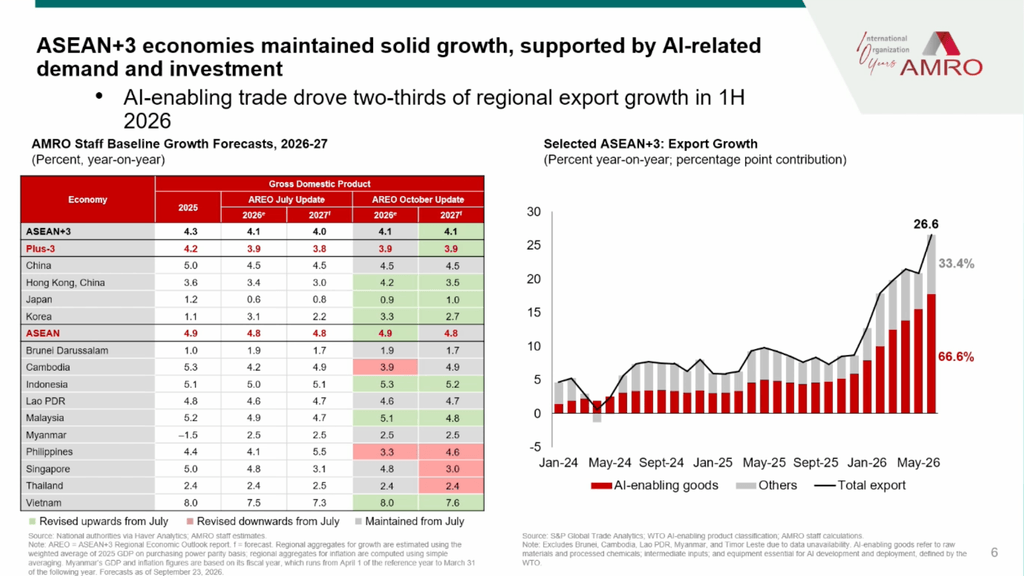
NEW OUTLOOK. The table shows that AMRO has cut the Philippines’ growth outlook for 2026 and 2027. Photo from AMRO briefing.

The October update is yet another downgrade from AMRO’s assessment after its annual consultation with Philippine authorities in August, when it expected growth of 3.4% this year and 4.8% next year. At the time, it already flagged weaker private consumption due to higher prices alongside subdued investment.

In its latest update, AMRO also pointed to persistent high global oil prices and its effect on energy.

“The Philippines is one of the economies that was hit harder by the energy shock,” AMRO chief economist Dong He said during a briefing on Monday, October 5. “Growth did slow down significantly and the inflation went up very quickly.” (READ: DOE sees ‘no signs’ oil prices will fall as excise tax relief goes on table)

But AMRO said the slowdown cannot be blamed on external conditions alone.

“The Philippines also had some domestic issues that they need to deal with. Remember, there was this flood control-related issue, and that’s significantly slowed down public investment,” He said.

“So the growth outlook is very dependent on how fast public investment and construction-related activities can pick up,” he added. 

Must Read

From ghost projects to growth slump, Marcos now faces a spending dilemma


From ghost projects to growth slump, Marcos now faces a spending dilemma

In a July analysis, AMRO said infrastructure projects had been delayed or cancelled following corruption allegations that emerged in mid-2025. It estimated that public construction contracted 31.5% year-on-year in the first quarter of 2026. 

The financial stability report similarly said foreign investors had pulled money out of Philippine equities, reflecting what AMRO said were “investor concerns over the Philippines’ widening current account deficit, delayed infrastructure implementation, and the potential implications for growth and corporate earnings.”

There are still buffers. He pointed to remittances and the country’s IT-BPM industry, while saying the Philippines has clear monetary and fiscal policy frameworks. But he stressed that the recovery would also depend on the quality and pace of government spending.

Authorities should ensure that “public investment, well-governed public investment, can pick up speed,” He said, calling this important for the economy to return to its potential growth rate. 

The World Bank likewise warned that the fallout from the flood control corruption controversy was weighing on the economy through weaker investment. In August, the World Bank said heightened scrutiny and audits of infrastructure projects had delayed spending and made private investors more hesitant, contributing to its decision to cut its 2026 Philippine growth forecast to 3.7% from 5.3%. – Rappler.com

Must Read

Flood control corruption cleanup spooks investors, drags PH growth – World Bank


Flood control corruption cleanup spooks investors, drags PH growth – World Bank

Similar Posts

  • | | |

    New KIA Sportage develops repeated fault within 90…

    Islamabad: A consumer court in Islamabad admitted a complaint against KIA Lucky Motors Corporation and related parties after a customer claimed that his brand new KIA Sportage developed a serious technical fault within days of purchase, rendering it unusable despite repeated inspections and repairs. The complaint has been filed under the Islamabad Consumer Protection Act, 1995, and the court has started regular hearing of the matter after reviewing the initial arguments. According to the complaint, the vehicle developed a “Shifter System Malfunctioning: Service Immediately” warning after covering only around 900 kilometres, causing the vehicle to stop working properly and requiring assistance. The complainant claimed that the same problem appeared again shortly after the first repair, raising concerns about the reliability and safety of a newly purchased vehicle. The case was filed against KIA Lucky Motors Corporation, its officials, the Islamabad dealership and KIA Corporation South Korea. The court issued notices to the concerned respondents for appearance and response. The complaint states that the customer purchased the KIA Sportage for personal and official use with the expectation that a new vehicle would be safe, reliable and free from defects. According to the documents, the vehicle was purchased on 13 February 2026 for Rs11.299 million. The customer alleged that while travelling for an official assignment, the vehicle suddenly displayed the shifter system warning and the gear system stopped functioning properly. He claimed that after reaching his destination, the same issue happened again, forcing him to seek help from the company. According to the complaint, the dealership initially informed the customer that the problem was caused by loose internal wiring. The vehicle was inspected and the customer was assured that the issue had been resolved and the vehicle was safe to drive. However, the customer claimed that the same warning appeared again on 30 May 2026 while he was travelling with his family, leaving the vehicle unusable and forcing him to arrange alternative transport. The complaint further states that the vehicle had to be taken away through a recovery service after attempts to fix the problem failed. The customer has alleged that different explanations were provided regarding the cause of the fault, including wiring issues, moisture concerns and failure of the Shifter Control Module, a key part of the vehicle’s transmission system. The complaint argues that these different explanations created further doubts about the actual cause of the problem and the effectiveness of the repairs carried out by the company. The customer has requested the court to order replacement of the vehicle or refund of the purchase price along with compensation for financial losses, inconvenience and distress. The complaint also mentions that the customer contacted the company through official channels and sent a legal notice, but claimed that the issue was not resolved. The company’s response, according to the complaint documents, acknowledged that a shifter malfunction was reported and that the Shifter Control Module was replaced under warranty after diagnosis. The legal case has brought attention to consumer rights in Pakistan, especially regarding the responsibilities of automobile companies when a newly purchased vehicle develops serious problems. The complainant’s lawyer Munir Ahmad Advocate High Court said the purpose of the case is to seek a fair solution for the customer and ensure consumers receive proper protection when purchasing expensive products. The court will continue hearing the matter after receiving responses from the concerned parties.

  • | | |

    PSX sheds 280 points amid cautious trading

    The Pakistan Stock Exchange (PSX) remained under pressure during Tuesday’s trading session as investors adopted a cautious approach. The benchmark KSE-100 Index opened on a weak note and stayed in negative territory during the first half of the session. By 1pm, the index had dropped 279.65 points, or 0.16%, to 177,982.68 points. It had closed at 178,262.33 points in the previous session. The market witnessed further pressure shortly after opening. At around 9:39am, the KSE-100 fell to 177,914.38 points, losing 347.95 points, or 0.20%. The index later recovered some of its early losses but remained below the previous close. Trading remained volatile during the session. The index reached an intraday high of 179,123 points and a low of 177,903.87 points. Despite the decline in the benchmark index, market activity remained relatively strong. Around 339.48 million shares were traded during the session. The total value of shares traded stood at approximately Rs19.71 billion. Investor sentiment remained subdued as market participants appeared cautious about taking fresh positions. Profit-taking also contributed to the pressure on the benchmark index. The partial recovery from the morning low indicated some buying interest at lower levels. However, it was not enough to push the index back into positive territory by midday. Investors continued to monitor market developments and broader economic indicators for direction. The afternoon session was expected to determine whether the index could recover its losses or close the day in negative territory.

  • |

    Punjab cotton crop in satisfactory shape as rice cultivation surpasses target

    LAHORE: The cotton crop in Punjab is currently showing a generally satisfactory condition, while rice cultivation in the province has exceeded the government’s target by a significant margin, with growers sowing the crop over more than six million acres against the planned five million acres. The latest assessment was shared at a high-level meeting held in Multan on Saturday to review the progress of major standing crops, agricultural extension services and measures aimed at strengthening farming activity across Punjab. The meeting was chaired by Additional Chief Secretary Punjab Iftikhar Ali Sahoo and brought together senior officials from the Agriculture and Irrigation departments, representatives of the farming community and experts from the agricultural sector. Among those attending were Muhammad Nawaz Sharif University of Agriculture Vice Chancellor Professor Dr Asif Ali, Special Secretary Agriculture South Punjab Sarfraz Hussain Magsi, Agriculture Department Directors General Abdul Hameed, Naveed Asmat Kahloon, Dr Aamir Rasool and Dr Sajid-ur-Rehman, as well as Kissan Ittehad President Khalid Mahmood Khokhar, Syed Hassan Raza and Dr Muhammad Iqbal Bandesha. Additional Secretary Task Force Shabbir Ahmed Khan, Director General Crop Reporting Dr Abdul Qayyum and Agriculture Department Consultant Dr Muhammad Anjum Ali participated in the meeting through a video link. Officials briefed the meeting on the condition of major crops and the progress of field-level initiatives designed to assist farmers. Cotton remained a major focus of the discussion because of its importance to Pakistan’s textile-based economy and its contribution to agricultural incomes. The participants were informed that the cotton crop across Punjab was in a satisfactory condition. However, officials stressed the need for continued field monitoring and timely technical support to protect the crop from potential threats during its critical growth stages. Cotton is considered one of Pakistan’s most important cash crops and serves as a major source of raw material for the country’s textile industry. Its performance has a direct bearing on farmers, ginners, textile manufacturers and export-oriented businesses. In recent years, cotton production has faced challenges from changing weather patterns, pest attacks, input costs and competition from alternative crops. Sahoo emphasised that the government was giving priority to agricultural development and the economic well-being of farmers. He directed agriculture officials and field formations to maintain regular contact with growers and ensure that technical advice reached farmers in a timely manner. He said the strategy prepared for the revival and strengthening of cotton cultivation should be implemented in letter and spirit. Officials were also asked to remain active in the field and assist growers in dealing with crop-related issues. Highlighting cotton’s wider economic significance, the additional chief secretary said the country’s economy and textile sector could not be viewed separately from the performance of the cotton crop. He stressed the need for coordinated efforts to improve productivity and strengthen the position of cotton growers. The meeting also reviewed the progress of rice cultivation. According to the officials, rice had already been planted over more than six million acres in Punjab, exceeding the season’s target of five million acres. Sahoo directed agricultural authorities to intensify technical guidance for rice growers, particularly to help them improve productivity, maintain crop quality and adopt better farming practices. He called for greater involvement of regional agricultural forums and professional experts in addressing issues faced by farmers at the local level. Such platforms, he said, should use their technical expertise to help improve agricultural performance and provide practical solutions to growers. The additional chief secretary also appreciated the efforts of Agriculture Department field teams for their role in supporting farmers and monitoring crop conditions across the province. Later, Sahoo visited the Model Agriculture Mall in Multan to inspect arrangements for the provision of agricultural inputs to farmers. During the visit, he reviewed the availability of fertilisers and other essential inputs and sought information from officials regarding stocks and farmer demand. He directed the relevant authorities to ensure uninterrupted availability of fertiliser at the facility so that farmers did not face shortages during the ongoing crop season. Officials said crop conditions would continue to be monitored closely in the coming weeks. With rice cultivation entering the final stages of the transplantation period and cotton moving into an important phase of its growth cycle, timely field intervention and availability of agricultural inputs would remain crucial to determining overall crop performance. The government is expected to maintain its focus on farmer guidance, crop monitoring and input availability as the province moves further into the agricultural season.

Leave a Reply

Your email address will not be published. Required fields are marked *