beyond riba reconstruction

Beyond Riba: Reconstruction of Just Financial Orde…

Pakistan has debated the elimination of riba—a Quranic term subjected to judicial interpretation and theological discourse but still lacking a precise statutory definition—for decades. Judicial decisions have been delivered, commissions constituted, reports prepared, appeals filed and withdrawn, deadlines announced and Islamic banking expanded. The central intellectual and legislative task, however, remains incomplete. We have not developed a precise, comprehensive and operational definition of the economic practices that must be prohibited.

This omission is not merely academic. No financial system can be reconstructed around a prohibition that is expressed only as a moral declaration. A law [Who will draft Riba Prohibition Law? Minute Mirror, April 7, 2026] must identify the transaction, the prohibited increment, the parties affected, the substance to be examined and the consequences of violation. It must also distinguish an unlawful return on money from lawful earnings arising from trade, labour, services, ownership and commercial risk.

The first requirement of a serious programme for the elimination of riba is clarity. Riba is commonly translated as interest/usury. This translation is useful but incomplete. Modern interest is one of its most important manifestations, particularly where a lender advances money and contractually claims an additional amount merely because the borrower is allowed time to repay. The prohibition, however, cannot be confined to instruments carrying the label “interest”. Nor can every commercial gain, deferred price or fixed payment be declared riba.

The distinction lies in the legal and economic substance of the transaction. Where money is advanced as a loan and the lender is guaranteed an increase over the principal, the return does not arise from ownership of a productive asset, provision of a service, participation in business or exposure to commercial loss. It arises from the loan itself and the passage of time. The borrower must pay the increase whether the borrowed funds generate profit, produce loss, meet a medical emergency or finance bare survival.

This asymmetry lies at the heart of the problem. Capital is protected; return is predetermined; risk is shifted to the borrower. Trade operates differently. A trader purchases or produces an asset, assumes the risks of ownership, incurs costs, faces the possibility of loss and sells the asset at a profit. The profit is not earned merely because money has been unavailable to another person for a period. It is connected with property, exchange, enterprise and market risk.

Lease income also rests upon a different foundation. An owner permits another person to use an asset while retaining the liabilities associated with ownership. Rent represents consideration for the use of the asset. The arrangement becomes questionable when the supposed owner bears no meaningful ownership risk and the entire structure is merely a cash loan disguised through documents.

Partnership profit has another character. Partners combine capital, work, expertise or enterprise. Profit is divided according to an agreed formula permitted by the applicable juristic principles, while financial loss follows the capital placed at risk. A partner cannot lawfully guarantee himself a fixed return upon capital and compel the other partner to bear every commercial loss.

These distinctions are recognised, with variations, across the major Muslim schools. They differ on matters such as the permissible relationship between capital contribution and profit-sharing ratios, conditions attached to contracts, possession, agency and the allocation of particular risks. They do not treat every profit as riba. Nor do they permit a partner to convert genuine risk participation into a guaranteed return on money. A modern Prohibition of Riba law must preserve these distinctions.

The difficulty is that contemporary finance has developed techniques through which a loan can be divided into several formally separate contracts. An institution may purchase an asset for a few moments, sell it to the customer at a marked-up price, obtain comprehensive security, transfer every economic risk to the customer and calculate its return by reference to the prevailing interest rate.

The transaction may satisfy documentary requirements while reproducing the economic substance of conventional lending. The institution receives a predetermined return; the customer bears the commercial risk; and the institution’s temporary ownership exists mainly to legitimise the financing charge.

This does not mean that murabaha, ijarah or diminishing musharakah are inherently invalid. Each can serve a legitimate commercial purpose. Murabaha can facilitate an actual purchase where the financier genuinely acquires and assumes responsibility for the asset before selling it. Ijarah can finance the use of an asset where the lessor retains real ownership obligations. Diminishing musharakah can support home ownership where the parties genuinely share ownership and the customer gradually acquires the financier’s units.

The problem arises when these contracts are treated as legal devices for guaranteeing the same return that would have been received under an interest-bearing loan. A workable definition must therefore contain both a formal and a substantive test. The formal test will examine the legal category of the contract.

The substantive test will determine whether the financier has provided an asset, service or productive participation and whether it has assumed a genuine risk corresponding to its return. This test should not be misunderstood as hostility towards fixed prices. A lawful sale price may be fixed. Rent may be determined in advance. A service fee may be agreed. The existence of a fixed amount does not by itself establish riba.

The decisive question is what the payment represents. A fee charged for maintaining an account, transferring funds, valuing property, arranging documentation or providing an identifiable professional service may be legitimate. A “service fee” calculated as a percentage of a loan, increasing with time and unrelated to the actual cost or nature of the service may be interest under another name.

The same care is required in relation to delayed payment. A seller, who supplies goods on deferred payment, may charge a price higher than the immediate cash price, provided one price is finally agreed when the contract is concluded. Once the debt has been created, however, an additional amount cannot ordinarily be imposed merely because the debtor requires more time.

This is where many modern systems institutionalise exploitation. A person who is already unable to pay is burdened with compounding additions. Debt grows without any corresponding asset, service or productive activity. The creditor’s claim expands while the debtor’s capacity to escape diminishes.

Inflation presents a more difficult question. A prolonged decline in the purchasing power of money can cause real injustice to a lender who receives the same nominal sum many years later. Muslim jurists and contemporary scholars have taken different approaches to indexation, currency depreciation and compensation for actual loss.

A modern law should not conceal this complexity. It must distinguish a predetermined real return from a narrowly designed mechanism intended to preserve value in exceptional circumstances. Any indexation rule would require strict statutory safeguards. It should not become an indirect method of guaranteeing profit on every loan.

Public debt must also fall within the definition. The State cannot prohibit riba in private transactions while financing its deficits through instruments that promise banks and investors a predetermined return funded by taxation. Sovereign status does not transform the nature of the transaction. Government borrowing must therefore be included in the reform programme rather than treated as a permanent exception.

The statutory definition should also cover disguised arrangements, including sale-and-buyback structures, artificial commodity transactions, guaranteed investment certificates, compulsory repurchase undertakings and partnerships in which one party is insulated from every commercial loss.

Courts and regulators should be authorised to examine connected contracts as a single transaction. Fragmenting one financing arrangement into multiple documents must not prevent scrutiny of its real economic effect.

At the same time, the law must avoid an overbroad definition that paralyses trade and investment. Profit is not riba. Rent is not riba. Salary is not riba.

A genuine service charge is not riba. Compensation for actual damage is not automatically riba. Equity investment is not riba merely because an investor expects profit.

A financial system cannot function without returns. The Quranic objection is not to earning. It is to unjustified entitlement: a claim to increase that is detached from productive participation, service, ownership responsibility and genuine exposure to commercial consequences.

The proposed law should define riba as any stipulated, guaranteed or contractually enforceable addition over a loan or debt that becomes payable by reason of time, without an independent lawful countervalue in the form of an asset, service or genuine participation in commercial risk.

This formulation would require refinement by jurists, economists, accountants, bankers and legislative drafters. It nevertheless provides a clearer starting point than the simple substitution of Islamic terminology for conventional contracts.

The elimination of riba cannot begin with the closure of banks or cancellation of contracts. It must begin with intellectual honesty.

We must decide what is prohibited, why it is prohibited and how it differs from legitimate economic return. Once this foundation is settled, the next question becomes unavoidable: who should possess the power to create money—society through a sovereign monetary authority, or commercial banks through the expansion of credit? This question will determine whether the proposed transformation redesign of the financial system or remains confined to the language of its contracts.

[To be continued]

_______________________________________________________________________


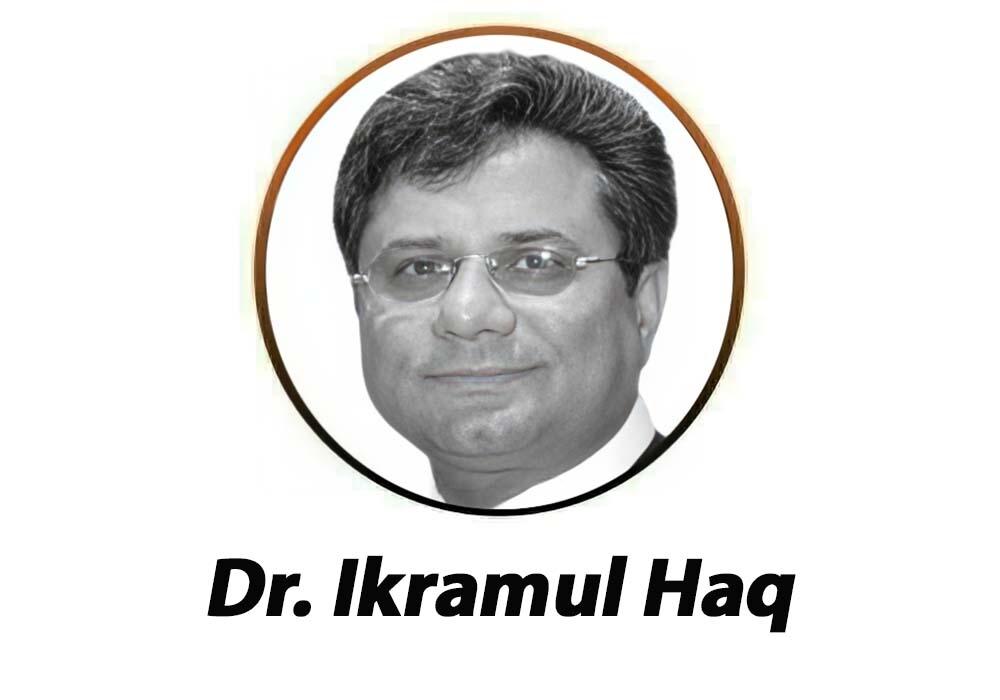
Dr. Ikramul Haq, Advocate Supreme Court, Adjunct Faculty at Lahore University of Management Sciences (LUMS), member Advisory Board and Visiting Senior Fellow of Pakistan Institute of Development Economics (PIDE), holds an LLD in tax laws. He was full-time journalist from 1979 to 1984 with Viewpoint and Dawn. He also served Civil Services of Pakistan from 1984 to 1996.

Similar Posts

  • Road to the East

    Vice President Pakistan-China Joint Chamber In the early 1990, when Chinese Government planned to develop the most modern city of the world at the south eat coast of China, named Shenzhen, the Government named it as the window of the world. In the modern history it is the most advanced, beautiful and well-planned city in the world with its population reaching almost 18 million. Along, Shenzhen GDP is bigger than the GDPs of many countries. Similarly, after the Chairman Xhi announced his initiative to develop for a global trade in the name of Belt and Road Initiative (BRI) which is considered to be the biggest financial project globally. In respect to active this project the initiative of CPEC as a flagship project of BRI was taken. Pakistan with its most sage borders with its neighboring countries China is also the key part of this initiative. Considering my experience to travel to China using a road link was started from the small city of Pakistan name coast. Which is even more than like 200 km from the border of the Khunjarab which leads you to enter to the new window of the world which is starting from the south west of China. Directly you pass the immigration process at Tashgorqan, you will feel the things have been entirely changed. My first inspiration was this city for its cultural background buildings, music, food, that totally fascinated me. I was just in the middle ages where there was a very beautiful city to welcome me with all its cultural strength. The city is even smaller like a country of Kashgar but still you can see the international food chains along with a lot of local delicacies. The ethnic people are mainly Chinese and Tajik origin. This city is similarly famous for the yolk beef. And that was my first feast tried at this city. The visitors of the city were even more than the locals who came from all over China to observe the rich culture of this city. Even I spent there few hours but the fascination, beauty and culture of this city will definitely attract me to visit it again. The roads were wide, clean, infrastructure was excellent, like a combination of an old civilization with modern infrastructure. If a got a chance in the future I would love to stay in this city significantly marking the importance of this city even in the ancient time till today. This was the first settlement as a city I found on my way to the Khunjarab border to tashgorqan. The people were very friendly, beautiful and they showed a lot of love not only fore me but for the all visitors. Such a small city with a rich culture for their dressing, music and traditional dance can fascinate anyone. Kashgar is about 5 hours drive from Tashgorqan. Being the second largest city of Xinjian, this city is I may call a new window of the world. Kashgar city which is normally a called as Kashi by Chinese is an inspiration. This city which was formally very undeveloped like a couple of decades before now have become a center of financial activities under the BRI. With its specific location along with the silk route the locals of Kashi claims that this city have a history to 2000 to 5000 years old. I have never observed a city like Xinjiang with such a remote area and having the ethnic communities for more than 13 including Yugur, dominating Han, Tatar, Tajik, Karghaiz, Mangol and many other are among the most prominent ethnic nationalities living in this city. This diversified this city as a multicultural hub.   China Government is very concerned and they are really developing this area with all the available resources they can inject. Within a decade of time Kashi is now one of the modern cities developing with the gigantic speed and its bordering with the countries like Kirghizstan, Pakistan, Afghanistan, and Tajikistan. With its population increasing ofr more than 6 million people is one of the biggest city in all this region. Yecheng as a county of Xinjiang, is considered to be a window to Tibet all that, who want to start their expedition to Tibet, they have to start from this city name , Yecheng. I got an opportunity to visit his small city which is similarly fascinating, I should appreciate this all areas are culturally being so rich that every building and every road is telling a new story about this city. What attracted me the most that was the food and the dancing culture of this city with some fascinating music. This area is rich for its dry fruits where you can see the most variety of dry fruits in the world. Yecheng is considered to be a capital city of walnuts. Coming back of Kashi which is my topic of the day, everybody can spend hours and hours to have a look at the rich culture. The Government have preserved the buildings and most of them have been converted into historical places mostly are called in the name of Mehman Khana (Hotel). The walled city of Kashgar is one of the top most attraction for any foreigners and mainland Chinese. Now the Kashi economy is mainly based on tourism as the Chairman Xhi announced in his last speech as tourism and health sector would be the main focus of Chinese Government. The streets of Kashi were swarming with the Chinese from all provinces who were eager to learn more about the history and culture of this region.   To be continued..

  • Every Year, Same Old Fight

    Every August, right on schedule, my phone starts buzzing. Friends send me lists. WhatsApp group start heated debates. Neighbours stop me at the corner shop. Someone always has an opinion about who made it onto Pakistan’s civil awards list this year, and someone always has an even louder opinion about who got left off. I have seen this happen so many times now that I could almost set my watch by it. The list comes out, the arguments start, and by the time the dust settles, nobody remembers what the fuss was even about. The award list carries the names which we like the most, and unfortunately, it carries those names, which do not like. I want to tell you something I have come to believe after watching this cycle play out year after year. This debate we keep having, about who deserved a medal and who did not, is about as useful as arguing over which cloud looks more like a rabbit. It never ends, and it never really goes anywhere either. People pick their favourites, defend them like family, and forget the whole point of what an award is supposed to mean in the first place. Here is the real point, plain and simple. An award is not a popularity contest. It is not a reward for showing up. It is meant for something extraordinary. Something exceptional. A person who did work so far above the ordinary that the state felt it had to stand up and say thank you in front of everybody. Now here is where the story gets interesting, and honestly, a little strange. An economist named Zehra Farooq sat down and did something most of us never bother to do. She pulled together every single civil award given out over nine years, all 2,209 of them, and looked at the pattern. What she found should stop us all in our tracks. Back in 2018, only 73 people received awards. By 2026, that number had climbed to 372. That is five times as many people being called extraordinary in less than a decade. Think about what that actually means. If we are handing out that many more awards for exceptional service, it should follow that we have more and more exceptional people walking among us. Teachers going beyond the call. Officers solving problems nobody else could touch. Scientists, engineers, public servants, all rising to meet the moment. That is what a growing list of honourees is supposed to tell us. But here is the part that keeps me up at night. If we truly have this many extraordinary minds working for the good of the country, why does the country not feel more extraordinary? Why do our institutions still creak and groan the way they always have? Why does public service still feel, for so many ordinary citizens, like an uphill climb rather than a smooth road paved by all this supposed excellence? Something does not add up. Either the definition of extraordinary has quietly loosened over the years, or the excellence being honoured is not translating into the everyday experience of the people it is meant to serve. Farooq’s numbers also show something else worth sitting with. Women still make up only around ten to sixteen percent of recipients, a share that has barely moved in nine years, and their share shrinks even further at the highest levels of honour. So the next time the list comes out and the arguments start flying, I hope we can steer the conversation somewhere more useful. Instead of fighting over names, let us ask why the growth in awards has not translated into a more exemplary, more ideal society. That is the debate worth having. That is the one that might actually change something.

  • No to the Division of Punjab

    Once again, the debate over the creation of new provinces has surfaced in Pakistan. In every political era, the issue is revived in one form or another. This time, however, there appears to be a growing push for creating additional provinces out of almost every major province in the country. The strongest argument being put forward is that Pakistan’s population was around 70 million in 1972, whereas it has now grown to more than three times that figure. Therefore, it is argued, new provinces have become necessary for administrative convenience. At first glance, this argument may sound convincing. But the real question is: can all of Pakistan’s problems be solved simply by creating new provinces? If population growth alone is a sufficient reason for creating new provinces, then why have all major countries in the world not followed the same path? The real issue is not the number of provinces but the quality of governance, equitable distribution of resources, an empowered local government system, transparent accountability and an effective administrative structure. When the basic system is weak, changing the map does not make the problems disappear. What is particularly concerning is that Punjab appears to be the main target of this debate. At different times, proposals have emerged for a separate South Punjab, Central Punjab and even further divisions. It seems that with every political season, Punjab becomes the centre of the debate over provincial division. This has understandably created a feeling among many Punjabis that the issue may not be merely about administrative reform, but could also weaken Punjab’s historical, cultural and political identity. Punjab is not merely another province. It is one of the strong pillars of Pakistan’s ideological, historical and economic foundations. The land played an important role in the Pakistan Movement, made enormous sacrifices for the defence of the country, strengthened Pakistan’s agriculture and industry, and has always played a key role in the national economy. Repeatedly dragging such a province into a debate over division is neither appropriate nor in the national interest. Those advocating new provinces speak extensively about administrative convenience, but remain largely silent about the financial consequences. Has anyone explained to the public that every new province would require a new governor, chief minister, cabinet, provincial assembly, speaker, deputy speaker, secretariat and numerous government departments? There would also be hundreds of new government positions, official residences, vehicle fleets, security arrangements, protocol and countless other administrative expenses. All of this would require billions of rupees. And ultimately, that money would not come from some separate source. It would come from the taxpayers and the public exchequer. Pakistan is already facing one of the most serious economic challenges in its history. The burden of domestic and external debt remains enormous, while a substantial portion of the national budget is spent every year on debt servicing and interest payments. The country continues to rely on programmes supported by the IMF and other international financial institutions, while ordinary citizens struggle with inflation, unemployment and rising electricity, gas and petrol prices. In such circumstances, would creating new provinces and expanding the size of the ruling and administrative machinery really be an act of national wisdom? Or would it simply place another burden on already stretched national resources? If the genuine objective is to serve the people, the existing system should first be made more effective. Local governments must be empowered, district administrations should be given adequate financial and administrative authority, bureaucratic reforms should be introduced, corruption must be tackled and the equitable distribution of resources must be ensured. If the existing system is not functioning to its full potential, how can simply drawing new boundaries across the map transform the lives of ordinary citizens? The issue of dividing Punjab is not merely administrative. It is also a question of identity. Punjab’s language, culture and heritage have already not received the level of official patronage and protection they deserve. If the geographical unity of Punjab is repeatedly subjected to calls for division, it could further weaken its cultural and historical identity. There is another important question: if population is to be the basis for creating new provinces, why should the same principle not be applied uniformly across the country? Will this criterion apply equally to every province, or is Punjab being singled out? National decisions should not be driven by political expediency. They should be based on constitutional requirements, the national interest and broad public consensus. In my view, Pakistan needs a new economic vision, stronger institutions, a fairer system of justice, quality education, better healthcare, greater employment opportunities and effective local governments far more urgently than it needs new provinces. People do not want more rulers; they want better governance. They do not need more official protocol; they need affordable food, quality healthcare, good education and decent employment. As a Pakistani, a journalist and a Punjabi, I believe that dividing Punjab is not in the national interest. Its unity, historical importance and cultural identity should be protected. If we genuinely want to strengthen Pakistan, we should strengthen the system rather than divide provinces, improve governance rather than expand administrative structures, and reduce the problems faced by ordinary citizens instead of placing an additional financial burden on them. The division of Punjab is, in my view, unacceptable. A strong Punjab contributes to a strong Pakistan, and a strong Pakistan should be our shared destination.

  • Gujrat: The Height of the Akbari Fort and the Trag…

    When rain descends from the folds of clouds, it assumes the form of divine mercy for the earth—reviving parched soil and spreading smiles across the weary faces of farmers. Yet, when this very rain turns unbridled and the administrative apparatus built to welcome it pulls a heavy shroud of negligence over its eyes, this descent of mercy transforms into a harrowing shape of torment and sudden calamity. Gujrat, a historic and industrial city of Punjab that holds a unique global identity through its civilizational expanse, skilled artisans, and proximity to the Chenab River, presents the terrifying spectacle of a pond and a swamp every monsoon season. Here, urban flooding is no longer merely a climatic accident; rather, it has become a chilling confession of administrative apathy, unscientific planning, and a criminal denial of historical geographical realities. When the hydrological management of cities is evaluated on a global scale, the concepts of “Sponge Cities” are put into practice, but our reality stands in stark opposition. When the state of urban drainage in Gujrat is objectively reviewed through the corridors of history, one’s eyes are opened to the bitter truth that the rulers and elements who dominated this city consciously hollowed out its roots at every level for the gratification of greed. The city’s drainage and sewerage system, in particular, fell prey to the plunder of commission agents belonging to the corruption mafia. It is an immensely agonizing chapter of history that two decades ago, when a renowned international Japanese company completed a detailed survey of Gujrat, officially announced its complete reconstruction on modern lines, and promised a world-class drainage system, the hungry brokers sitting in the echelons of power burnt this magnificent project in the fire of personal lust. The people of Gujrat can never forget the actors who sacrificed the Japanese company’s dream at the altar of kickbacks. Later, when times changed and Chaudhry Pervaiz Elahi assumed the helm of this region as Chief Minister, he released heavy, voluminous funds amounting to billions of rupees to radically improve and modernize Gujrat’s decrepit and worn-out drainage system. Yet the tragedy was that these billions of rupees in Gujrat’s history remained restricted to a few specific and powerful pockets, and to openly divide these funds, the entire system was mortgaged to a fostered contractor mafia. With an exceptionally substandard, superficial, and unprofessional approach, this mafia played a game of window-dressing that instead of fixing Gujrat’s sewerage system, ruined it permanently and turned the entire city into an artificial swamp. Today, the agony of drainage dancing through the city’s streets and roads offers no hope of deliverance from this terrifying urban flood unless a severe accountability of these true, deceitful culprits is carried out. The political leadership that followed also made efforts suited to their respective statures for the betterment of the city; and although their own technical errors consistently hampered this improvement, every resident of Gujrat continues to carry the heavy burden of those primary sinners who devastated Gujrat’s history, civilization, and urbanity. Last year, when urban flooding once again descended upon the city as a mortal torment, uproar echoed everywhere, the wheel of life halted, and the situation reached a point where the Chief Minister of Punjab had to personally make an emergency visit to Gujrat to rescue the district administration from this storm of incompetence. During this visit, a heavy downpour of announcements and promises took place, accompanied by the release of special funds worth billions for complete and sustainable improvement next year. Despite the sincere efforts and financial provisions of Honorable Maryam Nawaz Sharif, the district administration—entrenched in a colonial mindset—spent all its energies throughout the year on personal image-building and photo sessions rather than the timely completion of this vital sewerage project. As ill luck would have it, as soon as the monsoon season arrived once again this year, the colorful balloon of good governance and claims deflated entirely, exposing the bitter reality that this malaise of flawed planning persists and rainwater continues to rain down as a torment upon citizens’ lives. And when this rainwater has already devastated citizens’ lives, wounding their homes and businesses, only then do the traditional efforts of WASA and district institutions begin to bear fruit, with water finally receding from the streets after prolonged suffering. Success drums are then beaten over this very temporary performance, adding salt to the injuries of the citizens. A profound study of Gujrat’s urban geography reveals that its foundations and topography are deeply embedded in its centuries-old historical backdrop. Built during the Mughal era, the Akbari Fort serves as the greatest metaphor for the region’s military, political, and administrative history. Viewed from a geographical and topographical standpoint, the Akbari Fort is situated on a relatively high mound or plateau, and the city’s older structural layout spreads outward from this height in gradual slopes in all directions. Principally and naturally, this elevation of the fort and the surrounding natural slopes should have stood as an exceptional geographical blessing for a drainage system—provided the natural pathways of water flow had been preserved and left unmolested by grotesque tampering. The tragedy, however, is that over time, unbridled urban expansion and a flood of encroachments mutilated this natural sloping system so ruthlessly that today, that very height and slope have turned into a bane for the city. Unchecked commercialization and illegal constructions in and around the Akbari Fort and its adjoining low-lying areas have blocked all traditional water routes in such a manner that water finds no outlet. The consequence is that when rainwater flows down from the elevated parts of the fort, instead of finding an open path or paved drain ahead, it encounters dead alleys, narrow sewage pipelines, and an endless siege of encroachments. Consequently, this water accumulates in lower regions to form a permanent lake, leaving city residents weeping over their helplessness. Gujrat’s tragedy is not merely the accumulation of rainwater; it is a reflection of that collective apathy and corruption which wakes up with the arrival

  • Regulating DeFi Risk

    The development of decentralized finance represents a material reconfiguration of financial intermediation rather than a peripheral experiment in virtual assets. DeFi enables trading, lending, borrowing, liquidity provision and asset management through blockchain based smart contracts, with continuous availability, programmable execution, global accessibility and reduced dependence on conventional intermediaries. The FATF records total value locked at USD 86.644 billion in 2026, approximately 85 percent above the 2023 level, while institutional investors, virtual asset service providers and regulated entities are increasingly committing capital to DeFi arrangements. This track suggests that DeFi will not simply compete with traditional finance, but will progressively intersect with it through tokenized assets, settlement, payments, liquidity and market infrastructure. The policy significance of that convergence lies in the need to preserve innovation without permitting functional substitutes for regulated finance to escape equivalent safeguards. Traditional finance provides legal accountability, prudential discipline, customer identification and institutional channels for enforcement, while DeFi contributes automation, composability, transparency of public ledger transactions, broader access and rapid settlement. The future architecture is therefore likely to be hybrid: regulated institutions will use decentralized infrastructure where it produces efficiency, whereas supervisors will require comparable financial integrity outcomes whenever equivalent financial functions are performed. FATF, the Financial Stability Board, IOSCO and the IMF converge on a technology neutral and function oriented conception under which substance, activity, control and risk prevail over labels or technological form. The July 2026 FATF Targeted Report is consequently best understood as an implementation instrument that updates the 2021 Guidance in light of DeFi’s expansion. Its scope is to identify emerging money laundering, terrorist financing and proliferation financing risks, clarify when the FATF Standards apply. It also provide practical tools for identification, regulation, supervision and investigation, develop criteria for identifying controllers or persons exercising sufficient influence, and recommend measures for public and private actors. The report is expressly non-binding, but its analytical significance is substantial because it translates Recommendation 15 into a functional supervisory methodology for a market whose legal form, governance and territorial nexus are frequently indeterminate. The defining characteristics of DeFi create both utility and vulnerability. Similarly, smart contract automation removes many conventional execution functions, open source and composable architecture permit rapid replication and interaction among protocols, algorithmic market mechanisms automate liquidity, pricing and liquidation, pseudonymous liquidity provision permits participation without conventional identification, permissionless access may eliminate customer due diligence, and reliance on oracles imports external data into automated decisions. These characteristics permit rapid and complex movement of value but also allow illicit proceeds to be layered through liquidity pools, decentralized exchanges, bridges, swaps and multiple chains before supervisory or enforcement systems can react. The regulatory fragmentation, weak compliance, cyber vulnerabilities and diminishing dependence upon regulated entry and exit points further aggravate supervisory difficulty. The applicable legal framework begins with technological neutrality. The recommendation 15 applies where a natural or legal person, as a business, conducts or actively facilitates activities falling within the VASP definition. The software itself is not regulated merely because it executes a financial function, but persons exercising control or sufficient influence over a DeFi arrangement may fall within the regulatory perimeter. FATF differentiates centralized arrangements with identifiable controllers, centralized arrangements in which control exists but controllers are difficult to identify, and truly decentralized arrangements in which no person maintains control or sufficient influence. The first two categories fall within the Standards, the third falls outside direct application, although it remains subject to alternative risk mitigation through adjacent regulated actors. The principal implementation deficit is therefore institutional rather than conceptual. FATF’s 2026 survey found that only 26 of 142 responding jurisdictions had assessed DeFi risks, 132 had not identified qualifying DeFi arrangements operating in their territory, only four had implemented licensing or registration requirements, and only two had licensed or registered such arrangements. The resulting supervisory gap facilitates regulatory arbitrage and demonstrates why national authorities must integrate DeFi into national, sectoral or virtual asset risk assessments, calibrated to materiality, domestic exposure, cross border activity, governance structures and actual financial crime threats. The financial crime typologies identified by FATF demonstrate that DeFi risk is not confined to speculative misconduct. The fraudsters have used purported DeFi structures to misrepresent liquidity and divert investor assets, professional money laundering networks fragment funds across wallets and then use decentralized exchanges, bridges, mixers, swaps and chain hopping to obscure provenance, ransomware groups and hackers use DeFi immediately after compromise to convert and disperse proceeds, and proliferation financing actors have exploited governance weaknesses, oracles, bridges and limited compliance environments. The policy concern is intensified by speed: automated movement can complete layering before authorities, intermediaries or analytics providers can identify the event, establish attribution and initiate restraint. The decisive supervisory question is the identification of control or sufficient influence. FATF treats control as the practical ability to determine or materially influence key operations, service delivery or economic benefits. The relevant indicators include authority to modify or pause smart contracts, alter protocol parameters, control oracles, administer treasury assets, determine participation, appoint key actors, receive material fee flows, control governance votes, operate public interfaces, manage corporate entities, determine development priorities, control essential infrastructure, or direct branding and communications. No single indicator is conclusive. Additionally, authorities should combine public blockchain evidence, governance records, audits, service provider information, financial intelligence and investigative material, and should assess economic reality rather than formal claims of decentralization. The assessment of control must remain continuous because governance can migrate from a company or foundation to a decentralized autonomous organization without relinquishing substantive authority. The concentrated governance tokens, delegated voting blocs, special proposal rights, veto powers, administrative keys, clustered wallets and continuing receipt of protocol revenues may disclose retained control. On the contrary, a genuinely decentralized arrangement, after independent assessment, falls outside direct FATF obligations because no accountable person can be identified. That conclusion does not equate to absence of risk. The authorities should instead influence stablecoin issuers, regulated VASPs, financial institutions and controlled application interfaces, whereas encouraging digital identity, embedded customer due diligence and blockchain analytics within genuinely decentralized environments. The licensing and

  • Triple alliance and the regional situation

    The effects of the defence agreement between Pakistan and Saudi Arabia were witnessed by the entire world during the recent US-Iran-Israel war. At the same time, there was continuous speculation about whether the scope of this defence agreement could be expanded in the coming days. For years, the defence of major Middle Eastern countries has largely depended on the United States. However, during the recent conflict, the US appeared unable to fully protect either these countries or even some of its own military bases in the region. When Iran attacked Saudi Arabia, Pakistan immediately issued a strong warning, stating that if Iran wanted to protect its own territorial integrity, it should avoid any aggression against Saudi Arabia; otherwise, Pakistan would honour its defence commitments. Soon afterwards, the world witnessed a different situation in areas where Pakistani forces were present. While attacks continued in various parts of the region, areas protected by Pakistani forces experienced a markedly different security environment. Against this backdrop, international newspapers began suggesting that the United States’ influence in the Middle East could be entering a period of decline. As the poet famously said: “Insha Ji, get up and leave now; What is the point of becoming attached to this city?” The peace talks between Iran and the United States, hosted by Pakistan and referred to as the “Islamabad Accord”, created further diplomatic momentum. Shortly after the first meeting, discussions surrounding the Pakistan-Saudi defence agreement began attracting global attention. Influenced by these developments, other countries in the region also started exploring the possibility of joining or cooperating with the defence arrangement. Pakistan is the world’s only nuclear-armed Muslim-majority country. Saudi Arabia is one of the world’s most influential oil-producing states and holds immense religious significance for Muslims worldwide. Türkiye, meanwhile, has established a strong reputation for its drone technology and non-nuclear missile capabilities. The combination of these three countries could have significant strategic consequences for the region. Their growing defence cooperation is unlikely to be viewed favourably by either the United States or Israel. Even before the reported expansion of the defence arrangement, statements from the United States and Israel indicated growing concern. The role of American military bases and radar systems located in several Muslim-majority countries has also come under greater scrutiny, particularly over their alleged role in supporting Israel during the conflict. One US think tank reportedly described the emerging regional landscape as involving two major blocs: a Sunni alliance and a Shia alliance, with Israel and the United States potentially prepared to confront both. Such assessments could be interpreted as an indication of changing strategic dynamics and a possible reduction in American and Israeli influence across parts of the region. As mentioned earlier, several other countries are reportedly watching the development of the Pakistan-Saudi defence partnership closely. Egypt is also said to have participated in preliminary discussions, and its potential inclusion in the future cannot be ruled out. If Egypt joins the arrangement, the strategic balance could become even more significant. Egypt controls the Suez Canal, one of the world’s most important maritime trade routes on which a substantial portion of global commerce depends. It also possesses one of the region’s strongest naval forces and a large fleet of military aircraft. Access to Egyptian territory and strategic waterways could therefore have major implications for the Middle East, Israel and Europe. With Pakistan, Saudi Arabia, Türkiye and potentially Egypt forming a broader strategic group, the combined military capabilities of these countries, supported by Saudi Arabia’s enormous energy resources and financial strength, could create a formidable regional bloc. This is one reason why the emerging defence arrangement is increasingly being compared with Article 5 of the NATO treaty. Under Article 5, an armed attack against one NATO member is considered an attack against all members, triggering a collective commitment to assist the country under attack. NATO invoked Article 5 for the first and only time in its history following the terrorist attacks against the United States on September 11, 2001. In the coming days, countries such as Egypt, Bangladesh, Kuwait and Jordan could potentially become part of broader defence cooperation, although their formal participation would depend on future diplomatic and strategic decisions. At present, Israel, the United States, India and Iran all appear to have concerns about the potential consequences of such an alliance. However, the coming months will reveal its actual structure, scope and strategic impact on the region.

Leave a Reply

Your email address will not be published. Required fields are marked *