कारोबार

  • |

    Government raises petrol price by Rs4.45, cuts diesel by Rs2

    The federal government has announced a fresh revision in petroleum prices, increasing the cost of petrol while providing a slight reduction in the price of high-speed diesel. According to a notification issued by the Petroleum Division, the revised fuel prices came into effect on August 6 as part of the government’s regular fortnightly price adjustment mechanism, which is based on fluctuations in international oil markets and the exchange rate. Under the latest revision, the price of petrol has been increased by Rs4.45 per litre, taking the new retail price to Rs333.10 per litre. In contrast, the price of high-speed diesel (HSD) has been reduced by Rs2.00 per litre, bringing its new retail price down to Rs383.86 per litre. The increase in petrol prices is expected to affect millions of private vehicle owners, motorcycle riders and commuters across the country, as petrol is the primary fuel used in passenger transport. Meanwhile, the modest reduction in diesel prices may provide limited relief to the transport and agriculture sectors, where diesel is widely used for heavy vehicles, machinery and irrigation equipment. Petroleum prices in Pakistan are reviewed every two weeks, with adjustments reflecting movements in global crude oil prices, refined petroleum product premiums, freight costs and the rupee-dollar exchange rate. The government says the pricing mechanism is intended to align domestic fuel rates with international market trends while meeting fiscal commitments. The latest adjustment comes at a time when international oil markets remain volatile amid geopolitical developments and shifting global supply expectations. Analysts believe future fuel prices will continue to depend on global crude oil trends and currency movements.

  • |

    Pakistan’s exports post strong growth at start of FY2026-27, rising over 31% in July

    Pakistan recorded a strong increase in exports at the start of the new fiscal year, providing a positive signal for the country’s external trade performance despite continued regional uncertainty and global economic challenges. According to the latest trade data released by the Pakistan Bureau of Statistics (PBS), the country’s exports witnessed a sharp month-on-month increase during July 2026, reflecting improved demand for Pakistani products in international markets and stronger export activity across key sectors. The official figures show that exports reached $2.939 billion in July 2026, compared with $2.242 billion in June 2026, representing a 31.09% increase on a monthly basis. The substantial rise marks a promising beginning to the fiscal year 2026-27 and is being viewed as an encouraging development for the country’s economy. On a year-on-year basis, exports also recorded healthy growth. Compared with July of the previous year, Pakistan’s exports increased by 9.54%, indicating sustained improvement in export performance despite geopolitical tensions and volatility in international markets. Economic observers believe the rise in exports reflects the impact of government efforts to support exporters, improve industrial production, and expand access to international markets. Higher shipments from sectors such as textiles, food products, leather goods, sports equipment, surgical instruments, and information technology services are expected to have contributed to the overall increase. The latest trade figures are likely to strengthen the government’s confidence in its export-led growth strategy, which aims to reduce the trade deficit, improve foreign exchange earnings, and support macroeconomic stability. However, analysts caution that maintaining this momentum will require continued policy support, competitive energy prices, stable exchange rate management, and greater diversification of export products and destinations.

  • | |

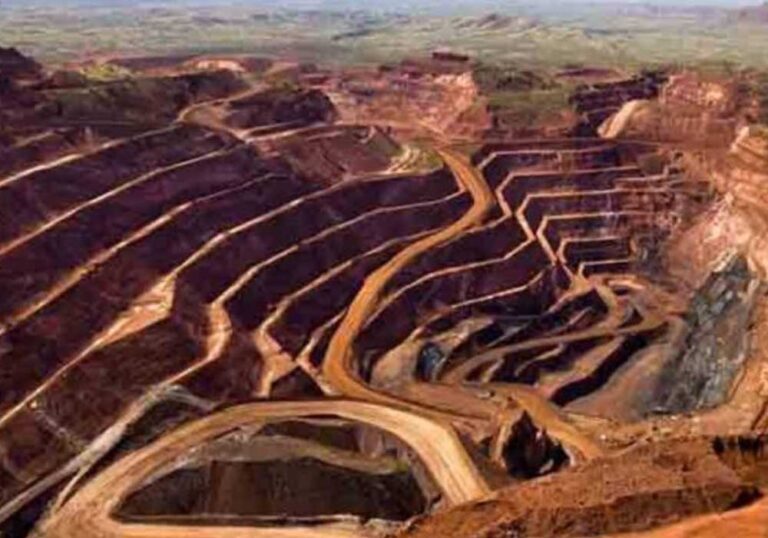
    Another Reko Diq-Sized mining project in Pakistan,…

    ISLAMABAD: The United States has expressed strong confidence in Pakistan’s mineral sector, with a senior US Embassy official revealing that the Trump administration is prepared to support another mega mining project on the scale of  to invest in Pakistan despite security concerns, viewing the country’s vast mineral wealth as strategically important for future global industries. During a background briefing with journalists on Wednesday, the embassy official said Washington considers Pakistan a key partner in the global race for critical minerals that are essential for advanced technologies, clean energy, artificial intelligence, semiconductors and defence manufacturing. According to the official, the US government is encouraging American investors to explore Pakistan’s untapped mineral resources, ranging from large-scale copper and gold projects to smaller mining ventures worth only a few million dollars. US Prepared to Finance Another Mega Project The official said the US administration is ready to support another project comparable to the multibillion-dollar Reko Diq development if geological surveys and feasibility studies demonstrate strong commercial potential. He added that financing support could be extended through US institutions such as the Export-Import (Exim) Bank and the Development Finance Corporation, both of which are playing a growing role in securing global supply chains for critical minerals. The official noted that American companies are not only interested in major mining investments but are also examining opportunities to acquire, develop and expand smaller mining operations across Pakistan. Reko Diq Progress Continues Despite Delays Discussing the Reko Diq copper and gold project, the official acknowledged that work is progressing, although at a slower pace than initially anticipated. He explained that project costs are currently being reassessed, after which developers will return to financiers to finalize the remaining funding package. The first phase of the Reko Diq project is estimated to cost around $7.7 billion, while the US Exim Bank has already offered $1.25 billion in financing. However, the overall financial structure remains under discussion. The project has experienced delays due to rising construction costs and security concerns in Balochistan, prompting project stakeholders to revise cost estimates more than once. Earlier this year, Barrick Gold, which owns a 50 percent stake in the project, also reviewed development timelines because of increasing costs and security-related challenges. Major Economic Benefits Expected The embassy official said Reko Diq has the potential to transform Pakistan’s economy once it becomes fully operational. According to the estimates shared during the briefing, the project could generate nearly $2 billion in annual free cash flow. Of this amount, around $500 million would go directly to the Government of Balochistan, while another $500 million would benefit Pakistan’s state-owned enterprises. The official further stated that Pakistan’s mining sector currently contributes roughly 3 percent to the country’s economy, while Reko Diq alone could increase national GDP by approximately 0.5 percentage points, highlighting its significance for long-term economic growth. Critical Minerals Becoming Strategic Priority The US official emphasized that critical minerals have become a top strategic priority for Washington as demand continues to rise across technology, renewable energy and defence sectors. Pakistan possesses commercially attractive reserves of copper, antimony, tungsten and several other minerals considered essential for future industries. He said American companies believe Pakistan has enormous untapped potential, particularly as global demand for copper is expected to rise sharply over the coming decades. The official added that US firms are actively seeking long-term supply agreements for minerals extracted from Pakistani mines, while some investors are interested in purchasing and developing smaller mining assets. Investment Opportunities Across Pakistan Besides Balochistan, American investors are also exploring mineral opportunities in Khyber-Pakhtunkhwa, particularly for copper deposits, while rare earth mineral prospects in Gilgit-Baltistan have also attracted attention. The official said the United States is searching globally for around 60 critical minerals needed for emerging technologies, many of which are found in Pakistan. He noted that several companies have already begun exploration and extraction activities in different regions of the country. Security Remains the Biggest Challenge Despite strong investment interest, the official acknowledged that security remains one of the most significant obstacles facing mining projects in Pakistan. He said US companies fully understand the risks associated with operating in regions such as Balochistan and Khyber-Pakhtunkhwa but remain willing to invest if appropriate security arrangements are provided. The official stressed that the Pakistani government should continue strengthening security measures and facilitating investors to ensure long-term success of mining projects. He added that American companies are encouraged to partner with local firms, which possess valuable experience in navigating operational and security challenges in remote mining areas. US Calls for Transparent Investment Environment The embassy official also urged Pakistan to maintain a transparent, predictable and competitive investment climate to attract greater foreign investment into the mineral sector. He noted that Pakistan’s participation in the US Critical Minerals Initiative earlier this year reflects growing cooperation between the two countries in securing future mineral supply chains. According to the official, if exploration and investment continue at the current pace, Pakistan’s mining industry could emerge as one of the country’s strongest economic sectors over the next 10 to 20 years, creating employment, increasing exports and significantly boosting national revenues.

  • |

    Pakistan’s trade deficit surges 25% to nearly $4 billion in July 

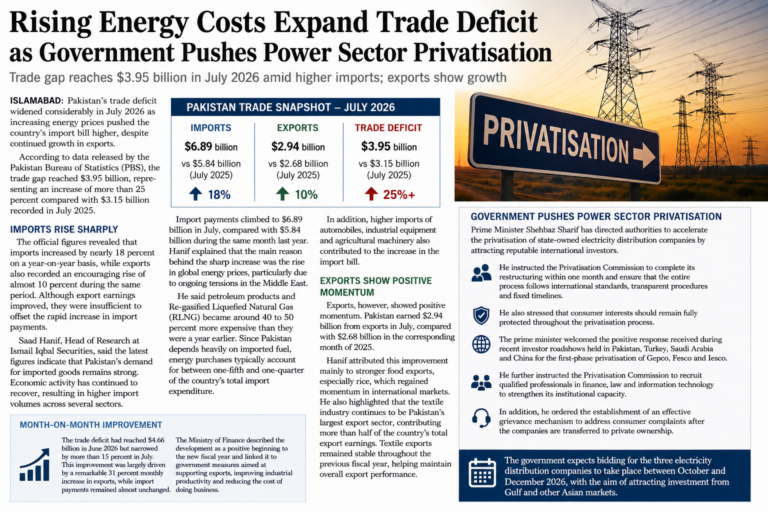
    ISLAMABAD: Pakistan’s trade deficit expanded sharply during the first month of the new fiscal year, reaching nearly $4 billion in July, as a strong rise in imports continued to outpace export growth, highlighting persistent weaknesses in the country’s external sector despite a series of incentives announced for exporters. According to the latest figures released by the Pakistan Bureau of Statistics (PBS), the country’s trade deficit widened to $3.95 billion in July 2026, compared to $3.16 billion recorded during the same month last year. The deficit increased by approximately $794 million, representing an annual rise of 25.2%. The widening gap was primarily driven by a substantial increase in imports, which climbed to $6.9 billion from $5.8 billion in July 2025. This reflects an increase of more than $1 billion, or 18% year-on-year, indicating stronger demand for imported goods and raw materials. Exports Show Growth but Remain Below Key Milestone While Pakistan’s exports registered positive growth, they once again failed to cross the important $3 billion monthly mark. Exports reached $2.94 billion, falling short of the milestone by around $61 million. On an annual basis, exports increased by 9.5%, adding nearly $256 million compared to July last year. Although the improvement reflects steady recovery in overseas shipments, analysts believe the pace remains insufficient to counter the rapid expansion in imports. Exports had crossed the $3 billion threshold in January 2026, touching approximately $3.05 billion, but the country has been unable to maintain that level in the months that followed. Tariff Reforms Under Scrutiny The latest trade figures have renewed debate over Pakistan’s tariff liberalisation policy, introduced under broader economic reforms supported by international financial institutions, including the World Bank and the International Monetary Fund (IMF). The government has gradually lowered tariff barriers to increase competition and integrate Pakistan more closely into global markets. However, economists argue that the economy was opened before domestic industries were provided with sufficient support to compete effectively. Business leaders have repeatedly pointed out that exporters continue to face high energy prices, elevated financing costs, tax-related uncertainties and exchange rate volatility, all of which reduce their competitiveness in international markets. Earlier projections by the World Bank had suggested that tariff reforms would increase exports by 14% while limiting import growth to around 7%. However, the latest figures suggest imports have grown much faster than anticipated, while export gains have remained comparatively modest. Government Rolls Out Fresh Export Incentives To strengthen export performance, the federal government has announced a series of financial support measures during the current fiscal year. In the federal budget, Prime Minister Shehbaz Sharif reduced the minimum and advance tax on exporters to 1.25% and abolished the 10% super tax on export earnings in an effort to improve liquidity and encourage investment in export-oriented industries. More recently, the government approved a Rs98 billion export support package aimed at improving competitiveness and increasing foreign exchange earnings. Under the revised Export Finance Scheme (E-EFS), exporters will be able to obtain six-month working capital loans at an interest rate of 8.5%, with the government absorbing 5 percentage points of the financing cost. The subsidy for this component alone is estimated at Rs58 billion during the current fiscal year. ECC Approves New Financing Facilities The Economic Coordination Committee (ECC) has also expanded access to concessional financing by increasing the ceiling of the existing short-term financing portfolio from Rs1 trillion to Rs1.5 trillion. In addition, the committee approved the launch of a new Long-Term Growth Financing Facility, allowing exporters to access loans at an interest rate of 2% for the first two years, followed by a fixed 5% rate for the subsequent eight years. The government has also introduced a performance-based rebate scheme, effective from July 1, 2026, with an estimated annual allocation of Rs15 billion. Under the programme, exporters recording annual export growth of up to 10% over the previous year will receive a rebate equal to 1% of the incremental export value, while exporters achieving growth exceeding 10% will qualify for a 2% rebate on additional exports. Long-Term Challenges Persist Despite successive incentive packages introduced over several decades, Pakistan continues to struggle with achieving sustained export-led growth. Industry observers note that no single Pakistani exporter has generated $1 billion in annual export earnings, underscoring the structural challenges facing the country’s export sector. These challenges include limited product diversification, low industrial productivity, rising production costs, inconsistent policy implementation and insufficient value addition. Monthly Performance Offers Some Relief On a month-on-month basis, the trade data presented a more encouraging picture. Exports increased by 31% in July compared to June, rising by approximately $697 million, while imports remained largely unchanged at around $6.9 billion. As a result, the monthly trade deficit narrowed by nearly 15%, or around $709 million, compared with the previous month.

  • |

    Oil prices edge lower as hopes rise for possible US-Iran agreement

    LONDON: Global oil prices slipped modestly on Thursday as optimism over a possible agreement between the United States and Iran eased concerns about potential supply disruptions in the Middle East, prompting investors to scale back risk premiums in the energy market. According to Reuters, market sentiment improved after reports of continued diplomatic engagement involving Iran and Oman, raising expectations that negotiations between Washington and Tehran could lead to a breakthrough. Traders believe any progress towards an agreement could help reduce regional tensions and improve the outlook for global oil supplies. Brent crude futures declined by 37 cents, or 0.5 per cent, to $79.08 per barrel, while US West Texas Intermediate (WTI) crude fell 53 cents, or 0.7 per cent, to $74.69 per barrel during early trading. The latest decline followed a modest gain in Brent crude during the previous trading session, reflecting continued uncertainty in global energy markets as investors closely monitor diplomatic developments and geopolitical risks. Market analysts said that hopes of a diplomatic settlement between the United States and Iran have encouraged traders to anticipate a more stable supply environment. A successful agreement could help resolve months of heightened tensions and reduce the risk of disruptions to oil exports from the Gulf region. Investors are also watching developments around the Strait of Hormuz, one of the world’s busiest oil shipping routes. Any easing of regional tensions is expected to improve the security of maritime trade and ensure the uninterrupted movement of crude oil, a factor that could put additional downward pressure on prices.

  • United States Swims in Natural Gas While Global Markets Gasp for Supply

    TEXAS – The global energy market has split into two very different worlds this year. While the conflict involving Iran has choked off crucial natural gas supplies to Europe and Asia, the United States is dealing with the exact opposite problem. America is producing far more natural gas than it can use right now. A […]

  • | | |

    Rising energy costs expand trade deficit

      Pakistan’s trade deficit widened considerably in July 2026 as increasing energy prices pushed the country’s import bill higher, despite continued growth in exports. According to data released by the Pakistan Bureau of Statistics (PBS), the trade gap reached $3.95 billion, representing an increase of more than 25 percent compared with $3.15 billion recorded in July 2025. The official figures revealed that imports increased by nearly 18 percent on a year-on-year basis, while exports also recorded an encouraging rise of almost 10 percent during the same period. Although export earnings improved, they were insufficient to offset the rapid increase in import payments. Saad Hanif, Head of Research at Ismail Iqbal Securities, said the latest figures indicate that Pakistan’s demand for imported goods remains strong. According to him, economic activity has continued to recover, resulting in higher import volumes across several sectors. He noted that the country’s reliance on imported products has remained significant despite efforts to improve the trade balance. Import payments climbed to $6.89 billion in July, compared with $5.84 billion during the same month last year. Hanif explained that the main reason behind the sharp increase was the rise in global energy prices, particularly due to ongoing tensions in the Middle East. He said petroleum products and Re-gasified Liquefied Natural Gas (RLNG) became around 40 to 50 percent more expensive than they were a year earlier. Since Pakistan depends heavily on imported fuel, energy purchases typically account for between one-fifth and one-quarter of the country’s total import expenditure. In addition, higher imports of automobiles, industrial equipment and agricultural machinery also contributed to the increase in the import bill. Exports, however, showed positive momentum. Pakistan earned $2.94 billion from exports in July, compared with $2.68 billion in the corresponding month of 2025. Hanif attributed this improvement mainly to stronger food exports, especially rice, which regained momentum in international markets. He also highlighted that the textile industry continues to be Pakistan’s largest export sector, contributing more than half of the country’s total export earnings. Textile exports remained stable throughout the previous fiscal year, helping maintain overall export performance. When compared with the previous month, Pakistan’s trade position showed some improvement. The trade deficit had reached $4.66 billion in June 2026 but narrowed by more than 15 percent in July. This improvement was largely driven by a remarkable 31 percent monthly increase in exports, one of the strongest monthly gains recorded in recent years, while import payments remained almost unchanged. The Ministry of Finance described the development as a positive beginning to the new fiscal year and linked it to government measures aimed at supporting exports, improving industrial productivity and reducing the cost of doing business. Meanwhile, Prime Minister Shehbaz Sharif has directed authorities to accelerate the privatisation of state-owned electricity distribution companies by attracting reputable international investors. During a review meeting in Islamabad, he instructed the Privatisation Commission to complete its restructuring within one month and ensure that the entire process follows international standards, transparent procedures and fixed timelines. He also stressed that consumer interests should remain fully protected throughout the privatisation process. The prime minister welcomed the positive response received during recent investor roadshows held in Pakistan, Turkey, Saudi Arabia and China for the first-phase privatisation of Gepco, Fesco and Iesco. He further instructed the Privatisation Commission to recruit qualified professionals in finance, law and information technology to strengthen its institutional capacity. In addition, he ordered the establishment of an effective grievance mechanism to address consumer complaints after the companies are transferred to private ownership. The government expects bidding for the three electricity distribution companies to take place between October and December 2026, with the aim of attracting investment from Gulf and other Asian markets.

  • | | |

    Gold Prices surge by Rs10,000 per tola in Pakistan

      Gold prices in Pakistan witnessed a dramatic increase on Wednesday, with the price of 24-karat gold rising by Rs10,000 per tola, marking one of the biggest single-day jumps in recent months. The sharp increase has pushed the domestic gold market to a new record level, adding to concerns among consumers, investors, and jewellery traders about the continued rise in precious metal prices. According to the All Pakistan Gems and Jewellers Association (APGJA) the price of one tola of gold has climbed to Rs437,936 following the latest increase. The association also reported that the price of 10 grams of 24-karat gold rose by Rs8,573 reaching Rs375,459 The latest surge reflects the ongoing volatility in both domestic and international bullion markets. Gold prices have remained under the spotlight in recent weeks due to global economic uncertainty, fluctuations in currency exchange rates, and increased investor demand for safe-haven assets. Although the association did not specify the exact reason behind the latest increase, analysts believe that a combination of rising international gold prices and the depreciation of the Pakistani rupee has contributed significantly to the record-high rates. The steep rise in gold prices is expected to have a major impact on Pakistan’s jewellery market. Many consumers traditionally purchase gold for weddings, gifts, and investment purposes. However, with prices reaching unprecedented levels, experts believe that demand for gold jewellery may decline as buyers postpone purchases or opt for lighter and more affordable designs. Jewellers have also expressed concerns that the continued rise in prices could slow business activity, particularly during the ongoing wedding season. Higher costs may discourage customers from making large purchases, affecting retailers and manufacturers across the country. At the same time, investors who view gold as a secure store of value may continue to buy the precious metal despite the rising prices. Financial experts note that gold often performs well during periods of economic uncertainty, inflation, and geopolitical tensions. As investors seek safer assets, demand for gold increases, driving prices higher in international markets. Since Pakistan imports gold and its domestic prices are closely linked to global trends and exchange rate movements, local prices often rise in response to international developments. The record increase also highlights the broader economic challenges facing Pakistan, where inflation and currency fluctuations continue to influence the prices of imported goods and commodities. Consumers are already coping with higher living costs, and the latest jump in gold prices adds another burden for those planning to invest in or purchase the precious metal. Market observers will closely monitor future movements in international bullion prices and the value of the Pakistani rupee to assess whether gold prices continue their upward trend or stabilize in the coming days. Until then, buyers and traders are expected to remain cautious as the market adjusts to the latest record-breaking increase.

  • Chiang Rai Leaders Back New Festival Tourism Project to Bring Visitors

    CHIANG RAI – Provincial Administration in Chiang Rai took a big step to boost local travel on July 8, 2026. Deputy Governor Norasak Suksomboon welcomed a team of researchers to the City Hall. The experts came from Thammasat University’s Lampang Center to discuss a major new plan. They met to talk about a project that […]

  • Chiang Rai Railway Station Makes Steady Progress: Massive Rail Project Hits 66% Completion

    CHIANG RAI – The construction of the new Chiang Rai Railway Station is making excellent and steady progress. Located in the Wiang Chai district, this station serves as a major hub for the north. It now stands as a truly vital part of the brand-new Northern Double-Track Railway project. This exciting rail line will connect […]