cop31 leaders try
| | | |

COP31 leaders try out new sales pitch for climate action: Do it for the economy

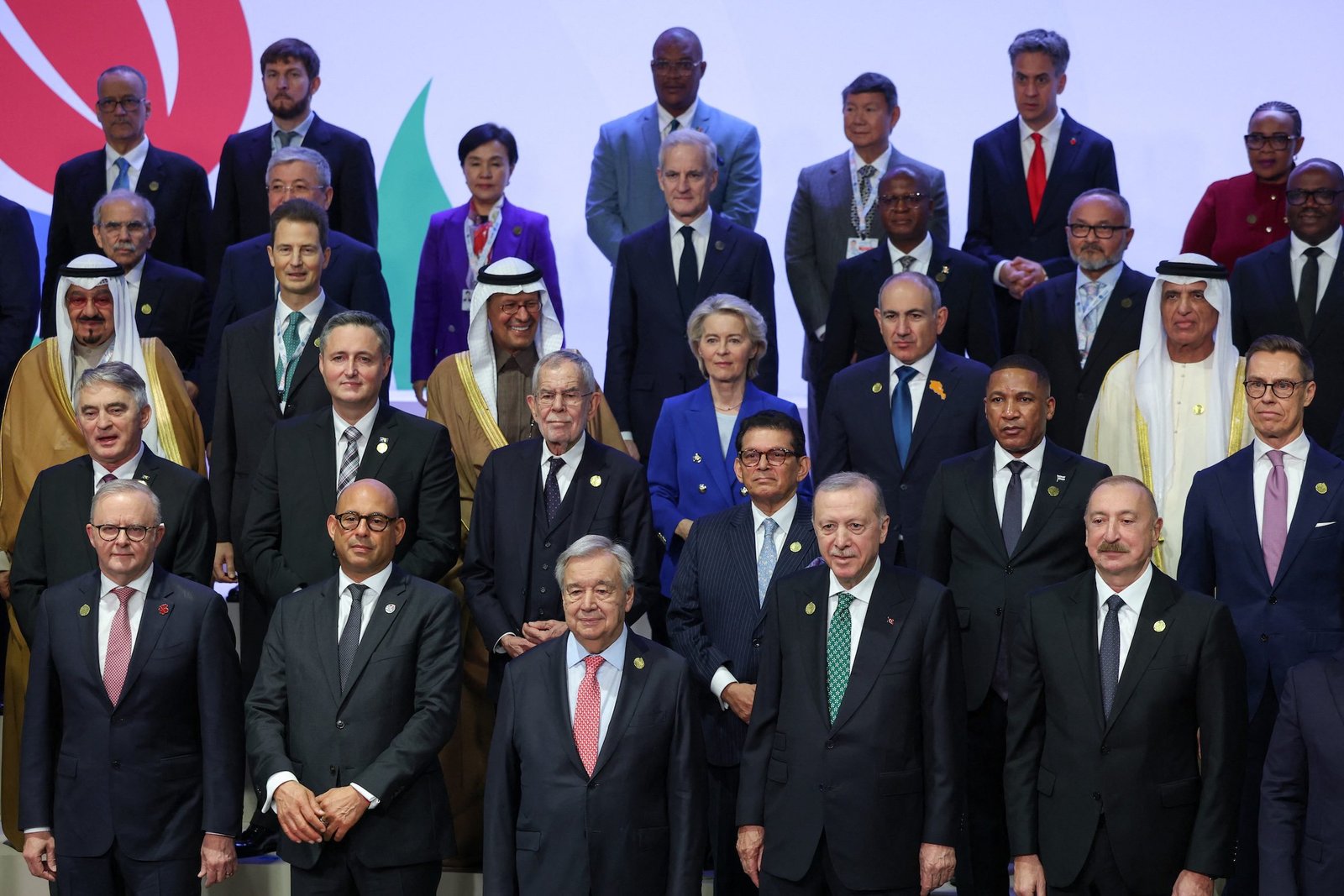
ANTALYA, Turkey – Leaders at the COP31 summit in Turkey are trying out a new sales pitch for climate action that is tailored to the times: do it to bolster the economy and bring down the cost of living.

The message, being repeated in the hallways and on the plenary stage of the annual UN conference, reflects efforts by organizers to capture the attention of governments wrestling with crises that have pushed global warming down the list of priorities.

Among those is rampant inflation driven in part by disruptions to Middle East crude oil shipments since the onset of the Iran war. Consumer price pressures from fuel to food were a major driver in the US midterm elections that handed control of Congress to Democrats, and are an important vulnerability for leaders across Europe, Asia and elsewhere.

“Three-quarters of humanity live in countries that import fossil fuels, hostage to price shocks they did not create and cannot control,” UN Secretary-General Antonio Guterres told world leaders attending the summit on Wednesday, November 11.

“Recent conflicts make clear that this is a recipe for chronic insecurity and a cost-of-living meltdown,” he added, saying the clear solution is a shift to renewable energy.

Simon Stiell, head of the UN’s climate office, made the same point. “Today, chaos in global energy markets and climate disasters are supercharging inflation, slamming government budgets, pushing household bills up and living standards down,” he told the conference.

“The political costs of fossil fuel dependency are unforgiving. Climate action can help relieve the pressures.”

John Kerry, a former US secretary of state who has been advocating for climate action for decades, said he liked the reframing of the issue.

Climate change has become a massively divisive political issue in recent years, including in the US, where President Donald Trump last year withdrew the world’s top historical greenhouse gas emitter from international climate cooperation after calling warming a hoax.

“I think everybody who is working on climate needs to change the way they talk about it,” Kerry told reporters on the sidelines of the summit.

“I think that grouping of security, health, jobs, stability of communities and food supply are all very real and very much on people’s minds when I talk to them.”

To be sure, speakers at COP31 tended to agree the primary motivation for climate action should center on the overwhelming scientific evidence that warming is human-driven and dangerous.

“It is our responsibility to turn scientific evidence into political action and ensure that our decisions are guided by fact, not short-term political interests,” Slovenian President Natasa Pirc Musar said in a speech to the summit on Wednesday.

But European energy commissioner Dan Jorgensen said emphasizing the other benefits of cutting emissions could help build a consensus for action that could even include climate sceptics.

“Because even if you don’t believe in climate change, which I obviously do, we should be able to agree that moving away from a dependency on fossils is extremely smart for security reasons,” he said. – Rappler.com

Similar Posts

  • | | | |

    Meta rejects claims it sought to hook children to Facebook, Instagram as landmark trial begins

    A bipartisan group of 29 US states is suing Meta, seeking potentially tens or hundreds of billions of dollars in penalties and changes to how Meta does business

  • | | | |

    Iran vows retaliation after fresh US strikes

    Iran has vowed to retaliate after the United States launched fresh overnight air strikes on multiple locations across the country, further escalating the conflict that has increasingly drawn several Middle Eastern nations into the fighting. The Islamic Revolutionary Guard Corps (IRGC) issued a strong warning, saying those responsible for the attacks would face punishment. Iranian media quoted the force as saying that the “aggressor” would be held accountable. The latest US strikes reportedly targeted several areas in southern Iran, including Bushehr province, which is home to the country’s only nuclear power plant. Explosions were also reported in Qeshm, Kish, Bandar Abbas, Abadan and other nearby locations. Iranian officials said a residential building on Qeshm Island was struck during the attacks. Local authorities confirmed that three members of the same family, including a child, were killed. Two other children from the same family were injured and shifted to hospital for treatment. The US military said the strikes were launched in response to recent Iranian missile attacks targeting American forces stationed in Jordan. Washington described the operation as a powerful response aimed at deterring further attacks on its troops in the region. The military action came shortly after US President Donald Trump warned that Iran would face severe consequences following attacks on American military facilities. Meanwhile, Jordan said its air defence systems intercepted and destroyed five Iranian missiles heading toward its territory. Officials said this was the fourth consecutive day that missiles or drones launched from Iran had been intercepted. No casualties or property damage were reported. Iran also strongly condemned recent joint US-Saudi air strikes carried out in Iraq. Tehran described the attacks as a violation of Iraq’s sovereignty and territorial integrity. It accused Washington of widening the regional conflict and expressed support for the Iraqi government. The Iraqi government also criticised the strikes and called on all parties to avoid further escalation. Iraqi officials stressed that the country should not become a battleground for regional disputes. Israeli Prime Minister Benjamin Netanyahu said it was difficult to predict Iran’s next moves regarding the Strait of Hormuz. However, he argued that alternative energy routes could eventually reduce the strategic importance of the vital shipping lane. The United Nations expressed deep concern over the renewed fighting. UN Secretary-General António Guterres urged both the United States and Iran to end hostilities and return to diplomatic negotiations. He also welcomed mediation efforts by regional countries seeking to reduce tensions. The IRGC claimed that two oil tankers attempting to sail through what it described as an unauthorised route in the Strait of Hormuz turned back after a fire reportedly broke out on one vessel. Iranian officials insisted the country maintained control over the strategic waterway and warned that restrictions would remain as long as foreign military threats continued. The United Arab Emirates also condemned drone attacks targeting Saudi oil facilities from Iraqi territory, calling them a serious violation of Saudi sovereignty and a threat to regional security. The conflict has expanded rapidly over recent days, with military activity reported in Iran, Iraq, Jordan, Egypt and the Gulf region. The growing instability has increased concerns over regional security and disrupted global energy markets. Oil prices climbed sharply as investors reacted to fears of further escalation and possible disruptions to shipping through the Strait of Hormuz, one of the world’s most important energy trade routes.

  • |

    North Korea battles heatwave with dog soup

    North Korea is highlighting traditional foods, health advice and leisure activities as an intense heatwave sweeps across the Korean Peninsula. State media reported that temperatures in the country reached 36.7°C, the highest recorded since modern weather observations began. The extreme heat has also brought a series of unusually warm nights. With the hottest period of summer underway, North Korean media has focused heavily on ways for people to stay cool and maintain their health. One of the recommendations receiving particular attention is dog-meat soup. State media described the dish as a traditional summer food and promoted a long-standing belief that it can help people cope with extreme heat. Other foods recommended by state media include watermelon, cucumbers, mung beans, fish porridge and red-bean porridge. Chicken soup prepared with ginseng, sticky rice and dates has also been promoted as a popular summer meal. Health programmes on North Korean television have urged people to remain hydrated and take precautions while swimming or exercising outdoors. The country has not released figures on deaths linked to the current heatwave. South Korea, meanwhile, has reported more than 20 heat-related deaths. North Korean state media has also used the extreme weather to highlight leader Kim Jong Un’s image as a leader who shares difficult conditions with ordinary citizens. A recent report recalled a 2013 visit by Kim to a construction site during hot weather. The report said his clothes became soaked with sweat during the inspection. According to the account, Kim insisted that important work for the people should continue despite the heat. State media also highlighted other past inspections in difficult weather conditions. These included a trip through mountainous terrain during heavy rain and a visit to a seafood factory where temperatures were reportedly around 39°C. There has been no detailed report on Kim’s activities during the current heatwave. Meanwhile, state television has shown large crowds visiting beaches, swimming pools and water parks to escape the extreme temperatures. Thousands of people have reportedly visited the Wonsan Kalma Coastal Tourist Zone, one of Kim’s major tourism projects on the country’s eastern coast.

  • |

    Russian missile enters polish airspace, NATO jets put on alert

    A Russian missile reportedly entered Polish airspace and exploded after crossing into the territory, prompting NATO and Polish forces to quickly deploy fighter jets and other surveillance aircraft. According to international media reports, the missile entered Polish airspace early Thursday as part of a large-scale Russian overnight attack on Ukraine involving ballistic missiles and drones. The wider strikes reportedly killed around eight civilians, including children, and injured more than 50 others. NATO officials said that allied forces immediately responded after detecting the unidentified object. Poland and other NATO members scrambled F-16 fighter jets, an aerial refueling aircraft and an early warning and surveillance plane to monitor the situation and protect allied airspace. A NATO spokesperson said the alliance would continue taking all necessary measures to safeguard its territory and maintain the security of its member states. Polish authorities reported that the missile exploded near the eastern village of Taranawa-Kolonia, leaving a large crater at the site. Officials said the incident caused no casualties or significant property damage. The incident has nevertheless raised fresh concerns over the potential expansion of the Russia-Ukraine war beyond Ukraine’s borders. European countries have repeatedly warned that continued attacks could increase the risk of the conflict spilling into NATO territory. The latest development is also likely to intensify tensions between Russia and NATO, particularly as Poland remains a key member of the alliance and a major logistical hub for international support to Ukraine. NATO has previously reinforced its eastern flank in response to security threats linked to the ongoing war.

Leave a Reply

Your email address will not be published. Required fields are marked *