finterest apple pay
| |

[Finterest] Apple Pay, LRT1 tap-to-pay? What’s next in BSP’s digital payment roadmap

MANILA, Philippines – The long-awaited launch of Apple Pay in the Philippines could be just around the corner, along with other digital payment methods.

Bangko Sentral ng Pilipinas (BSP) Deputy Governor Mamerto Tangonan said local banks are preparing to launch Apple Pay, while a tap-to-pay system for Light Rail Transit Line 1 (LRT1) is awaiting a final agreement with the rail line’s private operator.

Here’s a quick rundown of what we could see in the coming months.

Apple Pay: ‘Stay tuned’

Apple Pay has yet to officially launch in the Philippines, but Tangonan hinted that the wait may be nearly over.

“We didn’t object to it. So, it’s up to the banks,” Tangonan told reporters during a roundtable.

“Stay tuned kasi may alam akong mga banks mag-lalaunch (because I know some banks are looking to launch). Stay tuned,” he added, without mentioning the banks or giving an exact date.

Earlier reports had placed Apple Pay’s Philippine entry in the third quarter of 2026, as local banks worked to satisfy the platform’s technical requirements. As of Apple’s latest published list of supported markets on July 10, however, the Philippines was still not included.

Google Pay arrived earlier, launching in the Philippines on November 18, 2025, with initial partners including China Bank, EastWest, GCash, GoTyme, Maya, RCBC, UnionBank, Wise, and Zed.

LRT1 could complete the rail rollout

The next visible change for commuters may be LRT1.

“Coming soon,” Tangonan said, adding that the parties were down to a “final agreement” with the operator. He said he was hopeful that the system could be rolled out within the quarter.

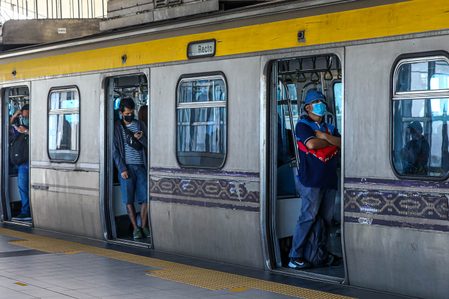
LRT1 would follow MRT3, which began rolling out its tap-to-pay fare system in July 2025, and LRT2, which also launched contactless payments across all 13 stations on July 13, 2026.

The new systems let commuters tap Visa or Mastercard bank cards, use NFC-enabled phones and wearables, or scan supported QR codes instead of buying a single-journey ticket or loading a Beep card. GCash is the principal payment partner for MRT3, while RCBC serves as the acquiring bank and fare-gate partner for LRT2.

“We just want to make sure that we provide an interoperable payment system,” Tangonan said. “Kahit ano ang gawin niyo diyan, basta ‘yung payment system (Whatever you do there, just make sure that the payment system is), interoperable.”

Interoperability means commuters should eventually be able to use an existing bank card, mobile wallet, or other accepted instrument across several transport systems, rather than buying a proprietary card for each one.
Must Read

You can now tap your Visa or Mastercard to pay for your LRT2 ride


You can now tap your Visa or Mastercard to pay for your LRT2 ride

What about buses?

The bus network is a more complicated test.

Beep is already accepted on selected routes, but it’s not the only cashless option. The EDSA Busway launched a separate GCash SoundPay pilot in December 2025, initially covering 260 buses. Passengers scan a QR code displayed on a conductor’s device and enter their fare.

That still falls short of the BSP’s broader vision. Tangonan said he hoped bus operators, including provincial services, would eventually carry terminals that could accept several payment instruments.

Connectivity remains a practical problem too on long-distance routes with stretches of highway that are mobile dead spots, meaning payment systems may also need ways to process or store transactions offline.

Tokenized bonds and cross-border payments

Some BSP projects are less visible to consumers but could eventually affect how they invest or send money abroad.

Under Project Agila 2, the BSP plans to test the near-simultaneous settlement of tokenized Treasury bonds and allow participating financial institutions to use those securities to obtain liquidity.

This is a wholesale central bank digital currency project for financial institutions, not a retail “digital peso” intended to replace cash in consumers’ wallets.

Tangonan said tokenization could also help financial institutions divide government securities into smaller, more affordable investment units, although banks and fintech firms would still have to develop the products offered to customers.

The BSP is also working with the Bank for International Settlements and other central banks on Project Mandala, which explores encoding regulatory checks into digital certificates or tokens. It could complement Project Nexus, the initiative linking participating countries’ instant-payment systems, by making cross-border compliance faster and potentially less expensive. – Rappler.com

Finterest is Rappler’s all-in-one financial literacy hub.

Below are other Finterest articles you may have missed:

Click here for other Finterest articles.

Similar Posts

  • | | |

    Oil prices surges avove $91 as Iran war fuels Horm…

    Oil prices climbed on Tuesday, with Brent crude moving above $91 a barrel as stalled diplomacy over the Iran conflict raised fresh concerns about global energy supplies. Brent futures gained 27 cents, or 0.3%, to $91.14 a barrel, while US West Texas Intermediate rose 42 cents to $85.04. WTI had earlier reached $85.37, its highest level since July 31. Markets remained tense after Iran signalled a shift toward a more offensive military posture, while Washington ruled out extending a temporary ceasefire. Progress toward reopening the Strait of Hormuz to normal tanker traffic has also slowed, adding to fears of prolonged supply disruptions. Only a handful of commodity vessels crossed the strategic waterway over the weekend, sharply below normal traffic levels. Concerns were further heightened by attacks in the Red Sea, reinforcing fears over disruptions at both the Strait of Hormuz and Bab el-Mandeb. Despite the growing tensions, reports of possible back-channel contacts between the US and Iran offered a limited sign of hope for renewed diplomacy. Meanwhile, markets are also watching US crude inventories, which are expected to have declined last week. Earlier, Oil prices climbed on Monday as uncertainty over a possible diplomatic breakthrough between the United States and Iran increased, while a sharp slowdown in tanker movements through the Strait of Hormuz heightened concerns about disruptions to global crude supplies. Brent crude futures gained as much as 1% during early trading to reach $89.40 per barrel. The benchmark was later up 72 cents, or about 0.8%, at $89.20 a barrel by 0229 GMT. US West Texas Intermediate (WTI) crude also moved higher, rising 44 cents to $82.83 per barrel. Both international benchmarks posted gains of more than 5% last week after a series of attacks involving energy and shipping assets in and around the strategically important Strait of Hormuz. The incidents have intensified fears that further escalation could affect one of the world’s most important oil transit routes. Market sentiment was further affected by developments over the weekend, when Iranian Foreign Minister Abbas Araqchi said Tehran had yet to decide whether it would resume negotiations with Washington. US President Donald Trump, meanwhile, told Americans to prepare for somewhat higher gasoline prices as the conflict continues. Analysts said the renewed uncertainty had brought geopolitical risk back into crude markets after oil prices had previously come under pressure on expectations that diplomatic efforts could ease tensions. “Oil prices have now rebounded almost completely from the lows seen in early August, as hopes for a more permanent resolution between the US and Iran have faded and geopolitical risk premiums have returned to the market,” said Priyanka Sachdeva, head of market insights at Phillip Nova in Singapore. Sachdeva cautioned, however, that the rally could lose momentum unless there is evidence of a further deterioration in the situation. She said the market would need to see renewed aggression in the Strait of Hormuz, particularly significant damage to oil tankers or energy infrastructure, before prices were likely to move substantially higher. Hormuz shipping activity slows Concerns over physical supply disruptions increased after ship-tracking data showed a marked decline in vessel traffic through the Strait of Hormuz over the weekend. According to data from Kpler, only five commodity vessels crossed the strategic waterway on Saturday, while no such transits were recorded on Sunday. This compared with 31 commodity vessel crossings during the previous weekend. The slowdown is significant because the Strait of Hormuz is a critical route for international energy shipments. Any prolonged disruption could increase transportation risks, raise insurance costs and place additional upward pressure on crude prices. The United Arab Emirates also accused Iran of attacking another vessel operated by Abu Dhabi National Oil Company (ADNOC) while it was passing through the strait on Friday, according to the Emirati state news agency WAM. The UAE had earlier blamed Iran for two separate incidents involving ADNOC-operated vessels on Thursday evening. The latest incidents have added to concerns among traders that the conflict could increasingly affect commercial shipping and energy infrastructure, rather than remaining confined to military and diplomatic confrontation. The Strait of Hormuz remains particularly important to global oil markets because a substantial volume of crude and petroleum products moves through the waterway. Any sustained interruption could therefore have consequences well beyond the region. For now, traders are closely monitoring developments involving US-Iran diplomatic contacts, attacks on shipping and the movement of tankers through the strait. While the latest price gains reflect a higher geopolitical risk premium, analysts remain cautious about predicting a prolonged rally. If shipping activity resumes and diplomatic channels reopen, some of the premium built into crude prices could quickly unwind. Conversely, additional attacks on tankers, oil facilities or other critical infrastructure could trigger a stronger market reaction and push prices higher as traders reassess the security of regional supplies.

  • Major Fuel Smuggling Ring Exposed at Chiang Rai-Myanmar Border

    CHIANG RAI – Thai law enforcement officials have exposed a massive fuel smuggling operation operating along the Mekong River. Smugglers have successfully bypassed a national export ban by using falsified shipping documents. The illegal operation has rerouted tens of millions of liters of fuel directly into Myanmar. National Police Deputy Chief General Thatchai Pitaneelaboot led […]

Leave a Reply

Your email address will not be published. Required fields are marked *