
france counts cost
|

France counts the cost of worst unrest in years; Macron urges calm

PARIS, France – French President Emmanuel Macron appealed for calm on Sunday, October 18, a day after France suffered one of its worst days of unrest in years, with thousands arrested and shops looted or damaged after protests over high prices and declining public services.

Fresh clashes broke out in Paris and Marseille, where riot police intervened to prevent attempts to ransack businesses.

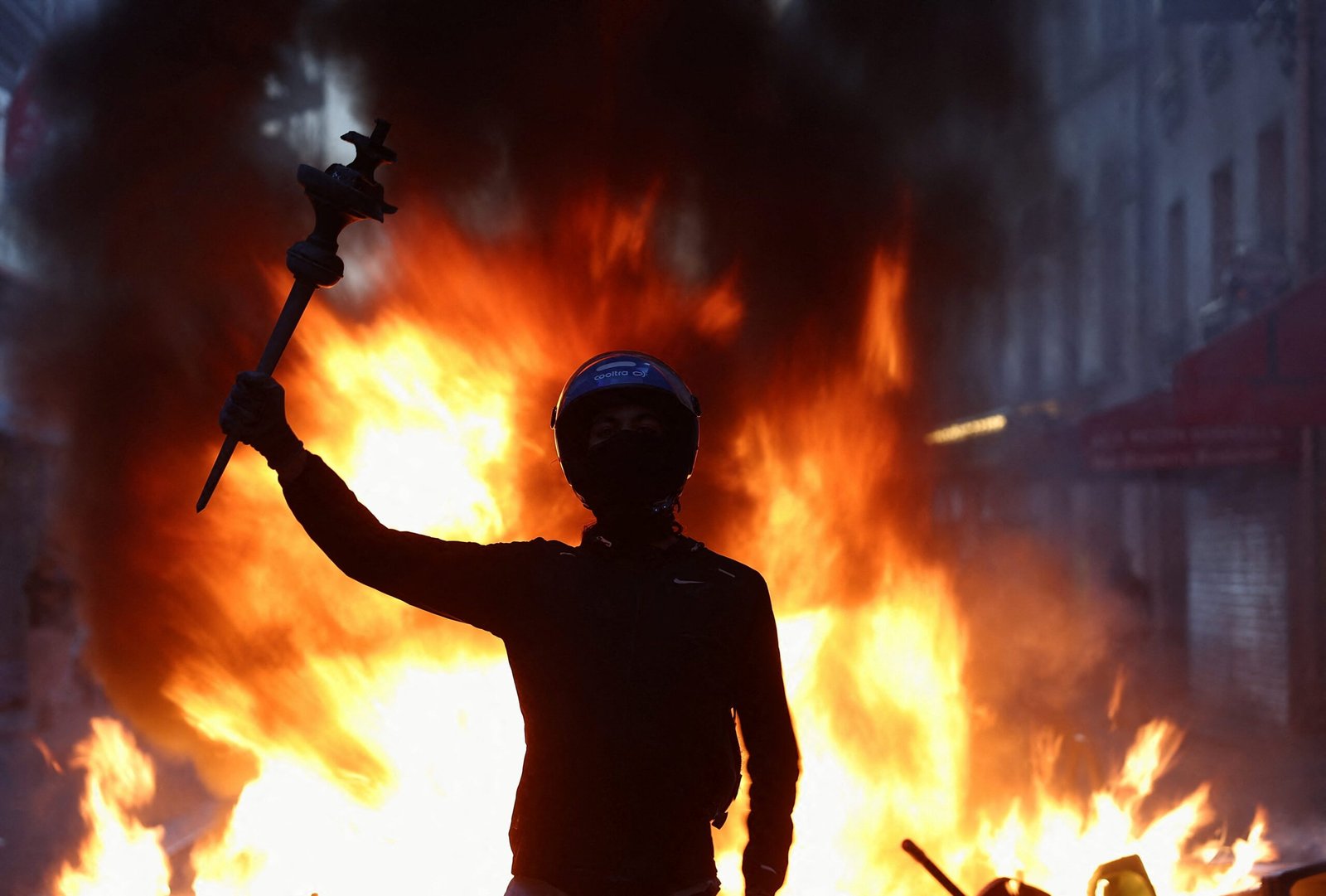
Nationwide demonstrations had erupted into riots on Saturday, with a town hall torched, shops pillaged and buildings covered in graffiti as violent groups clashed with police in cities across France.
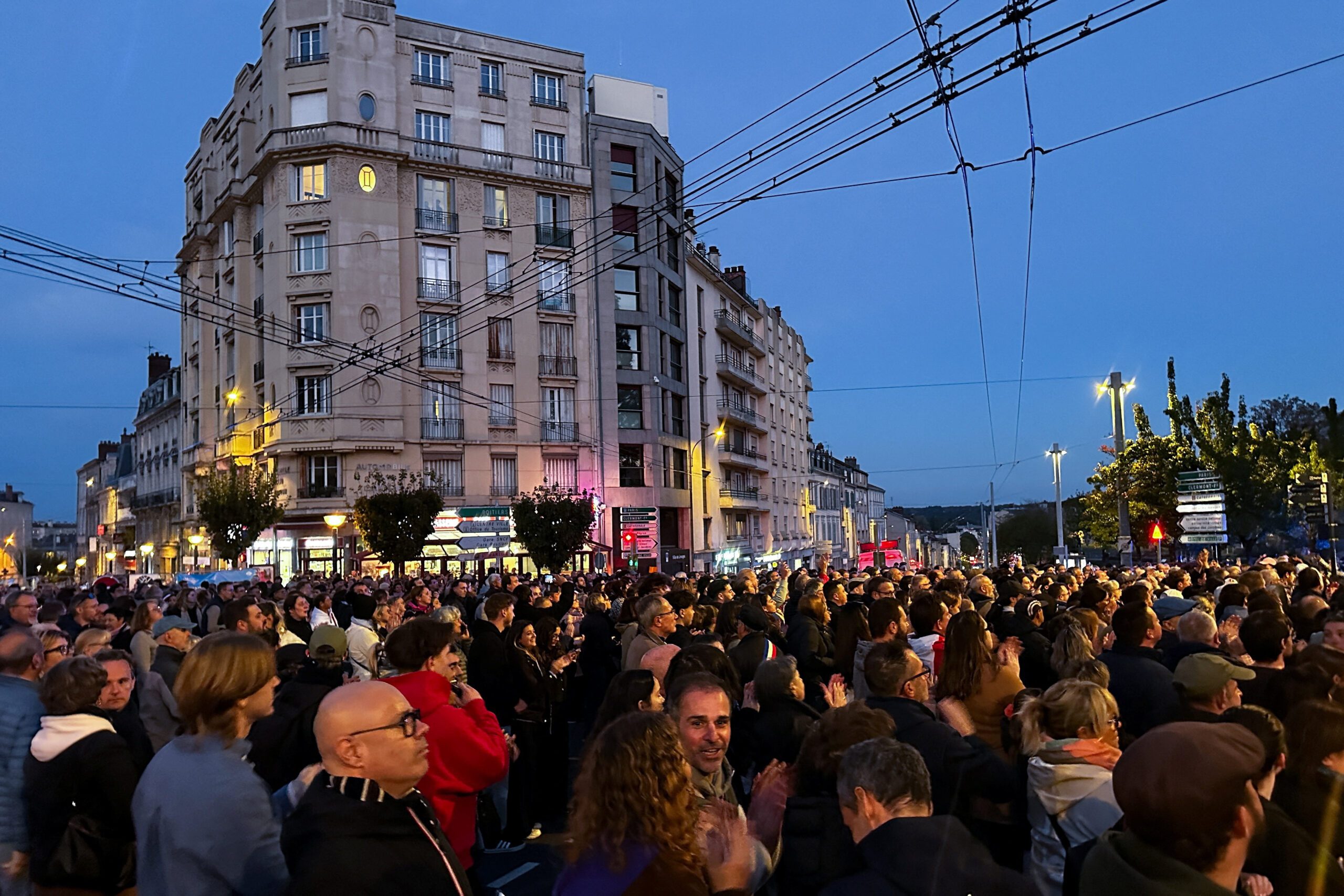
Residents gather during a protest following a fire at the town hall in Limoges, France, October 18, 2026
PROTEST. Residents gather during a protest following a fire at the town hall in Limoges, France, October 18, 2026. Reuters

“Looking at these images, we have all asked ourselves: What was going through their minds? How can French people do this to France?” Macron said in a televised address to the nation.

“Nothing justifies it, nothing explains it, nothing excuses it. Tonight, we all feel anger and shame.”

Saturday’s unrest laid bare the deep anger at Macron, who leaves office in 2027 after a decade in power that has increasingly become defined by social discontent, a weak economy and ballooning debt.

Macron said those protesting peacefully had legitimate grievances and their actions should not be confused with those seeking to wreak havoc.

He stopped short of declaring a state of emergency, as demanded by some right-wing politicians, but said the government would act to allow prefects to ban protests if necessary to protect public buildings and local businesses.

Paris protests ‘like a war zone’

The government has blamed the violence on what it said were ultra-left groups, as well as criminals it said had instigated the looting.

One protester died on Saturday after suffering a cardiac arrest during demonstrations in Paris. Police made 2,400 arrests across France, while nearly 1,000 officers were injured, French Interior Minister Laurent Nunez said.
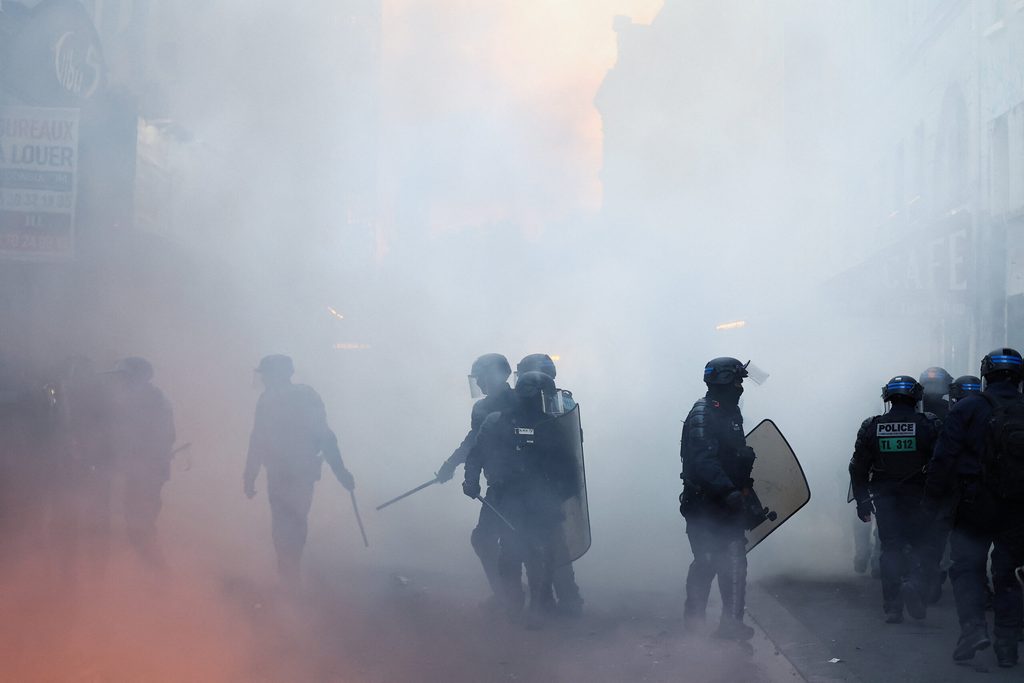
UNREST. Riot police operate during civil unrest, the day after a national day of demonstrations against the cost of living and rising fuel prices, in Paris, France, October 18, 2026. Reuters

Police again clashed with protesters and fired tear gas at Place de la Republique on Sunday afternoon, and protesters had set fire to piles of bicycles. A Reuters witness said there appeared to be several hundred protesters in the area.

A massive clean-up operation took place in cities from Lille in the north to Marseille in the south and from Strasbourg in the east to Bordeaux in the southwest, where a masked mob invaded the residence of the local prefect.

“It’s like a war zone here!” exclaimed Dutch entrepreneur Tije De Boer, who was visiting Paris with his children and said the unrest forced him to evacuate his hotel at Place de la Republique.

More than half a million people joined marches in scores of cities on Saturday, marking the convergence of a month-long student movement with broader social discontent against rising living costs and declining public services.

Several hundred shops damaged

While hundreds of thousands protested peacefully across France on Saturday, violent fringe groups targeted public buildings, looted luxury boutiques and supermarkets, and attacked police vehicles and officers.

Far-right National Rally leader Marine Le Pen, frontrunner going into next year’s presidential campaign, also called for calm, saying France must not become accustomed to images of the country being battered, abused and ransacked.

“Violence is not an opinion. Destruction is not a form of expression. And chaos cannot serve as a project for France,” she said in a video address.
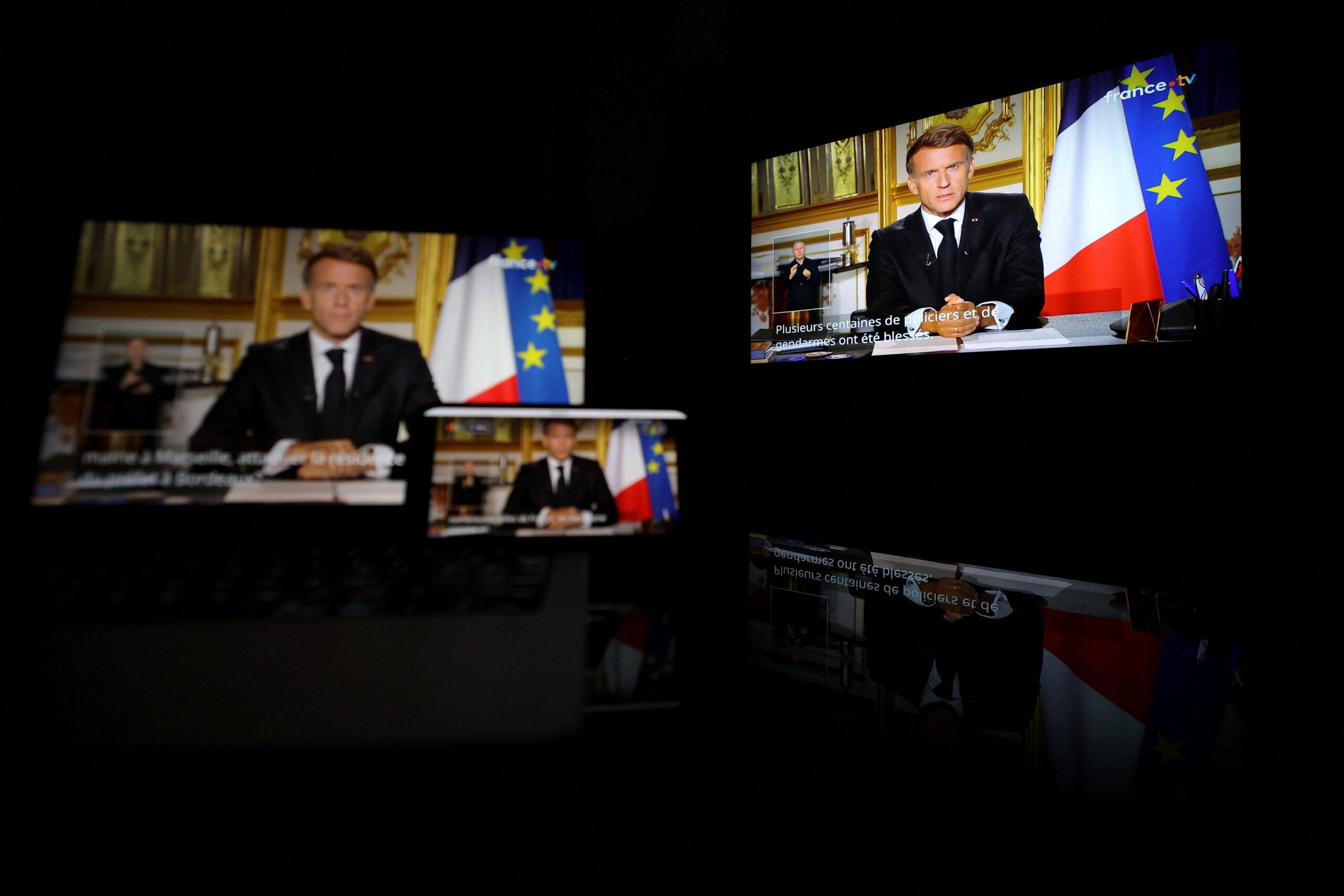
French President Emmanuel Macron appears on screen as he makes a television address to the nation a day after clashes during a national day of demonstrations against the cost of living and rising fuel prices, near Marseille, France, October 18, 2026
CALL FOR CALM. French President Emmanuel Macron appears on screen as he makes a television address to the nation a day after clashes during a national day of demonstrations against the cost of living and rising fuel prices, near Marseille, France, October 18, 2026. Reuters

Hard-left France Unbowed presidential candidate Jean-Luc Melenchon said Macron needed to answer the demands of protesting high-school students.

In Limoges, famed for its porcelain, the collapse of the town hall’s clock tower in a fiery blaze revived memories of the 2019 fire that devastated Paris’ Notre Dame cathedral. Mayor Guillaume Guerin said not enough officers from the national police had been deployed to his city.

“There was a clear, premeditated intention to burn down the town hall, and the people inside feared for their lives,” Guerin told Reuters on Sunday. He threatened to resign if the city did not receive the funds needed to repair the town hall.

Economy Minister Roland Lescure pledged support on Sunday for business owners who suffered losses. “Those who break things will pay, repair the damage and be held accountable for their intention to sow chaos,” Lescure said in a statement.

French retailer Carrefour’s CEO Alexandre Bompard told French broadcaster BFMTV that 50 of the company’s shops had been damaged, including 20 that were looted, with losses from the damage running into the tens of millions of euros. – Rappler.com

Similar Posts

  • |

    EU fines Google $1 billion over competition violations

    The European Union has imposed a heavy fine on Google for allegedly using its dominance in the search engine sector to suppress other companies. According to a statement issued by the European Commission, Google illegally used its dominant position in the search engine market to reduce competition. The statement said that Google has been fined €890 million (around $1 billion) for this violation. The move is expected to increase trade tensions between the European Union and the United States as the Trump administration has warned of possible retaliatory measures and described EU trade policies as “unfair.” According to the European Commission, Google unfairly used its dominant search engine position to promote its own services including shopping, travel, gaming and other platforms reaching more users. The commission stated that Google placed its own services higher in search results while pushing competing services lower. The statement further explained that under the European Union’s Digital Markets Act, technology companies cannot show such biased behavior toward their own services and must follow transparent, fair and non-discriminatory policies. The European Commission also accused Google of unfairly preventing developers from informing users about alternative payment options on the Google Play Store as this could reduce Google’s service fees. This action was also considered a violation of the Digital Markets Act which aims to prevent large technology companies from establishing monopolies. According to the statement, Google must comply with the decision within 60 days otherwise additional penalties may be imposed. On the other hand, Google said in a statement that the decision would harm European consumers. This is not the first time the European Union has fined Google. In 2018, the EU imposed a $4.7 billion fine on Google over the alleged abuse of its dominance in the Android mobile operating system market and Google’s final appeal against the decision was rejected. In 2017, Google was fined $2.8 billion for abusing its dominance in the search sector while in 2024 its final appeal was also rejected.

  • | | |

    Trump could resume Iran strikes, US senator warns

    US Republican Senator Jim Banks has warned that President Donald Trump could order fresh military strikes against Iran if Tehran does not quickly agree to end its nuclear programme and reopen the Strait of Hormuz. Speaking to Fox News, Banks said the Trump administration still prefers a diplomatic solution but expects Iran to return to negotiations and reach an agreement soon. He warned that if Iranian leaders refuse to come back to the negotiating table, the United States could resume heavy military attacks. According to Banks, the decision to delay further strikes does not represent weakness or a retreat by Washington. Instead, he said, Trump has given Tehran another opportunity to pursue a peaceful settlement and avoid further escalation. The senator also claimed that divisions exist within Iran’s leadership over how to respond to US pressure. He described the situation as a struggle between hardline military figures and elements within the ruling establishment who may favour negotiations. Banks argued that some Iranian officials now recognise the scale of America’s military capabilities and the potential consequences of continued confrontation. He said the pressure from the United States has created a situation in which parts of Iran’s leadership may be more willing to reach an agreement. The Republican senator’s remarks come amid heightened tensions over Iran’s nuclear programme and the strategic Strait of Hormuz, a vital global energy route. Any prolonged disruption in the waterway could have significant consequences for international oil supplies and global markets. Banks maintained that Washington’s objective remains to push Iran toward a deal while keeping military action as an option. His comments suggest that the Trump administration could increase military pressure if diplomatic efforts fail to produce progress in the near future.

  • | | |

    Uganda backs sending troops to planned Gaza peace …

    Uganda’s Parliament has approved a government proposal to deploy troops to a planned international peace and stabilisation force for Gaza, marking the country’s first commitment to the proposed multinational mission. The resolution was introduced by Uganda’s Minister of Defence and received parliamentary approval following debate among lawmakers. With the decision, Uganda joins Morocco, which has also announced its willingness to contribute troops to the proposed force. The Ugandan government has not publicly disclosed the diplomatic discussions or political considerations behind its decision. However, the move sparked debate in Parliament, with opposition members expressing concerns about the potential implications for Uganda’s foreign policy and regional relationships. Opposition lawmaker Hassan Kiromera questioned the mission’s objectives, asking which parties Ugandan troops would ultimately be expected to confront if deployed. He argued that the government should provide greater clarity regarding the mandate of the proposed force before committing military personnel. Defence Minister Jacob Oboth-Oboth defended the proposal, stating that the Uganda People’s Defence Forces (UPDF) possess extensive experience in international peacekeeping operations, including missions in Somalia and other conflict zones. He said that this experience would enable Ugandan troops to contribute effectively to efforts aimed at restoring peace and stability in Gaza. According to the report, the proposed Gaza International Stabilisation Force is expected to consist of approximately 20,000 personnel from multiple countries. The force is reportedly planned under a proposal associated with US President Donald Trump’s Board of Peace and would be commanded by US Major General Jasper Jeffers. The mission is intended to help maintain law and order in Gaza following the end of hostilities between Israel and Hamas. Reports indicate that the proposal was first introduced earlier this year as part of broader discussions on post-conflict governance and security arrangements in the territory. The development follows recent announcements regarding a reported agreement under which Hamas would disarm and Israel would gradually withdraw its military forces from Gaza. Under the reported framework, the international stabilisation force would be deployed after the phased Israeli withdrawal. However, uncertainty remains over the implementation of the proposed arrangement. Israeli officials have reportedly expressed serious security concerns after reviewing the reported agreement, arguing that certain provisions could pose risks to national security. As a result, questions remain about the timeline and conditions for the deployment of the multinational peace force despite Uganda’s parliamentary approval.

  • |

    Houthis seek to replicate Iran’s Strait of Hormuz strategy in Red Sea, warns Yemeni diplomat

    Yemen’s Houthi movement is attempting to replicate Iran’s strategy in the Strait of Hormuz by disrupting maritime traffic through the Bab el-Mandeb strait, Yemeni Foreign Minister-designate Afrah al-Zouba warned on Monday. Speaking to reporters at the Yemeni Embassy in Riyadh, al-Zouba stated that an insufficient international response has emboldened the group to pursue control over critical Red Sea shipping corridors. The Red Sea has emerged as a major flashpoint following escalations linked to the broader regional conflict involving Iran. The Houthis have intensified operations against Saudi Arabia by launching drone and missile strikes and announcing a blockade on Saudi-bound shipping. In response, Saudi Arabia has conducted airstrikes targeting Houthi military positions and reaffirmed its commitment to protecting commercial maritime routes. The surge in hostilities threatens to unravel the fragile truce established in 2022, raising concerns among diplomats and officials over a potential return to full-scale war in Yemen. Al-Zouba confirmed that while military skirmishes persist along frontline positions stretching from the Red Sea to the Saudi border, neither side has launched a major ground offensive. She emphasised that the internationally recognised government is prepared for further escalation, asserting that the conflict must ultimately be resolved either diplomatically or by force.

Leave a Reply

Your email address will not be published. Required fields are marked *