another fuel price
|

Another fuel price hike set for July 28

MANILA, Philippines – Pump prices are going up sharply again starting Tuesday, July 28, extending the run of fuel price increases driven by renewed volatility in the Middle East.

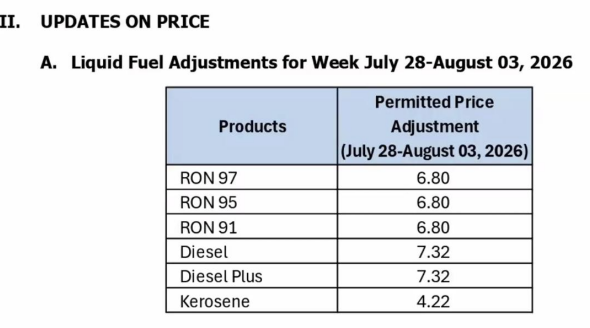
In a press conference on Tuesday, July 28, Energy Secretary Sharon Garin announced the following maximum price increases for the week of July 28 to August 3:

  • Gasoline – increase of P6.80 per liter
  • Diesel – increase of P7.32 per liter
  • Kerosene – increase of P4.22 per liter

The adjustments will take effect on Tuesday.
“These price movements continue to stem from the developments in the Middle East, which have kept global oil markets under pressure. If there’s trouble in Ukraine or in the Strait of Hormuz, prices here are affected,” Garin said in a mix of English and Filipino. “This is how vulnerable we are.”

Garin also said that fuel inventories remain “sufficient” at a “very healthy level” with no disruption to supply.

There is a “glimmer of hope” that fuel prices could decline next week, according to Energy Undersecretary Sandy Sales. Progress in third-party negotiations, including the involvement of China and Pakistan, as well as the halt in missile strikes between Iran and the United States, helped pull down global oil prices in trading sessions on last Friday, July 24, and Monday, July 27.

Before the latest adjustment, the Department of Energy’s (DOE) price monitoring showed common retail prices in Metro Manila at P71.80 per liter for gasoline RON95, P70.30 per liter for gasoline RON91, P88.40 per liter for diesel, and P117 per liter for kerosene for the week of July 21 to 27.

The latest increases follow last week’s bigtime fuel price hikes, when gasoline prices rose by P3.65 per liter, diesel by P10.68 per liter, and kerosene by P11.77 per liter.

Diesel and kerosene prices sharply higher on July 21, dashing hopes that pump prices would soon return to levels seen before the Middle East conflict. Garin had said the increase was still being driven by uncertainty from tensions involving Iran, Israel, and the United States, which have continued to affect the global oil market. (READ: Iran war spreads to Red Sea and Caspian, Gulf quiet as US forgoes strikes)

Global oil prices have remained volatile as conflict in the Middle East continues to threaten key shipping routes. The Strait of Hormuz, the narrow waterway between Iran and Oman, remains one of the world’s most important oil shipping routes. Any disruption to tanker traffic can quickly affect global crude and refined product prices.

That matters for the Philippines because the country imports much of its fuel as finished petroleum products, including diesel and gasoline. This means local pump prices are more directly influenced by regional traded prices of finished fuels, especially the Mean of Platts Singapore, or MOPS, rather than Dubai crude alone.

Despite intermittent easing in crude prices, local pump prices remain well above levels seen before fighting involving Iran and US-Israeli forces broke out on February 28. In the last full week before the conflict, DOE data showed common retail prices in Metro Manila at P56 per liter for gasoline RON95, P54.70 per liter for gasoline RON91, P55 per liter for diesel, and P83.47 per liter for kerosene.

The Philippines is a net importer of petroleum products, making local pump prices vulnerable to global oil price swings, foreign exchange movements, regional refined fuel prices, and disruptions in international supply routes. – Rappler.com

Must Read

[Vantage Point] Oil’s false prophets


[Vantage Point] Oil’s false prophets

Similar Posts

  • | |

    SBP appoints 10 primary dealers for FY27

    KARACHI: The State Bank of Pakistan (SBP) has appointed 10 financial institutions as Primary Dealers (PDs) and two institutions as Special Purpose Primary Dealers (SPDs) for the fiscal year 2026-27. The appointments will strengthen the government’s domestic borrowing programme and support the country’s financial market. The government continues to rely heavily on domestic borrowing to finance its fiscal requirements. In this system, primary dealers play an important role by participating in government debt auctions and helping raise funds through Treasury Bills and Pakistan Investment Bonds. According to the central bank, United Bank Limited (UBL), National Bank of Pakistan (NBP), and Bank Alfalah secured the top three positions among primary dealers during the fiscal year 2025-26. Their rankings were based on overall performance in government securities auctions and market activities. The 10 institutions selected as Primary Dealers for FY2026-27 are United Bank Limited, National Bank of Pakistan, Bank Alfalah, Habib Bank Limited, Habib Metropolitan Bank, MCB Bank, The Bank of Punjab, Pak Oman Investment Company, JS Bank, and Citi Bank NA Pakistan Branch. The State Bank has also appointed the Central Depository Company of Pakistan Limited (CDC) and the National Clearing Company of Pakistan Limited (NCCPL) as Special Purpose Primary Dealers for the new fiscal year. The appointments were made after evaluating applications submitted by financial institutions under the eligibility criteria laid down in the Primary Dealer System Rules. The central bank had invited applications for the new fiscal year through a circular issued earlier this year. Primary dealers are responsible for purchasing government securities directly from the central bank during auctions. They then distribute these securities among commercial banks, financial institutions and other investors. Their participation ensures that government borrowing operations continue without disruption. These institutions also play an important role in the secondary market by providing liquidity and facilitating the buying and selling of government securities. Their presence helps improve market efficiency and contributes to transparent price discovery. The role of primary dealers has become increasingly important as Pakistan continues to depend on domestic sources to meet its financing needs. Through their participation in debt auctions, they help the government raise funds while supporting stability in the country’s financial system.

  • |

    Government sets Rs1.676 trillion petroleum levy target for FY27

    The federal government has set an ambitious target of Rs1.676 trillion in petroleum levy (PL) collections for fiscal year 2026-27 (FY27), with the revenue plan based on an average levy of Rs80 per litre on petrol and High Speed Diesel (HSD). Minister for Energy (Petroleum Division) Ali Pervaiz Malik disclosed the details in a written response submitted to the National Assembly, explaining that the government is gradually restoring the petroleum levy in accordance with the revenue target approved under the federal budget. The levy has been adjusted several times since the beginning of the fiscal year as the government attempted to balance revenue requirements with the impact of fluctuations in international oil prices. According to the minister, the government had reduced the levy during a period of volatility in global oil markets to provide some relief to consumers. However, as part of its fiscal strategy and commitments to international financial institutions, the levy is now being increased in phases. Petroleum Levy Revised Multiple Times The petroleum levy structure underwent a series of changes during July and August. On July 1, the levy stood at Rs66.64 per litre on petrol and Rs79.54 per litre on HSD. A day later, on July 2, the rates were revised downward to Rs64.14 on petrol and Rs77.04 on HSD. The rates were subsequently changed again on July 4, when the levy on petrol was raised to Rs70.36 per litre, while the HSD levy was set at Rs70.82 per litre. The levy on petrol eventually reached the government’s budgeted benchmark of Rs80 per litre on July 11. The adjustment on HSD took place more gradually. The levy was increased in stages during August and reached Rs78.28 per litre on August 14. By August 20, the government had raised the levy to Rs80 per litre on both petrol and HSD, bringing both products in line with the budget assumption. As a result, the petroleum levy on petrol increased by Rs13.36 per litre between July 1 and August 20. Revenue Target Linked to Fiscal Commitments Responding to questions in the National Assembly, Malik said the petroleum levy collection target forms part of the government’s approved federal budget and is connected with broader fiscal commitments made with international financial institutions. The minister clarified that the Petroleum Division had not conducted a separate assessment of the impact of the levy on individual categories of consumers. The government is relying on petroleum levy receipts as an important source of non-tax revenue as it works to meet its overall fiscal targets for the financial year. The levy is particularly significant for the government’s revenue strategy because changes in the rate directly affect the amount collected from petroleum products sold in the domestic market. Relief Depends on Fiscal Space When asked whether the government could reduce the petroleum levy to provide relief to consumers, the minister said any decision would depend on several factors, including the government’s available fiscal space, revenue requirements, commitments to international financial institutions and movements in global oil prices. Malik also maintained that the government attempts to pass on the benefit of lower international petroleum prices to domestic consumers whenever fiscal conditions allow. This means that any substantial reduction in the petroleum levy or domestic fuel prices in the coming months is likely to depend on a combination of global oil market trends and the government’s budgetary position. The government’s decision to restore the levy to Rs80 per litre comes as authorities seek to strengthen revenue collection while simultaneously managing fuel prices and their impact on inflation and household budgets. For consumers, the levy remains a key component of the final retail price of petroleum products. Any increase or decrease in the levy can therefore influence the price paid at fuel stations, although the final price also depends on international oil prices, exchange-rate movements and other applicable taxes and charges. With the FY27 petroleum levy target set at Rs1.676 trillion, the government is expected to closely monitor both international energy prices and domestic revenue performance as it seeks to meet its fiscal commitments without placing additional pressure on consumers.

Leave a Reply

Your email address will not be published. Required fields are marked *