
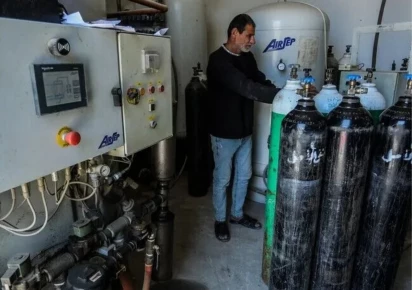
gaza oxygen stations
|

Gaza oxygen stations face shutdown

At least 22 of Gaza’s 34 oxygen stations have stopped operating, the Palestinian Health Ministry said Saturday, warning that the remaining facilities could also shut down because of the Israeli blockade and a critical shortage of spare parts.

The ministry said the 12 functioning stations are operating under severe technical and mechanical strain. Frequent breakdowns and a lack of maintenance have pushed the facilities beyond their normal capacity, making it increasingly difficult to supply oxygen to hospitals and other healthcare providers.

Only four of the 30 machines used to refill oxygen cylinders remain operational, according to the ministry. It warned that these machines could fail at any time because engineering teams lack the parts and equipment needed for emergency repairs.

The ministry stressed that oxygen supplies are essential for life-saving hospital departments and patients receiving treatment at home. It urged the immediate opening of channels to allow spare parts, technical equipment and new oxygen stations to enter Gaza.

The warning follows a statement by Doctors Without Borders (MSF) on August 12, which said Israeli authorities continued to restrict the entry of engine oil and spare parts needed for hospital generators, ambulances and other critical services.

The UN Office for the Coordination of Humanitarian Affairs said in its latest report that Kerem Shalom remains the only operational crossing for goods entering Gaza, while restrictions remain on several essential supplies and types of equipment.

The World Health Organisation, in data published on August 11 covering the period through July 31, also reported severe shortages of healthcare resources and services across Gaza’s medical facilities.

Similar Posts

  • | | |

    Thailand school shooting, teen kills 8 in deadly r…

    BANGKOK: A 14-year-old boy killed at least eight people, including his grandparents, before taking his own life in a shooting rampage at a school outside Bangkok on Friday, police said, in Thailand’s deadliest mass killing since 2022. The teenager opened fire at Debsirin Nonthaburi School in Nonthaburi province, northwest of Bangkok, after allegedly shooting his grandparents at their home. Police said the suspect was among those killed at the school. The attack left 15 people injured, with both students and teachers reported among the casualties. Emergency teams rushed to the school as frightened students streamed out of the building, many without shoes, while ambulances transported the wounded. Police said the teenager fired at least 26 rounds and had another 34 rounds of ammunition. Authorities said the weapon belonged to his grandfather. An 18-year-old student told Reuters he initially believed the loud noises were firecrackers or someone striking an object. He said the sounds stopped briefly before gunfire erupted again. Emergency worker Kiatikhun Verapongpradith said his team arrived while the shooting was still underway and treated students suffering injuries. He said teachers were also among those found injured or dead inside the school. The suspect was later found after apparently shooting himself, according to the emergency worker. He was taken to hospital, but authorities confirmed that he died. Education Minister Prasert Jantararuangtong said both teachers and students were among the casualties, while police identified the teenager as a student. Prime Minister Anutin Charnvirakul expressed sorrow over the incident, describing the shooting as a devastating event for the country. The attack is Thailand’s second school shooting this year. In February, a teacher was killed and a student injured in a shooting at a school in the southern part of the country. Thailand has experienced several deadly gun attacks in recent years. The country’s worst mass killing in recent history occurred in 2022, when a former police officer killed 36 people, including 22 children, during a rampage at a daycare centre in northeastern Thailand. A separate 2023 shooting at a Bangkok shopping centre, carried out by another 14-year-old, killed two people and injured five others. Following that attack, authorities introduced several gun-control measures, including restrictions on new firearm licences and tighter rules concerning access to shooting ranges by people under 20. Thailand has one of Southeast Asia’s highest rates of civilian gun ownership. A Small Arms Survey estimate from 2017 put the number of privately held firearms in the country at around 10.3 million. Friday’s tragedy is expected to renew debate over firearm access, school safety and measures aimed at preventing young people from obtaining weapons.

  • |

    Over 80,000 flee as escalating wildfires ravage south-west France and Spain

    More than 80,000 people have been forced to flee their homes and holiday accommodation across south-west France and central Spain as fierce, uncontained wildfires continue to sweep through the region. Fanned by relentless winds and intense heatwave conditions, the blazes have triggered national emergency declarations and prompted urgent requests for international military and civilian aerial support. In France, authorities ordered the total evacuation of the Cap Ferret peninsula on the Atlantic coast as a vast wildfire in the Gironde department consumed over 12,500 hectares of forest and destroyed at least 80 homes. With the main access road threatened by advancing flames, hundreds of residents and holidaymakers were evacuated by sea using ferries and local boats. A secondary blaze further south near Biscarrosse has burned an additional 2,500 hectares, leaving coastal emergency services struggling to contain the perimeter. Across the border in Spain, the central government declared a national emergency after two massive blazes merged outside Madrid and threatened to join a third active fire in the neighbouring province of Ávila. Over 19,000 people were evacuated overnight across affected municipalities as thick acrid smoke reached the capital’s outskirts. Spanish officials described the convergence of high temperatures, parched terrain, and strong winds as an unprecedented crisis for the region. Both nations have activated the European Union’s Civil Protection Mechanism to request specialized firefighting aircraft, with reinforcements deployed from Portugal, the Czech Republic, Croatia, and Slovakia. Environmental scientists highlight that Europe is warming at roughly twice the global average rate, warning that prolonged droughts and extreme seasonal weather patterns are driving wildfire destruction to historic levels across the continent.

  • |

    Taiwan to test shifting weapons production during major military exercise

    Taiwan will carry out a new military exercise next month to test whether it can continue producing weapons if key defence facilities come under attack during a conflict with China. The drills will include relocating arms production lines and converting civilian factories into military manufacturing sites to ensure the armed forces continue receiving essential equipment even if major supply hubs are damaged. The exercise will take place as part of Taiwan’s annual Han Kuang war games, scheduled from August 5 to August 14. According to the Ministry of National Defense, the scenario will simulate China using its regular military exercises as cover to prepare for a full scale invasion. Taiwan’s armed forces will respond by immediately increasing combat readiness and launching rapid defensive operations. One of the main objectives is to determine whether industrial production can be spread across different locations without disrupting the supply of military equipment. Officials say maintaining manufacturing capacity during wartime is essential because China would likely target command centers, ports, logistics networks and defence factories early in any military campaign. Beijing considers Taiwan part of its territory and has never ruled out using force to bring the island under its control. Taiwan strongly rejects those claims, maintaining that it is already a self governed and independent nation. Major General Lu Wen-yuan, who heads the Joint Operations Division, said the exercise will assume that Chinese forces use their routine annual military drills to hide preparations for a large scale assault. Under the scenario, Taiwan will activate emergency measures and begin moving critical defence production away from vulnerable locations. The drills will include the simulated relocation of the Armaments Bureau’s 202nd Arsenal in Taipei. Civilian factories responsible for assembling complete military systems will also be mobilized after emergency orders are issued. The exercise is designed to measure how quickly industries can shift operations while continuing to meet the military’s needs during a crisis. Taiwan will also examine its ability to keep vital shipping routes open if conflict disrupts normal transport. The navy and coast guard will conduct joint operations using personnel, equipment and live ammunition. These exercises will include escorting shipments of essential supplies, protecting coastal areas, carrying out maritime law enforcement missions and testing upgraded coast guard vessels. The military planning comes as Taiwan reports a noticeable increase in Chinese coast guard activity around the island. Officials in Taipei believe the growing presence could signal greater pressure on Taiwan’s eastern coastline and threaten sea routes that are critical for importing fuel, food and other strategic supplies. For the first time, the Han Kuang exercises will also include a nationwide communications test. Mobile internet speeds will be deliberately reduced during parts of the ten day exercise to assess how the public and emergency services would communicate if network capacity became limited because of natural disasters or military action. Authorities hope the test will help identify weaknesses in emergency communication systems and improve the island’s ability to function during a prolonged crisis. The expanded drills reflect Taiwan’s efforts to strengthen its overall resilience against potential military threats. By preparing industries, transport networks and communication systems for wartime conditions, officials aim to ensure that the island can continue supporting both its armed forces and civilian population even if key infrastructure comes under sustained attack.

  • | | |

    Iran says every threat will strengthen its militar…

    TEHRAN: Iran’s acting Defence Minister, Seyed Majid Ibn al-Reza, has declared that Tehran will continue strengthening its military capabilities by treating every threat from its adversaries as genuine, even as the United States signals a renewed diplomatic effort. His remarks came after US President Donald Trump announced that Washington had postponed a planned military strike against Iran in favour of restarting negotiations aimed at reducing tensions in the Middle East. In a statement posted on social media platform X on Monday, Ibn al-Reza said Iran viewed recent statements from its enemies as part of a broader campaign of psychological and cognitive warfare. However, he stressed that Tehran would not dismiss any warning, regardless of its nature. “We consider every threat to be real and deserving of a serious response,” the acting defence minister said, adding that Iran’s strategy was to transform every external challenge into an opportunity to reinforce its military preparedness and national defence. He said the Iranian armed forces would neither be caught off guard nor remain passive in the face of rising regional tensions. Instead, every warning or hostile statement would serve as a catalyst for expanding the country’s defensive capabilities and maintaining operational readiness. The comments underscore Iran’s continued emphasis on deterrence at a time when uncertainty surrounds the future of US-Iran relations and broader security dynamics across the Gulf. Earlier, President Trump announced that the United States had suspended plans for military action against Iran after requests from Tehran and several Middle Eastern countries to give diplomacy another chance. Writing on his social media platform, Truth Social, Trump claimed the US military had been fully prepared for an operation of unprecedented scale, describing it as one of the largest potential military actions since the Second World War. According to Trump, the proposed negotiations focus on two key objectives: ensuring the immediate and uninterrupted reopening of the Strait of Hormuz for global shipping and addressing concerns over Iran’s nuclear programme. The Strait of Hormuz remains one of the world’s most strategically important maritime routes, carrying a significant share of global oil exports. Any disruption in the waterway has the potential to affect international energy markets and regional stability. While Washington has presented the renewed talks as an opportunity to prevent further escalation, Iranian officials continue to insist that the country will not relax its military vigilance during the diplomatic process. The latest exchange of statements reflects the delicate balance between diplomacy and deterrence, with both sides signalling a willingness to negotiate while simultaneously emphasizing military preparedness amid persistent regional tensions.

  • |

    Far-right extremism expert Heidi Beirich arrested as US Justice Department expands case against SPLC

    The United States Department of Justice has arrested leading far-right extremism expert Heidi Beirich, charging her with financial crimes in an expansion of the federal government’s criminal case against the Southern Poverty Law Centre (SPLC). A superseding indictment returned in Alabama federal court charges Beirich, the former chief financial officer and Intelligence Project director for the SPLC, with conspiracy to commit wire fraud, conspiracy to make false statements to a bank, and conspiracy to commit money laundering. The charges stem from an April indictment against the civil rights organization over a discontinued intelligence programme that paid informants to infiltrate white supremacist groups. Federal prosecutors allege the SPLC secretly funneled donor funds through shell companies and fictitious entities to hide payments made to field sources. The government claims Beirich engaged in a romantic relationship with one informant and oversaw the transfer of $140,000 in donor funds into a shared bank account. Beirich, who currently serves as chief strategy officer and co-founder of the Global Project Against Hate and Extremism, denied the allegations through her legal counsel. Defense attorney Michael Proctor characterized the prosecution as politically motivated retaliation against an expert who dedicated decades to dismantling white supremacist movements. A federal judge in Alabama permitted the broader case against the SPLC to proceed last week after rejecting arguments requesting a dismissal on grounds of vindictive prosecution.

  • |

    Trump media loss widens to $238m as new revenue pu…

    NEW YORK: Trump Media & Technology Group, the company behind US President Donald Trump’s Truth Social platform, reported a sharply wider quarterly loss as falling cryptocurrency values weighed heavily on its finances. The company said its net loss for the second quarter reached $238.1 million, compared with a loss of about $20 million during the same period a year earlier. The steep increase was largely linked to unrealised losses on digital assets held by the company, highlighting the financial risks of its growing exposure to cryptocurrencies. The results come at a time when digital assets faced renewed pressure from investors. During the April-to-June quarter, uncertainty over US interest rates, geopolitical tensions and continued outflows from crypto investment products pushed many investors away from riskier assets. Despite the large loss, Trump Media reported an increase in revenue. Revenue for the quarter ended in June rose to $1.7 million, compared with $900,000 during the same period last year. The company is now attempting to build new sources of income beyond advertising and social media. Truth API enters the market One of its most closely watched projects is Truth API, a licensed data feed launched on August 1. The service is designed to provide banks, trading firms and other financial institutions with rapid access to posts from influential Truth Social accounts. Trump’s posts frequently attract significant attention from investors and can influence financial markets, making access to the data potentially valuable for trading and financial analysis. Trump Media has reportedly discussed charging customers as much as $100,000 per month for the service. The company said it had already signed more than 10 customer agreements for Truth API and was continuing to add partners. “Our new Truth API product is already generating revenue, with more than ten customer agreements signed to date,” interim Chief Executive Kevin McGurn said in a statement. The early agreements offer the company a potentially important new revenue stream as it seeks to reduce its dependence on Truth Social. Bigger ambitions beyond social media Trump Media is also pursuing an ambitious expansion into other industries. McGurn said the company was making progress toward its proposed merger with TAE Technologies, a fusion-energy developer. The planned deal reflects a broader strategy to position Trump Media around emerging technologies and businesses expected to benefit from growing demand for electricity. Fusion energy has attracted increased attention as artificial intelligence data centres consume increasing amounts of power, creating pressure for new energy sources. The company’s expansion adds another unusual chapter to Trump Media’s corporate strategy, which already stretches from social media and cryptocurrency into financial technology and other ventures. Investors watching closely The latest results underline the challenge facing Trump Media as it attempts to turn its high-profile brand into a sustainable business. Truth Social has significant visibility because of Trump’s political influence and his large following on the platform. However, the company’s relatively modest quarterly revenue compared with its substantial loss highlights the difficulty of converting that attention into consistent earnings. The launch of Truth API could provide a new path if financial institutions continue signing up for the service. At the same time, the company’s exposure to cryptocurrency means its financial results could remain sensitive to swings in digital-asset prices. For investors, the latest figures present a mixed picture: Trump Media is expanding its business ambitions and adding new customers, but its losses remain substantial and its strategy carries considerable financial risk.

Leave a Reply

Your email address will not be published. Required fields are marked *