gold prices surge

Gold prices surge sharply in Pakistan 


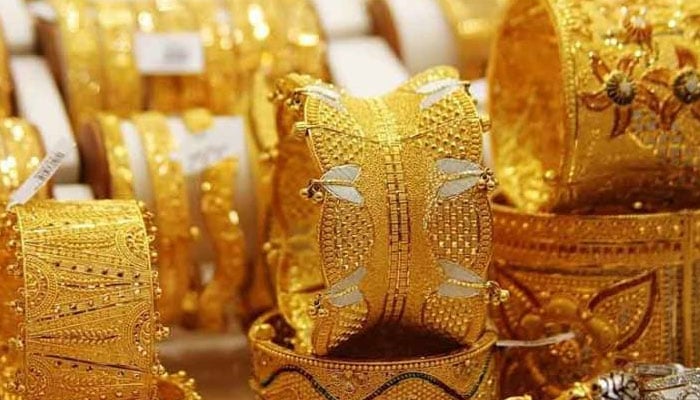
Gold prices in Pakistan recorded a significant increase on Wednesday, with the price of the precious metal rising by Rs4,600 per tola in a single day. The sharp jump reflects the continued upward trend in international gold markets, where rising prices have influenced local rates as well

According to the All Pakistan Sarafa Gems and Jewellers Association, the latest increase has pushed the price of one tola of gold to Rs433,836, marking another record-high level in the domestic bullion market. The continued rise in gold prices has drawn the attention of investors, traders, and consumers, particularly those planning to purchase jewellery or invest in the precious metal.

The association reported that the price of 10 grams of gold also witnessed a notable increase. Following a gain of Rs3,944, the price of 10 grams reached Rs371,944. The increase is consistent with the movement in international gold prices and reflects the close connection between Pakistan’s bullion market and global trading trends.

Market experts say fluctuations in the international gold market often have a direct impact on local prices. Gold is widely considered a safe-haven asset, and demand for the precious metal generally rises during periods of global economic uncertainty, geopolitical tensions, inflation concerns, or fluctuations in currency values. These factors can drive prices higher in international markets, which are then reflected in domestic rates.

According to the All Pakistan Sarafa Gems and Jewellers Association, the increase in local gold prices follows a strong rally in the global bullion market. Internationally, the price of gold rose by 46 US dollars per ounce, taking it to 4,114 dollars per ounce. The rise in international prices played a key role in pushing domestic gold rates to new highs.

The recent surge has created mixed reactions among different groups. Investors who already hold gold may benefit from the increase in value, while consumers looking to purchase jewellery or invest for the first time may find the higher prices challenging. Jewellers also closely monitor these price movements, as sudden increases can influence customer demand and overall market activity.

Gold remains one of the most preferred investment options in Pakistan, particularly during periods of economic uncertainty. Many people purchase gold not only for jewellery but also as a long-term investment and a hedge against inflation. As a result, even small changes in international prices can significantly affect buying and selling trends in local markets.

Financial analysts believe future gold prices will largely depend on developments in the global economy, central bank policies, inflation trends, and geopolitical events. Any further movement in international bullion markets is likely to influence domestic prices in the coming days.

With gold reaching Rs433,836 per tola and Rs371,944 per 10 grams, the local market continues to reflect the strength of global demand for the precious metal. Traders and investors will now be closely watching international market developments to determine whether the upward trend continues or prices stabilize in the near future.

Similar Posts

  • | | |

    PSX retreats as profit-taking, oil prices hit sent…

    The Pakistan Stock Exchange (PSX) came under pressure on Friday as investors opted to book profits after the market’s recent gains. The benchmark KSE-100 Index fell sharply during early trading, reflecting cautious investor sentiment amid rising global oil prices and uncertainty over developments surrounding the Strait of Hormuz. The index dropped 771.05 points, or 0.42%, to 181,005.54 by 9:39am. Selling was reported across several major sectors, putting pressure on the overall market. By noon, the KSE-100 had recovered some of its losses and was trading at 181,326.54 points, down 450.05 points, or 0.25%, from Thursday’s close of 181,776.59. During the session, the index moved between an intraday high of 181,647.27 and a low of 180,620.08 points. Trading activity remained moderate, with around 146.05 million shares changing hands. The total value of traded shares stood at approximately Rs10.06 billion. Selling was visible in several heavyweight sectors, including automobile assemblers, cement companies, commercial banks, fertiliser firms, oil and gas exploration companies and oil marketing companies. Market sentiment was also affected by the continued rise in international crude prices. Investors remained cautious over possible disruptions to energy supplies amid tensions surrounding the Strait of Hormuz. Analysts attributed the decline largely to profit-taking following the market’s recent strong performance. Investors appeared reluctant to make fresh aggressive positions while global oil prices and geopolitical risks remained elevated. Despite Friday’s decline, the KSE-100 remained above the 181,000-point level, indicating that the broader market continued to retain much of its recent gains.

  • |

    Global oil prices decline as OPEC cuts 2026 demand forecast

    Global crude oil prices fell by more than $1 a barrel on Thursday after a period of gains, as concerns over weaker oil consumption in 2026 outweighed ongoing supply risks linked to the conflict in the Middle East. Brent crude futures declined by $1.29, or around 1.5%, to $87.69 per barrel, while US West Texas Intermediate (WTI) crude dropped $1.30, or about 1.6%, to $81.97 per barrel. Market sentiment was pressured by fresh estimates indicating that global oil demand could grow more slowly than previously expected next year. The weaker demand outlook has encouraged investors to reassess the strength of the oil market despite continued uncertainty over supplies from the Middle East. The latest decline came after the Organisation of the Petroleum Exporting Countries (OPEC) lowered its forecast for global oil demand growth in 2026 to 580,000 barrels per day in its monthly oil market report. This marks the fourth consecutive reduction in the organisation’s demand-growth projection. The ongoing conflict involving Iran and the United States and Israel has disrupted energy supplies and shipping routes, creating significant uncertainty in international oil markets. However, analysts say the economic and logistical disruptions are also weighing on fuel consumption and broader global demand. Despite the latest decline, supply concerns continue to provide some support to crude prices. Traders remain focused on developments in the Middle East, particularly the impact of the conflict on oil production, exports and major shipping routes. Analysts are therefore expecting continued volatility in global oil prices as markets balance two opposing factors: the risk of supply shortages caused by geopolitical tensions and the possibility of weaker demand resulting from disruptions to economic activity. The latest OPEC forecast is likely to remain an important factor for investors in the coming sessions, particularly as traders assess whether weaker demand can offset the supply risks currently affecting the global energy market.

  • |

    CDA launches Rs5.07bn Six-Lane Road project from Faizabad to Koral Chowk

    The Capital Development Authority (CDA) has accelerated plans to construct a new six-lane carriageway along Service Road East, approving a project worth Rs5.072 billion aimed at easing chronic traffic congestion on the Islamabad Expressway and improving connectivity between Faizabad and Koral Chowk. The 9.25-kilometre road will run parallel to the Islamabad Expressway, extending from Faizabad to Koral Chowk near Gulberg Housing Society. Once completed, the new corridor is expected to provide motorists with an alternative route, reducing travel time on one of the capital’s busiest transport arteries while facilitating smoother traffic movement for commuters travelling to Islamabad and Rawalpindi. Officials said the project forms part of the CDA’s broader strategy to upgrade the capital’s road infrastructure in response to increasing traffic volumes and rapid urban expansion in surrounding residential and commercial areas. According to official sources, the new carriageway is expected to improve access to several housing societies and neighbourhoods located along the eastern side of the Islamabad Expressway. Authorities believe the project will not only ease traffic bottlenecks but also stimulate commercial development by increasing the value of properties and attracting new businesses along the corridor. To facilitate construction, the CDA has earmarked approximately Rs500 million for the relocation of critical utility infrastructure. This includes fibre-optic networks operated by the Islamabad Police Safe City Project, the Strategic Plans Division (SPD), Sui Northern Gas Pipelines Limited (SNGPL), and the Islamabad Electric Supply Company (IESCO). Sources said extensive utility shifting will be required before the main construction work can proceed at full pace. The project involves relocating 11kV electricity distribution lines, shifting 242 electricity poles, and relocating 248 graves that fall within the road alignment. Earthwork activities have already begun at selected locations. The road project also incorporates environmental protection measures. Officials said engineers have planned the preservation of 22 underground water channels, natural streams, and stormwater drains located along the proposed route to minimise environmental disruption and maintain the area’s natural drainage system. A breakdown of utility relocation costs shows that around Rs406 million has been allocated for IESCO infrastructure, Rs87.3 million for shifting Safe City fibre-optic networks, and approximately Rs6 million for relocating SPD facilities. Work on these utility relocation components is expected to commence after the completion of technical and administrative formalities. A senior CDA official said the authority has revised the project’s completion timeline, reducing the original target of 12 months to between six and eight months. However, the official acknowledged that the timely relocation of utilities remains the biggest hurdle and will largely determine whether the revised deadline can be achieved.

  • | | |

    Pakistan pushes stronger ties with Belarus, Centra…

    Pakistan has renewed its commitment to strengthening relations with Belarus and Central Asian countries. Deputy Prime Minister and Foreign Minister Ishaq Dar held separate meetings with the foreign ministers of Belarus, Kazakhstan, Tajikistan and Uzbekistan in Cholpon-Ata, Kyrgyzstan. The meetings were held on the sidelines of the Shanghai Cooperation Organisation (SCO) Council of Foreign Ministers meeting.The discussions focused on bilateral relations, trade, investment, regional connectivity and security. Dar met Belarusian Foreign Minister Maxim Ryzhenkov and reviewed the progress of relations between the two countries.The two sides agreed to expand cooperation in several important areas. These include trade, investment, defence, agriculture, technology and workforce exchanges.They also discussed ways to strengthen economic ties and increase bilateral business activity. Pakistan and Belarus are also preparing for the next session of their Joint Ministerial Commission.The ninth session is scheduled to take place in Islamabad on August 11 and 12, 2026. The two countries are expected to use the meeting to explore new areas of cooperation.Dar and Ryzhenkov also discussed regional developments. The Belarusian foreign minister appreciated Pakistan’s diplomatic efforts to support dialogue and promote peace and stability in the region. Dar also met Kazakhstan’s Foreign Minister Yermek Kosherbayev.The two ministers reviewed the positive progress in relations between Pakistan and Kazakhstan. They agreed to accelerate the implementation of agreements reached during recent high-level exchanges.A key focus was the implementation of 37 memorandums of understanding signed during a high-level visit. The two countries also agreed to increase cooperation in trade, investment, transport, energy and regional connectivity. People-to-people contacts and cooperation at international forums were also discussed.Kosherbayev appreciated Pakistan’s efforts to support regional peace and diplomacy. He also invited Dar to visit Kazakhstan.The Pakistani foreign minister accepted the invitation and said the visit would take place at a mutually convenient time. In another meeting, Dar held talks with Tajik Foreign Minister Sirojiddin Muhriddin.Both sides described Pakistan-Tajikistan relations as close and longstanding. They agreed to further expand cooperation in several sectors.These include trade, investment, energy, connectivity and culture. The two ministers also highlighted the importance of stronger people-to-people contacts.They agreed that regular high-level exchanges could help deepen bilateral relations. The two sides also discussed regional and global developments.They stressed the importance of cooperation through international and multilateral platforms. Tajikistan also expressed support for Pakistan’s efforts to promote peace and the peaceful resolution of regional issues.Dar also met Uzbek Foreign Minister Bakhtiyor Saidov. The two ministers reaffirmed the importance of the Pakistan-Uzbekistan strategic partnership. They reviewed progress in bilateral cooperation.Trade, investment, connectivity, energy, culture and people-to-people relations were among the key areas discussed. Dar and Saidov also stressed the importance of stronger links between the business communities of both countries. They said closer business engagement could help increase trade and investment.The two ministers also discussed the implementation of understandings reached during Uzbek President Shavkat Mirziyoyev’s recent visit to Pakistan. They agreed that existing agreements should be converted into practical projects through timely implementation. Regional and global developments were also discussed.Saidov appreciated Pakistan’s diplomatic efforts to promote regional peace and stability. Both sides expressed hope that dialogue and diplomacy would continue to support lasting peace in the region. Dar’s meetings took place during his visit to Kyrgyzstan for the SCO Council of Foreign Ministers meeting. Pakistan used the diplomatic engagement to highlight its longstanding relations with SCO member states. Islamabad also reaffirmed its readiness to assume the SCO chairmanship for 2026–27.Pakistan has expressed its intention to promote greater cooperation among member states. The focus will include socioeconomic development, regional connectivity and mutual economic benefits. Dar also attended an informal dinner hosted by Kyrgyz Foreign Minister Zheenbek Kulubaev for visiting dignitaries. During the visit, Dar met Kyrgyz President Sadyr Zhaparov and conveyed greetings from Pakistan’s leadership.He expressed Islamabad’s desire to strengthen cooperation with Kyrgyzstan across different sectors. Dar later led Pakistan’s delegation at the SCO ministerial meeting. In his national statement, he reaffirmed Pakistan’s commitment to the SCO Charter and the principles of the Shanghai Spirit.These principles include mutual trust, mutual respect, shared prosperity and development. Pakistan has also invited SCO member states to attend the SCO Council of Heads of State summit in Pakistan next year.The government says Islamabad’s upcoming SCO leadership will provide an opportunity to strengthen regional cooperation and deepen economic and diplomatic ties with member states.

  • How Thai SMEs Can Audit & Prepare Product Catalogs for Amazon Global Selling

    For Thai SMEs, this is often where the gap lies. A product catalog that performs well on local sales channels may still fall short of Amazon’s cross-border selling requirements for product identifiers, category attributes, variation structure, listing content, images, claims, compliance documents, and fulfillment data. An Amazon product catalog audit helps identify these gaps before […]

  • | |

    Punjab bans manual receipts

    The Punjab Revenue Authority (PRA) has banned the issuance of handwritten or manual receipts by businesses operating in the province, according to a notification issued by the authority. Under the new directive, hotels, restaurants, coffee shops and marriage halls must use the Electronic Invoice Management System (EIMS) for issuing customer receipts. The system aims to ensure that businesses properly record their transactions and comply with provincial sales tax regulations. A PRA spokesperson said businesses covered by the directive must generate receipts through EIMS instead of providing handwritten slips or informal receipts to customers. The authority will monitor compliance and take action against businesses that fail to follow the requirement. Businesses that do not issue receipts through the EIMS may face fines ranging from Rs400,000 to Rs1 million, the spokesperson said. The PRA has also warned that repeated violations could lead to stricter action. Authorities may seal the business premises for up to one month if an establishment continues to disregard the rules despite previous enforcement measures. The move forms part of the Punjab government’s efforts to strengthen digital documentation of commercial transactions, improve tax compliance and reduce the possibility of underreporting sales and tax liabilities. The authority has urged businesses in the affected sectors to ensure that their invoicing systems comply with the new requirements to avoid financial penalties and other enforcement action.

Leave a Reply

Your email address will not be published. Required fields are marked *