heavy rain kills
|

Heavy rain kills four in Japan


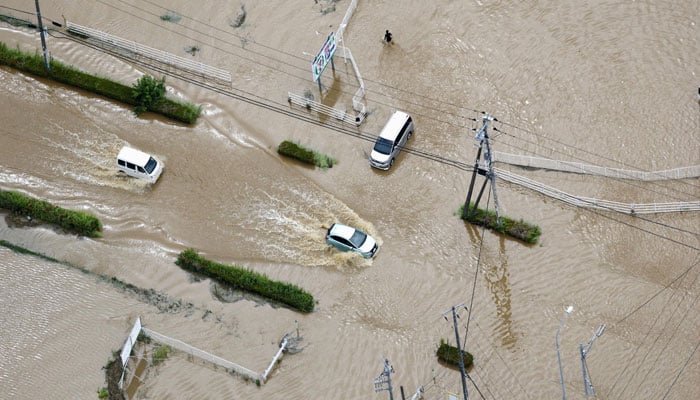
CHIBA, Japan: At least four people have died and another remains missing after record-breaking rainfall triggered flooding and severe disruption in Chiba Prefecture, east of Tokyo.

Japan’s weather authorities reported that Chiba City received 367 millimetres of rain within 24 hours, marking an exceptionally heavy downpour for the region. The intense rainfall caused flooding, damaged infrastructure and disrupted daily life across several areas.

More than 25,000 households lost electricity as the storm damaged power infrastructure. The severe weather also disrupted air travel, leaving more than 7,000 passengers stranded at airports. Authorities cancelled dozens of train services, while flooding and dangerous road conditions forced the closure of several major highways.

Officials issued an emergency high alert for areas facing the greatest risk from flooding and further rain. Rescue teams have been working to reach affected communities, while the Japanese government has sought assistance from the Self-Defense Forces to support evacuation and relief operations.

Authorities have urged residents in vulnerable areas to remain alert, avoid flooded roads and follow evacuation instructions as emergency crews continue searching for the missing person and assessing the extent of the damage.


Similar Posts

  • | |

    Modi unveils free coaching and AI training plan to…

    NEW DELHI: Indian Prime Minister Narendra Modi has announced a major education and skills initiative aimed at addressing growing concerns among young people over employment, competitive exams and the rising cost of education. Speaking at India’s Independence Day ceremony at the Red Fort, Modi said the government would offer free online coaching for a range of competitive examinations. He said the programme would help reduce the financial pressure on families whose children spend years preparing for highly competitive entrance and recruitment tests. The announcement follows nationwide youth protests sparked by allegations of examination paper leaks and recruitment irregularities. The demonstrations intensified pressure on the government and contributed to the resignation of Education Minister Dharmendra Pradhan last month. Modi also announced an ambitious artificial intelligence skills programme, saying 10 million young Indians would receive AI-related training over the next year. The government hopes the initiative will equip young people with skills needed in a rapidly changing job market. India’s competitive education system has created a large private coaching industry, with many families spending heavily on preparation courses. Modi said free digital coaching would allow students to remain with their families while reducing the financial burden associated with preparation. During his speech, Modi also outlined a broader seven-point development and reform agenda covering manufacturing, agriculture, technology, defence and sectors linked to India’s cultural influence. He reiterated his goal of transforming India into a developed economy within the next two decades. The prime minister also announced plans for additional semiconductor facilities and nuclear reactors, with the government seeking to expand domestic manufacturing and energy capacity. Modi said India’s young population would be central to achieving the country’s development ambitions, describing youth as the biggest potential beneficiaries of a more prosperous and developed India.

  • |

    Saudi sounds alarm on rising sea threats

      Saudi Arabia has issued a forceful warning over escalating security dangers in the region, making it clear that the era of unilateral action is over. In an official statement, Ministry of Defense Spokesman Major General Turki Al-Malki stressed that new and complex threats—ranging from maritime terrorism to drone swarms and smuggling networks—now demand a collective response. “Every country has the right to protect its national interests,” Al-Malki said, “but the scale and sophistication of today’s risks require us to act together. No nation can stand alone.” He specifically pointed to the Red Sea corridor, a lifeline for global oil shipments and trade, as a flashpoint that needs constant vigilance. The nations bordering this strategic waterway, he added, are already in continuous dialogue to align their security strategies. The spokesman made it clear that the multi-national naval defense coalition—first proposed by Saudi Arabia—is not an offensive alliance but a defensive shield. Its core mission: to secure international shipping lanes, deter hostile acts, and ensure freedom of navigation in accordance with international law. The coalition, he emphasized, is open to all nations that share these goals and is firmly rooted in the principles of the United Nations Convention on the Law of the Sea. Al-Malki warned that the threat landscape has shifted dramatically. Non-state actors now possess advanced unmanned systems, anti-ship missiles, and cyber capabilities that can disrupt maritime traffic within minutes. Piracy and human trafficking add another layer of complexity. “We are not facing traditional navies,” he noted. “We are facing hybrid threats that exploit every gap in coordination. That is why interoperability, intelligence-sharing, and joint patrols are no longer optional—they are survival tools.” In a move that underscores Saudi Arabia’s commitment to this mission, the Ministry of Defense announced the appointment of Rear Admiral Abdullah bin Salim as the commander of the coalition. A distinguished naval officer with decades of command experience, bin Salim has served in multiple high-level posts within the Royal Saudi Naval Forces, overseeing fleet modernization and participating in large-scale international exercises. His leadership is expected to bring operational sharpness, strategic clarity, and a hands-on approach to coalition drills and rapid-response mechanisms. Rear Admiral bin Salim’s appointment is not merely symbolic. It reflects Saudi Arabia’s willingness to shoulder greater responsibility in regional security while maintaining an inclusive, consultative stance. He will oversee the integration of naval assets from partner nations, coordinate joint training missions, and ensure that the coalition can respond within hours—not days—to any maritime breach. Al-Malki also extended an open invitation to the international community. “We welcome all nations that believe in a rules-based maritime order,” he said. “The Red Sea is not just a regional asset—it is a global artery. Its security is everyone’s business.” He called for increased naval presence, technology transfers, and financial backing to sustain the coalition’s operations over the long term. The spokesman concluded with a sobering reminder: in a world of drone warfare, proxy conflicts, and rapidly evolving tactics, waiting for disaster is not a strategy. “The coalition is already active,” he said. “Our patrols are ongoing, our command is in place, and our resolve is firm. We are building a security architecture that will outlast any single crisis.” With Rear Admiral bin Salim now at the helm, the coalition enters a new phase—one defined by action, accountability, and unity. Saudi Arabia has made its position clear: the time for talk is over. The time for collective defense is now.

  • |

    Morocco commits to repatriating unaccompanied minors following mass migration into Ceuta

    The Moroccan government has announced its willingness to collaborate with Spain and European authorities to identify and repatriate unaccompanied minors who crossed into the Spanish North African enclave of Ceuta during a recent surge in border crossings. According to state news agency MAP, King Mohammed VI directed the interior and foreign affairs ministries to coordinate the identification and safe return of the young migrants to their families in Morocco. The official statement follows diplomatic discussions aimed at addressing the logistical and legal challenges surrounding under-age migrants, who cannot be immediately turned back under standard border control agreements. The initiative comes in the wake of a massive border influx that saw tens of thousands of individuals attempt to enter European territory on foot and by sea. Spanish officials estimated that 72,000 migrants crossed the border during the height of the crisis, while Moroccan estimates placed the figure closer to 40,000. Although the vast majority of adult migrants have since returned or been repatriated to Morocco, local authorities in Ceuta report that at least 1,100 unaccompanied minors remain in government reception facilities. The diplomatic agreement marks a pivotal step toward relieving pressure on regional welfare services in Ceuta while establishing formal bilateral protocols between Rabat and Madrid to ensure child protection standards are met during repatriation procedures.

  • |

    Tipu Usman seeks closer media engagement to strengthen Pakistan’s UK diaspora outreach

    LONDON: Pakistan’s High Commissioner to the United Kingdom, Tipu Usman, has called for closer engagement with Pakistani media in the UK to strengthen outreach to the Pakistani diaspora and ensure the community remains informed about initiatives and reforms aimed at facilitating overseas Pakistanis. The High Commissioner made the remarks during an introductory meeting with representatives of Pakistani media houses working in London. Tipu Usman appreciated the positive role played by Pakistani media in the UK during Marka-e-Haq, particularly its contribution to keeping the Pakistani diaspora informed about important national developments and issues affecting the community. He said the Pakistan High Commission in London remained committed to working closely with Pakistani media representatives to enhance outreach and effectively communicate initiatives and reforms that would facilitate members of the Pakistani diaspora across the UK. The High Commissioner stressed the importance of effective communication and engagement with the Pakistani community, saying the media could play an important role in ensuring that information about government initiatives and services reaches overseas Pakistanis in a timely and effective manner. The representatives of Pakistani media houses welcomed Tipu Usman on assuming his responsibilities as Pakistan’s High Commissioner to the UK and conveyed their best wishes for his tenure. During the interactive session, media representatives shared various suggestions aimed at improving the High Commission’s outreach to the Pakistani diaspora and strengthening efforts for the welfare of the Pakistani community residing across the United Kingdom. The participants discussed the importance of maintaining regular engagement between the High Commission and Pakistani media to improve communication with the community and provide greater awareness of initiatives, services and reforms relevant to overseas Pakistanis. The meeting provided an opportunity for an open exchange of views on ways to further strengthen coordination between the Pakistan High Commission, Pakistani media and the wider Pakistani diaspora in the UK. The High Commissioner welcomed the suggestions put forward by the media representatives and reaffirmed the High Commission’s readiness to work collaboratively with the media for more effective engagement with the Pakistani community across Britain.

  • |

    Indian activist Sonam Wangchuk ends 26-day hunger strike

    Indian environmentalist and social activist Sonam Wangchuk has ended his 26-day hunger strike after holding discussions over the ongoing nationwide protests against alleged examination paper leaks. However, demonstrations demanding the resignation of Education Minister Dharmendra Pradhan are continuing across India. Wangchuk announced his decision through a post on social media, saying he ended the fast after lengthy negotiations and concerns that the situation could lead to further violence. He said he would soon explain the conditions that led to his decision in a separate video message. The 59-year-old activist had been fasting since June 28 in support of a youth-led protest movement that accuses the government of failing to prevent repeated examination paper leaks. Protesters have demanded the resignation of the education minister after alleged leaks in medical college entrance examinations forced millions of students to retake the tests. Shortly before Wangchuk’s announcement, Prime Minister Narendra Modi addressed the nation and pledged stronger legal action against those responsible for examination fraud. He described the paper leak scandal as a serious issue affecting the future of hundreds of thousands of students and said the government would introduce tougher legislation to combat such crimes. Modi also announced plans to speed up court proceedings against those involved in examination fraud, adding that the issue would be discussed by the federal cabinet. While outlining the government’s response, he did not comment on demands for the education minister’s resignation. Despite Wangchuk ending his fast, thousands of protesters continue to gather at New Delhi’s Jantar Mantar and in several other cities. Demonstrators say they will maintain their peaceful campaign until the education minister steps down and comprehensive reforms are introduced to restore transparency and fairness in India’s examination system. The protests have become one of the biggest public challenges faced by Prime Minister Modi’s government since beginning its third term. Tensions have risen in recent days after clashes between police and protesters. Security forces used tear gas and batons to stop demonstrators attempting to march towards parliament, leading to widespread criticism from rights organisations over the handling of the protests.

  • |

    Indian court acquits ex-wrestling chief in harassment case

    A court in New Delhi has acquitted former Wrestling Federation of India (WFI) chief Brij Bhushan Sharan Singh in a high-profile sexual harassment and stalking case filed by several women wrestlers, bringing an end to one of India’s most closely watched legal proceedings involving the sports community. Singh, 69, a former member of parliament from the ruling Bharatiya Janata Party (BJP), had faced allegations from a group of prominent female wrestlers who accused him of sexual harassment, inappropriate conduct and demanding sexual favours. He consistently denied all allegations throughout the investigation and trial. The case attracted nationwide attention in 2023 after leading Indian wrestlers, including world champion Vinesh Phogat and Olympic bronze medallist Sakshi Malik, launched weeks-long protests demanding Singh’s removal from the Wrestling Federation of India and legal action against him. The demonstrations sparked widespread debate over athlete safety, accountability and the treatment of women in Indian sports. According to Singh’s legal team, the court cleared him of all charges after finding inconsistencies in witness testimonies and contradictions in key aspects of the prosecution’s case. Following the verdict, his supporters celebrated outside the court by showering him with flower petals, bursting firecrackers and chanting slogans. Reacting to the ruling, Singh welcomed the decision and maintained that he had always been confident of his innocence. He described the judgment as a complete vindication of his position. Despite the acquittal, wrestler Vinesh Phogat said the legal battle was not over. She announced that the athletes would challenge the verdict before a higher court, insisting they would continue seeking justice. Phogat said it had taken immense courage for the wrestlers to file complaints against a politically influential figure and vowed to pursue the case through all available legal channels. The controversy first erupted in 2023 when protesting wrestlers accused authorities of delaying action despite their complaints. Images of athletes being detained while marching towards the Indian Parliament drew widespread attention and intensified public scrutiny of the case.

Leave a Reply

Your email address will not be published. Required fields are marked *