
this economy dapat
| | | |

[In This Economy] Dapat ka bang singilin dahil sa utang ng Pilipinas?

Umani ng kontrobersya ang pahayag ni Senador Alan Peter Cayetano noong September 23 sa umpisa ng plenary sessions sa pagtalakay sa 2027 budget.

Pinalutang kasi niya ang ideyang kusang mag-ambag ang mga Pilipino ng mahigit P170,000 bawat isa.

Ito ay bunsod ng mga ulat na sa P19.66 trilyon ang utang ng pambansang gobyerno sa pagtatapos ng Setyembre 2026, ayon sa Bureau of the Treasury. Katumbas ’yan ng 66.9% ng GDP, mula sa 66% noong katapusan ng Hunyo.

Sa madaling salita, lumaki na talaga ang utang kumpara sa laki ng ekonomiya.

Ang pahayag ni Cayetano ay pinatulan naman ng media. Sa iba’t ibang ulat, pinukaw ang atensyon ng mga tao sa tanong na, “Magkano ang utang ng bawat Pilipino?”

Ang sagot umano ay P174,405.06. Nakuha ’yan sa paghahati ng utang ng gobyerno sa populasyong naitala sa 2024 census.

Ngunit may pakiusap ako sa media at sa mga politiko. Tuwing lumalabas ang bagong datos sa utang ng gobyerno, tigilan na po sana natin ang pagsasabing “ganito na kalaki ang utang ng bawat Pilipino.”

Alam ko naman kung bakit patok ang linyang ’yan. Mahirap arukin kung gaano kalaki ang isang trilyong piso. Kapag hinati mo ang utang sa dami ng Pilipino, mas relatable ang halaga at mas madaling isama sa headline.

Ngunit ang implikasyon ng ganitong numero ay pati ang mga sanggol na kapapanganak lang ay may utang na dapat bayaran. At pinapahiwatig din na pwedeng singilin ang bawat Pilipino. Maling-mali ito!

Tandaan na gobyerno ang umutang. Gobyerno rin ang may obligasyong magbayad.

Siyempre, apektado tayong mga ordinaryong mamamayan dahil sa buwis din natin nanggagaling ang malaking bahagi ng perang ginagamit ng gobyerno para magbayad. Bukod diyan, kapag lumalaki ang kinakain ng interes sa budget, mas kaunti ang perang puwedeng ilaan sa mga silid-aralan, ospital, at iba pang serbisyo.

Pero wala tayong kanya-kanyang bill na katumbas ng “utang kada Pilipino.”

Misleading ang debt per person na numero. Kasi kung pareho lang ang utang ng gobyerno at dumami ang populasyon, bababa agad ang utang kada tao. Pero may nabayaran ba ang gobyerno? Wala. Nadagdagan ba agad ang koleksiyon ng buwis? Wala rin. Bumaba ang numero dahil dumami ang pinaghati-hatian.

Kaya ang mas magandang tanong na dapat nating sagutin ay: Sustainable ba ang utang? At kaya bang tugunan ng gobyerno ang mga obligasyon nito sa paglipas ng panahon nang hindi napipilitang magtaas nang husto ng buwis o magbawas nang malaki sa mahahalagang serbisyo?
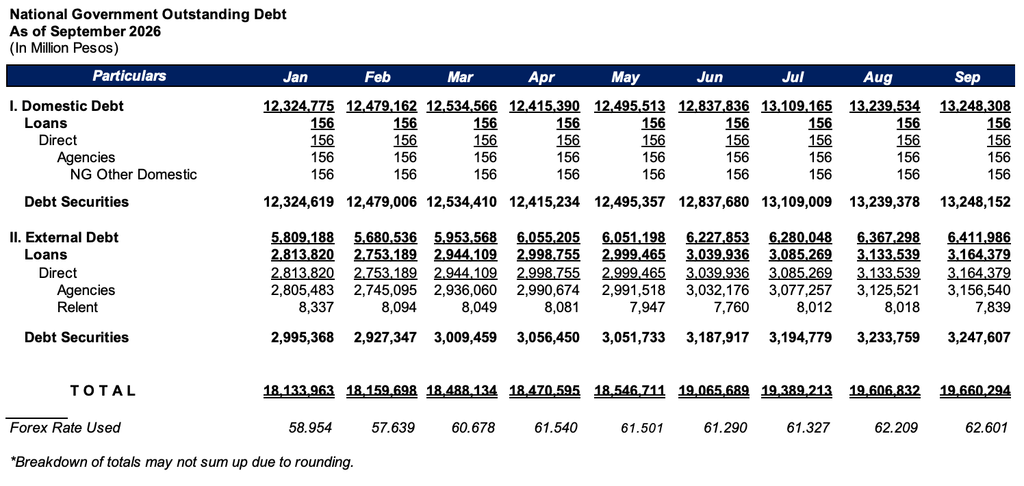
National government oustanding debt, table, as of September 2026
Source: Bureau of Treasury
Gaano kalaki ang utang kumpara sa ekonomiya?

Dito pumapasok ang konsepto ng “debt-to-GDP ratio.”

Kinukumpara nito ang kabuuang utang sa gross domestic product o GDP, ang halaga ng mga produkto at serbisyong nalilikha ng ekonomiya sa loob ng isang taon.

Halimbawa, kung P15 trilyon ang utang at P25 trilyon ang GDP, 60% ang ratio.

Kung tumaas ang utang sa P16 trilyon pero lumaki ang GDP sa P28 trilyon, bababa ang ratio sa mga 57%. Lumaki ang utang sa piso, pero mas mabilis lumaki ang ekonomiyang pinanggagalingan ng kita at buwis.

Walang namang awtomatikong “safe” na numero. Magkaiba ang sitwasyon ng dalawang gobyernong pareho ang debt-to-GDP ratio kung mas mataas ang interes na binabayaran ng isa, o kung mas maliit ang nakokolekta nitong buwis.

Kaya mahalaga ring tingnan kung pataas o pababa ang debt-to-GDP ratio at kung gaano kalaki sa kita ng gobyerno ang napupunta sa interes.

Must Read

[In This Economy] The Philippines has entered stagflation territory


[In This Economy] The Philippines has entered stagflation territory

Alin ang mas mabilis, interes o growth ng ekonomiya?

May isa pang paghahambing na madalas gamitin ng mga ekonomista, at ito ang r vs. g.

Ang r ay ang average na interes sa utang ng gobyerno, at ang g ay ang bilis ng paglago ng ekonomiya.

Kapag mas mabilis lumaki ang ekonomiya kaysa sa interes sa utang, mas madaling pigilan ang pagtaas ng debt-to-GDP ratio. Kapag mas mataas naman ang interes kaysa sa paglago, mas mahirap.

At kahit paborable ang agwat, puwede pa ring tumaas ang debt ratio kung taon-taon ay mas malaki ang gastos ng gobyerno kaysa sa kita nito, kahit ibukod pa ang bayad sa interes.

Panghuli, at marahil pinaka-importante, dapat ding tanungin: Saan napunta ang inutang?

‘Di naman kasi masama ang umutang. Kung ginamit sa tulay na nagpapababa ng gastos sa pagbiyahe at pagdadala ng produkto, may pakinabang na puwedeng tumagal nang maraming taon. Ngunit kung napunta sa proyektong binayaran pero wala palang naitayo (aka “ghost projects”), taon din nating babayaran ang interes.

Kaya sa susunod na maglabas ng datos sa utang, ito ang itanong natin sa mga opisyal: Gaano kalaking bahagi ng kita ng gobyerno ang kinakain ng interes? Sa bilis ng paglago ngayon, saan papunta ang debt-to-GDP ratio? At ano ang naipagawa o naibigay sa publiko gamit ang perang inutang?

Mas may silbi sa mga Pilipino ang mga sagot diyan, kaysa sa isa na namang click-baity headline na may utang daw ang bawat isa sa atin. – Rappler.com

Jan Carlo “JC” Punongbayan, PhD, is an associate professor at the University of the Philippines School of Economics. His professional experience includes the Securities and Exchange Commission, the World Bank Office in Manila, the Far Eastern University Public Policy Center, and the National Economic and Development Authority. JC writes a weekly economics column for Rappler. He is also co-founder of UsapangEcon.com and co-host of Usapang Econ Podcast.

His first book, False Nostalgia: The Marcos “Golden Age” Myths and How to Debunk Them, was published by Ateneo de Manila University Press in February 2023. His second book, Twin Plagues: How Duterte and COVID-19 Wrecked the Philippine Economy, was published by Penguin Random House SEA in June 2026. Follow him on Instagram (@jcpunongbayan).

Below are In This Economy pieces you may have missed:

Click here for other In This Economy articles.

Similar Posts

  • Singapore’s Global Talent Push: ONE Pass Holders Double in Two Years

    BANGKOK – Singapore has significantly ramped up its push to attract the best minds in the world. The city-state has more than doubled the number of high-earning foreign professionals holding a special work visa since its launch. The number of Overseas Networks and Expertise (ONE) Pass holders jumped to 8,500 by December 2025. This is […]

  • | | | | |

    New US opportunities emerge for Pakistani nurses

    Pakistani nurses and other healthcare professionals could soon have better access to professional opportunities in the United States. A new initiative is being developed to strengthen medical education and workforce development in Pakistan. It also aims to help meet the growing demand for trained healthcare professionals in the US. The American Pakistan Education Foundation and the Pakistan Education Foundation are set to sign a memorandum of understanding in New York. The agreement will establish a framework for cooperation between the two organizations. It will focus on education, professional preparation, training, certification and qualification requirements. The initiative will also explore suitable pathways for qualified Pakistani healthcare professionals to access professional opportunities in the United States. The organizations plan to build stronger links with hospitals, healthcare systems, educational institutions and professional organizations in the US. The American Pakistan Education Foundation is a US-based nonprofit organization. It works on education, healthcare workforce development, professional training and community-focused initiatives in both countries. The project to create professional opportunities for Pakistani nurses was launched with support from New York State Assembly Deputy Speaker Phil Ramos. Members of the foundation’s board have already visited Pakistan twice. During the visits, they met relevant stakeholders and discussed ways to strengthen nursing education and the wider healthcare workforce. The discussions also focused on professional training and the development of medical skills. The delegation examined opportunities to expand institutional cooperation between Pakistan and the United States. Meanwhile, the Pakistan Education Foundation has launched an NCLEX nurse placement programme. The initiative is aimed at helping Pakistani registered nurses prepare for international licensing. A nationwide registration campaign was conducted under the programme. A total of 2,759 candidates registered. After a detailed screening and selection process, 300 eligible nurses were selected for training. More than 80 nurses have so far obtained NCLEX-related licensing credentials. They are now prepared to pursue international professional opportunities. More than 220 additional nurses are currently progressing through the examination process. The programme has also helped candidates who face financial difficulties. They have been able to prepare for the costly licensing examination without travelling abroad. The new memorandum is expected to provide a stronger basis for connecting qualified Pakistani healthcare professionals with potential employers in the US. The American Pakistan Education Foundation plans to establish links with hospitals, healthcare networks, nursing facilities, universities and professional organizations. These institutions could provide employment, training and partnership opportunities for qualified professionals. The two organizations also intend to strengthen nursing and medical education. They will explore professional development programmes for teachers and healthcare workers. Professional exchange programmes could also be developed. Scholarships and educational assistance may be considered as part of future cooperation. The Pakistan Education Foundation will identify nurses and other healthcare professionals with suitable educational and professional backgrounds. It will also assist candidates interested in further education, professional development and potential employment opportunities in the United States. Support could include exam preparation, professional training and assistance with certification and documentation. The proposed cooperation may also involve universities, nursing schools, hospitals, training institutions and professional organizations. Joint educational programmes could be developed for nurses and other healthcare professionals. Existing programmes could also receive additional support. A joint working group may be established to oversee implementation of the memorandum and develop further cooperation between the two organizations. Officials involved in the initiative have welcomed the development. They said the project could create stronger institutional links between Pakistan and the United States. The initiative is also being viewed as a step towards expanding international career opportunities for Pakistani healthcare workers.

  • |

    Petrol sold Rs139, diesel Rs116 per litre above basic cost

    Consumers continue to bear a substantial burden of taxes, levies and distribution margins on petroleum products, with a significant portion of the prices of petrol and high-speed diesel (HSD) going towards government charges and other components rather than the basic fuel cost. According to official documents, petrol is currently priced at Rs327.62 per litre, while the basic cost of the product stands at Rs197.69 per litre. This means consumers are paying around Rs130 per litre in the form of petroleum levy, taxes, freight-related charges and margins. The documents indicate that the government has imposed a petroleum levy of Rs80 per litre on petrol, making it one of the largest components of the additional charges paid by consumers. In addition to the petroleum levy, petrol carries a climate support levy of Rs5 per litre and customs duty of Rs21.24 per litre. The price also includes an inland freight equalisation margin of Rs7.48 per litre. Meanwhile, oil marketing companies (OMCs) receive a margin of Rs7.87 per litre, while petroleum dealers are entitled to a margin of Rs8.64 per litre. Taken together, these taxes, levies, freight charges and commercial margins add a sizeable amount to the underlying cost of petrol, resulting in a significant difference between the basic product cost and the final price paid at filling stations. Diesel also carries substantial charges A similar situation is visible in the pricing structure of high-speed diesel. According to the documents, the basic cost of HSD has been calculated at Rs264.76 per litre, whereas its notified consumer price stands at Rs380.86 per litre. The difference of approximately Rs116 per litre represents taxes, levies and various margins included in the final price of diesel. The petroleum levy on HSD stands at Rs74.28 per litre, while a climate support levy of Rs5 per litre is also included in the price structure. Consumers are additionally paying Rs15.68 per litre in customs duty on HSD. The inland freight equalisation margin accounts for another Rs4.63 per litre. The pricing structure also provides Rs7.87 per litre as the margin for oil marketing companies and Rs8.64 per litre as the dealers’ margin. The figures highlight the significant role played by government levies and other charges in determining retail petroleum prices. While the basic cost reflects the underlying price of the petroleum product, the final amount paid by consumers also incorporates a range of taxes, levies, freight costs and margins. The petroleum levy remains one of the most prominent components of the pricing structure for both petrol and diesel. The government uses petroleum-related levies as an important source of revenue, while other components are intended to cover costs associated with transportation, marketing and retail distribution. The high level of charges has a direct impact on consumers and businesses, particularly because petrol and diesel are widely used for transportation and commercial activities. Changes in fuel prices can also influence the cost of transporting goods and passengers and may eventually affect prices across different sectors of the economy.

Leave a Reply

Your email address will not be published. Required fields are marked *