
cop31 iran wants
| | | | | |

COP31: Iran wants compensation for environmental damage from US-Israeli strikes

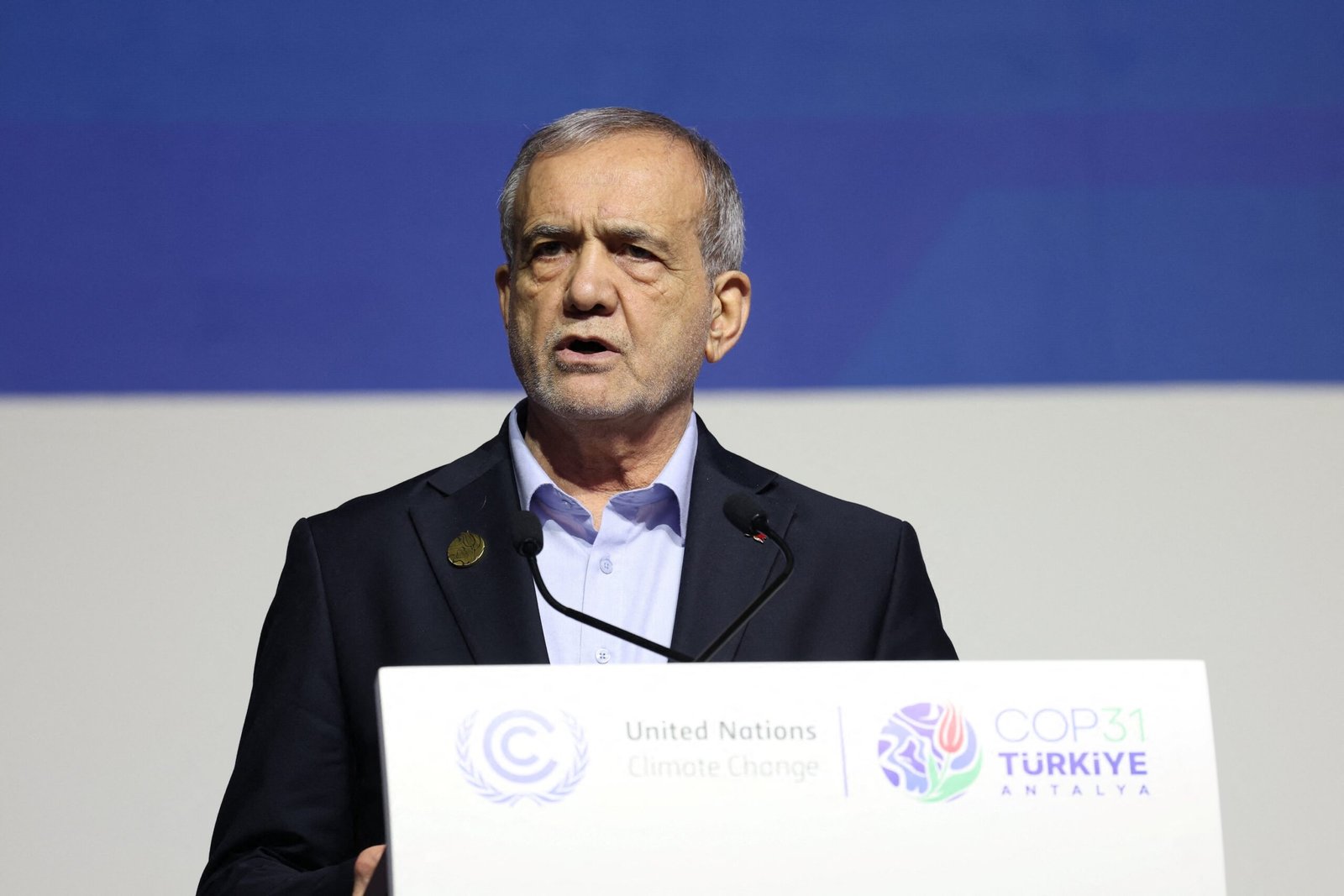
ANTALYA, Turkey – Iran’s President Masoud Pezeshkian told the COP31 climate conference on Wednesday, November 11, his country wanted compensation for environmental damage caused by US and Israeli strikes, saying the issue related to global efforts to fight climate change.

“We expect the global community to establish a genuine and meaningful link between climate commitments in times of peace and responsibility in times of war, to document and assess the environmental damages caused by military aggressions and to develop compensation mechanisms,” he said.


COP31: Iran wants compensation for environmental damage from US-Israeli strikes

His comments were part of back-to-back speeches by heads of state on the third day of the two-week conference in Turkey.

International climate agreements currently include billions of dollars in wealthy-country finance to help developing countries adapt to climate change and pay for its impacts, but there is no provision covering environmental impacts of military strikes.

The US and Israel launched a military campaign against Iran in late February. The conflict, which spread to Lebanon and the Gulf, has involved repeated strikes on energy infrastructure in Iran and across the wider region, as well as strikes on shipping. Iran has repeatedly attacked oil tankers navigating the Strait of Hormuz.

Those attacks have caused environmental damage, including substantial oil leaks.

The Iran war may also have led to a reduction in overall global emissions. A report from a consortium of international scientists on Tuesday, November 10, said global fossil fuel emissions are on track to fall slightly this year, in part due to high prices for fuel and expanded use of renewable energy in the wake of the conflict. – Rappler.com


Similar Posts

  • |

    Saudi airstrikes on Hodeidah trigger Houthi warning, raising regional tensions

    Saudi Arabia’s airstrikes on the Houthi-controlled Yemeni city of Hodeidah have triggered a strong response from the group, with the Houthis warning that the attacks could have serious consequences and further escalate tensions in the region. According to Arab media reports, Houthi officials said Saudi-led forces targeted telecommunications facilities in Hodeidah as well as Kamaran Island. A woman was reportedly injured in the strike on Kamaran Island. Witnesses also reported hearing explosions near Hodeidah port. However, the Saudi-led military coalition denied targeting the port itself. The coalition said its operations were aimed at Houthi military positions in Hodeidah. Hodeidah port is a major commercial and humanitarian gateway for northern Yemen. The port plays an important role in bringing essential goods and humanitarian supplies into areas controlled by the Houthis. The latest strikes followed growing tensions in the Red Sea. Saudi-led coalition spokesman Turki al-Malki had described recent Houthi activities in the area as irresponsible and provocative. He warned that the coalition would take further military action if Houthi attacks continued. The Houthis recently claimed responsibility for attacks on Saudi oil tankers in the Red Sea. The group said the vessels had violated a naval blockade it had announced against Saudi Arabia. The Houthis declared the blockade on July 20. They described it as a response to an attack on Sanaa International Airport a week earlier. The internationally recognised Yemeni government, which is backed by Saudi Arabia, claimed responsibility for the airport attack. It said the strike was carried out after an Iranian aircraft allegedly arrived at the airport without authorisation. Following the latest escalation, concerns are growing over the impact on commercial shipping and global trade. Two Chinese oil tankers carrying Saudi crude reportedly crossed the Bab el-Mandeb Strait safely despite the heightened tensions. The Red Sea is a crucial international shipping route. It handles a significant share of global container trade and connects major markets between Asia, Europe and the Middle East. Any prolonged disruption to shipping in the Red Sea could increase transportation costs and put further pressure on global supply chains. The situation is particularly sensitive because the Strait of Hormuz is also facing serious disruption amid the wider regional conflict. Houthi spokesman Mohammed Abdulsalam said the group’s naval blockade does not amount to a complete closure of the Bab el-Mandeb Strait. He said the measure is specifically focused on maritime activity linked to Saudi Arabia. According to the Houthi position, the blockade is intended as a response to what the group describes as the continued blockade of Yemen. The latest exchange of airstrikes, threats and attacks on shipping has increased fears that the conflict could spread further across the region.

  • | |

    British Columbia declares emergency as fast-moving…

    British Columbia declared a provincial state of emergency on Saturday after a rapidly spreading wildfire forced thousands of residents in the western Canadian province to flee their homes overnight, with the blaze nearly doubling in size within hours. The Bald Range wildfire burned out of control and expanded rapidly to roughly 9,500 hectares, prompting evacuation orders across Summerland, Peachland and other districts west of Okanagan Lake in the province’s southern interior. The region produces the majority of British Columbia’s wine and ranks as Canada’s second largest wine producing area, adding an economic dimension to the disaster beyond the immediate threat to homes and lives. Officials describe explosive fire behaviour Premier David Eby told a news conference on Saturday that one fire official had compared the blaze to an explosion going off. Eby said the official described flames reaching 100 feet up trees, with additional flames shooting a further 200 feet above that, and the fire generating its own weather system that produced lightning, which in turn fed further fire growth in a self-sustaining cycle. “Homes have been lost, and properties have been destroyed,” Eby said, adding that some residents became trapped as conditions shifted rapidly and required rescue. The premier described the situation as highly dynamic and continuing to pose a serious threat to the region. Summerland had a population of about 12,000 residents according to the 2021 census, while neighbouring Peachland is home to roughly 6,500 people. Province activates emergency powers The declaration of a state of emergency grants provincial authorities immediate access to special powers, including the ability to impose travel restrictions, protect essential supplies from price gouging and deploy specific tools to coordinate rescue operations across affected areas. Officials said the Bald Range wildfire has triggered the largest evacuation event of the summer so far, with more than 20,000 people across British Columbia forced from their homes since the fire began its rapid expansion. Summerland Mayor Doug Holmes, speaking by phone from nearby Penticton, said a large number of farms in the area have been affected and that officials do not yet know the full extent of structural losses. “They’re still busy fighting the fire,” Holmes said, adding that the community needed to prepare for the worst possible outcome as firefighting efforts continued. Residents flee as highways begin closing Many residents left their homes overnight, driving south toward Penticton or north toward Kelowna before several highways in the region began closing due to the advancing fire. Terry Fries, a Summerland resident, said he was watching a football game on Friday night when a neighbour warned him to prepare an emergency bag as the fire continued to grow nearby. Fries said the fire remained visible behind nearby hills earlier in the evening before conditions worsened. When British Columbia authorities issued the formal evacuation order around midnight, Fries and his family drove approximately 45 kilometres north to the city of Kelowna to reach safety. Residents captured video footage showing fires burning along the highway and structures engulfed in flames as they fled the area. By Saturday afternoon, ash had begun settling on cars and houses in nearby communities as smoke from the fire cast an orange glow across the sky. Power and water systems disrupted Summerland lost electricity on Saturday and issued a boil water notice for residents after untreated water entered the municipal system when it bypassed the standard water treatment plant due to disruptions caused by the wildfire. Wildfires strain resources nationwide Several Canadian provinces, including Ontario and Quebec, have battled significant wildfires this year as hot and dry weather conditions fuelled blazes across dense forest regions. International firefighting crews from Mexico, Australia, France and New Zealand have travelled to Canada to assist local personnel in combating the fires. In British Columbia specifically, where continued hot and dry conditions have heightened the risk of further fire spread, approximately 1,500 firefighting personnel are currently battling more than 100 active fires across the province. Authorities have issued 40 formal evacuation orders and an additional 49 evacuation alerts as the fire season continues to intensify. Wildfires have burned through approximately 4 million hectares of land across Canada so far this year, according to figures from the Canadian Interagency Forest Fire Centre, underscoring the scale of a fire season that has placed sustained pressure on emergency services and firefighting resources nationwide.

Leave a Reply

Your email address will not be published. Required fields are marked *