
ishaq dar urges
| |

Ishaq Dar urges global support for gulf peace effo…

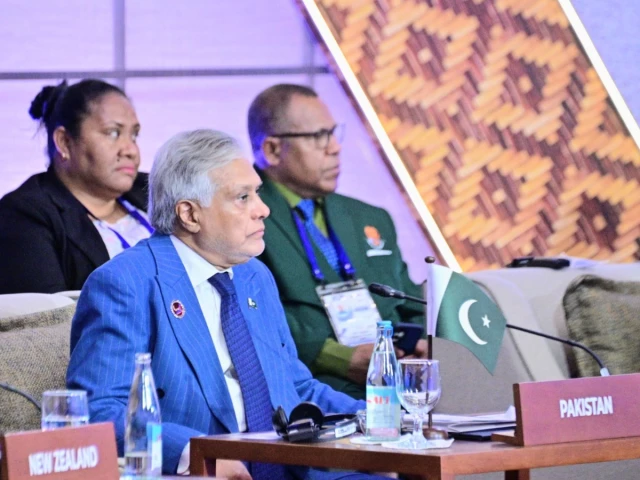
Deputy Prime Minister and Foreign Minister Ishaq Dar has urged the international community to build on recent diplomatic progress in the Gulf region, emphasizing that the opportunity to achieve lasting peace should not be wasted. Speaking at the 33rd ASEAN Regional Forum (ARF) Ministerial Meeting in Manila, Dar stressed the importance of continued dialogue, diplomacy, and constructive engagement to maintain regional stability.

Dar, who arrived in the Philippines with a high-level delegation, is attending the ARF Plenary Meeting and holding bilateral discussions with foreign ministers on the sidelines of the forum. During his address, he noted that recent developments in the Gulf have had far-reaching consequences for countries across the region, making it essential for all stakeholders to work together to prevent further instability.

The foreign minister highlighted Pakistan’s role in promoting peace by facilitating diplomatic efforts that contributed to a ceasefire in the Gulf. He referred to the Islamabad Talks, held after a gap of 47 years, followed by the signing of the Islamabad Memorandum of Understanding in Bürgenstock. According to Dar, these initiatives reflected Pakistan’s commitment to peaceful conflict resolution and regional stability.

He expressed gratitude to the United States, Iran, Gulf nations, and other international partners for placing their trust in Pakistan’s diplomatic efforts. Describing the recent progress as the result of patient negotiations and dialogue, Dar warned that these achievements must be safeguarded through continued engagement rather than allowing tensions to resurface.

Dar reaffirmed Pakistan’s commitment to supporting every initiative aimed at restoring peace and security in the region. He urged all parties to exercise restraint, fulfill their commitments, and prioritize diplomatic solutions over confrontation. He also expressed hope that ongoing negotiations would help restore normal shipping operations through the Strait of Hormuz, a vital international trade route.

At the beginning of his speech, Dar thanked the Philippines for hosting the ministerial meeting and reaffirmed Pakistan’s support for dialogue, mutual respect, and peaceful coexistence. He described the ASEAN Regional Forum as a key platform for regional security cooperation and welcomed the adoption of the Manila Plan of Action (2026–2036), pledging Pakistan’s support for its successful implementation.

Addressing South Asian affairs, Dar reiterated Pakistan’s position that the unresolved Jammu and Kashmir dispute remains a major source of regional instability. He called for a peaceful resolution based on the United Nations Charter, relevant UN Security Council resolutions, and the wishes of the Kashmiri people.

He also voiced concerns over India’s decision to suspend the Indus Waters Treaty, describing the move as a unilateral action that could threaten Pakistan’s water security and the livelihoods of millions of its citizens. Dar urged the international community to support international law and encourage peaceful solutions to regional disputes.

Speaking on the humanitarian crisis in Gaza, Dar described the situation as deeply concerning and called for immediate international action to prevent further suffering. He reaffirmed Pakistan’s longstanding support for the Palestinian people’s right to self-determination and the establishment of an independent Palestinian state based on the pre-1967 borders, with Al-Quds Al-Sharif as its capital.

Concluding his address, Dar highlighted Pakistan’s sacrifices in the global fight against terrorism, noting that the country has lost more than 80,000 lives and suffered significant economic losses. He reaffirmed Pakistan’s determination to continue working with the international community to promote peace, stability, and security both regionally and globally.
Similar Posts

  • |

    Ines Garcia opens up on scary hospital visit amid needle fear

    Ines Garcia, girlfriend of football star Lamine Yamal, has revealed a frightening health scare through her Instagram. The 21-year-old influencer left fans worried after describing a sudden trip to the hospital. Sharing the update on Friday, August 7, Garcia walked followers through the unexpected medical emergency as it unfolded. She explained that despite never having a fear of needles before, the entire experience turned out to be genuinely horrible for her. She also praised the hospital staff for helping her stay calm throughout the ordeal. Garcia said she felt overwhelmed during the visit, but noted the nurse looking after her had a good sense of humour that helped ease the tension. In a follow-up story, Garcia posted a photo of herself lying in a hospital bed, looking noticeably pale. She joked about how visibly her emotions and health always show on her face, saying she can never hide it when something is wrong. The update came just a day after Garcia had already hinted that something was off. She’d posted a selfie earlier in the week, telling followers she had so much bad news lately that she barely knew where to begin. Garcia and Yamal have remained under intense public scrutiny since the conclusion of the 2026 World Cup. Their relationship first drew attention after rumours suggested Garcia had ended a previous relationship to be with the young football star. Speculations did not stop there either, with some fans even suggesting she might be pregnant, though nothing was ever confirmed. The couple’s relationship first became public knowledge during the FIFA tournament, and it’s kept them in headlines ever since. While Garcia has not shared the exact medical reason behind her hospital visit, her posts were enough to spark concern among her large online following. Fans have since flooded her comments section with messages wishing her a quick and full recovery. For now, both Garcia and Yamal appear to be navigating a stretch of unusually intense media attention, with little sign of it slowing down anytime soon.

  • |

    Turkish Vice President, top officials join Pakistan Day celebration in Ankara

    ANKARA: Pakistan’s 79th Independence Day was celebrated with a grand ceremony at Pakistan House in Ankara, where Türkiye’s senior leadership joined Pakistani officials, diplomats and members of the community to highlight the deep and enduring friendship between the two countries. Türkiye’s Vice President Cevdet Yilmaz attended the event as chief guest, joined by senior political, military and diplomatic officials. The high-level participation underscored the importance Ankara attaches to its relationship with Islamabad and the longstanding bonds between the two nations. Among those attending were Turkish Defence Minister Yaşar Güler, Chief of General Staff Gen Selçuk Bayraktaroğlu, Naval Forces Commander Adm Ercüment Tatlıoğlu, Land Forces Commander Gen Metin Tokel and Air Force Commander Gen Ziya Cemal Kadıoğlu. Former senior officials, members of parliament, ambassadors, diplomatic representatives, Pakistani community members and media representatives also attended the ceremony. The event began with the recitation of the Holy Quran, followed by the national anthems of Pakistan and Türkiye. Students from the Pakistan Embassy International Study Group School added a colourful touch to the celebrations with national songs and traditional performances. Guests warmly applauded the cultural presentation. A documentary showcasing Pakistan’s history, cultural heritage, natural beauty, tourism potential and social and economic development was also screened. Yilmaz: Pakistan-Türkiye ties go beyond diplomacy Addressing the gathering, Vice President Yilmaz conveyed greetings from President Recep Tayyip Erdogan and the Turkish people to the government and people of Pakistan. He emphasised that the relationship between Pakistan and Türkiye went far beyond conventional diplomatic ties, describing it as a unique brotherly bond rooted in shared history and mutual solidarity. Yilmaz recalled the support shown by Muslims of the subcontinent to the Turkish people during the Turkish War of Independence, saying the historic connection continued to shape relations between the two countries. He reaffirmed Türkiye’s commitment to expanding bilateral cooperation with Pakistan and said both countries would continue working together to promote peace and stability in the region. The Turkish vice president also highlighted the importance of strengthening strategic cooperation and exploring new avenues for regional collaboration, including greater trilateral cooperation among Türkiye, Pakistan and Saudi Arabia. Pakistan envoy highlights sacrifices behind independence Pakistan’s Ambassador to Türkiye, Dr Yousaf Junaid, paid tribute to Quaid-i-Azam Muhammad Ali Jinnah and the sacrifices made during the Pakistan Movement. He said Pakistan’s independence was achieved through extraordinary courage, perseverance, determination and sacrifice. The ambassador urged Pakistanis to strengthen national unity and work collectively for the country’s stability, prosperity and development. Referring to Pakistan-Türkiye relations, Junaid said the partnership was based not merely on formal diplomacy but on shared values, history, mutual trust and strong public sentiment. He said cooperation between the two countries was expanding across defence, trade, investment, education, culture and people-to-people contacts. Jinnah exhibition adds historic touch The ceremony also featured a special photographic exhibition marking the 150th birth anniversary of Quaid-i-Azam Muhammad Ali Jinnah. Vice President Yilmaz, Ambassador Junaid and other dignitaries jointly inaugurated the exhibition, which highlighted Jinnah’s life, political vision, leadership and historic role in the creation of Pakistan. The event concluded with a traditional Pakistani dinner hosted in the gardens of Pakistan House. Against the backdrop of Pakistan’s green and white flags and warm Turkish hospitality, the Ankara celebration became more than an Independence Day ceremony. It served as a vivid reminder of a relationship built on history, affection and mutual trust — and of the two countries’ shared ambition to take that friendship into a stronger and broader future.

  • | | |

    President delays assent for 19 high court judges

    The appointment of 19 additional judges to four high courts remains pending as President Asif Ali Zardari has yet to approve the summary. The Judicial Commission of Pakistan (JCP) approved the nominations during meetings held on July 20 and 21. The proposed appointments involve the Lahore High Court, Sindh High Court, Balochistan High Court and Islamabad High Court. Nine days have passed since the JCP approved the nominations. However, the president has not yet given his assent to the summary. The delay has caused concern within the government. A senior cabinet member questioned why the approval had not yet been granted. The official argued that the summary was initiated by the JCP rather than the prime minister. Therefore, according to the government’s position, the president could not send it back to the prime minister for reconsideration. The official also warned that continued inaction could create further tension within the superior judiciary. The government’s legal team is reportedly examining possible options to address the issue. The matter has also exposed differences between the government and the Pakistan Peoples Party (PPP). According to government officials, the PPP leadership is unhappy with the JCP because some of its preferred nominees were not considered for judicial appointments. The PPP had shown particular interest in securing the appointment of two candidates to the Sindh High Court. However, neither the judicial nor executive members of the JCP supported their nominations. Officials said the candidates were below the age of 45. Both government and judicial representatives reportedly agreed that nominees below that age should not be approved. PPP Senator Farooq H Naek, a senior legal figure and member of the JCP, had proposed 33 candidates for the four high courts. His proposed list included 16 candidates for the Sindh High Court, 10 for the Lahore High Court, five for the Balochistan High Court and two for the Islamabad High Court. A member of the commission said the PPP could potentially have secured appointments for other candidates from interior Sindh. Some of those candidates were considered sympathetic to the party. However, the commission member claimed that the party’s insistence on its two preferred nominees affected the outcome. The dispute comes amid wider political and judicial developments involving Sindh. JCP judicial members have already reached a consensus on the performance of constitutional benches in the Sindh High Court. The judges serving on those benches were given three months to demonstrate their performance. The commission’s judicial members also opposed the confirmation of Sindh High Court Additional Judge Syed Fiaz ul Hassan Shah. The development was viewed by some political circles as another setback for the PPP. The party has historically sought influence over judicial appointments in Sindh and other provinces. Last year, the PPP was able to influence appointments in several high courts, including the Sindh High Court, Peshawar High Court and Lahore High Court. The judicial landscape has also changed following the 27th Constitutional Amendment. After the amendment, Justice K K Agha was elevated to the newly established Federal Constitutional Court. Another judge of the Sindh High Court was transferred to the Islamabad High Court.

  • | |

    Kangana Ranaut attacks Gen Z protesters, targets young women

    Actress and BJP Member of Parliament Kangana Ranaut has sparked widespread outrage after sharing a series of inflammatory Instagram Stories targeting the Gen Z-led Cockroach Janta Party movement, which has been demanding accountability over exam paper leaks that rocked India’s education system. Her remarks, which took direct aim at young women protesters and described them in deeply offensive terms, have drawn sharp condemnation from across the country. The political context for her comments is significant. The CJP protests, which began in New Delhi and spread to other cities, were triggered by widespread allegations of paper leaks in competitive examinations. The movement gained considerable momentum after Education Minister Dharmendra Pradhan resigned, intensifying public debate around the protesters’ demands for systemic reform and accountability. Ranaut chose not to address those demands. Instead, she used her platform to launch a sweeping attack on the character of the people participating in the protests. “They don’t do this at the cost of their parents or families,” she wrote. “Here is a new generation of so-called westernised Indian women. I call them generational gutter. Some of them have nothing to offer to the system. They are not good at studies but they are so ugly and corrupt that they can’t be home makers either. But they probably flaunt their freedom to have drugs, drinks or endless body counts.” She went on to specifically criticise young Hindu women whom she accused of aspiring to a form of independence they had not earned. “Most appalled is the behaviour of young Hindu women who want to imitate the lives of independent career women, without earning that freedom,” she said. “Women who are truly independent, they make rebellious choices, bold opinions, unconventional career moves and they take accountability for their actions.” She also addressed those who had faced physical confrontations during the protests, framing the violence as a natural consequence of their own behaviour. “Protesters who are getting beaten and abused on the roads by the common people because of their filthy and abusive roles, must understand that once you post, you will be criticised and once you damage public property, the public will damage you.” She concluded with a statement she presented as philosophical but which read to many as dismissive. “Now is not a time to cry. If you receive the opposite reaction, it is due to cause and effect. You will understand soon if you have not already.” The remarks have landed with considerable force at a moment when Indian celebrities are already divided over whether and how to support the CJP movement. While figures including Diljit Dosanjh, Arijit Singh and actor Imran Khan have expressed solidarity with the protesters, Ranaut has positioned herself firmly on the opposite side, in a manner that has gone well beyond political disagreement into personal attack. The language she used about young women in particular has drawn the most intense criticism, with many pointing out the specific ugliness of describing protesting citizens in the terms she chose.

  • | |

    Javed Sheikh says he refused fee for Om Shanti Om

    Veteran Pakistani actor Javed Sheikh has revealed that he initially refused to take any remuneration for his role in the hit 2007 Bollywood film Om Shanti Om, stating that sharing the screen with Indian megastar Shah Rukh Khan was an honor in itself. ​Speaking in an interview with Vasay Chaudhry, the veteran actor reminisced about playing the role of Rajesh Kapoor—Shah Rukh Khan’s on-screen father in the Farah Khan directorial—and reflected on the immense warmth and respect he experienced during the film’s production. ​Recalling the financial negotiations prior to filming, Sheikh shared that when the production manager approached him to finalize his contract and discuss his fee, he immediately declined monetary compensation. He emphasized that being chosen out of countless actors across India to portray Shah Rukh Khan’s father felt like a massive privilege that transcended money: ​”Farah Khan wanted me to play Shah Rukh’s father and they started discussing my fee. I said, ‘Money? I won’t take it.’ They said that was impossible. I told them it was such a big honour that, out of everyone in India, they had chosen a Pakistani actor to play Shah Rukh Khan’s father. Money wasn’t important.” ​When the production team insisted that working without pay violated contract guidelines, Sheikh jokingly proposed accepting a symbolic fee of just one rupee. However, both director Farah Khan and Shah Rukh Khan rejected the gesture, insisting on compensating him generously to honor his professional standing. Sheikh praised Shah Rukh Khan for his exceptional hospitality and care on set, describing their working relationship during the shoot as superb. ​Reflecting on his journey in the entertainment industry, Sheikh spoke candidly about his early career struggles. He disclosed that despite his deep passion for acting—which often involved running from school to Radio Pakistan—his father remained strict and skeptical. After his debut film Dhamaka (1974) failed at the box office, his career faced significant setbacks, leaving him devastated when industry insiders initially labeled him a “flop actor.” ​Five years later, his fortunes took a dramatic turn with the hit television drama Ankahi, which earned immense popularity across both Pakistan and India, effectively cementing his star status. Sheikh concluded by highlighting the mindset that guided his decade-long career: focusing entirely on self-improvement rather than competition, envy, or status. ​With a career spanning over four decades, Javed Sheikh continues to remain a vital force across Pakistani media, recently appearing in prominent projects including Delhi Gate, Aag Lagey Basti Mein, and the drama series Kabhi Main Kabhi Tum.

  • | |

    PHA marks Independence Day across Punjab

    LAHORE: District agencies of the Punjab Horticulture Authority (PHA) have launched a range of Independence Day activities across Punjab, including fireworks, green-and-white illuminations, cultural programmes and plantation drives. Lahore, Murree, Jhelum and Faisalabad welcomed August 14 with fireworks late Wednesday night. Authorities also decorated major roads, parks and public spaces with lights and national flags in the colours of the Pakistani flag. In Lahore, the agency organised midnight fireworks at five locations, including Greater Iqbal Park, Liberty Roundabout and Gulshan Iqbal Park. It also installed decorative crescents, stars and traditional lamps at several sites and arranged a musical night. Faisalabad hosted an entertainment programme at Bagh-i-Jinnah, featuring fireworks, family activities, magic shows and musical performances. The agency also decorated several parts of the city with illuminated structures. Murree held a fireworks display and planned a cake-cutting ceremony after the flag-hoisting. Officials decorated Kuldana Road, Bagh-i-Shaheedan, View Forth Road, Jhika Gali, Kashmir Point and Pindi Point. In Jhelum, fireworks took place at Akram Shaheed Park, which also received decorative lighting. Officials installed flags along the green belt on Old GT Road and placed streamers in several parks. Rawalpindi will combine Independence Day celebrations with a plantation initiative at Allama Iqbal Park, where officials will distribute plants after the flag-hoisting ceremony. The agency has also decorated several major roads with lights. Other districts, including Khushab, Nankana Sahib, Multan, Gujranwala, Dera Ghazi Khan and Okara, have arranged similar activities. Multan will distribute saplings at several parks, while Okara plans to plant 1,000 saplings and decorate nine major parks. Dera Ghazi Khan has organised a musical night and will hold a rally in coordination with the deputy commissioner’s office. Gujranwala is promoting Independence Day through digital campaigns and decorations in parks. The PHA said its celebrations also highlight environmental responsibility. District agencies are continuing monsoon plantation campaigns across Punjab to increase green cover and expand parks in urban areas. A PHA spokesperson said Independence Day provides an opportunity to remember the sacrifices behind Pakistan’s creation while renewing the commitment to the country’s future and environmental well-being.

Leave a Reply

Your email address will not be published. Required fields are marked *