italy joins tunisias
|

Italy joins Tunisia’s wildfire fight

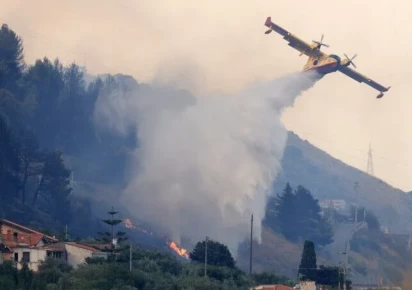
An Italian firefighting aircraft has joined efforts to contain two major wildfires in Tunisia’s western Kef province, as authorities continue a large-scale operation to prevent the flames from spreading through forested and mountainous areas.

The Italian Embassy in Tunis announced on Friday that Italy had sent a Canadair firefighting aircraft to assist Tunisian emergency teams. The aircraft collected water from the Mellegue Dam and repeatedly dropped it over areas affected by the fires, according to footage broadcast by Tunisia’s national radio.

Khalil Mechri, head of operations and monitoring at Tunisia’s Civil Protection Directorate, said firefighting teams continued their work throughout Friday evening to bring both blazes under control. He said the fires began several days earlier in Jebel Touila and Jebel Takrouna, two mountainous areas in the Kef province.

The wildfires have already scorched hundreds of hectares of forests and vegetation, Mechri told Tunisia’s state news agency TAP. Around 22 fire engines and large numbers of civil protection personnel remain engaged in the operation, while several government ministries and local authorities have provided additional equipment and logistical support.

Tunisia’s Defense Ministry has also contributed to the response by deploying military aircraft to provide aerial assistance in the firefighting operation.

The latest fires come amid a sharp rise in wildfire damage across Tunisia this summer. According to figures released by Tunisian authorities, wildfires have destroyed around 4,400 hectares (10,873 acres) of land since the beginning of May.

Mohamed Noufel Ben Haha, director general of forests at the Agriculture Ministry, said fires recorded between May 1 and July 23 had burned approximately 4,400 hectares. The figure represents a significant increase from the 2,705 hectares affected by wildfires during the same period in 2025, marking a rise of nearly 63 percent.

Authorities continue to monitor the situation as firefighters work to contain the remaining flames and protect nearby forests and communities from further damage.

Similar Posts

  • |

    Over one million evacuated as Typhoon Dolphin makes landfall in eastern China

    More than one million people have been evacuated across eastern China following the landfall of Typhoon Dolphin, which struck Zhejiang province on Sunday evening packing maximum sustained winds of 150 km/h. The system slammed into Yuhuan before making a second landfall in Wenzhou shortly after, forcing emergency relocations and widespread transport shutdowns. Meteorological authorities downgraded Dolphin to a tropical storm on Monday morning, but critical warnings remain active for severe urban flooding, torrential downpours, and landslides across eastern provinces through Wednesday. The severe weather triggered massive transport disruptions, including the cancellation of 1,400 flights in Shanghai alone. In Wenzhou, officials relocated roughly 900,000 residents and opened over 1,000 emergency shelters, while Taizhou evacuated 390,000 people. In Shanghai, urban flooding submerged ground-floor businesses in high-traffic tourist areas, prompting major attractions like Disneyland and Legoland to halt operations. In Fujian province, maritime agencies suspended dozens of passenger ferry routes and shut down over 100 offshore construction projects. Search operations are underway in Wenling, Zhejiang, for a nine-year-old boy who remains missing after being swept into the sea. Chinese state media also confirmed the arrest of two individuals accused of fabricating and spreading AI-generated misinformation about storm casualties online. Before striking mainland China, the storm system intensified monsoon conditions across the region, causing eight deaths in the Philippines and injuring five elderly residents in Okinawa, Japan.

  • |

    Trump approves landmark US-Saudi nuclear pact

    US President Donald Trump has approved a landmark civilian nuclear agreement with Saudi Arabia, marking a major step in expanding strategic cooperation between the two countries. The proposed deal is expected to remain in effect for 30 years and is valued at tens of billions of dollars. The agreement is designed to support the development of Saudi Arabia’s civilian nuclear energy program while giving American companies a leading role in building the kingdom’s nuclear infrastructure. It is expected to create significant investment opportunities for US firms and strengthen long-term energy cooperation between Washington and Riyadh. Under the proposed framework, American companies could participate in constructing nuclear facilities across Saudi Arabia. The agreement also allows for the possibility of building a uranium enrichment plant in the kingdom if future joint studies by both governments determine that such a project is necessary. US officials say the deal will enable Washington to remain closely involved in the development of Saudi Arabia’s nuclear program. They believe this cooperation will help ensure that the kingdom’s nuclear activities remain focused on peaceful civilian purposes. The Trump administration is expected to submit the agreement to the US Congress in the coming days. The pact is being introduced under Section 123 of the US Atomic Energy Act of 1954, which provides the legal framework for civilian nuclear cooperation between the United States and foreign countries. Once submitted, Congress will have about 90 days to review the agreement. If lawmakers do not reject it during the review period, the agreement will automatically enter into force. Blocking the deal would require Congress to pass a joint resolution with enough votes to override a possible presidential veto. According to officials familiar with the proposal, the agreement does not include the “Gold Standard,” a condition that permanently bars partner countries from enriching uranium or reprocessing spent nuclear fuel. These activities can potentially be used in the production of nuclear weapons. The proposed agreement also reportedly does not include the International Atomic Energy Agency’s Additional Protocol. This protocol allows international inspectors to conduct broader inspections and monitor undeclared nuclear facilities. Its absence has raised concerns among some non-proliferation experts and lawmakers. US officials, however, insist that the agreement contains strong safeguards required under American law. They stress that the deal does not obligate the United States to transfer sensitive uranium enrichment technology or nuclear fuel cycle capabilities to Saudi Arabia. Instead, it establishes a legal pathway for future civilian cooperation while requiring separate approvals for any advanced technology transfers. The agreement follows earlier discussions between senior US and Saudi officials, who signed a preliminary framework last year to expand cooperation in the peaceful use of nuclear energy. The proposal has generated debate in Washington. Several Democratic lawmakers, along with some Republicans, have argued that stronger safeguards should be included before the agreement is approved. They believe stricter restrictions are necessary to reduce the risk of nuclear weapons proliferation in the Middle East. Saudi Arabia has repeatedly stated that its nuclear program is intended to meet growing energy demands and diversify the country’s energy resources. However, Crown Prince Mohammed bin Salman has previously said that if Iran were to acquire a nuclear weapon, Saudi Arabia would also seek similar capabilities. His remarks have fueled international concerns about a possible regional nuclear arms race.

  • | |

    2,300 Israeli settlers storm Al-Aqsa

    Around 2,300 Israeli settlers entered the Al-Aqsa Mosque compound in occupied East Jerusalem on Wednesday morning, according to Palestinian officials and international media reports. Palestinian authorities described the mass entry as one of the largest such incursions this year. The incident took place as Jewish settlers marked Tisha B’Av, a religious day of mourning that commemorates the destruction of ancient Jewish temples, according to Jewish tradition. The site holds deep religious significance for both Muslims and Jews. Muslims refer to it as the Al-Aqsa Mosque compound, while Jews call the area the Temple Mount. Israel’s far-right National Security Minister Itamar Ben-Gvir also entered the compound under heavy police protection. His presence at the sensitive holy site has previously drawn strong criticism from Palestinians and sparked concerns over rising tensions in Jerusalem. The Jerusalem Governorate said the number of Israeli settlers entering the compound could increase further by sunset. Palestinian officials also reported that Israeli forces imposed tight security restrictions around the entrances to Al-Aqsa and across the Old City of Jerusalem. Large numbers of Israeli security personnel deployed throughout the area, while Palestinian worshippers faced restrictions on accessing the mosque. According to the governorate, only a limited number of Palestinians managed to reach Al-Aqsa for the dawn prayer. Palestinian officials further alleged that Israeli forces assaulted several worshippers and local residents during the heightened security measures. The latest incident comes amid continued tensions surrounding access to and control of the Al-Aqsa Mosque compound, one of the most sensitive religious and political flashpoints in the Israeli-Palestinian conflict.

  • | | | |

    Roman-Era masterpiece found hidden beneath fields …

    Archaeologists have uncovered a stunning 4th-century Roman mosaic beneath farmland in England, offering new insight into life during the period when Britain was part of the Roman Empire. The remarkable mosaic was discovered at the remains of an ancient Roman villa in Devon. Made from thousands of colorful stones arranged into intricate floral patterns, the artwork is believed to date back to the fourth century AD. The discovery provides fresh evidence of the wealth, architecture and cultural influence that existed in Roman Britain. The Roman Empire controlled much of Britain from around AD 43 until around AD 410, leaving behind numerous settlements, villas, roads and other archaeological remains. Alongside the mosaic, archaeologists discovered a large and sophisticated Roman bathhouse near the site. The complex reportedly contained several small pools, walls decorated with colorful plaster and a range of other ancient artifacts. The excavation was carried out over a two-month period by archaeologists from the University of Exeter and Cotswold Archaeology. Volunteers also participated in the work, helping researchers investigate the agricultural land located between the Devon villages of Hill Barton and Sampford Peverell. The archaeological team already knew that the Roman villa and surrounding working areas were potentially important for understanding the spread of Roman culture across Devon. However, the latest findings have revealed that the site was considerably larger and more significant than previously understood. Project leader Dr Susan Greaney said the discoveries could help researchers better understand Roman cultural influence and its interaction with local communities in the region. The detailed mosaic is particularly significant because such decorative artwork can provide clues about the status and lifestyle of people who lived at Roman villas. Its elaborate design and the presence of a substantial bathhouse suggest that the site was an important settlement rather than a simple rural dwelling. Archaeologists will now continue studying the discoveries and artifacts recovered from the site. Researchers hope the evidence will shed more light on how people lived, worked and adopted Roman customs in southwest England nearly 2,000 years ago. The Roman mosaic discovered in Devon is another reminder of how much of Britain’s ancient history remains hidden beneath modern farmland. Further archaeological investigation could reveal even more about the communities that lived in the region during the final centuries of Roman rule.

  • |

    Guterres to make historic Syria visit after 17 years

    United Nations Secretary-General Antonio Guterres will visit Syria on Saturday. It will be the first visit by a serving UN secretary-general to the country since 2009. The visit comes at a major turning point for Syria. The country is trying to rebuild after years of war, political instability and international isolation. Syria’s conflict began in 2011. It continued for almost 14 years. The war killed hundreds of thousands of people. Millions more were forced to leave their homes. The conflict ended with the fall of former President Bashar al-Assad in late 2024. Syrian opposition forces removed Assad from power after a rapid offensive. The country is now being led through a transitional period under President Ahmed al-Sharaa. His administration is seeking to establish a new political system and restore Syria’s relations with the international community. Guterres is expected to meet Sharaa during his visit to Damascus. He will also hold talks with Foreign Minister Asaad al-Shaibani. The UN secretary-general is also expected to meet other Syrian officials. He will hold discussions with representatives of civil society as part of his visit. The United Nations says Guterres will focus on Syria’s future. He is expected to underline the importance of creating a stable, inclusive and prosperous country. The visit is also expected to highlight the need for national reconciliation. Syria faces major challenges after years of destruction and displacement. The country’s transition has not been without difficulties. Sectarian violence remains a serious concern. Large numbers of Alawites were killed in violence in Syria’s coastal region last year. The Alawite community was closely associated with the former Assad government. Violence later affected the Druze community in southern Syria. Hundreds of people were reportedly killed during clashes. Guterres has expressed concern over both episodes of violence. He has called for accountability and protection for Syria’s minority communities. The new Syrian government is also working to restore diplomatic relations. Damascus wants to move beyond the alliances that dominated the country during Assad’s rule. Syria had long relied heavily on Russia and Iran. The new leadership is now seeking broader international engagement. Sharaa has already taken steps towards rebuilding Syria’s global diplomatic presence. Last year, he became the first Syrian president since 1967 to attend the UN General Assembly in New York. Washington has also taken steps towards improving relations with Damascus. The United States has removed most of its broad sanctions on Syria. US President Donald Trump has also indicated that Washington intends to remove Syria from its list of state sponsors of terrorism. Guterres is expected to address Syria’s new parliament on Monday. The speech could focus on the country’s political transition and its future relationship with the international community. He will also visit a UN peacekeeping force operating near the Israeli-Syrian frontier. The force has maintained a buffer zone between Israeli and Syrian forces for decades. The situation in southern Syria remains sensitive. Israeli forces have occupied additional areas in the region since Assad’s removal. The Syrian government has demanded the withdrawal of Israeli troops. Damascus has also called for a return to the 1974 disengagement agreement. Guterres’ visit therefore carries significant diplomatic importance. It comes as Syria attempts to rebuild its institutions, economy and international relationships. For the United Nations, the visit also provides an opportunity to engage directly with Syria’s new leadership.

Leave a Reply

Your email address will not be published. Required fields are marked *