southern japan rocked
|

Southern Japan rocked by major earthquake, people trapped in mall

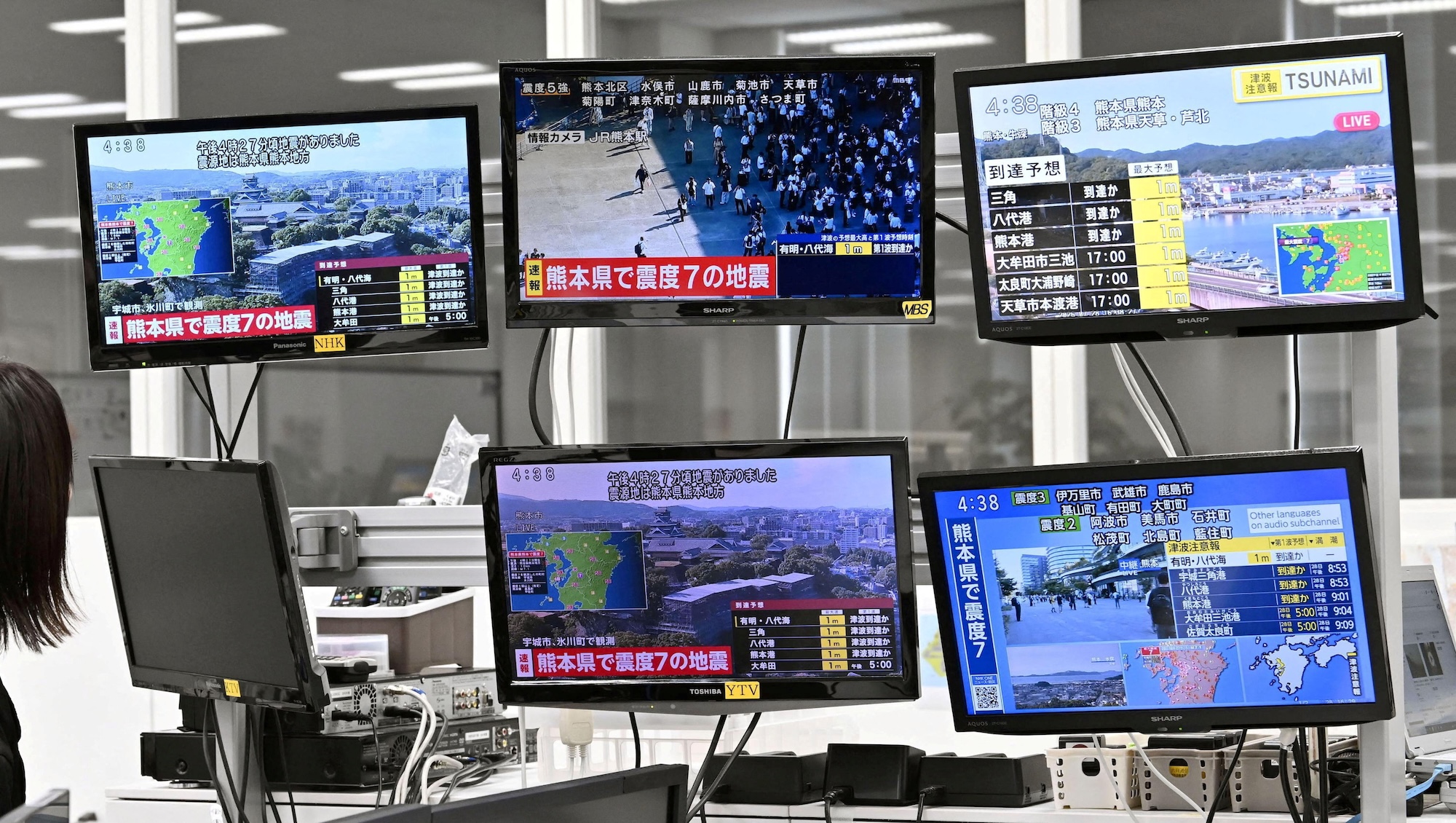
TOKYO, Japan – A magnitude 7.1 earthquake hit Japan‘s southern Kumamoto prefecture on Tuesday, July 28, knocking out power to thousands of homes, rupturing roads and injuring at least 50 people, including some trapped inside a partially collapsed shopping mall.

Speaking to reporters at her office in Tokyo, Japanese Prime Minister Sanae Takaichi said the number of casualties and extent of the damage in the area – which was devastated by a tremblor a decade ago – were still being assessed.


Southern Japan rocked by major earthquake, people trapped in mall

“We have already been informed that people have been injured. Power outages and fires have occurred in some areas, and there has also been damage to roads and bridges and the collapse of buildings,” Takaichi said.

“I ask everyone to take action to protect themselves, including evacuating to a safe location.”

‘Like volcanic ash was falling’

One hospital had reported more than 50 injuries, public broadcaster NHK said. Several people on a high-speed train at the time of the quake were also injured, Nikkei newspaper said.

Multiple people were trapped inside an Aeon shopping mall rocked by an explosion that occurred after the earthquake, emergency services said.

An Aeon spokesperson said customers and employees were evacuated right after the initial quake and that the exact cause of the ensuing explosion was unclear.

Kazuya Tsurunaga told broadcaster TBS he heard the explosion while cleaning up dishes broken by the earthquake inside a pub about 300 meters from the Aeon mall.

“It was a huge impact,” he said. “A large cloud of smoke billowed up, and because the wind happened to be blowing and the wind direction was towards the shop, the area around us was in a state like volcanic ash was falling.”

Buildings on fire

Several other buildings were also on fire or partially collapsed, according to footage from NHK, while large cracks appeared on major roads, including an elevated highway. Rail services were halted and flights grounded.

TSMC, the world’s largest contract chipmaker, evacuated workers from its plant in the area as a precaution, a spokesperson for the firm said.

Sony and Fujifilm also evacuated staff from their plants in the area, Nikkei newspaper reported. A Sony spokesperson earlier said it was checking the situation.

Around 300,000 people have been instructed to go to evacuation centers, the disaster management agency said. The quake’s epicenter was about 20 kilometers south of Kumamoto, central Kyushu island’s largest city with a population of around 700,000.

Residents in the areas that felt the biggest tremors must beware of further strong quakes for about a week, as well as the risk of landslides, an official for the Japan Meteorological Agency said.

Tsunami warning lifted

Japan is one of the world’s most earthquake-prone countries, with a tremor occurring at least every five minutes.

Located along the “Ring of Fire” of volcanoes and oceanic trenches partly encircling the Pacific Basin, Japan accounts for about 20% of the world’s earthquakes of magnitude 6.0 or more.

A tsunami warning was issued immediately after Tuesday’s quake, but was later lifted.

Kyushu Electric Power said 48,000 homes had lost power as a result of the latest quake, while railway company JR Kyushu said that it had suspended services, including its high-speed bullet trains. Kumamoto airport also shut its runway, as airlines diverted and canceled flights.

Telecoms operators KDDI and Docomo said there was disruption to their mobile phone services due to power shortages and transmission-line failures.

There were no irregularities reported at the nuclear power stations in the area, Japan’s nuclear regulation authority said.

A massive earthquake in Kumamoto 10 years ago killed 275 people and injured a further 2,739, according to an official count, and damaged thousands of buildings including the city’s castle, a top tourist site.

Some portions of the stone walls at the castle also collapsed as a result of Tuesday’s quake, an official at the castle’s office said. – Rappler.com

Similar Posts

  • |

    Bangladesh MP defends controversial second marriage

    A controversy has erupted in Bangladesh after a member of parliament from Jamaat-e-Islami, Ghazi Nazrul Islam, became the center of public debate over his alleged second marriage following the circulation of a viral video on social media. According to Bangladeshi media reports, the video showed Ghazi Nazrul Islam with a young woman whom he later identified as his second wife. The footage quickly spread online, prompting widespread discussion and speculation. A fact-checking organization examined the video and stated that it found no evidence suggesting it had been generated using artificial intelligence or digitally manipulated. Following that assessment, public attention shifted from the authenticity of the video to the identity of the woman and the nature of her relationship with the lawmaker. In a statement, Ghazi Nazrul Islam confirmed that the woman is his second wife. He said the marriage took place on June 17 with the consent of both families and the approval of his first wife. The lawmaker alleged that the viral video had been secretly recorded and later released as part of an extortion attempt and a politically motivated campaign to damage his reputation. His first wife also released a video supporting his account. She confirmed that her husband had married Maryam Begum as his second wife and said the marriage had taken place with her knowledge and consent. Maryam Begum also appeared in a separate video, identifying herself as Ghazi Nazrul Islam’s wife. She said the marriage ceremony was held on June 17 in the presence of both families and the lawmaker’s first wife. Despite these public statements, Bangladeshi media reported that documents related to Maryam Begum later surfaced on social media. The authenticity of those documents has not been independently verified, and neither the lawmaker nor Maryam Begum or her family has publicly addressed the apparent inconsistencies contained in them. According to the documents, Maryam Begum’s marital status was listed as “unmarried.” The papers also reportedly included a recommendation signed by Ghazi Nazrul Islam on June 22—five days after the claimed marriage—in support of her application for a government job. Reports said Maryam Begum had applied for public sector employment and that the MP had endorsed her application. Ghazi Nazrul Islam rejected all allegations arising from the documents. He claimed that on July 13 he visited an office in Dhaka’s Moghbazar area, where both of his wives were present. He alleged that his driver, his second wife’s uncle and several unidentified individuals held him captive, extorted 100,000 taka, demanded additional money and secretly recorded a private video, which was later circulated on social media. Meanwhile, Jamaat-e-Islami Bangladesh said it is gathering information about the incident and will decide on any organizational action once all facts have been established. Assistant Secretary General Ehsanul Haque Mahbub Zubair said the party is reviewing media reports as well as statements from the member of parliament, his two wives and the woman’s father before reaching any conclusion.

  • | | | |

    Iranian strike hits Chinese company building in Ku…

    KUWAIT CITY: A building belonging to a Chinese company in northern Kuwait was struck during an alleged Iranian attack, leaving one worker dead and causing extensive structural damage, according to Kuwait’s Ministry of Defense. The ministry confirmed the incident in an official statement on Wednesday, saying emergency response teams and security agencies were immediately dispatched to the affected site to secure the area, assess the damage, and launch rescue operations. Authorities said one worker was killed in the strike, but did not immediately disclose the victim’s identity or nationality. Officials added that investigations are continuing to determine whether there were additional casualties or injuries and to establish the full extent of the damage caused by the attack. Images from the scene showed emergency personnel working around the damaged building as security forces cordoned off the area. Officials have yet to release further details regarding the type of weapon used or the circumstances surrounding the strike. In its statement, Kuwait’s Ministry of Defense stressed that the country’s armed forces remain on high alert and are fully prepared to safeguard Kuwait’s sovereignty, territorial integrity, and national security against any external threat. The ministry also urged the public to rely only on official government statements for updates, warning citizens against spreading or believing unverified reports and rumors circulating on social media. The attack comes amid heightened regional tensions linked to the ongoing confrontation between Iran and the United States, which has fueled growing security concerns across the Gulf region. In recent weeks, military facilities, energy infrastructure, commercial shipping routes, and strategic installations have increasingly come under threat, raising fears of a wider regional escalation. Security analysts say the latest strike demonstrates how the conflict is expanding beyond its primary actors, with neighboring Gulf states facing increasing risks from the deteriorating security environment. Kuwait, which has traditionally sought to maintain balanced regional relations, now finds itself confronting the possibility of being directly affected by the broader conflict. The incident is expected to intensify security measures across the country, particularly around critical infrastructure, industrial facilities, and foreign-owned commercial sites. Regional governments have already strengthened surveillance and emergency preparedness in response to the growing threat of cross-border attacks. No immediate statement was issued by Iranian authorities regarding the alleged strike. Meanwhile, Kuwaiti officials said investigations remain underway and pledged to provide further information as more details become available. The latest incident underscores the widening regional impact of the Iran-US confrontation and highlights growing concerns that escalating hostilities could increasingly affect civilian infrastructure and foreign businesses operating across the Gulf.

  • |

    30 children geared to have been conceived using wrong IVF donors

    At least 30 children, most of them believed to be British, may have been conceived through IVF treatment in northern Cyprus using sperm or egg donors different from those selected by their parents. The allegations have emerged from an investigation into fertility clinics in the region, raising serious concerns about the treatment of international patients and the regulation of fertility services. The parents involved say they carefully chose anonymous donors before undergoing treatment. Their decisions were based on detailed information provided by clinics, including the donors’ medical backgrounds, physical appearance, education, personalities, interests and hobbies. However, after their children were born, some parents began to question whether the donors they had selected were actually used during their IVF procedures. The latest investigation has identified at least 30 cases in which parents believe the wrong sperm or egg donors may have been used. This is a significant increase from the seven cases . Around half of the children were reportedly conceived following treatment at Dogus IVF Centre, a fertility clinic in northern Cyprus. Several individuals involved in the treatment of these patients have come under scrutiny, including doctors Firdevs Uguz Tip and Sevket Alpturk, as well as patient coordinator Julie Hodson. One mother, identified as Rachel, said she recently discovered that the sperm donor used during her treatment may not have been the donor she had chosen. She described the situation as extremely shocking and unacceptable. The parents have raised concerns that staff members at the clinic may have provided misleading information about the donors. Dr Firdevs Uguz Tip has denied any wrongdoing. The investigation has also uncovered information about the relationship between Dogus IVF Centre and Cryos International, one of the world’s largest sperm banks. Cryos placed Dogus on its blacklist in 2016, adding another concern surrounding the clinic’s practices. Northern Cyprus has become a popular destination for British and other international patients seeking fertility treatment. The region offers relatively low treatment costs, reportedly high success rates and access to a wide selection of sperm and egg donors. However, its regulatory system is significantly different from that of European Union countries. Northern Cyprus is internationally recognised only by Turkey, and EU laws do not apply there. Fertility clinics in the territory have been described as operating under relatively loose regulation, raising questions about oversight and accountability. According to previous reports on the emerging allegations in March, when seven parents came forward with concerns that they may have been misled about the donors used in their treatments. Following those reports, the Ministry of Health in northern Cyprus said it had opened an official investigation. However, the ministry has reportedly failed to provide further information. Many parents said clinics had promised them donors who had undergone health screening and were from Western European backgrounds. Their suspicions reportedly grew after their children were born. DNA testing has provided further evidence that has intensified these concerns. Eleven of the 30 children have undergone commercial DNA tests, with results indicating genetic ancestry connected to Turkey or nearby regions. According to the investigation, these results may suggest that the donors selected by the parents were not the individuals whose genetic material was ultimately used. The allegations have caused distress among affected families, many of whom travelled abroad believing they were receiving carefully selected fertility treatment. The growing number of cases is now raising serious questions about donor identification, patient information, clinic accountability and the regulation of fertility services in northern Cyprus.

  • |

    Pakistani American Dr Asif Mahmood elected chair of US religious freedom commission

    Pakistani American physician and human rights advocate Dr Asif Mahmood has been unanimously elected as chair of the US Commission on International Religious Freedom, becoming the first South Asian to lead the independent bipartisan body. Dr Mahmood, who previously served as the commission’s vice chair, described his election as a great honour and reflected on his journey from a small village in Pakistan to leading one of the world’s leading organisations focused on protecting freedom of religion and belief. In his acceptance remarks, he said he remains committed to defending the rights of people from all religious backgrounds as well as those who do not follow any faith. He expressed hope for a world where religious freedom, human dignity and peaceful coexistence are respected and protected. His appointment follows his reappointment to the commission for a second term in May 2026, extending his service until 2028. Earlier this year, he noted that he was the first Pakistani, the first Muslim and the first Asian American to serve consecutive terms on the commission. The US Commission on International Religious Freedom was established in 1998 under legislation signed by former President Bill Clinton. It serves as an independent advisory body that monitors religious freedom around the world and provides policy recommendations to the White House, the US State Department and Congress. The commission is made up of nine members appointed by the US president and congressional leaders from both major political parties. Dr Mahmood was reappointed by House Minority Leader Hakeem Jeffries and now succeeds former congresswoman Vicky Hartzler as chair. Political observers have described his election as significant because of his Democratic Party affiliation despite receiving his latest appointment during the Trump administration. His leadership is expected to draw international attention, particularly because of his work on religious freedom issues in South Asia. Dr Mahmood has played a leading role in preparing reports examining allegations of religious freedom violations in India. He has publicly called for greater international scrutiny of the treatment of religious minorities and urged the United States to consider stronger measures in response to concerns raised by the commission. The commission has also recommended that US officials seek independent assessments of religious freedom conditions in India and consider targeted measures against individuals or organisations found responsible for serious violations. Those recommendations have generated considerable debate and have been strongly rejected by Indian authorities in the past. Beyond his work on religious freedom, Dr Mahmood has remained active in public service and politics. In 2022, he contested California’s 40th Congressional District as the Democratic candidate but was defeated by Republican incumbent Young Kim. Earlier, he also ran for California Insurance Commissioner and received hundreds of thousands of votes. A native of Kharian in Pakistan’s Punjab province, Dr Mahmood completed his medical education at Sindh Medical College before moving to the United States. He later completed his medical training at the University of Kentucky Medical Center and pursued a fellowship in pulmonary medicine at Harlem Hospital, which is affiliated with Columbia University. He currently serves on the Medical Board of California after being appointed by Governor Gavin Newsom in 2023. Over the years, he has also worked with several humanitarian and community organisations and has received recognition for providing free medical care to patients who could not afford treatment. His election as chair marks another milestone in a career that combines medicine, public service and advocacy for human rights.

  • |

    Australia initiates legal action against Telegram over failure to remove extremist content

    Australia’s eSafety Commissioner, Julie Inman-Grant, has launched legal proceedings in the Federal Court against messaging platform Telegram, alleging the company failed to comply with statutory safety obligations under the country’s Online Safety Act. The regulator claims Telegram permitted a permissive environment by hosting easily accessible extremist content, including footage of the 2019 Christchurch mosque shootings, the May 2022 Buffalo attack in New York, and filmed terrorist executions. The platform faces potential fines of up to 54.6 million Australian dollars for its non-compliance. The legal action follows a history of regulatory friction, including a one million Australian dollar fine imposed on Telegram in February 2025 for failing to answer inquiries regarding child abuse and violent material on time. Inman-Grant noted that whilst Australia does not license digital services, the regulator possesses the statutory authority to request a Federal Court order ceasing Telegram’s operations within the country if necessary. A spokesperson for Telegram rejected the allegations, stating that the platform’s anti-terrorism moderation efforts are well documented and confirming that the company will contest the claims in court.

  • |

    Iran’s revolutionary guard claims destruction of US military aircraft and casualties during “Operation Nasr II

    Iran’s Islamic Revolutionary Guard Corps (IRGC) has claimed that it destroyed 11 fighter aircraft at US military bases and killed 200 American personnel within 15 days during what it described as “Operation Nasr II.” The claims were made by IRGC spokesperson Brigadier General Hossein Mohebi during an interview, in which he discussed Iran’s reported military operations against American targets. According to the IRGC spokesperson, the US defense system had become significantly weakened, allowing Iranian drones and missiles to reach their intended targets without facing major obstacles. He claimed that Iran’s military capabilities had successfully challenged American defense mechanisms and demonstrated the effectiveness of its missile and drone technology. Brigadier General Mohebi stated that Iran targeted eight military deployment centers during attacks on US positions. He further claimed that, at one location, 20 shelters were destroyed as part of the operations. However, the details and figures presented by the IRGC have not been independently verified. The IRGC spokesperson also issued warnings to Israel, stating that if it became involved in the conflict again, it should be prepared to face serious consequences. He said that any renewed Israeli participation in military operations would result in a strong response from Iran. In his remarks, Mohebi also addressed the United Kingdom, warning that a bomber aircraft had recently taken off from a British air base. He stated that if Britain cooperated with the United States in military actions against Iran, British interests could become legitimate targets from Iran’s perspective. The IRGC official called on the US government to allow journalists to visit the damaged military facilities in order to assess the actual scale of destruction and casualties. He argued that allowing independent media access would reveal the real impact of Iran’s reported attacks. The statements come amid heightened tensions between Iran, the United States, and their regional allies. Military confrontations and threats between these countries have repeatedly increased concerns about the possibility of wider conflict in the Middle East. Iran has frequently emphasized its missile and drone capabilities as a key part of its defense strategy. Iranian officials have often stated that their military strength enables them to respond to threats and protect national interests. Meanwhile, the United States and its allies have continued to monitor Iran’s military activities and have expressed concerns about regional security. The claims made by the IRGC spokesperson represent Iran’s official account of the reported military operation. At the same time, independent confirmation of the number of aircraft destroyed, casualties reported, and damage caused has not been provided. International observers have warned that continued military exchanges and aggressive statements from involved parties could increase instability in the region. Diplomatic efforts have repeatedly been encouraged as a way to reduce tensions and prevent further escalation. The situation remains closely watched by governments and security analysts around the world, as any direct confrontation involving major military powers could have significant regional and international consequences. Further developments are expected to determine the accuracy of the claims and the future direction of relations between Iran, the United States, and their allies.

Leave a Reply

Your email address will not be published. Required fields are marked *