
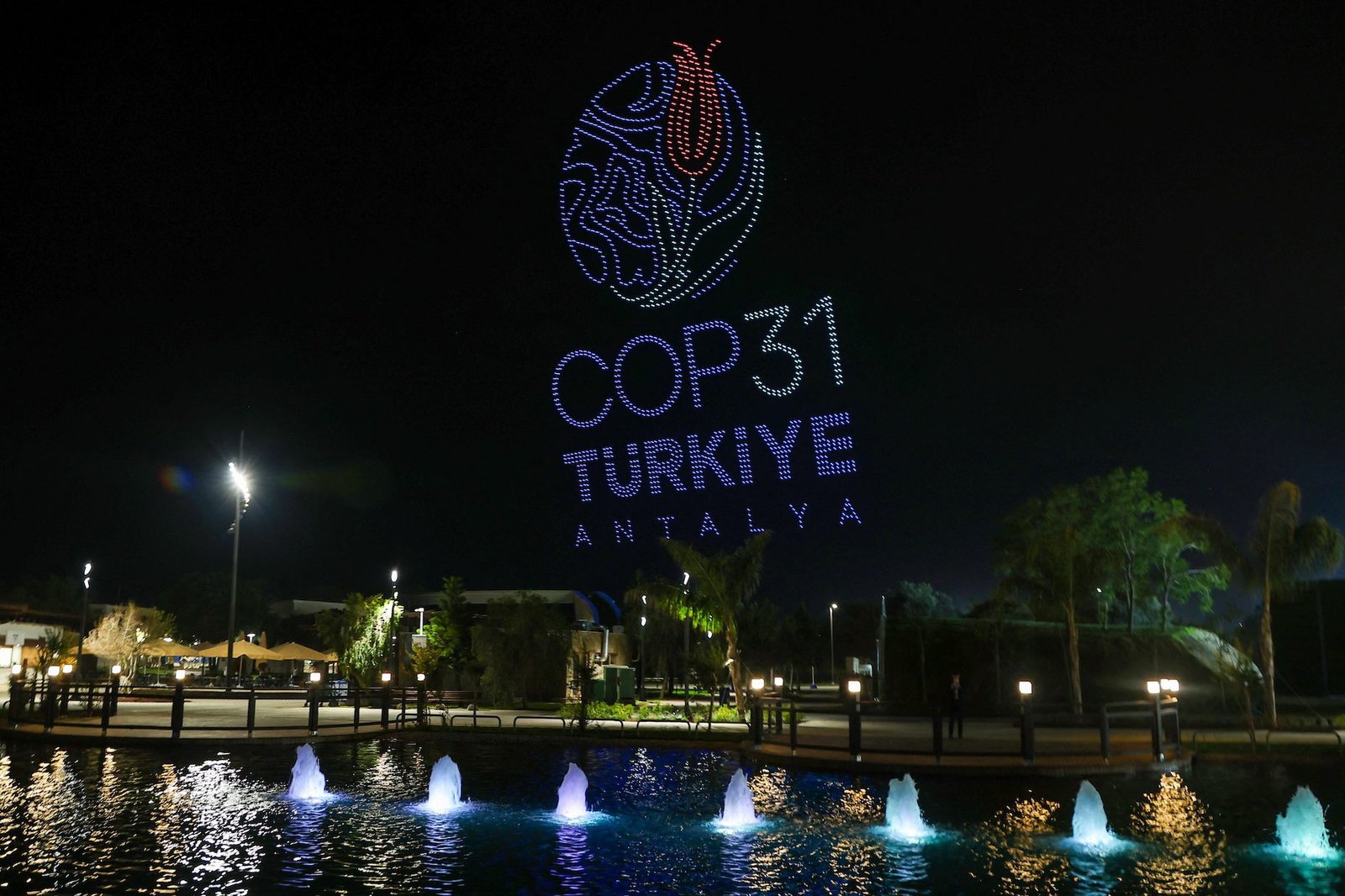
world leaders set
| | |

World leaders set out clashing priorities as COP31 turns to negotiations

ANTALYA, Turkey – World leaders have set out competing positions and made clashing demands in two days of intense speech-making at the COP31 climate change talks in Turkey, leaving negotiators with a tough task to draft a meaningful deal that all can agree.

Small island states, among the most vulnerable in the world as global warming makes sea levels rise, pleaded for urgent cuts to greenhouse gas emissions.

European leaders, meanwhile, lined up behind a proposal to expand global electrification, developing countries asked for more finance from rich ones, and fossil fuel producers said oil, gas, and coal should continue to be used.

“We reaffirm our sovereign right to strengthen our energy and oil industry as a driver of our national development,” Venezuela’s acting President Delcy Rodriguez told the conference, after UN leaders had made the case for bringing to an end the age of fossil fuel.

Apart from trying to accommodate incompatible national positions aired on Wednesday, November 11 and Thursday, November 12, conference host Turkey and negotiations lead Australia also have the challenge of trying to make progress when wars and inflation have pushed climate concerns down the political agenda.

“It’s my job to steer consensus, not to bang tables and demand any particular action, but to steer consensus to the strongest, most ambitious possible outcome within the constraints of that consensus-driven process,” Chris Bowen, Australia’s COP31 president of negotiations, told Reuters.

Asked what a good deal might look like, he said: “I have many more hours of consultations with partners to do.”

Climate activists say short-term political concerns should not get in the way of addressing an issue that will get more pressing if ignored.

A UN report last month found the world was already on course to break through the 1.5 degrees Celsius (2.7 degrees Fahrenheit) warming limit that countries had agreed to pursue under the 2015 Paris Agreement to prevent the worst effects of climate change.

“The situation could not be less under control. The planet is not dying. It is being killed,” Swedish climate activist Greta Thunberg said on the sidelines of the UN conference.

“It is being killed by the very same people often thought to come to our rescue. No one is coming to our rescue.”

Britain’s Burnham backs renewables

Earlier on Thursday, the leaders of small island states including the Bahamas, Tuvalu, the Solomon Islands and Saint Lucia called for swift action.

“Major emitters must move beyond the usual promises. They must reduce emissions that the climate crisis demands,” said Saint Lucia’s Prime Minister Philip J. Pierre.

British Prime Minister Andy Burnham backed a proposal by Turkey to increase electricity’s share of world energy consumption to 35% by 2035, from a little over a fifth now, to help advance that goal. Turkey has not specified whether the extra energy used would be renewable.

Burnham told the conference that energy supply disruptions from the US-Israeli war with Iran and Russia’s war with Ukraine showed clean energy was the wise choice.

“It is now plain for everyone to see that if we depend on energy we do not control, then we leave ourselves exposed to prices we cannot control,” he said. “The shift to clean energy is the only route to energy security.”

Developing countries reiterated requests that they have made during many years of UN talks for rich countries to provide more finance to help them shift to cleaner energy, adapt to a warming world, and repair climate-driven destruction.

Fernanda de Carvalho, the head of climate policy for the World Wildlife Fund environmental group, said he found the leaders’ speeches underwhelming, especially as COP31 is the first UN conference since scientists have publicly said the world is set to breach the 1.5C threshold.

“It is worrying that the climate issue is not as high on the global political agenda as it needs to be,” he said. – Rappler.com

Similar Posts

  • |

    UK cancels military training exercise in Kenya amid legal jurisdiction and funding dispute

    The British Ministry of Defence (MoD) has been forced to cancel a major military training exercise in Kenya after the Kenyan government refused to ratify a renewed bilateral defence agreement. The decision follows a stalemate between London and Nairobi regarding the framework governing the British Army Training Unit Kenya (BATUK). Kenyan lawmakers have demanded key structural revisions to the pact, including greater local authority and primary jurisdiction to prosecute British soldiers who commit criminal offences on Kenyan soil. Disagreements over the financial compensation Britain pays to host its training operations in Laikipia have also stalled negotiations. As a direct consequence of the expired permits, a scheduled exercise involving the 1st Battalion, the Duke of Lancaster’s Regiment, set to begin in September, has been called off, with the MoD relocating the drills to an alternative site outside Kenya. The diplomatic standoff comes amid escalating domestic pressure in Kenya over alleged human rights violations, environmental damage, and misconduct associated with BATUK operations. Scrutiny has particularly intensified around the high-profile 2012 murder of Agnes Wanjiru. A former British soldier, Robert Purkiss, faces a single charge of murder in the case, with Kenya retaining jurisdiction and an extradition hearing scheduled for November. While both governments maintain that they are actively engaging to resolve the outstanding legal and financial issues, the training suspension deals a immediate blow to local businesses in Laikipia that depend on the economic activity generated by visiting British troops.

  • |

    Tanzania opens government debt market to all overseas investors

    Tanzania has relaxed its foreign exchange regulations to permit all international investors to purchase government-issued Treasury bills and bonds. The Bank of Tanzania announced that the policy change aims to deepen domestic financial markets and position the country as an attractive investment destination. Participation in government securities was previously restricted to residents of the East African Community, the Southern African Development Community, and the Tanzanian diaspora. President Samia Suluhu Hassan’s administration is seeking fresh revenue options following recent reductions in aid from international partners.

  • |

    Zelensky alleges Russia shared satellite intelligence with Iran to target US bases

    Ukrainian President Volodymyr Zelensky has accused Russia of helping Iran identify US military positions in the Gulf by providing satellite intelligence, adding another layer of tension to the already strained relationship between Moscow, Tehran, and Kyiv. His remarks come as Ukraine and Iran exchange fresh accusations following an attack on an Iranian vessel in the Caspian Sea. In a statement shared on social media, Zelensky claimed that Ukraine had observed increased Russian satellite monitoring of Gulf countries and American military installations since the beginning of July. According to him, the satellite images were later used by Iran, with a noticeable connection between the timing of the surveillance and Iranian attacks. He alleged that the imagery was gathered before strikes to assist with planning and then again afterward to evaluate the extent of the damage. While Zelensky did not release evidence to support the claim, he insisted the pattern was clear and significant. The allegations surfaced shortly after Ukraine announced a series of long range military operations in the Caspian Sea. Zelensky said Ukrainian forces had successfully struck vessels carrying military cargo linked to Iran as well as a warship. Ukrainian intelligence later stated that drones had targeted sanctioned cargo ships allegedly involved in transporting military equipment between Iran and Russia. The operation marked one of Kyiv’s most direct actions against assets connected to Tehran and reflected Ukraine’s growing willingness to challenge countries it believes are supporting Russia’s war effort. Iran reacted strongly to the reported strikes. The Iranian Foreign Ministry summoned Ukraine’s senior diplomat in Tehran to protest what it described as a hostile and unlawful attack. Iranian officials said one sailor was killed and several others were injured when a commercial vessel exploded following the strike. The ministry rejected any suggestion that Iran had played a role in the war between Russia and Ukraine and insisted the country had remained outside the conflict. Iranian Foreign Minister Abbas Araghchi also condemned the attack, describing it as a serious violation of the United Nations Charter. He claimed the operation had been carried out to advance Israeli interests and accused Kyiv of trying to draw Europe deeper into the regional conflict. Araghchi said he had discussed the matter with European Union foreign policy chief Kaja Kallas and Russian Foreign Minister Sergei Lavrov, warning that Iran would not allow the incident to pass without a response. Zelensky’s latest accusations regarding Russian support for Iran are not entirely new. Earlier reports citing US officials claimed that Moscow had shared intelligence with Tehran about American military positions in the Middle East during the recent conflict involving Iran and the United States. Those reports also suggested that China could have played a supporting role, although no public evidence has confirmed those claims. The issue has also created mixed messages within the US government. During a congressional hearing, US Defence Secretary Pete Hegseth acknowledged that Russia and China were helping Iran in different ways. He said there was clear cooperation among American rivals but declined to discuss the full extent of that support, arguing that the details should remain classified for security reasons. Only days later, however, President Donald Trump publicly disagreed with that assessment. Writing on his Truth Social platform, Trump said he did not believe Russia or China had assisted Iran. He stated that both Russian President Vladimir Putin and Chinese President Xi Jinping had assured him they were not involved in supporting Iranian military operations. Despite those conflicting views, Zelensky maintained that Russian satellite activity offered direct evidence of cooperation. He specifically pointed to satellite surveillance conducted on July 19 and 20, claiming Russian satellites closely monitored four air bases used by the United States in Bahrain, Jordan, and Kuwait. According to the Ukrainian leader, the timing of those observations raised serious concerns about Russia’s role in helping Iran monitor American military assets in the region.

  • |

    Amanda Knox defends comedy show after backlash from Meredith Kercher’s sister

    Amanda Knox is standing by her Edinburgh Fringe comedy show, pushing back against claims from Meredith Kercher’s sister that the performance trivializes violence against women. Knox, 39, was convicted and later acquitted of murdering her British roommate Kercher in Italy 19 years ago. She took to Instagram on Thursday to say her show “honors Meredith Kercher’s memory” and “calls out the violence that was done to her and to me.” The show, titled “Cartwheel,” debuted Friday evening and runs for 11 nights straight at the Scottish festival. Its title nods to a widely repeated claim that Knox did cartwheels at the police station after Kercher’s death. The show is being pitched as the story of a woman nearing forty, balancing motherhood while finally processing her wrongful imprisonment. The backlash follows a BBC interview with Kercher’s sister, Stephanie, who said the show “normalizes and trivializes violence against women.” She acknowledged that Knox is free to live her life however she chooses, but argued that turning this particular story into comedy crosses a line. Stephanie stressed that her objection is not about guilt or innocence. She said the same discomfort would apply even if someone else were behind the show, though she admitted it stings more knowing it’s Knox herself. She said she feels strongly that the project shouldn’t be given a platform at all. An online petition demanding the show’s cancellation has gathered more than 4,400 signatures so far. It accuses the show of mocking the tragedy surrounding Kercher’s death and turning it into entertainment. Knox has previously defended the project in other interviews too. She told The Telegraph she believes Kercher would have “appreciated” the show, calling it an honest look at what it means to be a young woman, and even guessed her late roommate would have found parts of it funny. Despite the criticism, Knox appears set on moving forward with the run as planned. The show continues through the rest of its scheduled dates in Edinburgh, with public reaction still divided over whether the format is appropriate for such a painful and personal subject. For now, the controversy has added extra attention to a performance that was already drawing curiosity given Knox’s unusual path from headline-making legal saga to stand-up stage.

  • |

    Indonesia earthquake, 38 dead as rescue teams race…

    JAKARTA: At least 38 people have died after a powerful magnitude-7.7 earthquake struck eastern Indonesia on Saturday, sending residents fleeing from homes, damaging buildings and triggering a brief tsunami warning, officials said. The shallow offshore earthquake was followed by dozens of aftershocks, complicating rescue efforts across East Nusa Tenggara province. Authorities said tsunami waves measuring less than one metre were recorded in several areas before the warning was lifted about three hours after the main tremor. Suharyanto, head of Indonesia’s National Disaster Management Agency (BNPB), said 38 people had died, while two were seriously injured and 11 suffered minor injuries. About 2,000 residents were evacuated to safer areas as authorities assessed the damage. Maumere, the main town in Sikka Regency on Flores Island, was among the worst-hit locations. Rescue officials reported finding 20 bodies there, while several people were injured and others remained trapped beneath collapsed structures. The disaster also struck Nagekeo, the area closest to the earthquake’s epicentre. Rescue teams faced major difficulties reaching the region because landslides blocked roads and communication signals were disrupted. Authorities said around 2,000 residents in Nagekeo had moved to safer locations, while houses, warehouses and government facilities were damaged. Officials said power outages and traffic congestion were reported in parts of the affected region. In some locations, residents rushed outdoors as buildings shook violently. Hospitals also moved patients outside as a precaution against further tremors. A resident of Talibura described the shaking as extremely powerful, saying her family ran from their home after the earthquake struck. Her account reflected the panic felt across communities as the ground continued to shake. The Indonesian geophysics agency said the initial earthquake occurred at a depth of about 15 kilometres and was followed by multiple aftershocks. Rescue workers are continuing to search damaged buildings and isolated communities for survivors. Officials said emergency crews were using boats and other routes where roads remained blocked by landslides and debris. Indonesia is particularly vulnerable to earthquakes because it lies along the Pacific Ring of Fire, a highly active seismic zone where tectonic plates meet. The region has suffered devastating earthquakes before, including a magnitude-7.5 quake in 1992 that caused extensive destruction. Authorities warned that the situation remains fluid as rescue teams work to reach isolated areas, determine the full scale of damage and provide assistance to displaced residents. The death toll could rise as search operations continue.

  • |

    Trump appoints Will Scharf as new White House counsel

    US President Donald Trump has named Will Scharf as the incoming White House counsel and assistant to the president, succeeding David Warrington on September 1, 2026. Warrington, who previously served as general counsel for Trump’s campaign and managed initial administration legal affairs, will be departing for the private sector. Scharf currently serves as the White House staff secretary, a role where he manages the daily flow of papers and documents reaching the president’s desk. In addition to these duties, he chairs the National Capital Planning Commission, where he helped fast-track approvals for a controversial $400 million White House ballroom project. A former federal prosecutor and appellate law clerk, Scharf joined Trump’s personal legal team in 2023. He played a central role in defending Trump across several high-profile legal battles, including the federal election interference case and the landmark presidential immunity ruling before the US Supreme Court. In his new post, Scharf will lead the administration’s legal strategy. His responsibilities will include overseeing executive privilege, managing judicial nominations, liaising with the Department of Justice, and preparing for potential congressional inquiries ahead of the upcoming midterm elections.

Leave a Reply

Your email address will not be published. Required fields are marked *