maharlika funds ngcp
| |

Maharlika Fund’s NGCP deal collapses nearly 2 years after Marcos’ blessing

MANILA, Philippines – The Maharlika Investment Corporation (MIC) has backed out of its planned P19.7-billion investment in Synergy Grid and Development Philippines (SGP), abandoning for now a deal that would have given the government a bigger say in the operations of the country’s power grid.

In a disclosure to the Philippine Stock Exchange on Friday, October 30, SGP said MIC had informed them that it would no longer pursue the transaction for now.

“MIC has decided not to proceed with the transaction for the time being due to their current strategic direction,” SGP said, adding that the decision would have no impact on its finances or the operations of the National Grid Corporation of the Philippines (NGCP).

SGP is a listed holding company that indirectly controls 60% of NGCP’s voting shares, with an effective equity interest of 40.2%. NGCP is the private concessionaire that operates the country’s electricity transmission network, with the remaining 40% owned by China’s State Grid Corporation.

The development comes more than a year and nine months after President Ferdinand Marcos Jr. personally witnessed the signing of the agreement between MIC chief executive officer Rafael Consing Jr. and SGP chairman Henry Sy Jr. at Malacañang on January 27, 2025.
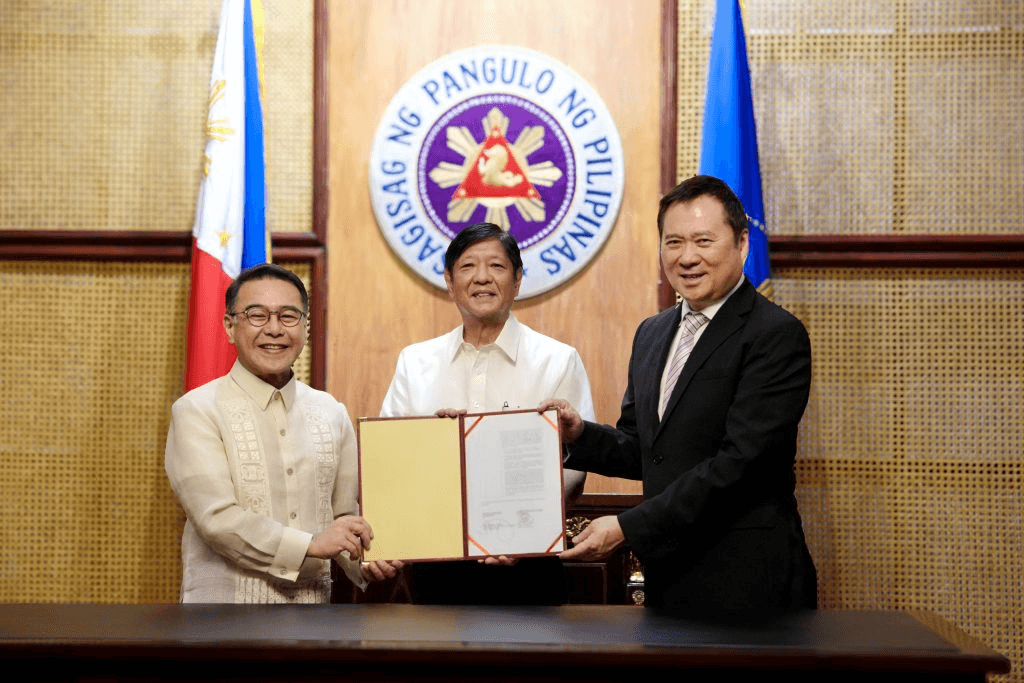
DEAL? President Ferdinand Marcos Jr. with MIC president and CEO Rafael Consing Jr. (left) and SGP chairman Henry Sy Jr. (right). Photo from Philippine Communications Office.

Under the agreement, MIC was supposed to acquire a 20% stake in SGP through convertible preferred shares. This would entitle the sovereign wealth fund to two board seats each in SGP and NGCP, giving the government greater access to information and influence over the privately operated transmission grid.

Consing had initially expected the transaction documents to be signed within 90 days, with a possible 90-day extension. 

The canceled transaction is separate from MIC’s existing investment in SGP. MIC had already invested P1.2 billion in the listed company’s shares through stock market purchases, generating P589.2 million in dividends and unrealized gains that year.

The reported collapse of the deal comes as Consing approaches the end of his three-year term in November. No successor has been formally named.

The sovereign wealth fund, whose creation was dogged by controversy over governance safeguards, has had a slow and shaky start. By the end of 2025, Maharlika had invested just P5.9 billion of the initial P75 billion contributed by two state-owned banks.

Investments picked up in 2026, bringing cumulative capital deployment to P24.7 billion as of June, or about a third of its initial funding. However, P15 billion of that amount came from a working capital facility extended to Petron Corporation, while MIC still held P53 billion in cash and cash equivalents. – Rappler.com

Must Read

[In This Economy] The nothing burger that is the Maharlika Investment Fund


[In This Economy] The nothing burger that is the Maharlika Investment Fund

Similar Posts

  • | | |

    Pakistan requests $10bn US foreign exchange stabil…

    Pakistan has requested a $10 billion foreign exchange stabilization facility from the United States in an effort to strengthen its economy and improve its external financial position. The proposed facility is expected to help increase the country’s foreign exchange reserves, ease pressure on the Pakistani rupee, and reduce dependence on emergency financial assistance from international lenders. According to reports, the Pakistani government has submitted a formal proposal to US Treasury Secretary Scott Bessent seeking a five-year bilateral Exchange Stabilization Support Facility. If approved, the financial arrangement could provide Pakistan with greater economic stability at a time when the country continues to face external financing challenges. The proposed fund is designed to support Pakistan’s foreign exchange reserves, which remain under pressure despite recent improvements in the country’s economic outlook. Stronger reserves would help stabilize the rupee, improve investor confidence, and provide the government with greater flexibility in managing external debt repayments. The request comes after Pakistan’s reported diplomatic efforts during the Iran conflict. According to the report, Islamabad played a facilitating role in communication between Tehran and Washington. The diplomatic engagement is believed to have enhanced Pakistan’s strategic importance and may have contributed to closer economic discussions with the United States. If Washington approves the request, Pakistan could reduce its dependence on short-term financial support from multilateral institutions, including the International Monetary Fund (IMF). The facility would also help the country better manage future external financing needs while maintaining stability in the foreign exchange market. Pakistan is currently implementing wide-ranging economic reforms under the IMF’s $7 billion Extended Fund Facility (EFF). The programme requires the government to increase tax revenues, reduce public spending, improve fiscal discipline, and introduce structural reforms aimed at strengthening the economy. The country narrowly avoided a sovereign default in 2023 after securing a $3 billion IMF emergency programme. That support was later followed by the approval of the larger $7 billion EFF programme. Although the reforms have improved economic indicators, Pakistan still relies heavily on external borrowing, financial assistance from friendly countries, and the rollover of existing loans to meet its financing requirements. Economic experts believe that a US-backed stabilization facility would provide a significant boost to Pakistan’s financial position. It could strengthen foreign exchange reserves, support currency stability, improve investor confidence, and reduce the need for repeated emergency borrowing.

  • |

    Electricity tariff likely to increase by Rs1 per unit from next month

    ISLAMABAD: Electricity consumers across Pakistan may face higher power bills from next month as electricity distribution companies have approached the National Electric Power Regulatory Authority (NEPRA) seeking a quarterly tariff adjustment. According to sources, the proposed adjustment could result in an increase of around Rs1 per unit in electricity prices during the upcoming quarter. The distribution companies have submitted their adjustment request to NEPRA, which will examine the figures and determine the impact on consumers under the applicable quarterly tariff mechanism. Sources said the expected increase is linked to the expiry of the existing quarterly adjustment relief. Under the current arrangement, consumers are receiving a relief of Rs1.99 per unit, which is scheduled to expire at the end of the current month. With the relief ending, electricity tariffs are expected to rise for consumers across the country from next month, subject to NEPRA’s approval of the proposed adjustment. The quarterly tariff adjustment mechanism is used to pass on changes in electricity generation costs and other relevant expenses to consumers. Depending on the regulator’s assessment, the resulting adjustment can either increase or reduce electricity bills. The proposed increase is likely to add to the financial burden on households and businesses already facing elevated electricity costs. Consumers are now awaiting NEPRA’s decision, which will determine the final impact on electricity tariffs in the upcoming quarter. NEPRA is expected to review the distribution companies’ submissions before announcing its decision. The final adjustment may differ from the amount initially sought by the power distribution companies following the regulator’s scrutiny of the data and applicable costs.

Leave a Reply

Your email address will not be published. Required fields are marked *