man returns book

Man returns book He stole 40 years ago

A US bookstore staff was left surprised when a package arrived containing a book that had been stolen from the store nearly 40 years ago.

The package also included an apology letter and $100 in cash as compensation. The package was recently delivered to Bookleggers, a bookstore in Old Town Eureka, California. When the staff opened it, they found a copy of The Unstrung Harp.

The letter explained that the sender had stolen the book from the store about four decades ago.  He said he was a student at the time and was struggling with alcohol addiction and financial problems.

He also wrote that he found the book recently while cleaning out his garage. After discovering that the bookstore was still operating he decided to return the book and apologize for what he had done.

The man included $100 with the book and told the store owners they could contact him if they wanted to take any further action.

Bookstore owner Jennifer McPhaiden said she and her staff were deeply touched by the letter. She said it was surprising to see someone return after so many years to admit their mistake and try to make things right.

Similar Posts

  • Why walking slows with age

    Getting older is a natural part of life and it cannot be stopped. But have you ever noticed that people often walk more slowly and feel tired more quickly as they age? A new study may explain why this happens. Researchers from Flinders University and the University of Canberra in Australia studied how walking changes with age.  They found that as people get older the body starts to focus more on safety and balance than on walking speed. The study included 107 healthy people between 26 and 86 years old. Researchers examined how their bodies moved while walking. They found that movement around the ankles and other muscles changes with age. The ankle muscles play an important role in keeping the body balanced and helping people move forward. As people age the body appears to use more muscle effort to stay stable and upright. Older adults may move the muscles around their ankles in a way that makes the ankle joints stiffer.  This can improve balance and reduce the risk of losing stability. However there is a downside. Using the muscles this way requires more effort which can make older people feel tired sooner and walk more  slowly. Researchers believe that the nervous system also becomes more focused on preventing falls and maintaining stability with age. The good news is that regular physical activity can help maintain movement and muscle strength. Exercises that improve balance and strengthen the muscles may help older adults stay active and move more confidently.

  • 5 Makeup secrets used by pro artists

    Professional makeup artists know how to bring out natural beauty and create a polished look. Their techniques can make makeup look smoother brighter and last longer. Here are five easy makeup tips you can try at home. Never skip primer Makeup artists often use primer before foundation. It creates a smooth base by helping blur the look of pores and fine lines. Choose a primer according to your skin type. For example, an oil-control primer can be useful for oily skin. Use concealer smartly Concealer is great for covering dark circles spots and uneven areas. But it can also be used to brighten and shape the face. Apply a small amount under the eyes along the bridge of the nose and on other high points of the face for a fresh brighter look.  Master your blending Good blending can make a big difference. Makeup artists carefully blend different shades and textures so there are no harsh lines. Whether you are blending eyeshadow or smoothing out foundation take your time for a more natural and professional finish. Try multi use products Makeup artists often choose products that can do more than one job. For example a cream blush can sometimes be used on the cheeks and lips. Using multi purpose products can save time reduce the number of products you need and make your makeup routine easier. Set your makeup properly Setting your makeup helps it stay in place for longer. Makeup artists may use setting powder setting spray or both depending on the look. For extra staying power lightly apply powder under the eyes and leave it for a few minutes before gently brushing away the excess. With these simple techniques you can make your everyday makeup look smoother fresher and more polished.

  • The Geography of Governance

    By Syed Tahir Rashdi  The writer is a Shahdadpur-based contributing columnist, book reviewer, and climate change activist. He holds a BS degree in Pakistan Studies from University of Sindh Pakistan’s debate over new provinces has returned with familiar demands: South Punjab, Bahawalpur, Hazara, Karachi and, periodically, proposals for a more extensive reorganisation of the federation. There are credible arguments behind some of these demands. Population growth, administrative distance, uneven development and the persistence of regional identities have altered the circumstances in which Pakistan’s present provincial arrangement was conceived. Yet the debate tends to proceed from an assumption that deserves greater scrutiny: that creating smaller provinces will, in itself, improve governance. It may. But it may also not. The distinction is important because Pakistan’s principal difficulty has never been simply the size of its administrative units. It has been the weakness, discontinuity and politicisation of the institutions through which those units are governed. This does not make the case for new provinces illegitimate. It does, however, suggest that provincial restructuring should be considered as one component of administrative reform rather than as a substitute for it. Pakistan’s provincial boundaries have never been immutable. The One Unit scheme of 1955 consolidated the western wing into a single province, partly to establish parity between the two wings of the country. It was abolished in 1970, restoring the provinces. The episode remains relevant because it demonstrated the limits of administrative engineering. A territorial arrangement can be imposed constitutionally, but its durability ultimately depends upon political legitimacy. The present debate is considerably more complex. The demand for a South Punjab province contains at least three distinct strands: the historical claim associated with Bahawalpur, the linguistic and cultural politics of Saraiki identity, and the administrative argument that the southern districts have remained distant from the provincial centre in Lahore. There is also the persistent claim of regional economic neglect. These strands should not be conflated. Similarly, the Hazara demand has a strong identity component, while the Karachi question is inseparable from the city’s unusual demographic, economic and political history and the longstanding contest over authority between urban local institutions and the provincial government. The differences matter because different problems require different institutional responses. The Constitution does not make the creation of a new province a matter of political declaration. Article 239 provides a demanding procedure for constitutional amendment, including the approval of the concerned provincial assembly where provincial boundaries are affected. That requirement is not an accidental obstacle. It reflects the logic of federalism: a federation cannot permit the territorial boundaries of one constituent unit to be altered without giving that unit a decisive constitutional voice. The experience of the parliamentary commission on new provinces in 2012 illustrated the complexity of the exercise. Questions of boundaries, resources, representation, administrative structures and constitutional amendments quickly became inseparable from the political question of who would gain or lose influence. That is why the debate deserves to be insulated, as far as possible, from electoral expediency. There is, however, a more fundamental issue that receives considerably less attention. Article 140-A of the Constitution requires provincial governments to establish local government systems and devolve political, administrative and financial responsibility and authority to elected local representatives. This provision goes to the heart of the governance question. A citizen’s encounter with government is rarely with the federal government or even with a provincial assembly. It is with the school, hospital, police station, municipal authority, land office, sanitation service or local administration. Yet local governments in Pakistan have rarely acquired the institutional continuity, fiscal autonomy and political authority envisaged by the Constitution. The result is an unusual form of devolution. The 18th Amendment substantially strengthened the provinces by transferring functions and resources from the federation, but the transfer of authority has often stopped at the provincial level. Islamabad became less dominant. The provinces became stronger. The citizen did not necessarily become more powerful. This is perhaps the most important issue in the new-provinces debate. If a region is suffering because decisions are too distant from its population, the first question should be whether existing institutions can be decentralised before an entirely new tier of government is created. Comparative experience does not provide a universal answer, but it does offer useful cautions. Indonesia’s post-Suharto decentralisation transferred extensive responsibilities to subnational governments. The reform was necessary after decades of centralised rule, but decentralisation itself did not guarantee effective or accountable government. Subsequent reforms had to focus on institutional capacity, fiscal management and local accountability. Nigeria provides another caution. The creation of additional states was partly intended to improve political representation and accommodate regional interests. Yet the country continues to face substantial governance and institutional-capacity problems across its states. The lesson from both cases is not that administrative restructuring is futile. It is that territorial fragmentation and institutional development are different processes. South Africa offers a somewhat different model. Its Constitution explicitly recognises local government as a sphere of government and assigns municipalities constitutional responsibilities relating to democratic participation and service delivery. The significance lies less in the number of provinces than in the distribution of authority among the different levels of government. Switzerland’s federal tradition similarly rests on substantial cantonal and communal autonomy. Its relevance to Pakistan is not institutional imitation but a principle: government functions should be located at the level at which they can be performed most effectively, while higher levels retain responsibilities that require wider coordination. There is therefore no universally correct number of provinces. The appropriate administrative scale depends upon geography, population, fiscal capacity, the nature of the public service and, above all, institutional competence. Pakistan’s governance difficulties are familiar enough to require little elaboration: weak rule of law, politicisation of public institutions, patronage, corruption, uneven accountability, administrative discontinuity and the recurrent weakening of local government. None of these problems disappears when a provincial boundary is moved. A new province may shorten the administrative distance between a region and its provincial capital. It does not automatically make the police independent,

  • |

    Press play on nostalgia

    There is an absurdly satisfying drama to slipping a shiny compact disc into a silver portable CD player. Next up, click the lid shut and voila! Listen to that faint mechanical whir-click as the laser reads the track. We live in an era where a glass smartphone screen gives you instant access to 100 million songs. And when one chooses to carry around a plastic disc player, it feels less like a modern inconvenience and more like a heroic act of rebellion. Well! In order to figure out why Gen Z is suddenly obsessing over vintage music players that take up actual pocket space, we have to look at the wild journey of how we got here. From Giant Plastic Discs to Invisible Spotify Soundtracks The evolution of portable music is essentially a history of humans constantly trading physical soul for pure convenience. The Boombox & Tape Era Back in 1979, the original Sony Walkman fundamentally changed society by letting people walk down the street with their own personal soundtrack playing on magnetic cassette tape. It was revolutionary, even if you occasionally had to fix a tangled tape using a No. 2 pencil. The Silver Disc Reign By the late 80s and 90s, the CD player (affectionately nicknamed the Discman, though brands like Goodmans ruled the market too) took over. Suddenly, music was crisp, digital and skip-resistant. The condition that provided your player had a reliable 45-second anti-shock buffer and you didn’t jump off while walking! Albums came with jewel cases, actual artwork and fold-out lyric booklets you could read on the bus. The MP3 Tidal Wave The early 2000s crushed physical media into tiny digital files. The iPod and cheap MP3 players meant you could hoard thousands of low-bitrate songs in your pocket. They effectively killed off the concept of buying an album just to listen to it as a cohesive story. The Infinite Streaming Void Today, platforms like Spotify and Apple Music serve us endless music on demand.  Every track on Earth is accessible with a single tap. That’s why music easily morphs into background noise rather than a meaningful event. The Retro Revival You’d think the generation born into high-speed Wi-Fi would turn their noses up at retro tech. However, physical music sales among young listeners are skyrocketing. It turns out that living entirely online gets exhausting. The antique way of listening to music hits differently for a few fun reasons. Spotify’s algorithm loves to push you into a hyper-specific mood bubble. On the other hand, physical disc into a portable player forces you to listen to an entire album from track 1 to track 20 the way the artist intended. On top, there are no skips, no ads, no doomscrolling while listening. There is a joy in pressing actual spring-loaded plastic buttons instead of tapping a flat screen. The mechanical clicks, volume dials and tangled headphone wires bring a sensory connection. In my opinion, a digital app just can’t match. In the subscription economy, you don’t own anything. If a streaming platform loses licensing rights, your favorite album vanishes overnight. A physical CD on your shelf, however, is yours forever. Now, let’s be honest! Pulled-out wired earbuds connected to a metallic silver CD player looking like straight out of Y2K sci-fi is an undeniable aesthetic flex.

  • When global recognition becomes a local burden

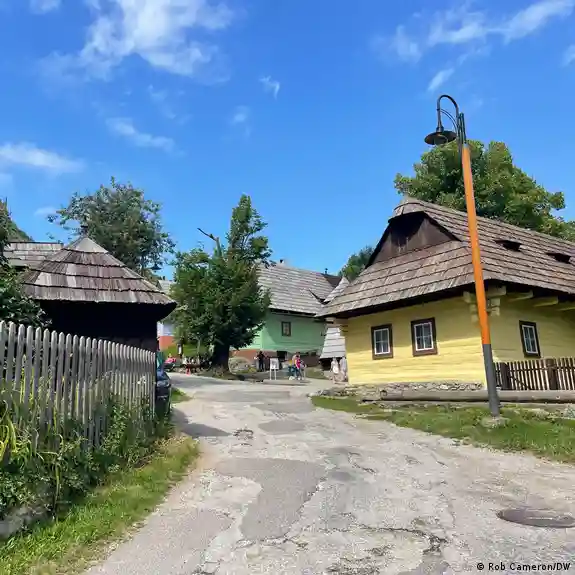
    In the Carpathian Mountains of central Slovakia lies Vlkolínec, a preserved settlement. This village is renowned for its pastel-painted timber cottages and traditional 19th-century folk architecture. It was inscribed as a UNESCO World Heritage site in 1993. Vlkolínec was celebrated not merely as a set of historical buildings, but as a living community. A rare surviving traditional rural life in Central Europe. However, three decades after receiving this prestigious designation, the small mountain is struggling with an existential dilemma. What was meant to be a cultural preservation has transformed into a challenge for the few villagers who still call Vlkolínec home. Now, frustration among permanent residents has reached a boiling point. There are calls to have the village removed from the UNESCO list altogether. When UNESCO designated Vlkolínec as a World Heritage site, one of the criteria was that it remained an inhabited settlement. At the time of inscription, the village was home to around 200 residents. Today, that permanent population has declined to just 14 to 17 people spread across four core families. In contrast to this dwindling resident count, Vlkolínec receives approximately 100,000 tourists every year. For the remaining inhabitants, the ratio of over 7,000 visitors per resident has basically altered the daily life. Locals report feeling as though they live inside a tourist zoo. The boundaries between public spaces and private homes are routinely ignored. Despite signs requesting privacy, visitors frequently wander into private yards, peer through kitchen windows, and treat active properties as open-access museum displays. The loss of privacy is compounded by anti-social tourist behavior. This conduct has been leaving locals feeling alienated in their own hometown. Overtourism is only one side of the coin. Residents also voice deep frustration over the rigid conservation framework that accompanies World Heritage status. Under national protection laws and strict UNESCO guidelines, historic homes face tight restrictions on modern modifications and physical alterations. Elderly villagers point out that these preservation rules have made customary rural activities increasingly difficult. Small-scale farming, livestock keeping, and land cultivation have gradually vanished. Surrounding agricultural terraces have become overgrown. Traditional meadow mowing has largely ceased as older generations pass away and younger generations move away. Furthermore, many of the village’s timber cottages have been bought up by outside buyers to serve as weekend holiday retreats. This phenomenon has increased the loss of a permanent, cohesive community. Some residents argue that revoking UNESCO status would reduce tourist pressure and ease regulatory burdens. However, municipal officials and heritage experts contend that delisting is neither practical nor the right solution. Local administrators in the nearby town of Ružomberok emphasize that UNESCO status brings significant heritage recognition and funding opportunities. Rather than abandoning the title, officials advocate for smarter tourism management. From a procedural standpoint, voluntary delisting at the request of a local community is virtually unprecedented in UNESCO’s history. The organization typically removes properties only when they lose their outstanding universal value due to severe destruction or irreversible development. The debate unfolding in Vlkolínec highlights a broader issue facing protected historic sites around the globe. How to balance global recognition and economic benefits with the rights and wellbeing of local inhabitants! Small historic communities across Europe and beyond battle with overcrowding and demographic decline. Vlkolínec serves as a reminder that preserving physical architecture alone is not enough. Without protecting the living social fabric of a community, world heritage sites risk turning into empty shells of their former selves.  

  • Wave clouds go viral in California

    People in the California city of Santa Cruz were left amazed after unusual wave shaped clouds appeared across the evening sky. According to media reports the stunning cloud formation was seen on Tuesday evening. Dark and white clouds stretched across the sky creating a pattern that looked like ocean waves. As the sun began to set its golden light reflected off the clouds making the view even more beautiful. Many local residents captured the rare moment on their phones and shared photos and videos on social media, where they quickly went viral. One woman at the beach posted a video of the breathtaking sky, and it has attracted widespread attention online.

Leave a Reply

Your email address will not be published. Required fields are marked *