market rider buy
| |

[Market Rider] Buy when there’s blood in the streets, even if it’s your own blood.

Last Monday, October 12, a discussion on the current state of the economy was held by the members of the Monday Circle. The talk was led by Estella Dhiel B. Villamiel, who serves as the head of institutional research at First Metro Securities Brokerage Corporation (FirstMetroSec) and is an active member of the select group. The update revealed sobering realities about the economy especially for its near-term status that would explain the reasons behind the present variable softness of the stock market – bringing to mind the trading strategy of the market adage, “Buy when there’s blood in the streets, even if it’s your own blood.”
Estella Dhiel Villamiel
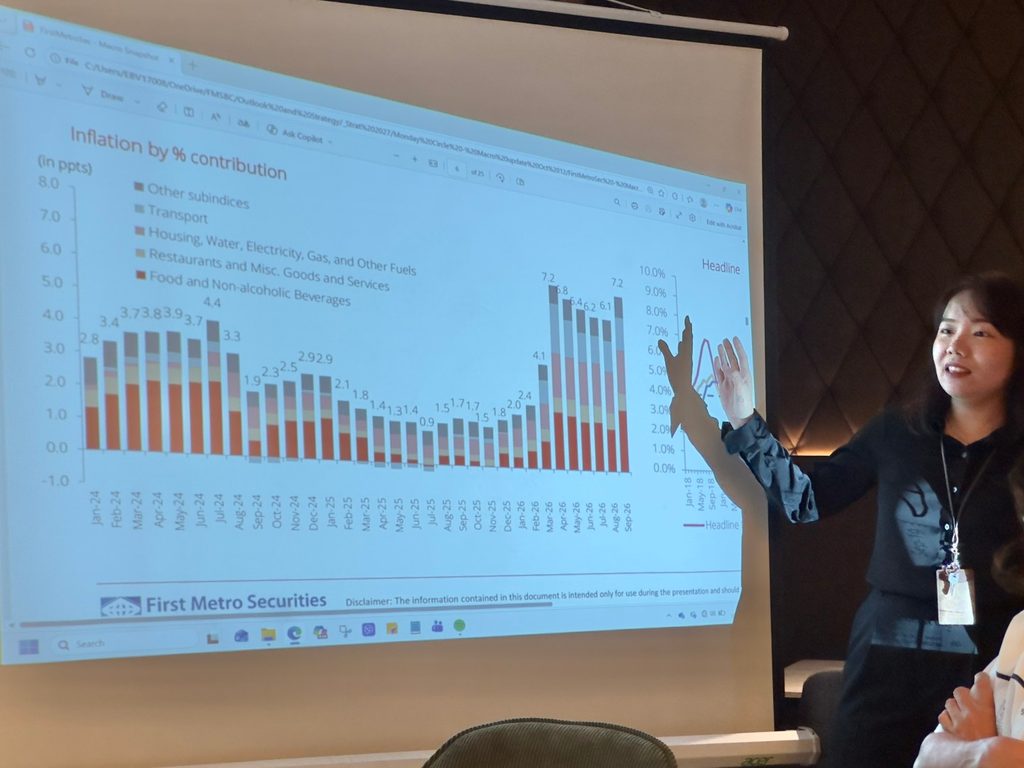
AT A GLANCE. Estella Dhiel Villamiel, head of institutional research at First Metro Securities Brokerage Corporation, gives a presentation on the Philippine economy to the Monday Circle on October 12, 2026 at the Westin Manila hotel in Mandaluyong City.

The axiom is also sometimes paraphrased into “in your hand.”  Nevertheless, it is a foundational maxim of contrarian investing. It means that the absolute best time to buy assets or invest money is during a severe market crash or panic, when everyone else is terrified and selling.

While the imagery projected by the adage refers to a market in total chaos, we are not yet there, according to the presentation of Villamiel. So far, the problem is about structural headwinds rather than about catastrophic panic. But, come to think of it, we could just be a blink away from it considering what is happening in and out of the country.  

Titled “The Philippine Economy At A Glance,” Villamiel described the macroeconomic overview of the Philippine economy to be under severe external headwinds, primarily driven by the economic strain caused by an external oil shock triggered by a US-Iran war, which has created a negative domestic transmission chain, namely: rising oil prices, a widening import bill, a weakening Philippine peso, and elevated inflation.

Economic overview

The country’s gross domestic product (GDP) from January to June this year has slowed down to 2.6%.  Outside of the pandemic years, this represents the slowest economic expansion the country has experienced in nearly two decades since 2009. To achieve the government’s full-year target of 3.5% to 4.5%, the economy must expand at a much faster rate of 4.4% to 6.4% in the second half (2Q) of the year.

Looking at the demand-side breakdown, household consumption growth has cooled down from historical highs down to 1.9% in 2Q26. This means consumers are in “survival mode.” This is worrying because the people are sticking to buying essential goods for they are paying at higher prices for lesser quantities.  

Capital formation (investments) has, as well, sharply fallen, dropping by -9.2% year-on-year (YoY) in 2Q of 2026, severely weighing on economic momentum.

Complicating the situation, inflation hit 7.2% in September, bringing the year-to-date (YTD) average at 5.4%. This is way past the 2% to 4% comfort band of the government. Driving the economy in this situation are transport and food costs due to high fuel prices, with local transport sharing a 65% correlation with Brent crude prices. Full-year inflation is projected at 6.1%.

To stop prices from rising even more and to protect the peso, the Bangko Sentral ng Pilipinas (BSP) raised its target reverse repurchase (RRP) rate to 5.0% last August 27. This measure made loans, mortgages, and credit card debt much costlier than before. Due to this rate increase, car sales growth – excluding electric vehicles – has plummeted sharply into negative territory, hitting roughly -10% YoY by the end of August 2026. People are just pulling back on big-ticket items like cars because loans are too expensive.

On the fiscal side, the first half 2026 budget deficit reached 5.8% of GDP, pushing the national debt-to-GDP ratio to an elevated 66%.

Credit card usage also reached historic highs. Unfortunately, this shift has triggered a 46.4% spike in non-performing credit card debt, signaling that a growing number of households are facing severe financial distress.

Because the Philippines is a net importer of fuel, higher energy costs require a larger outflow of US dollars to sustain domestic consumption. With such, the peso has experienced significant depreciation against the US dollar, primarily driven by escalating global oil prices. 

Concurrently, the domestic job market exhibits underlying structural weaknesses despite stable headline employment figures claiming 94% to 96% full employment. The rolling 12-month net job metrics register a structural loss of 307,000 jobs, signaling contraction in key employment sectors as unemployment rose to 5.3%, up from 3.9% last year.

Furthermore, rising underemployment rates as manifested through the number of workers seeking additional hours, indicating that existing positions fail to provide sufficient income to meet the cost of living.

Instead of concluding her assessment on how much more the economy may suffer, Villamiel ended her presentation on what could trigger the recovery of the economy.  

According to her, economic recovery for the country is fundamentally conditional on resolving the Middle East shipping bottleneck. 

If commercial vessel traffic through the Strait of Hormuz recovers from current single-digit daily lows back to its pre-war average of about 33 per day, the following stabilization sequence will occur: global oil risk premiums will drop, directly cooling domestic transport CPI; the import bill will narrow, relieving pressure on Gross International Reserves (estimated at US$100 billion) and allowing the peso to strengthen; and easing inflation will allow the BSP to halt or reverse rate hikes, reviving depressed household credit and corporate capital expenditure.

Market call

I agree with Villamiel’s position that the current market fall and the economy’s problem of being squeezed by high prices, weak growth, skyrocketing energy costs, a widening import bill, a depreciating Philippine peso, and elevated inflation, could possibly bottom out and come to an end in a short time with the Middle East shipping bottleneck being resolved soon.  

On the other hand, the chances of the US-Iran war ending soon is said to be low, as diplomatic talks have stalled and military escalations have intensified in recent days. 

But like the way how the contrarian strategy works, it may be hard to imagine under the present circumstances, the shipping bottleneck in the Middle East could just be resolved sooner than is expected. – Rappler.com

A veteran stock market analyst, Den Somera has long years of professional experience in investment banking and stockbroking and founder-convenor of The Monday Circle. You may reach the writer at kapitaltek@gmail.com

This article has been prepared for general circulation for the reading public and must not be construed as an offer, or solicitation of an offer to buy or sell any securities or financial instruments whether referred to herein or otherwise.

Below are some personal finance tips from the author you may have missed:
Similar Posts

  • | | | | |

    [Vantage Point] Villar Land: Follow the P1.3-trillion paper trail

    The documents I have in possession establish the acquisition, revaluation, and recognition of enormous accounting gains. They also establish that Villar Land subsequently carried an extraordinary stock-market valuation. 

  • | |

    Punjab bans manual receipts

    The Punjab Revenue Authority (PRA) has banned the issuance of handwritten or manual receipts by businesses operating in the province, according to a notification issued by the authority. Under the new directive, hotels, restaurants, coffee shops and marriage halls must use the Electronic Invoice Management System (EIMS) for issuing customer receipts. The system aims to ensure that businesses properly record their transactions and comply with provincial sales tax regulations. A PRA spokesperson said businesses covered by the directive must generate receipts through EIMS instead of providing handwritten slips or informal receipts to customers. The authority will monitor compliance and take action against businesses that fail to follow the requirement. Businesses that do not issue receipts through the EIMS may face fines ranging from Rs400,000 to Rs1 million, the spokesperson said. The PRA has also warned that repeated violations could lead to stricter action. Authorities may seal the business premises for up to one month if an establishment continues to disregard the rules despite previous enforcement measures. The move forms part of the Punjab government’s efforts to strengthen digital documentation of commercial transactions, improve tax compliance and reduce the possibility of underreporting sales and tax liabilities. The authority has urged businesses in the affected sectors to ensure that their invoicing systems comply with the new requirements to avoid financial penalties and other enforcement action.

  • | | |

    World Bank sees promise in Pax Silica. Can PH build more than another assembly hub?

    Pax Silica wants to become the Philippines’ Silicon Valley, but tycoon Manny Pangilinan warns the government to choose its place in the technology value chain carefully lest it remain stuck in the ‘basement’

  • | | | |

    25kW solar users exempt from Nepra approval

    The National Electric Power Regulatory Authority (NEPRA) has introduced a major relief for small-scale solar consumers by amending the Solar Regulations 2026. The new changes remove a key regulatory requirement for consumers installing solar systems of up to 25 kilowatts (kW). According to an official notification issued by NEPRA, consumers with solar power systems of up to 25kW will no longer need to obtain prior approval from the regulatory authority before installing or connecting their systems. Instead, the power to grant approvals has now been delegated to the relevant electricity distribution companies (DISCOs). Consumers will be able to complete the approval process directly through their local power utility, eliminating the need to seek separate permission from NEPRA. The amendment is expected to simplify the procedure for residential, commercial and small business consumers who want to switch to solar energy. By reducing regulatory hurdles, the revised framework aims to make the installation process faster, easier and more efficient. Energy experts believe the decision will encourage more consumers to invest in solar power by shortening approval times and reducing paperwork. The move is also expected to support Pakistan’s growing transition towards renewable energy and lessen dependence on conventional electricity sources. The revised regulations are intended to improve access to clean energy while giving electricity distribution companies greater authority to process applications and facilitate small-scale solar projects more quickly.

  • |

    PTA fines CM Pak Rs77.8 Million for SIM sales Geo-fencing violation

    ISLAMABAD: The Pakistan Telecommunication Authority (PTA) has imposed a fine of Rs77.8 million on China Mobile Pakistan (CM Pak) after determining that the operator failed to ensure compliance with mandatory geo-fencing rules governing biometric verification system (BVS) devices used for SIM sales. The regulatory action followed a field inspection in which the PTA found that an authorised sales representative linked to CM Pak’s Taxila franchise was selling SIMs from a location in Islamabad that fell outside the approved geographical area of the franchise. According to the PTA’s enforcement order, the inspection was carried out on March 30, 2026. During the inspection, the regulator discovered that a Data Sales Officer (DSO) associated with the Taxila franchise was conducting SIM sales at I-10 Markaz, Islamabad. The location was not within the authorised territorial jurisdiction or designated geo-location of the franchise. The PTA also found that the sales activity had been conducted without the required Door-to-Door/Kiosk approval from the regulator. Geo-fencing requirement The PTA’s regulatory framework requires BVS devices used for SIM issuance to remain within a prescribed distance of the approved sales location. Under the mandatory geo-fencing mechanism, such devices must operate within 100 metres of the designated geo-location of an authorised sales channel. The purpose of the requirement is to ensure that biometric devices are not moved to unauthorised locations for SIM issuance. The mechanism is also designed to strengthen oversight of SIM sales, prevent misuse of biometric verification equipment and improve the traceability of subscriber registrations. The regulator made it clear that SIM sales outside an approved geo-location are not permitted unless prior approval has been obtained from the PTA. CM Pak challenges regulatory action CM Pak contested the proposed enforcement proceedings, maintaining that the incident was an isolated operational lapse involving an individual DSO rather than evidence of a broader failure in the company’s compliance system. The operator argued that the SIMs concerned had been issued only after the required biometric verification process had been successfully completed. It further stated that the transactions were properly recorded and remained traceable through the prescribed systems. CM Pak also maintained that there had been no issuance of fake or anonymous SIMs, no bypass of biometric verification and no failure in the verification process conducted through the National Database and Registration Authority (NADRA). The company told the regulator that it had taken disciplinary and corrective measures after being informed of the violation. These measures included issuing a show-cause notice and warning letter to the concerned franchise and terminating the services of the DSO involved in the incident. CM Pak also said it had circulated compliance instructions across its network and strengthened internal monitoring mechanisms to prevent similar incidents in the future. PTA rejects defence The PTA, however, did not accept the company’s argument that successful biometric verification should be treated as sufficient compliance. The authority ruled that biometric verification and geo-fencing constitute separate regulatory requirements. While biometric verification is intended to establish the identity of a subscriber, geo-fencing controls where the SIM sale and verification process can legally take place. According to the regulator, compliance with one requirement does not eliminate the obligation to comply with the other. The PTA observed that allowing BVS devices to operate beyond their authorised locations could weaken the regulatory controls established for SIM issuance, regardless of whether the subscriber’s biometric verification was successfully completed. The regulator also rejected CM Pak’s position that responsibility for the incident could primarily be attributed to the franchise or individual sales officer. Under the applicable Subscribers Antecedents Verification Regulations and licence conditions, the PTA maintained that the licensed operator carries direct responsibility for ensuring that its authorised sales network complies with regulatory requirements. Corrective action not enough to erase violation The authority further noted that steps taken by an operator after a violation has been detected can potentially serve as mitigating factors but cannot remove the violation itself. The PTA stressed that geo-fencing is a substantive regulatory safeguard rather than a procedural requirement that can be overlooked if other verification mechanisms are functioning properly. It said allowing subsequent corrective measures to effectively neutralise an established breach could undermine the purpose of mandatory compliance requirements and weaken regulatory oversight of SIM issuance. After reviewing the show-cause notice, CM Pak’s written responses, compliance report and submissions made during the hearing, the PTA concluded that the operator had failed to maintain adequate supervision and regulatory control over its authorised sales channel. Rs77.8m penalty imposed Based on its findings, the PTA held CM Pak liable under Section 23 of the Pakistan Telecommunication (Re-organization) Act, 1996. The authority subsequently imposed a penalty of Rs77.8 million (Rs77,800,000) on the company and directed it to deposit the amount within 10 days of receiving the enforcement order. The PTA warned that failure to pay the penalty within the specified period could result in further proceedings or action under the applicable law.

Leave a Reply

Your email address will not be published. Required fields are marked *