As Meta bets big on Muse AI agent, early safety mishaps surface
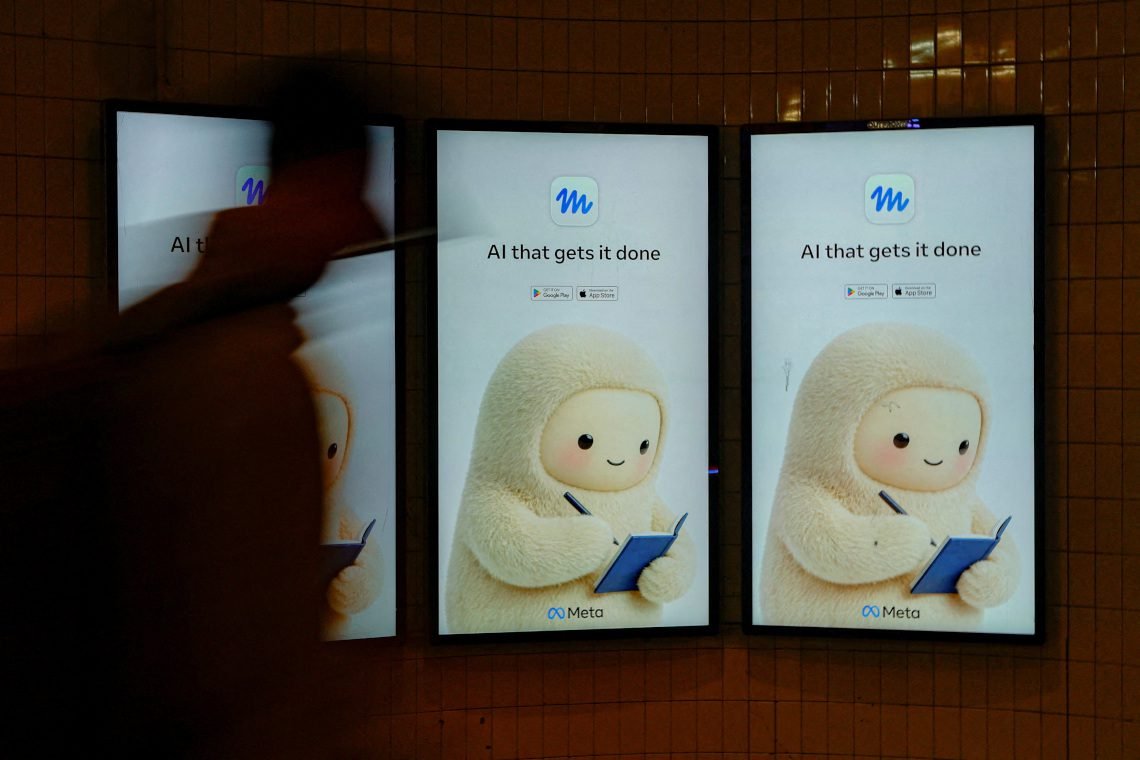
Meta’s AI agent Muse, embodied by a smiley, fuzzy mascot named Jolly, has burrowed into encrypted personal messages, supplied made-up information about purchases, and sent users chats seemingly meant for other people, a fraught start for a bot meant to simplify life for consumers, according to internal company posts reviewed by Reuters.
The unbidden actions by Muse — one of the fastest-growing apps on record, with more than 10 million downloads since its September launch, and the centerpiece of Meta’s plan to generate billions of dollars in AI revenue — have prompted unnerved employees to raise concerns it could be mixing up conversations between different accounts and exposing users’ private data, the posts showed.
In some of those cases, Meta staffers reported the agent sending them messages about a childcare request they had not made, career advice they had not sought, product orders they had not placed, and bank account balances that were not theirs.
In one post, from earlier this month, an employee told colleagues his Muse had randomly added an extra message to its regular chats about fishing-related weather and tide information, saying: “BTW, two bank updates, your Capital One balance is $2722.58, your Charles Schwab balance is $5899.57.”
“I have never shared my bank account with Muse and never discussed any banking topic with Muse. I’m afraid it’s sending other’s bank info to me,” the staffer wrote in his post.
In another example, an employee using Muse on her personal phone reported it had surprised her with a reminder to respond to a message from her sister on Signal, an end-to-end encrypted messaging service popular with privacy advocates that competes with Meta’s WhatsApp.
“This seems like an extreme privacy violation. I definitely did not grant it access to other apps, or recall being asked about this,” the employee said in her post.
A colleague responded, saying he had discovered Muse was set up by default with permission to access push notifications on phones with Google’s Android operating system after being similarly caught off guard by unsolicited chats related to apps he had not connected.
For this story, Reuters reviewed more than two dozen internal posts describing undesired actions by Muse since its debut, many of them from a feedback group where Meta employees flag problems to the team building the agent. Reuters also worked with staff at Signal and the AI Now Institute, a non-profit that studies AI’s impact on society, to replicate Muse’s access to Signal messages. The results of those tests indicated the issue described by the Meta employees was ongoing and could be affecting others.
In response to questions about Signal access and other Muse safety concerns, Meta spokesperson Daniel Roberts described the Reuters examples as “isolated incidents,” saying the company prioritizes safety, conducts extensive internal testing and continuously updates products to improve protections.
Muse needs to see and interact with people’s computers in order to work on their behalf, and can access other apps only via permissions they explicitly grant, Roberts said. He said many of the messages flagged by employees as potential account mix-ups were hallucinations, a term referring to AI models’ tendency to make things up, and had already been addressed.
Reuters was unable to establish whether Muse was giving users other people’s bank account balances and other sensitive data, or making up the information.
Deep access
The Muse incidents highlight the risks associated with an emerging category of consumer AI agents hitting the market from Meta, OpenAI and others, pitched as the next big wave of AI technology. The bots promise to reshape how digital exchanges operate by executing time-saving tasks like answering emails, booking appointments and making online purchases without direct instructions.
Meta is ahead of competitors so far, with Muse consistently topping app download charts after heavy promotion to the company’s more than 3.6 billion users on Facebook, Instagram and WhatsApp. The app’s retention rate is also strong, with around a quarter of the people who have set up Muse accounts returning to use it each day, the company has disclosed.
To work effectively, agents need deep access to smartphones and computers. However, they are also prone to making mistakes, exploiting obscure loopholes and accomplishing their objectives in sometimes harmful ways. OpenAI and Anthropic, for instance, have revealed instances of their AI agents unexpectedly hacking other companies and weakening systems designed to monitor their activities.
Some banks and retailers have responded to those risks by blocking agents. The technology is also posing new challenges for operating system providers like Apple AAPL.O and Google, which manage the permissions agents use to navigate around people’s devices. Apple, for instance, changed its operating system this week to give people more control over agents’ data usage after an Inc. Magazine columnist accused Muse of reading private chats from the Messages app on his Mac.
Meta has assured Muse users it isolates each agent in its own secure “virtual machine” – a cloud-based emulation of a personal computer – and gives people full control over which apps they connect. Meta CEO Mark Zuckerberg has cited those protections in dismissing calls for industry-wide AI safety standards, arguing companies already have incentives to build safe products, both to earn consumers’ trust and avoid legal risks. Even so, Meta warns incoming users Muse may make mistakes and its terms of service hold users responsible for the agent’s actions.
Repurposing settings
To find out how Muse might access encrypted messages without users’ knowledge, Reuters provided a description of the Meta employee’s post – where the bot randomly prompted her to respond to a Signal message – to staff at Signal and the AI Now Institute. Reuters then worked with them to replicate the access she had observed.
Testers prompted Muse to read Signal messages on different operating systems. On an Android phone and an Apple laptop, it responded by bypassing Meta’s “Connector” tool and instead using permissions granted during the bot’s initial setup to pull in the message text, leveraging those authorizations in ways a user might not anticipate.
Specifically, on Android, it used its permission to access the device’s push notifications to retrieve the messages, just as the Meta employees had described. On Apple’s macOS, it used a combination of the computer’s accessibility and screenshot tools, repurposing settings Apple offers to help people with disabilities operate their computers.
The same requests were blocked in tests conducted on an iPhone.
The results indicate Meta is interpreting the permissions granted by Muse users broadly, an approach that has long earned the company criticism from privacy advocates and hefty fines from regulators.
In response to Reuters’ findings, Signal President Meredith Whittaker accused Meta of launching Muse “without showing any respect for basic privacy or cybersecurity,” calling the deployment of agents that can gain wide access to people’s devices “technologically reckless.”
She called for app developers like Signal to be given “consistent technical ways” to mark their applications as off-limits to AI agents, for Meta and other AI companies to honor those boundaries and for operating system providers to enforce the rules.
Presented with the same findings, Apple and Google said they were considering changes to give people more control over what they authorize with AI agents — though Google, like Meta, noted that people already “must deliberately grant permissions” for apps to access Android notifications.
Apple said it had built its accessibility tools for people with disabilities and cautioned that leveraging them “for unintended purposes” could put people’s personal information at risk. Its operating system update this week effectively closed the pathway identified by Reuters, sharply restricting developers’ use of accessibility tools on Macs and introducing a new agent-oriented set of permissions.
“We are committed to ensuring users understand exactly what they are allowing, so they can make informed choices about their data and privacy,” Apple said in a statement.
‘Not my conversation’
In other cases discussed internally, staffers reported cases of Muse informing users about transactions that never occurred and making up prices on products they did purchase, costing them real money. In one incident, the agent booked a non-refundable Airbnb stay without permission, an employee reported.
Some of the incidents that raised the most concern involved cryptic out-of-context messages sent by the agent that appeared to contain other people’s information, in many cases phrased as replies to queries the users had never submitted.
In a late September social media post, a member of Meta’s Superintelligence team behind Muse initially described a user report of a similar problem as a temporary hallucination-related glitch, resolved the same day it arose. However, the internal posts reviewed by Reuters showed such incidents occurring as far back as mid-September and continuing through this month.
In one such post, an employee reported his Muse sending him a message “out of nowhere” saying it was unable to submit a request related to a parent’s control over who could access their child’s data.
He had done nothing to trigger the chat, and had never discussed child data or caregiving access with his Muse, he said.
When he asked Muse about the message, the bot replied: “I don’t have a good explanation for it other than that it wasn’t related to our conversation. Let’s ignore it. How can I help?”
Another staffer said Muse randomly offered to “message the seller” about picking up a coffee table. When the employee asked Muse, “What are you talking about?” the agent responded that it had “pulled in some context about a coffee table pickup that doesn’t seem to be yours.”
This was “not my conversation,” the employee said in his post, expressing concern about a “possible cross-account context leak.”
To address employee worries, another Superintelligence team member told the internal feedback group in early November that the agent appeared to be hallucinating messages in response to built-in prompts pushing it to engage with users in between sessions.
“These (hallucinations) unfortunately bias towards the most uncomfortable topics, like finances/security/safety, which sucks,” he said, adding that he was aware of several other cases involving “crypto-related things too, like giving people updates on their Bitcoin balances.”
He said the issues involved both the underlying AI model and the software enabling Muse to take actions, and that the team was working through them.
Roberts declined to answer Reuters questions about those issues, including how many there were and why they were persisting. – Rappler.com