nerve rapplearn launch
|

Nerve, RappLearn launch crisis management masterclass for the AI age

What do you do when the story about you or your organization is no longer yours to control? 

Generative AI can produce persuasive content at the press of a button. This blurs the line between authentic information and deceptively manipulated information, according to the UN Preliminary Report of the Independent International Scientific Panel on AI. 

When your audiences are challenged to distinguish fact from fiction, your organization’s next crisis won’t just move fast — it will move at the speed of AI.

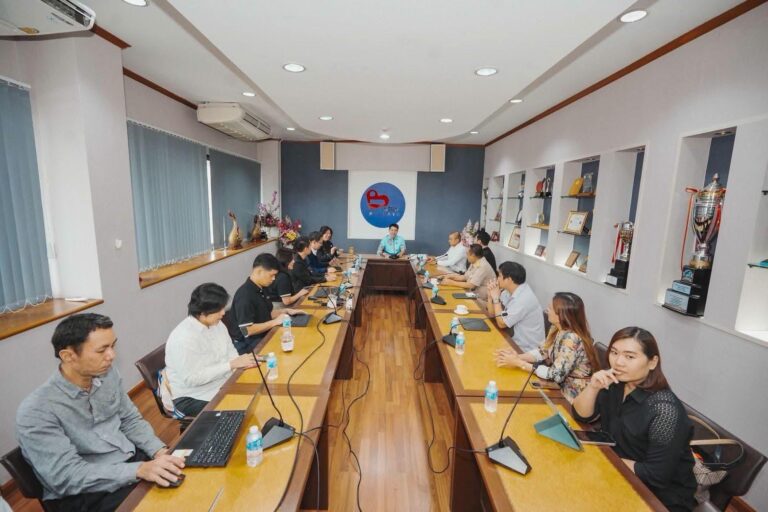
The Nerve understands this high-stakes information environment and how to respond during hard pressed situations. The data forensics company is partnering with RappLearn, Rappler’s training arm, to launch Under Pressure: Managing Crisis in the Age of AI to help organizations proactively navigate the online space. This hands-on workshop will happen in the Rappler Newsroom in Pasig City on Friday, October 9, 2026, from 9 am to 5 pm. 

Born from crisis and forged in fire, The Nerve has spent nearly a decade helping corporate and institutional partners manage online threats and understand real-world trends. Through this immersive masterclass, participants will learn directly from the experts to gain the right toolkits to anticipate, detect, and effectively mitigate crisis incidents.

Attendees will practice rapid triage, undergo mock media interviews, and learn to craft their own crisis management playbook. 
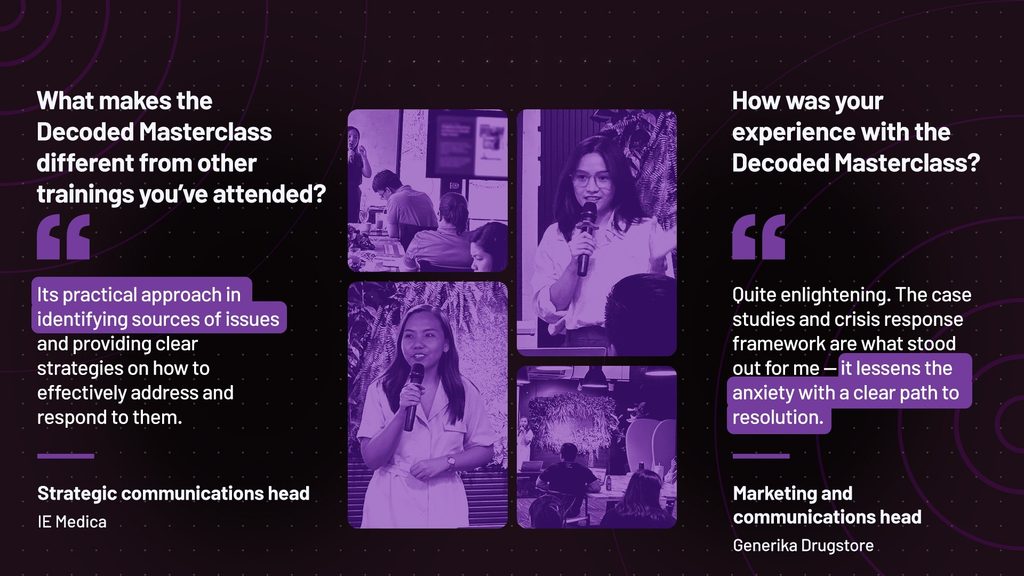
Previous participants found the Crisis Masterclass practical and enlightening
Who is this workshop for?

This masterclass is designed for communication practitioners with a beginner to intermediate level of understanding of reputational crisis and risk. The session is specifically built for teams operating at a reactive or developing stage of crisis resilience, helping them move from “firefighting” to a proactive, framework-driven state including the following groups: 

  • Crisis & PR Managers
  • Brand Marketing Leaders
  • Media & Information Practitioners
  • Academic & Public Institutions
  • Government & Regulatory Agencies
What you’ll gain
  • A Customized Crisis Response Blueprint: Walk away with a tailored operational playbook to map your company’s vulnerability, define escalation guidelines, and coordinate swift internal action.
  • The 5-Step Forensic Framework: Master a step-by-step methodology built by The Nerve to classify risks, locate digital fires, map online networks, decode threats, and reclaim your narrative.
  • Real-World Media Discipline Under Fire: Face mock interviews with newsroom journalists to practice rapid-fire holding statements and maintain message discipline under extreme pressure.
  • Strategies Against AI & Coordinated Campaigns: Learn how to identify and classify actors such as bots, micro-influencers and mainstream media, and map strategies to activate trusted allies to defend your company.
  • Rapid Triage Skills: Gain the instincts to instantly distinguish between minor issues, incidents, and full-blown crises so your team stops reacting out of panic and starts leading with data. 
Meet your instructors

Kit Posadas is Head of Strategy at The Nerve, a data forensics consultancy born from Rappler’s investigative work on disinformation, now enabling changemakers to navigate real-world trends and issues. Her expertise lies in making insights from big data actionable for brands — be it for reputation management, communications planning, or marketing and branding campaigns.

Miriam Grace Go is Managing Editor at Rappler. Gigi is an award-winning investigative journalist and author who has spent decades covering local governance, campaigns, and elections across various publications. Recognized as an outstanding UP alumnus and Glory Medal of Distinction recipient, she has co-authored multiple books on Philippine politics and has completed fellowships in Hawaii, Canada, and Thailand. 

Pauline Macaraeg is the Lead Forensics Researcher at The Nerve. Her work focuses on analyzing data-driven online trends, mapping disinformation actors and networks, and decoding the spread of information across the digital space. She has an academic foundation in Data Science through her MS studies at the Asian Institute of Management.

Lance Spencer Yu is a Multimedia Reporter at Rappler, covering business, finance, transportation, and economics. An award-winning feature writer and magna cum laude holding a degree in Management of Financial Institutions from De La Salle University, he joined Rappler in 2022 before expanding his expertise as a private capital analyst for global research and investment firms.

How to join

Interested participants can sign up for the October 9 session directly through this registration link. Capacity is limited to 30 seats to ensure an immersive and hands-on experience.

REGISTER HERE

Regular seats start at P29,999, but discounted early-bird rates are available at P24,999 while slots last. The fee covers participation, lunch and snacks, learning materials, access to tools and additional resources. 

For inquiries and group packages, email hello@thenerve.co. – Rappler.com

The Nerve is a data forensics company that enables changemakers to navigate real-world trends and issues through narrative and network investigations. Taking the best of human and machine, we enable partners to unlock powerful insights that shape informed decisions. Composed of a team of data scientists, strategists, award-winning storytellers, and designers, the company is on a mission to deliver data with real-world impact.

Similar Posts

  • |

    Young people increasingly turn to AI chatbots for emotional support and social advice

      Artificial intelligence is becoming an increasingly common source of support for teenagers and young adults as many begin relying on AI-powered chatbots to navigate personal conversations, relationships, and everyday social situations. Recent national studies suggest that around 20 percent of young people now seek guidance from AI companions for emotional support and relationship advice instead of turning to friends, family members, or other trusted individuals. Experts say that the growing popularity of AI chatbots reflects changing communication habits among younger generations. Many users are employing these digital tools to help write difficult text messages, prepare for challenging conversations, and better understand complicated social interactions. For many, artificial intelligence provides a convenient and accessible way to think through personal situations before speaking with others. Researchers have found that many teenagers appreciate AI because it is available at any time of the day or night. Unlike human conversations, interacting with a chatbot does not involve the immediate fear of criticism, embarrassment, or rejection. This constant availability has made AI an appealing option for individuals who may feel anxious about discussing sensitive topics with people in their lives. Clinical psychologist Joshua Goodman believes that AI chatbots can offer users a comfortable environment to explore their thoughts and emotions. He explained that conversations with artificial intelligence may feel like a safe place where young people can discuss issues they might hesitate to share with parents, teachers, or friends. This sense of privacy and emotional comfort has contributed to the increasing use of AI for personal guidance. However, mental health professionals caution that artificial intelligence should not be viewed as a replacement for genuine human relationships. While AI can provide information, suggestions, and conversational support, experts emphasize that it lacks the emotional understanding, empathy, and lived experience that real people bring to meaningful relationships. Clinical psychologist Mary Alvord has warned that although AI conversations may seem safe, users should remember that perceived privacy is different from actual privacy. She pointed out that interactions with chatbots may be stored, analyzed, or processed by technology providers, meaning users should be careful about sharing highly personal or sensitive information. Experts also stress that artificial intelligence cannot fully replicate the complexity of human communication. Media psychologist Don Grant explained that chatbots are generally designed to remain supportive and non-confrontational. While this may make conversations feel comfortable, it also means users may not experience the constructive challenges, disagreements, or honest feedback that often help people develop stronger communication skills and emotional resilience. According to specialists, relying too heavily on AI for social interactions could reduce opportunities to practice real-life communication. Building confidence in conversations, resolving disagreements, and forming lasting friendships require experiences that technology cannot fully provide. Human relationships involve empathy, body language, emotional understanding, and shared experiences that remain difficult for artificial intelligence to reproduce. To encourage a healthy balance, health professionals recommend using AI as a supportive tool rather than a substitute for personal relationships. They advise parents, educators, and young adults to establish clear boundaries regarding AI use while continuing to prioritize conversations with family members, friends, teachers, and mental health professionals when needed. Experts also encourage young people to regularly practice face-to-face communication, participate in social activities, and develop interpersonal skills that strengthen emotional well-being. These experiences help build self-confidence, improve problem-solving abilities, and create meaningful personal connections. As artificial intelligence continues to become part of everyday life, specialists believe it can play a positive role when used responsibly. However, they emphasize that maintaining genuine human relationships remains essential for emotional growth, mental health, and long-term social development. AI may offer convenience and support, but meaningful human connection continues to be irreplaceable.

  • | | | | | | |

    [OPINION] What America’s AI boom teaches us about scrutinizing Pax Silica

    Communities across the United States are already grappling with soaring electricity demand, opaque utility agreements, environmental concerns, and questions over promised jobs. Before Pax Silica breaks ground, if ever, Filipinos should learn from those experiences.

  • | |

    Pattaya Advances Smart City Vision with GISTDA Through Digital Twin Platform Talks

    PATTAYA, Thailand – On August 10th, 2026, at 9:00 a.m., Pattaya City Mayor Poramese Ngamphichet chaired a meeting to discuss cooperation on applying space technology and geo-informatics to support the city’s transformation into a Smart City. The discussions were held with the executive team from the Geo-Informatics and Space Technology Development Agency (GISTDA), a public […]

  • | | | | | | | | | | | | |

    [OPINION] Understanding the Gen Z audience: Hollywood doesn’t own Homer

    A Broadway-loving teenager, an ancient Greek epic, and the surprising return of collaborative storytelling

  • |

    Google DeepMind exec admits AI extinction risk is “not zero

    Lila Ibrahim, Google DeepMind’s Chief AI Readiness Officer, will not put a number on the odds of AI wiping out humanity. She is not dismissing the possibility either. Speaking to Fortune, she said the risk is “not zero,” admitting that anything more specific would just be guesswork on her part. Ibrahim was among those who signed the Center for AI Safety’s 2023 statement, alongside co-founders of Anthropic and OpenAI. That statement argued AI extinction risk deserves the same global priority as nuclear war and pandemics. Three years on, she still believes staying silent on existential risk would be irresponsible. She feels this way especially now, given how far the technology has advanced since then. Some of her peers sound even more alarmed. Geoffrey Hinton, often called the “godfather of AI,” estimates a 10% to 20% chance of extinction within the next three decades. Anthropic’s Dario Amodei has gone further, putting the odds of things going “really, really badly” at around 25%. These warnings are not new either. Physicist Stephen Hawking, who used AI tools himself, raised similar concerns long before ChatGPT even existed. Ibrahim compares the situation to the pandemic, pointing out that the worst risks rarely arrive the way people expect. She noted that entire industries failed to properly weigh risk during earlier tech shifts, including the rise of the internet and social media. She is just as sceptical of the optimistic predictions floating around. Elon Musk recently told The Economist that money will stop mattering by 2036, imagining a future of cheap abundance and universal high income once robots take over most jobs. Jeff Bezos has predicted millions of people living in space by 2045. Sam Altman, meanwhile, envisions new job opportunities specifically for graduates working in space. Ibrahim isn’t convinced by either scenario, arguing that AI simply is not developing fast enough to make these predictions realistic anytime soon. Rather than debating far-off futures, Ibrahim says she is more focused on using AI to tackle problems happening right now. She pointed to climate change and industrial pollution as areas where the technology could make a real difference. She was also clear that AI’s benefits should not be limited to a handful of powerful companies. For her, that is just as important as managing the risks.

Leave a Reply

Your email address will not be published. Required fields are marked *