ogdc top executives
| |

OGDC top executives receive monthly salaries rangi…


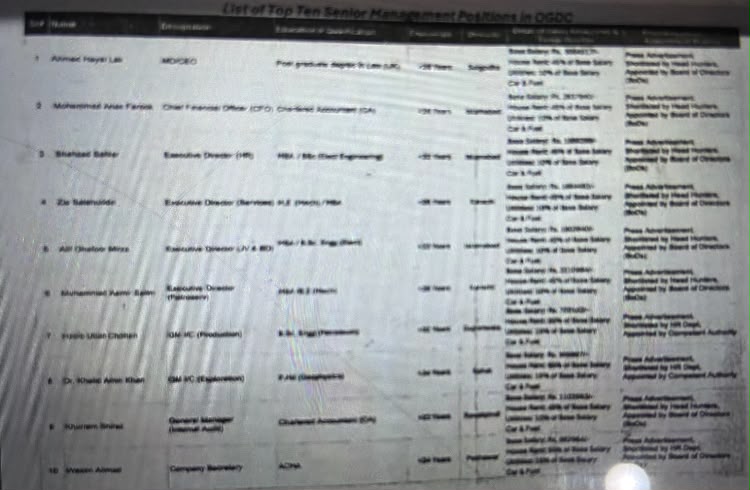
Islamabad:Details of the salaries and benefits of senior officials at Oil and Gas Development Company Limited (OGDC) were presented before the Senate, revealing that the company’s Managing Director and Chief Executive Officer receives a basic monthly salary of more than Rs. 5.56 million.

The information was shared with parliament as part of a disclosure concerning the remuneration packages of senior executives at the state-owned exploration and production company. The figures show significant differences in the basic salaries of OGDC’s top management, with the company’s highest-paid official earning several million rupees each month before allowances and other facilities are added.

According to the details presented in the Senate, Ahmed Hayat Lak, OGDC’s Managing Director and CEO, receives a basic monthly salary of Rs. 5,564,171. Chief Financial Officer Muhammad Anas Farooq earns Rs. 2,837,940 per month, while Executive Director Petroleum Muhammad Aamir Saleem receives Rs. 2,211,990.

Among other executive directors, Shehzad Safdar, Executive Director Human Resources, has a basic monthly salary of Rs. 1,889,298. Zia Salahuddin, Executive Director Services, receives Rs. 1,849,433, while Atif Ghafoor Mirza, Executive Director Joint Ventures and Business Development, earns Rs. 1,893,434.

The salaries of general managers are comparatively lower but still substantial. Khurram Shehraz, General Manager Internal Audit, receives Rs. 1,100,929 per month. Dr. Khalid Ameen Khan, General Manager Exploration, earns Rs. 900,881, while General Manager Production Habib Ullah Chohan receives Rs. 700,443.

The company secretary, Waseem Ahmad, has a basic monthly salary of Rs. 607,754.

In addition to their basic salaries, the ten senior officials are entitled to several allowances and facilities. These include a house-rent allowance equivalent to 45 percent of their basic salary and utilities allowance amounting to 10 percent of the basic pay. They are also provided with car and fuel facilities.

After the applicable allowances are included, the monthly remuneration package of the OGDC managing director exceeds Rs. 8.6 million. The CFO’s overall monthly package is reported to be more than Rs. 4.4 million.

The information presented to the Senate also showed that all ten officials have more than three decades of professional experience. Most of the executives were recruited through press advertisements and headhunters before being appointed by OGDC’s Board of Directors.

Their educational qualifications include professional and advanced degrees in fields such as law, chartered accountancy, business administration, engineering and geophysics. The MD is based in Islamabad, while other senior executives are posted in Islamabad, Karachi, Quetta and Sukkur.

OGDC is Pakistan’s largest exploration and production company and is listed on the stock exchange, with the government holding a majority share. The disclosure has drawn attention to the compensation structures followed by state-owned enterprises.

During the Senate proceedings, questions were raised regarding whether OGDC’s remuneration packages are comparable with those offered by private-sector exploration and production companies. Senators also discussed the possible impact of high executive compensation on the company’s overall operational expenses.

However, no change to the existing salary and benefits structure was announced during the briefing.

Similar Posts

  • |

    Saba Hameed’s double role as mom and wife sparks confusion

    Saba Hameed continues to prove her versatility as an actor, appearing in more projects than most of her peers. Her latest casting choices, though, have left fans and colleagues puzzled. In ARY Digital’s Bas Tera Saath Ho, now 28 episodes deep, Saba portrays the wife of the male lead’s uncle, played by Faran Tahir. Around the same time, she plays the mother of the female lead’s father in Dar-e-Nijaat, another ARY production, again opposite Tahir. She is essentially his wife in one show and his mother in another, with both airing simultaneously. Content creator K Khan raised the issue in an Instagram reel on Monday. He questioned how the makers of Dar-e-Nijaat decided she suited the role of Tahir’s mother, given that she plays his spouse elsewhere on the same channel. Actor Zhalay Sarhadi weighed in through the comments, arguing that only women seem to age in Pakistani show business, while men remain perpetually youthful on screen. She said the industry keeps reinforcing this outdated mindset, even as attitudes shift elsewhere in the world. Sarhadi called for better, more realistic roles written for female actors, and joked she might soon end up playing Humayun Saeed’s mother if the trend continues. Atiqa Odho voiced similar frustration on her show Kya Drama Hai, posted to YouTube on Tuesday. She praised the overall cast but admitted she could not understand the casting logic behind Hameed’s role. She added that Hameed’s look in the part felt unconvincing, since she does not resemble a grandmother. Not everyone agreed. TV host Juggun Kazim defended the casting, calling it proof of Hameed’s exceptional range as a performer. She said Hameed has a rare gift for making audiences forget she is acting and fully believe each character. This is not the first time ageism has stirred debate in Pakistani television. Atiqa herself was previously targeted over remarks about her appearance. Critics often point out that male actors in their 40s still land lead roles as young men, such as Fahad Mustafa in Kabhi Main Kabhi Tum, frequently paired with much younger actresses. Women of similar age, meanwhile, are routinely pushed into roles as mothers or older relatives, underscoring a persistent double standard in casting across the industry.

  • | |

    AJK assembly to elect prime minister on August 27

    MUZAFFARABAD: The Azad Jammu and Kashmir (AJK) Legislative Assembly will elect the new prime minister on August 27, with the Pakistan Muslim League-Nawaz (PML-N) in a strong position to secure the top office. The election schedule was issued on Wednesday, setting out the timeline for nomination papers, scrutiny, withdrawal and polling. Under the schedule, candidates will submit their nomination papers between 9:30am and 10:30am. The scrutiny process will take place from 10:30am to 10:45am. The list of candidates will be displayed at 11am. Candidates will have 30 minutes, from 11am to 11:30am, to withdraw their nominations. The final list of candidates will be issued at noon. Polling for the office of prime minister will begin at 12:30pm in the Legislative Assembly. The newly elected prime minister is scheduled to take the oath between 4pm and 5pm on the same day. The PML-N has nominated party president Shah Ghulam Qadir for the position. Based on the current strength of the assembly, he is considered the leading candidate for the office. The recent AJK elections were conducted in three phases between July 27 and August 10. Polling was held in 38 of the 45 directly contested constituencies. The PML-N emerged as the largest parliamentary group by winning 25 seats, while the Pakistan Peoples Party (PPP) secured 12 seats. The PML-N’s position was further strengthened after the lone elected member of the Awami Dast-o-Bazu party joined the ruling alliance. The PML-N currently has the backing of 32 members, compared with 14 members supporting the PPP. The numbers give the PML-N a clear advantage ahead of the prime ministerial election. The political balance was also reflected in the recent elections for the assembly’s top offices. PML-N AJK Secretary General Chaudhry Tariq Farooq was elected speaker with 32 votes. Ahmed Raza Qadri also secured 32 votes to become deputy speaker. PPP nominee Qasim Majid received 13 votes in the speaker’s election, while PPP candidate Amir Abdul Ghaffar Lone secured 13 votes in the deputy speaker’s contest. One PPP vote was declared invalid. The new assembly formally began its parliamentary term on August 24, when 46 newly elected members took their oaths. Outgoing Speaker Latif Akbar administered the oath during the inaugural sitting.

  • | |

    Over 4,000 cops to secure AJK elections in Rawalpi…

    More than 4,000 police personnel will be deployed in Rawalpindi division to ensure security during the Azad Jammu and Kashmir (AJK) Legislative Assembly elections on August 2. Police officials have prepared a detailed security plan for polling in four constituencies of the division, including Attock, Jhelum, Chakwal and Murree. A total of 4,029 police officers will be assigned duties at 175 polling stations. The polling stations have been divided into three categories according to their security requirements. Category A includes highly sensitive stations, Category B covers sensitive locations, while Category C consists of normal polling stations. Rawalpindi Regional Police Officer Babar Sarfraz Alpa said providing voters with a safe and peaceful environment is the top priority. He added that all available resources would be used to ensure free and transparent elections. He said strict monitoring would be carried out at sensitive polling stations. Additional patrolling and surveillance measures would remain active throughout the polling process. Police officials will also monitor suspicious activities, illegal weapons and any violations of the election code of conduct. Legal action will be taken against individuals involved in disrupting the electoral process. In Rawalpindi district, more than 3,100 police personnel and 200 traffic police officials will be deployed at 100 polling stations. These stations are located in different areas, including Rawalpindi city, Taxila, Wah Cantt, Gujar Khan, Kallar Syedan and Kahuta. Among the 100 polling stations, 18 have been declared highly sensitive, 45 sensitive and 37 normal. Security arrangements have also been made for the safe transportation of polling materials. City Police Officer Hassan Mushtaq Sukhera said the police would ensure implementation of the Election Commission’s rules and maintain law and order until the completion of the election process. The AJK elections are being conducted in phases due to security concerns. Authorities have increased security measures after previous election-related tensions and allegations of irregularities.

  • | | | |

    Rome talks continue despite fresh Israel-Lebanon c…

    JERUSALEM: Fresh violence erupted along the Israel-Lebanon border on Wednesday after two Israeli soldiers were killed during a military operation in southern Lebanon, prompting retaliatory Israeli airstrikes even as diplomatic talks aimed at reducing tensions continued in Rome. The latest escalation comes despite a US-brokered security arrangement reached in June, which was intended to ease hostilities between Israel and Lebanon following months of cross-border clashes. According to Israeli authorities, the two soldiers were killed and four others wounded when an explosion ripped through a building they had entered during a security sweep inside southern Lebanon. Israeli Army Radio, citing a security source, reported that investigators were still trying to determine whether the explosive device had been planted before or after the ceasefire agreement. Soon after the incident, the Israeli military described the explosion as a “blatant ceasefire violation” and launched a series of retaliatory strikes targeting areas in southern Lebanon. Lebanese officials said one civilian was killed and at least 12 others were injured after Israeli strikes hit the town of Tibnin, around 25 kilometres from Mansouri. Before the attack, the Israeli military issued an evacuation warning for residents in the area—the first such online warning directed at Lebanon in more than a month. However, Israel’s tone appeared to soften a day later. In a statement mourning the soldiers, Defence Minister Israel Katz did not directly accuse Hezbollah or refer to a ceasefire violation, signalling that Israeli authorities may be seeking to avoid a wider military escalation. Israel continues to maintain a buffer zone inside southern Lebanon, saying its forces are operating there to eliminate threats posed by the Iran-backed Hezbollah movement and to enhance border security. Meanwhile, diplomatic efforts remain underway in Rome, where Israeli and Lebanese officials are participating in talks that began on Tuesday and are scheduled to continue through Thursday. The negotiations are focused on strengthening the June security arrangement and preventing further violence along the volatile frontier. The renewed bloodshed underscores the fragile nature of the ceasefire and highlights the challenges facing mediators seeking lasting stability in the region. While both sides have expressed interest in preventing a broader conflict, sporadic violence continues to threaten the progress made through recent diplomatic initiatives. With negotiations still in progress and tensions remaining high, regional observers fear that any further incidents along the border could quickly undermine the fragile peace and derail ongoing efforts to maintain security between the neighbouring countries.

  • | |

    Indian activist Sonam Wangchuk says he remains ali…

    Indian activist Sonam Wangchuk says he has lost 11 kilograms during a 26 day hunger strike but remains alive, as his protest continues to fuel a wider youth movement demanding education reforms in India. Wangchuk, known widely as Sonam sir, has become the central figure in a youth led campaign organized by the Cockroach Janta Party, which is calling for sweeping education reforms and the resignation of Education Minister Dharmendra Pradhan. He was removed from the group’s protest site at Delhi’s Jantar Mantar on Saturday and taken to a hospital, where he has continued his fast. Despite his removal from the demonstration site, thousands of supporters have kept returning to Jantar Mantar, even after a heavy handed police response to a march toward parliament earlier in the week left numerous protesters and police officers injured. That crackdown has intensified public anger and energized opposition parties, creating a growing political challenge for Prime Minister Narendra Modi’s government. Modi has not addressed the protests directly or met with demonstrators, but he issued a statement on social media that many interpreted as an effort to connect with students angered by repeated leaks of exam papers. He wrote that the welfare of the country’s youth matters above all else and said the government would establish fast track courts to deliver swift punishment for those responsible for the leaks. A spokesperson for the Cockroach Janta Party, Ashutosh Ranka, responded that the government’s plan addressed the aftermath rather than the root cause, saying the movement wants to know why the leaks keep happening and who profits from them. He indicated in a video statement that protesters intend to continue their campaign until their demands are met. Even though Wangchuk is no longer physically present at the protest grounds, his fast has become a symbolic centerpiece of the movement, with demonstrators displaying placards and artwork referencing his hunger strike. Before he was hospitalized, he spent 21 days enduring intense summer heat while consuming only salt and water. Medanta Hospital in Gurugram said in a statement that Wangchuk was admitted to intensive care and is being monitored by a team of specialists. The hospital described his condition as stable and said his vital signs remain within normal ranges, adding that all treatment is being given with his consent. On Wednesday, senior figures including Cockroach Janta Party founder Abhijeet Dipke, along with opposition lawmakers, activists and public personalities, again urged Wangchuk to end his fast. Health Minister JP Nadda, who visited the hospital on Tuesday night, said he too had asked the activist to stop and rejoin efforts to guide young people, adding that the government remains willing to discuss the issues he has raised. Wangchuk has so far rejected these appeals. In a video statement recorded from his hospital bed on Wednesday night, he said he wants to end his fast because his work matters to him, but added that he would only do so once the government guarantees no force or retaliation will be used against students. He said he would end the strike immediately if that assurance comes, and would continue if it does not. He also praised the students involved in Monday’s confrontation with police, saying they showed remarkable composure even while being beaten with sticks, and said their restraint under pressure led him to keep going with his fast. Neither Wangchuk’s latest statement nor an earlier letter he sent to government ministers he met on Tuesday mentioned Pradhan’s resignation directly, though the Cockroach Janta Party maintains that the demand has not changed. Dipke told supporters that the protest at Jantar Mantar will continue until Pradhan steps down, and said the movement would not let Wangchuk’s sacrifice or the injuries suffered by students go without result. The standoff reflects a broader pattern seen in past protest movements across South Asia, where a single high profile figure’s personal sacrifice becomes a rallying point that sustains momentum long after the initial spark fades. Hunger strikes in particular have a long history in Indian political life as a tool for applying moral pressure on governments, dating back to independence era activism, and their effectiveness often depends on sustained public attention and the government’s willingness to negotiate before a health crisis forces the issue. As the standoff continues, the government faces mounting pressure to address both the immediate demand for accountability over exam paper leaks and the broader question of how education policy is managed, while doctors continue to monitor Wangchuk’s condition inside the hospital.

  • | |

    Fresh monsoon spell to hit Pakistan from July 29

    Pakistan is expected to receive another widespread spell of monsoon rains from July 29 to August 5, with the weather system likely to affect several parts of the country. The Pakistan Meteorological Department (PMD) has warned of heavy and very heavy rainfall in several areas. It has also cautioned about urban flooding, flash floods and landslides. According to the weather advisory, moist monsoon currents from the Arabian Sea and Bay of Bengal are expected to enter the upper and central parts of the country from July 29. A westerly weather system affecting northern areas is also likely to strengthen from August 1. It may bring widespread rain and thunderstorms to upper and central regions. Islamabad, Rawalpindi, Murree and the Galliyat are expected to receive rain and thunderstorms from July 29 to August 4. Attock, Chakwal, Jhelum, Gujrat, Gujranwala, Hafizabad, Sialkot and nearby areas may also experience heavy rainfall. Several districts of central and southern Punjab are also likely to receive rain. These include Lahore, Narowal, Kasur, Okara, Sheikhupura, Faisalabad, Jhang, Sargodha and Sahiwal. Southern Punjab may see rainfall between July 31 and August 3. Bahawalpur, Rahim Yar Khan, Multan, Vehari, Khanewal, Lodhran, Muzaffargarh, Dera Ghazi Khan and Rajanpur are among the areas expected to be affected. Sindh is likely to receive rain from July 31 to August 2. Karachi, Hyderabad, Tharparkar, Umerkot, Mirpurkhas, Badin, Sanghar and several other districts may experience thunderstorms and moderate to heavy rainfall. Other parts of Sindh, including Sukkur, Larkana, Khairpur, Ghotki, Jacobabad, Shikarpur and Thatta, are also expected to receive rain. Khyber-Pakhtunkhwa is likely to face widespread rain and thunderstorms from July 29 to August 5. Dir, Chitral, Swat, Kohistan, Malakand, Nowshera, Charsadda, Bannu, Dera Ismail Khan and several other districts may receive heavy or very heavy rain. Peshawar, Mardan, Swabi, Mansehra, Abbottabad, Haripur, Bajaur, Mohmand, Khyber, Kurram, Orakzai and Waziristan are also expected to experience rainfall during the forecast period. Balochistan is likely to receive rain and thunderstorms from July 31 to August 3. Zhob, Loralai, Kohlu, Sibi, Kalat, Khuzdar, Lasbela, Awaran, Turbat, Panjgur, Gwadar and several surrounding areas may be affected. Kashmir and Gilgit-Baltistan are also expected to receive rain and thunderstorms. Kashmir may experience rainfall from the night of July 28 to August 5, while parts of Gilgit-Baltistan may remain affected until August 6. The PMD has issued a specific warning about urban flooding. Low-lying areas of Islamabad, Rawalpindi, Peshawar, Nowshera, Gujranwala, Gujrat, Sialkot, Lahore, Multan and Faisalabad could face flooding between July 30 and August 4. Several cities and districts in Sindh may also face urban flooding from July 31 to August 2. These include Hyderabad, Sukkur, Shaheed Benazirabad, Thatta, Badin, Sanghar, Khairpur, Mithi, Mirpurkhas and Umerkot. The weather department has also warned of landslides in vulnerable mountainous areas. Upper Khyber-Pakhtunkhwa, Gilgit-Baltistan, Murree, Galliyat and Kashmir could be affected. Heavy rainfall may also cause flash floods in streams and nullahs. Hill torrents in Dera Ghazi Khan and parts of northeastern Balochistan could also experience sudden flooding. Strong winds and lightning may damage weak structures during the spell. Solar panels, electricity poles, billboards and other vulnerable installations could be affected. The PMD has advised tourists and travellers to exercise caution during the rainy period. People travelling through mountainous areas have been urged to remain alert. Farmers have also been advised to plan agricultural activities according to weather conditions. They have been asked to take precautionary measures to protect crops and livestock.

Leave a Reply

Your email address will not be published. Required fields are marked *