pakistan information commission
| |

Pakistan information commission declares Pakistan …

ISLAMABAD: The Pakistan Information Commission (PIC) has declared the Pakistan Bar Council (PBC) a public body under the Right of Access to Information Act, 2017, and directed it to provide within 15 days information sought regarding lawyers’ degrees, licence cancellations, government grants and governing body proceedings.

The order was issued in appeal titled Saddia Mazhar vs Pakistan Bar Council, by Chief Information Commissioner Shoaib Ahmad Siddiqui and Information Commissioner Ijaz Hassan Awan.

The applicant had sought eight categories of information, including province-wise numbers of PBC members or licence holders; those who had submitted attested degrees; lawyers whose licences were cancelled for failing to submit attested educational documents; and those whose licences were cancelled over fake degrees.

She also sought copies of circulars and notifications concerning degree attestation, details of federal and provincial government grants received since 2020, including amounts and dates, and a copy of the latest minutes of the PBC Governing Body meeting.

In its reply to the Commission, that the PBC maintained that it was an autonomous statutory body generating its own funds and did not fall within the definition of a public body. Its representatives argued that the government exercised neither financial nor administrative control over it, while acknowledging that the Attorney General for Pakistan is its ex officio member.

The Commission rejected the PBC’s position, holding that it is a statutory organisation established under the Legal Practitioners and Bar Councils Act, 1973, and performs important public functions relating to legal education, recognition of law degrees and regulation of legal practitioners.

It also observed that Bar Councils receive public funds or government grants and their offices are located in public buildings.

The PIC ruled that the PBC falls within the definition of a public body under Section 2(ix)(g) and (h) of the Right of Access to Information Act, 2017. It further held that none of the eight information requests attracted an exemption under the law.

The Secretary, Pakistan Bar Council, was consequently directed to provide the requested information within 15 days of receiving the order. The case was adjourned until September 2, 2026.

Similar Posts

  • | |

    Security forces intensify K-P anti-terror operatio…

    Security forces have stepped up intelligence-based operations (IBOs) across Khyber Pakhtunkhwa under the Azm-e-Istehkam campaign, targeting militant hideouts and disrupting terrorist networks in several areas over the past two months, according to security sources. Officials said one of the major operations was carried out in the Khatti Killi area of North Waziristan, where security forces raided suspected militant hideouts following intelligence reports. During the operation, several terrorists were killed after an exchange of fire, while others sustained injuries and managed to flee. Security sources said troops recovered a large cache of weapons, ammunition and communication equipment from the militants’ hideouts. The recovered material is expected to assist investigators in tracing the activities and support networks of militant groups operating in the region. According to officials, the operations specifically targeted members of Fitna al-Khawarij, the term used by the state for the banned Tehreek-e-Taliban Pakistan (TTP). Authorities said the campaign was conducted with great care to protect civilians and prevent damage to local communities. Security officials emphasised that the ongoing operations are aimed at eliminating terrorist threats, restoring law and order, and ensuring lasting peace across Khyber Pakhtunkhwa. They reaffirmed that intelligence-led operations would continue until militant networks are dismantled and terrorism is eradicated. The latest operations are part of the broader Azm-e-Istehkam strategy launched to strengthen counterterrorism efforts nationwide. The campaign focuses on targeted intelligence operations against militant groups while enhancing the security of vulnerable areas. Last week, Director General of Inter-Services Public Relations (ISPR) Lieutenant General Ahmed Sharif Chaudhry said security forces had carried out more than 40,000 intelligence-based operations across Pakistan so far this year, with a significant number conducted in Balochistan and Khyber Pakhtunkhwa. He said nearly 194 intelligence-based operations are being conducted daily across the country. According to the military spokesperson, security forces have eliminated more than 2,000 terrorists during 2026, reflecting the intensified pace of counterterrorism operations.

  • |

    Punjab considers three-day Basant Festival in Lahore for March 2027

    By Muhammad Hussain LAHORE: The Punjab government has proposed holding a three-day Basant festival in Lahore on March 12, 13 and 14, 2027, with preparations reportedly beginning at the administrative level. The proposed dates for the traditional kite-flying festival will be submitted to Punjab Chief Minister Maryam Nawaz for approval. The final decision on the dates and arrangements for Basant 2027 will be taken by the chief minister. Administrative preparations for holding the three-day festival have also been initiated, while relevant authorities are working on arrangements for the event. The proposal is aimed at holding Basant in Lahore over three consecutive days, subject to final approval from the Punjab chief minister.

  • | |

    Experts call for gender-responsive water policies …

    LAHORE: The growing impact of water insecurity and climate change on women took center stage at a dialogue titled “Women and Water,” jointly organized by Women in Struggle for Empowerment (WISE) and the University of Home Economics, Lahore. The event brought together academics, development professionals, and civil society representatives to advocate for inclusive and gender-responsive water governance in Pakistan. Addressing the gathering, Vice Chancellor of the University of Home Economics, Prof. Dr. Zaib-un-Nisa, underscored the urgent need to tackle water pollution, plastic waste, and inadequate water treatment systems. She stressed that sustainable solutions require greater investment in scientific water management, wider adoption of rainwater harvesting, improved household water storage, advanced recycling technologies, and university-led awareness campaigns to encourage responsible water use. Executive Director of WISE, Bushra Khaliq, said that Pakistan’s water challenges cannot be effectively addressed without recognizing their disproportionate impact on women and girls, who often bear the greatest burden of water scarcity. She emphasized the importance of drawing lessons from organizations working directly in urban water management and called for stronger collaboration among government institutions, academia, civil society, and local communities. She also urged policymakers to ensure women’s voices, experiences, and leadership are fully integrated into water governance at every level. Speaking on the occasion, Dr. Iram Rubab, Head of the Sociology Department at the University of Home Economics, described water as a multidimensional issue linked to health, agriculture, family welfare, livelihoods, sociology, and environmental sustainability. She encouraged interdisciplinary dialogue and collaborative research, noting that adopting a gender perspective in water management leads to more effective identification of challenges and practical solutions, particularly as women remain the primary managers of household water resources. The participants agreed that addressing Pakistan’s growing water crisis requires policies that not only strengthen water management but also recognize the vital role of women in ensuring sustainable and equitable access to this essential resource.

  • | |

    Israeli court halts Ben-Gvir plan to place crocodi…

    An Israeli court has temporarily blocked National Security Minister Itamar Ben-Gvir’s plan to install crocodiles around Ketziot Prison in southern Israel’s Negev desert, where Palestinian detainees from Gaza are being held, according to Israeli media reports on Monday. Israeli authorities had already begun digging trenches around the section of the prison holding Palestinians detained from Gaza over alleged involvement in the events of October 7, 2023. Under the plan championed by Ben-Gvir, crocodiles would be placed inside these trenches as a security measure. Israel’s public broadcaster reported that the Jerusalem District Court issued a temporary injunction on Sunday evening after the animal rights group Let the Animals Live filed a legal petition challenging the plan, which has the backing of the National Security Ministry and the Israel Prison Service. Judge Avraham Rubin ordered authorities to halt any action based on a decision by Environmental Protection Minister Idit Silman to classify crocodiles as tended wild animals, a legal designation that would have permitted their transfer to and use at the prison facility. According to the broadcaster, the ruling followed an administrative petition the organization filed against Silman, Ben-Gvir and the Israel Prison Service just hours earlier. The temporary order will stay in place until authorities file their formal response, which the court expects by mid August. The dispute centers on a decision Silman made on July 15 that was designed to allow crocodiles to serve as what officials described as a deterrent and security measure inside prisons. The petition filed against the plan argues that the decision effectively strips crocodiles of protections normally applied to wild animals by removing the licensing and oversight mechanisms that would otherwise govern their care and control. Let the Animals Live told the broadcaster that the Israel Prison Service had already started infrastructure work, including digging a canal around the prison, and said the National Security Ministry had set aside 21 million shekels, or roughly 6.9 million dollars, to fund the pilot project. The group said the decision was made without adequate legal authority and disregarded expert and legal warnings about risks to the animals themselves, to the public and to the surrounding environment. Officials have not yet submitted the government’s formal position to the court, though a response is expected as part of the proceedings tied to the injunction request. Representatives from Let the Animals Live and the Environmental Justice and Animal Rights Clinic at Tel Aviv University said the court’s order prevents irreversible construction work from moving forward for now and protects the animals’ welfare while they continue pursuing a permanent cancellation of the plan. Since taking office in late 2022, Ben-Gvir has overseen a broader tightening of detention conditions for Palestinian prisoners, including measures involving food deprivation, denial of medical care, mistreatment and prolonged isolation. Palestinian and Israeli human rights organizations report that approximately 9,500 Palestinian prisoners, including women and children, are currently held in Israeli facilities under harsh conditions, with dozens reported to have died as a result of starvation, mistreatment and medical neglect.

  • | | | |

    US launches heavy strikes on Iran after missile at…

    The United States has resumed large-scale military operations against Iran, launching what officials described as a “heavy wave” of precision strikes after a five-night pause, dramatically escalating tensions across the Middle East and raising fresh concerns over the security of the Strait of Hormuz. According to the US Central Command (CENTCOM), the overnight operation targeted dozens of sites linked to Iran’s Islamic Revolutionary Guard Corps (IRGC), including military command centres, missile and drone facilities, coastal defence systems and maritime infrastructure. The strikes came in response to Iranian missile attacks a day earlier on American forces stationed at a US military base in Jordan. US President Donald Trump had warned that Washington would respond “very hard” to any attack on American troops, and the latest operation marked one of the most extensive US offensives since the conflict intensified earlier this year. Iranian state media reported that at least three civilians were killed in the strikes, including a couple and their two-year-old child after a residential building on Qeshm Island was hit. The IRGC also confirmed that three of its personnel were killed during the attacks. Explosions were reported across several southern Iranian cities, including Ahvaz, Abadan, Bushehr, Kazerun and Farashband. Iranian media said power outages affected parts of Ahvaz following strikes in the oil-rich Khuzestan province, while local officials confirmed that multiple locations in Abadan had also been targeted. The confrontation quickly spread beyond Iran. Jordan said its air defence systems intercepted five Iranian missiles launched toward its territory after Tehran targeted a US airbase and command headquarters inside the kingdom. No casualties were reported. Meanwhile, Kuwait confirmed that an Iranian strike hit a building belonging to a Chinese company in the country’s north, killing one worker and causing significant damage. Saudi Arabia condemned Iran’s attacks on Jordan, describing them as a violation of international law and regional stability. Despite the renewed fighting, diplomatic contacts continue behind the scenes. Pakistan’s Foreign Ministry said negotiations between Tehran and Washington remain active, particularly over the Strait of Hormuz and efforts to reduce tensions. Iranian officials also confirmed that discussions with Omani mediators regarding the future of the strategic waterway are continuing. The Strait of Hormuz remains at the heart of the crisis. Iran insists the waterway remains closed because of US military actions, while Washington accuses Tehran of threatening global shipping and using maritime pressure to strengthen the IRGC’s influence. Adding economic pressure, the US Treasury imposed fresh sanctions on two Iranian companies accused of supporting an IRGC-backed maritime insurance network. Security analysts say Washington now faces a critical decision: continue targeting Iran’s military infrastructure around Hormuz or expand attacks on key national infrastructure. While the latest strikes signal a tougher military posture, experts believe both sides still have incentives to leave the door open for diplomacy, even as the risk of a wider regional war continues to grow.

  • | |

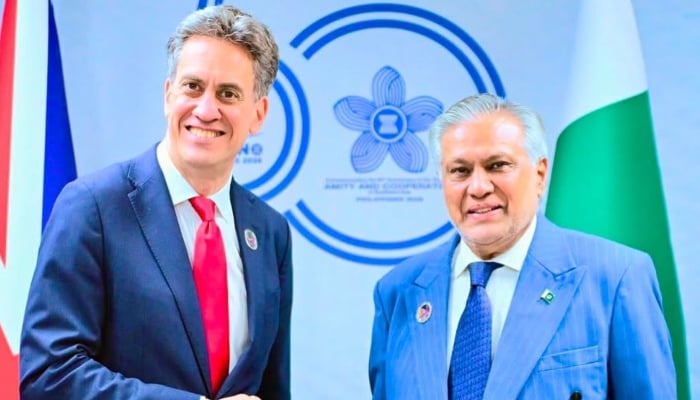
    Ishaq Dar to visit UK from August 24-28

    Deputy Prime Minister and Foreign Minister Ishaq Dar will travel to the United Kingdom on an official visit from August 24 to 28, where he is scheduled to hold talks with senior British officials and meet members of the Pakistani community. According to the Foreign Office, Dar will meet UK Foreign Secretary Ed Miliband and FCDO Minister of State for Pakistan Stephen Doughty during his visit. He is also expected to hold discussions with other senior British government officials. A key focus of the visit will be the situation of Pakistani sailors held by Somali pirates. Dar is scheduled to meet the secretary-general of the International Maritime Organisation to discuss efforts to secure the release of the hostages. The MT Honour 25 oil tanker was hijacked near Somalia’s Puntland region on April 21. The vessel was carrying 17 crew members, including 10 Pakistani nationals. The prolonged captivity has raised concerns among the families of the crew, who have called for urgent efforts to secure their safe release. The Foreign Office has reaffirmed that the government remains committed to bringing the Pakistani nationals home safely. During his UK visit, Dar will also meet Commonwealth Secretary-General Shirley Ayorkor Botchwey. His schedule includes engagements with British parliamentarians and representatives of the British-Pakistani community. The visit comes as Pakistan and the UK continue to strengthen cooperation on security, migration and law enforcement. Earlier this year, the UK announced an additional £8 million in funding for joint efforts with Pakistan to tackle crime and illegal migration. The funding is intended to improve border and visa systems and strengthen law enforcement against human smuggling and trafficking networks. It will also support the return of people who do not have the legal right to remain in the UK and finance community-based programmes aimed at addressing factors contributing to irregular migration.

Leave a Reply

Your email address will not be published. Required fields are marked *