pakistan intensifies efforts
| |

Pakistan intensifies efforts to secure release of …


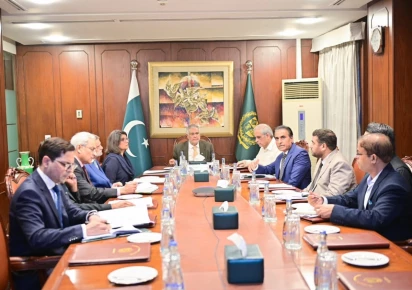
Deputy Prime Minister and Foreign Minister Ishaq Dar on Thursday chaired a high-level meeting to assess Pakistan’s ongoing efforts to secure the safe and early release of 10 Pakistani nationals being held hostage aboard the oil tanker MT Honour 25 after it was hijacked by pirates off the coast of Somalia.

The tanker, which was operating under the Somali flag, was travelling from Oman to Somalia when it was seized by pirates on April 21. A total of 17 crew members were on board the vessel, including 10 Pakistani citizens. Since the incident, the families of the Pakistani hostages have repeatedly appealed to the government to intensify efforts for their loved ones’ safe recovery.

During the meeting, officials briefed the deputy prime minister on the latest developments surrounding the hostage situation and the measures being taken to secure the release of the Pakistani nationals. Dar directed all relevant authorities and stakeholders to maintain close and regular coordination while further strengthening diplomatic efforts with both national and international partners.

The foreign minister placed particular emphasis on continued communication with Somali authorities and relevant international organisations. He said sustained diplomatic engagement was essential to creating conditions that could facilitate the safe recovery and repatriation of the hostages.

Dar also expressed solidarity with the families of the detained Pakistanis and assured them that the government was closely monitoring the situation. He stressed that all possible efforts were being made to achieve a positive outcome and expressed hope that ongoing diplomatic contacts would ultimately result in the safe return of all 10 Pakistani citizens.

Last month, Dar spoke by telephone with his Somali counterpart, Abdisalam Abdi Ali, to convey Pakistan’s serious concern over the hostage situation. During the conversation, Dar emphasised the need to protect the health and safety of the hostages, secure their early release and ensure their safe return to Pakistan.

The Somali foreign minister assured Dar that his government was continuing sincere efforts to help secure the hostages’ release as soon as possible. The latest meeting in Islamabad comes amid growing concerns about the deteriorating conditions reportedly being faced by the Pakistani nationals aboard the vessel.

In video and audio messages, some of the hostages have described severe shortages of essential supplies. They said food and medicines had run out and claimed that they were receiving only one serving of boiled rice each day. They also reported that clean drinking water was no longer available, forcing them to consume contaminated water.

According to the hostages, the lack of safe water has already caused illnesses among several crew members, further increasing concerns about their health. One hostage said their lives remained under constant threat and that gunfire could be heard almost every day in the surrounding area.

The situation has renewed attention on piracy along Somalia’s coastline and its potential threat to international shipping. Somali pirate attacks reached their highest level in 2011, when armed groups operated as far as 3,655 kilometres from Somalia’s coastline.

At its peak, Somali piracy posed a major threat to one of the world’s busiest maritime trade routes, disrupting commercial shipping and placing hundreds of seafarers at risk.

Pakistan’s government is now seeking to strengthen diplomatic and international cooperation to ensure the safe release of the 10 Pakistani nationals. Authorities remain engaged with Somalia and other relevant stakeholders as efforts continue to bring the hostages home safely.

Similar Posts

  • | |

    Iran cannot be subdued, people are forcing enemies…

    TEHRAN: Iranian Parliament Speaker Mohammad Baqer Qalibaf has said that Iran cannot be subdued, claiming that the country’s people are standing united against external pressure and forcing their opponents to retreat. Qalibaf made the remarks while congratulating General Mohsen Rezaei on his appointment to the Supreme National Security Council. He described Rezaei’s inclusion in the council as evidence of the confidence placed in him by Iran’s Supreme Leader. According to Qalibaf, Iran is currently passing through one of the most sensitive periods in its history. He said recent developments had demonstrated to the international community that attempts to bring Iran under pressure would not succeed. The Iranian parliament speaker said national unity remained strong across the country, with the public, military and diplomatic institutions standing together under the leadership of Supreme Leader Mojtaba Khamenei. Qalibaf further claimed that the Iranian people were demonstrating resilience in the face of their adversaries and were now putting pressure on the opposing side to back down. His comments come amid heightened tensions surrounding Iran and the United States, with disagreements over regional security, military threats and the strategic Strait of Hormuz continuing to dominate international attention.

  • | |

    PMDC announces special measures for AJK students a…

      The Pakistan Medical and Dental Council (PMDC) has announced a series of special measures to ensure that students from Azad Jammu and Kashmir (AJK), who have been affected by prolonged internet disruptions, are able to participate in the Medical and Dental College Admission Test (MDCAT) without facing unnecessary obstacles. As part of these initiatives, the PMDC has established a dedicated examination center in Islamabad and has also reached a preliminary agreement to set up a regional PMDC office in Azad Kashmir. The decisions were made during a meeting between AJK Secretary of Health Brigadier Aamir Raza and Joint Admission Committee Chairman Professor Dr. Faisal Bashir with PMDC President Professor Dr. Rizwan Taj, Registrar Brigadier (Retd.) Rehan Naqvi, and Director of Admission Affairs Dr. Imdad Ali Khushk. The meeting focused on the registration challenges faced by AJK students due to the prolonged internet shutdown and explored practical solutions to ensure that no eligible candidate is deprived of the opportunity to take the MDCAT. During the meeting, the Secretary of Health of the AJK government informed PMDC officials that the ongoing internet suspension in the region had created serious difficulties for students attempting to complete their online registration for the entrance examination. He requested the council to extend every possible facility to affected students so that deserving candidates would not miss the examination because of circumstances beyond their control. Speaking on the occasion, PMDC President Professor Dr. Rizwan Taj stated that the council had already introduced several special measures to facilitate students from Azad Kashmir. He emphasized that the Government of Pakistan remains committed to ensuring equal opportunities for every eligible student seeking admission to medical and dental colleges, regardless of the challenges they face. Dr. Rizwan Taj explained that, considering the extraordinary circumstances in the region, the deadline for MDCAT registration with the regular fee had been extended twice. Initially, the deadline was extended until July 13, and later it was further extended until July 23, 2026, to provide additional time for students affected by the communication disruptions to complete their registration process. The PMDC President further said that students from Azad Kashmir had been given multiple options for submitting their registration applications. In addition to the online process, applications could be sent through WhatsApp, email, postal mail, or submitted in person. He also assured students experiencing registration difficulties that they could contact the PMDC directly, where officials would provide all possible assistance to help them complete the process successfully. To further support students, the PMDC has established a special MDCAT examination center in Islamabad specifically for candidates from Azad Kashmir. A public notice has already been issued regarding the facility, and a dedicated focal person has been appointed to guide students throughout the registration and examination process. The council hopes these measures will reduce confusion and ensure smooth coordination for affected candidates. During the meeting, PMDC President Professor Dr. Rizwan Taj and Registrar Brigadier (Retd.) Rehan Naqvi assured the Government of Azad Jammu and Kashmir of their full cooperation in addressing students’ concerns. Both sides also reached a preliminary agreement to establish a PMDC regional office in Azad Kashmir to improve access to council services for students and healthcare professionals in the region. The proposal will now be presented to the PMDC Governing Body for formal approval. At the conclusion of the meeting, the AJK Secretary of Health and the Chairman of the Joint Admission Committee appreciated the PMDC’s timely response and the special facilities provided for students affected by the internet shutdown. They expressed confidence that these initiatives would ensure that no eligible student from Azad Jammu and Kashmir would be deprived of the opportunity to appear in the MDCAT because of technical or communication-related difficulties.

  • | |

    Sharjeel Memon turns to NCCIA over social media al…

    KARACHI: Senior Sindh Minister Sharjeel Inam Memon has approached the National Cyber Crime Investigation Agency (NCCIA) over what he described as a social media campaign aimed at damaging his reputation and that of his son, Rawal Memon. Memon filed a written complaint with the cybercrime agency on August 9, seeking an investigation into what he termed false, fabricated and malicious claims circulating online. The controversy centres on social media allegations linking Memon to a guesthouse in Gulistan-e-Jauhar, Karachi, where Mir Ali Raza was allegedly tortured and killed. Posts circulating on social media claimed that the property was owned by the Sindh minister. Taking notice of the allegations, Memon urged the NCCIA to investigate the matter and determine the facts behind the claims. He also expressed his willingness to cooperate fully with the authorities during the investigation. The minister’s complaint comes as scrutiny surrounding the Mir Ali Raza case continues to generate discussion on social media, with competing claims being circulated online.

  • | |

    SpaceX Falcon 9 rocket crashes into the moon after…

    A SpaceX Falcon 9 rocket’s upper stage has crashed into the Moon after becoming uncontrollable following the completion of its mission, drawing renewed attention to the growing challenge of space debris and the long-term sustainability of space exploration. According to reports, the approximately 4,000-kilogram upper stage was originally used to launch a lunar lander into space. After successfully completing its primary mission, the rocket stage remained in space but could no longer be actively controlled. Over time, its trajectory led to an inevitable collision with the Moon. The impact occurred with an estimated force comparable to nearly three tons of TNT, creating another artificial impact site on the lunar surface. While the collision was significant, experts stressed that it does not pose any immediate danger to Earth or its inhabitants. NASA has confirmed that the incident presents no direct threat to Earth. However, scientists say the event serves as a reminder of the increasing amount of human-made debris orbiting Earth and traveling through deep space. As the number of space missions continues to grow, properly managing retired rocket stages and other spacecraft components is becoming an increasingly important issue for the global space community. Space debris has become a major concern for space agencies and private companies alike, as abandoned rocket stages, inactive satellites, and fragments from previous missions can create risks for future spacecraft. Experts believe that stronger international cooperation and improved end-of-mission disposal strategies will be essential to reduce the accumulation of debris in Earth’s orbit and beyond. Researchers also noted that impacts on the Moon are not uncommon. Natural meteoroids frequently strike the lunar surface, leaving countless craters over billions of years. In addition, several spacecraft have intentionally or accidentally impacted the Moon during previous missions, making such events scientifically valuable in some cases. Although the Falcon 9 upper stage’s collision is unusual because it involved an uncontrolled commercial rocket component, experts emphasized that it should not be viewed as an immediate cause for alarm. Instead, they say it highlights the need for responsible space operations as exploration of the Moon and deep space accelerates. The incident underscores the growing importance of sustainable space practices, ensuring that future missions can continue safely while minimizing the long-term impact of space debris on both Earth and the wider space environment.

  • | | |

    PM Shehbaz unveils first Youth Employment Policy

    ISLAMABAD: Prime Minister Shehbaz Sharif has announced Pakistan’s first Youth Employment Policy. He said the government is focusing on education, skills, employment and entrepreneurship for young people. Addressing a ceremony in Islamabad, Shehbaz said a significant amount of money had been allocated for youth development this year. He stressed the importance of equal educational opportunities. He said every child should have access to quality education.The prime minister said Pakistan could not achieve the vision of Quaid-e-Azam if quality education remained limited to wealthy families. He criticised the gap between privileged and poor students. He said elite institutions provide better facilities to children from affluent families. According to Shehbaz, this inequality has contributed to Pakistan’s weak performance in the education sector. He said his government had worked to bring students from remote and less-developed areas into the education system. The prime minister also highlighted the Daanish Schools programme. He said its network is being expanded beyond Punjab. New Daanish Schools are being established in Azad Jammu and Kashmir and Gilgit-Baltistan, he added. Shehbaz said young people must be given access to modern education and technology. He warned that Pakistan would fall further behind if its youth were not prepared for the changing global economy. 35% quota for women The prime minister announced important measures under the new employment policy. He said women would receive a 35% quota across the labour force.He also announced a 10% annual quota for startups. The measure is aimed at encouraging young entrepreneurs and creating new employment opportunities. Shehbaz said young people should not only look for jobs. They should also be encouraged to establish businesses and create employment for others. Daanish University in Islamabad The prime minister also announced progress on Daanish University in Islamabad.He said the university is being established to provide modern and quality education. Classes are expected to begin next year.Shehbaz said financial difficulties should not prevent talented students from pursuing higher education. He said students with strong academic results would be given opportunities even if they could not afford expensive education. The prime minister pledged that his government would take every possible step for youth development. He said higher education and employment would remain among the government’s key priorities. Shehbaz also highlighted the government’s laptop distribution programme. He said around 700,000 laptops had already been distributed among deserving students.According to the prime minister, the laptops were awarded strictly on merit. He recalled that the programme had faced criticism in the past. Some critics had accused the government of using laptops for political purposes.Shehbaz rejected the criticism and said deserving students received the devices based on their academic performance. He further announced that 250,000 students would receive Chromebooks this year.The devices will also be distributed on merit. The prime minister said investment in education and digital skills was essential for Pakistan’s future.He said young people represent the country’s biggest resource. Providing them with education, technology and employment opportunities, he added, would help build a skilled workforce and strengthen the national economy.The new Youth Employment Policy is therefore being presented as a broader government effort to connect education with employment and entrepreneurship.

  • | |

    Transport crisis threatens to disrupt economic act…

    The economists and business experts have warned that the nationwide suspension of goods and oil transportation could create serious disruptions across Pakistan’s supply chains if the dispute is not resolved quickly, adding that prolonged interruption in cargo movement would increase operating costs, disrupt industrial production and put further pressure on exports. Experts said the ongoing situation should not be viewed merely as a dispute between transporters and the government, as the uninterrupted movement of goods is essential for manufacturing, agriculture, wholesale and retail trade, imports, exports and the distribution of essential commodities. They said the suspension of a large portion of the country’s freight fleet could create a chain reaction across the economy. Factories dependent on regular supplies of imported and locally produced raw materials could face interruptions, while manufacturers with completed consignments could experience difficulties in moving goods to ports, warehouses and domestic markets. According to economic experts, any prolonged disruption in freight movement could raise costs at multiple stages of the supply chain, ultimately increasing prices for businesses and consumers. They urged the government to give immediate priority to negotiations with transport representatives and ensure restoration of normal cargo movement, while simultaneously addressing the structural issues that have contributed to growing tensions in the transport sector. Experts said the introduction of daily petroleum price adjustments had added another layer of uncertainty to an already difficult operating environment. Fuel represents a major component of freight costs, and daily changes make it difficult for transport operators to determine charges for journeys that may take several days. The resulting uncertainty also affects manufacturers and traders because businesses cannot accurately forecast the cost of moving raw materials and finished products. For exporters, the issue is particularly significant as freight costs are often incorporated into orders and contracts agreed weeks or months before shipment. Economists said Pakistan needed a petroleum pricing framework that reflected international market movements while providing sufficient predictability for businesses. They noted that frequent changes in fuel prices could complicate production planning, inventory management and commercial contracting. They further cautioned that heavy reliance on petroleum taxes and levies could become counterproductive if it substantially increased transportation and production costs. Higher fuel prices raise the delivered cost of raw materials, machinery, food products and finished goods and also increase the cost of moving agricultural inputs and crops between production areas and markets. According to experts, the current disruption has also exposed weaknesses in Pakistan’s logistics infrastructure. The country needs better freight facilities, rationalised toll charges, adequate parking for heavy vehicles around ports and industrial zones, streamlined licensing procedures and a taxation framework that does not place excessive pressure on formal transport operators. They stressed that logistics costs should be considered an integral part of Pakistan’s export strategy. Export competitiveness depends not only on the cost of manufacturing a product but also on the expense and reliability of moving raw materials to factories and finished goods to ports. Experts said Pakistani exporters already face intense competition from regional economies where supply chains are becoming more efficient and predictable. Any additional increase in domestic transportation costs could further reduce the price competitiveness of Pakistani products in international markets. They recommended establishing a permanent consultation mechanism involving transporters, chambers of commerce, manufacturers, exporters, oil-sector representatives and relevant government agencies. Such a platform could identify emerging problems and develop solutions before individual disputes escalate into economy-wide disruptions. Economists also called for a review of withholding tax arrangements affecting goods transporters, saying the taxation system should encourage formalisation, investment and expansion of the logistics sector rather than create additional working-capital pressures. They said all transport-related taxes, tolls, fees and regulatory charges should be reviewed collectively to determine their overall impact on freight costs.

Leave a Reply

Your email address will not be published. Required fields are marked *