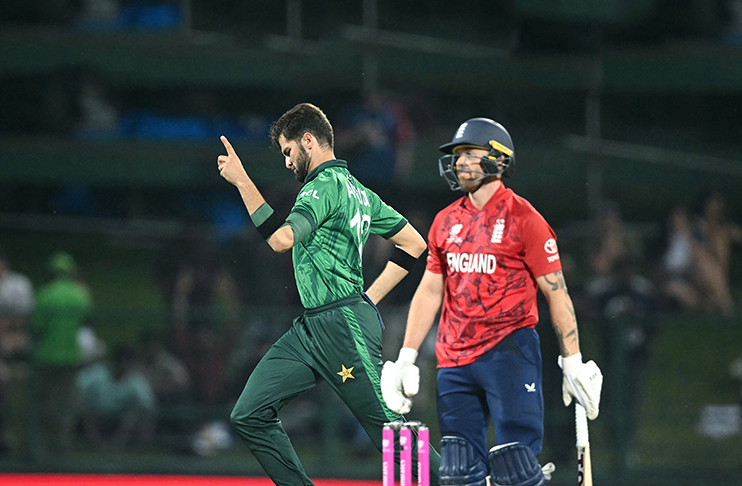
pakistan tour england
|

Pakistan to tour England for five-match ODI series ahead of 2027 World Cup

Pakistan’s men’s cricket team will tour England in May 2027 for a five-match One-Day International (ODI) series, offering both sides an important opportunity to fine-tune their preparations ahead of the ICC Men’s Cricket World Cup later that year. The Pakistan Cricket Board (PCB) has officially confirmed the tour schedule, with matches set to be played at five different venues across England.

The series will begin on 15 May 2027 in Southampton, where the opening ODI will be played. The second match is scheduled for 19 May in Manchester before the teams travel to Leeds for the third ODI on 21 May. Chester-le-Street will host the fourth match on 23 May, while the fifth and final ODI will be played in Cardiff on 26 May, concluding Pakistan’s limited-overs tour.

The five-match series is expected to play a significant role in both teams’ preparations for the ICC Men’s Cricket World Cup 2027, which will be jointly hosted by South Africa, Zimbabwe, and Namibia from 4 October to 21 November. With the tournament only a few months away, the ODI series will provide players with valuable match practice and allow team management to evaluate combinations, strategies, and player form before the global event.

Pakistan are currently involved in a two-match Test series against the West Indies. After completing that assignment, the national team will travel to England next month for a three-match Test series scheduled to take place between 19 August and 13 September. The 2027 ODI tour will further strengthen the long-standing cricket rivalry between Pakistan and England and provide another competitive contest between two experienced international sides.

According to the latest ICC Men’s ODI Team Rankings, Pakistan are currently placed fifth, while England occupy seventh position. Both teams have consistently remained among the leading sides in one-day cricket, making the upcoming series an important contest as they build momentum ahead of the World Cup.

The last time Pakistan toured England for an ODI series was in 2021, when the two teams played a three-match contest. Although Pakistan did not win the series, then-captain Babar Azam produced an outstanding batting performance. He finished as the leading run-scorer with 177 runs in three innings, including a memorable knock of 158 in the third ODI. His performance was widely praised and remains one of Pakistan’s finest individual displays in England in recent years.

Cricket supporters from both countries are expected to eagerly follow the 2027 series, which promises exciting competition at some of England’s most famous cricket venues. Beyond the results, the series will serve as a crucial testing ground for both squads as they prepare for the challenges of the ICC Men’s Cricket World Cup. With experienced players and emerging talent expected to feature, the five-match ODI series is likely to provide high-quality cricket and valuable insights for both teams before they head to the biggest tournament in the one-day format.

Similar Posts

  • | |

    FBISE unveils SSC 2026 results, 1st time AI assist…

    ISLAMABAD: The Federal Board of Intermediate and Secondary Education (FBISE) has announced the results of the Secondary School Certificate (SSC) Part-I and Part-II First Annual Examination 2026, revealing strong overall performance while introducing artificial intelligence (AI) in the paper-marking process for the first time. The results were officially declared during a ceremony in Islamabad, where Federal Minister for Education and Professional Training Dr Khalid Maqbool Siddiqui inaugurated the announcement. Addressing the event, FBISE Chairman Prof Dr Ikram Ali Malik highlighted the Board’s efforts to ensure smooth and transparent examinations. He said a total of 292,831 students appeared in the SSC examinations this year, with 1,006 examination centres established across the country. To oversee the process, 2,012 supervisory staff members and 6,996 invigilators were deployed. The chairman also revealed that more than 10,700 teachers applied to assess examination papers, while 4,855 examiners were selected for the task. He described the introduction of AI-assisted marking as a major step towards improving accuracy and efficiency in the evaluation process. During the examination period, 86 cases involving the use of unfair means were reported. According to the results, SSC Part-I recorded an overall pass percentage of 59.77 per cent, with 88,646 students passing out of 150,077 candidates. SSC Part-II achieved a significantly higher success rate of 91.33 per cent, as 128,070 of the 141,653 candidates cleared the examinations. In the Science Group, Afeera Ijaz secured the top position with 1,089 marks. Amna Nauman claimed second place with 1,088 marks, while Huzaifa Haider finished third with 1,086 marks. Among Humanities students, Fatima Zahra emerged as the overall topper with 1,037 marks. Muhammad Maaz and Manaal Zahid shared second position after each scoring 1,031 marks, while Aneesa Nisar secured third place with 1,023 marks. The Board said the introduction of AI-assisted marking reflects its commitment to modernising Pakistan’s examination system while maintaining transparency and fairness in the assessment process.

  • | |

    MLO removed after lapses in Mir Raza autopsy

    Authorities have removed Medico-Legal Officer Dr Osama from his post following an inquiry into serious shortcomings in the initial post-mortem examination of businessman Mir Raza Ali. Officials said the doctor has been directed to appear before the relevant authorities as part of an inquiry into the alleged procedural lapses. The action comes after questions were raised over the accuracy and completeness of the initial medico-legal examination. The case came under renewed scrutiny after a dispute emerged between police investigators and the Karachi police surgeon over shortcomings in the original medico-legal report. The family subsequently approached a Karachi court, seeking a fresh examination of the body. The court later permitted the exhumation of Mir Raza Ali. A second autopsy conducted after the exhumation reportedly found evidence indicating that the businessman had sustained a gunshot injury to the back. The new medical examination identified two gunshot holes in his clothing, along with several other injuries. Medical findings also reportedly included marks of violence, injuries to the feet, a fracture and a roughly 12-centimetre injury to the right thigh, as well as a deep injury and fracture around the jaw. A separate chemical examination has also added new dimensions to the investigation. According to the report, particles consistent with acid were detected on the victim’s shirt, while material associated with gunshot residue was also found. The report further indicated that efforts may have been made to conceal the victim’s identity and that fingerprints were not detected on his hands. Family lawyer Jibran Nasir has previously raised questions about the initial investigation, including the absence of an X-ray and the failure to establish the cause of death in the first examination. He has also alleged that acid burns may have damaged the victim’s face. The family has urged investigators to examine CCTV footage, digital records and other forensic evidence. Questions have also been raised over the handling of the victim’s mobile phone, smartwatch and surveillance recordings from locations linked to the case. Investigators are now examining additional evidence and locations connected to the death. Authorities have also moved to obtain the victim’s mobile data records and conduct geofencing around the relevant crime scene. The new probe team is also coordinating with the National Cyber Crime Investigation Agency to determine whether Mir Raza had received threats before his death. Mir Raza’s family has said it is cooperating with investigators and has provided information about several suspicious individuals and locations. His father, Mir Hussain, has expressed hope that the newly constituted investigation team will establish the facts and take the case to its logical conclusion.

  • | |

    Court orders Azma Bukhari to appear in person over…

    LAHORE: The Lahore Sessions Court has directed Punjab Information Minister Azma Bukhari to appear in person and record her statement in a case involving the alleged circulation of a fake video on social media. The matter was heard by Additional Sessions Judge Nusrat Ali Siddiqui, who rejected Bukhari’s request to record her statement through video link. The court ordered her to personally appear at the next hearing to record her statement. Bukhari had challenged an earlier order issued by a judicial magistrate requiring her to appear before the court in person. The case relates to allegations surrounding the circulation of a fabricated video attributed to the provincial minister. Bukhari had approached the authorities against the alleged dissemination of the video and lodged a complaint with the National Cyber Crime Investigation Agency (NCCIA) against Falak Javed. The court’s latest order means Bukhari will have to appear before the Sessions Court at the upcoming hearing as proceedings in the case continue.

  • | |

    Petrol price reduced slightly as diesel price incr…

    The State Bank of Pakistan (SBP) has decided to keep its benchmark policy interest rate unchanged at 11.50% following the latest meeting of its Monetary Policy Committee (MPC). The decision reflects the central bank’s cautious approach as it continues to monitor inflation, economic growth, and global developments that could influence Pakistan’s financial outlook. The policy rate has remained at 11.50% since April 27, with policymakers choosing to maintain the current stance despite recent inflationary pressures. During the meeting, the committee reviewed key economic indicators, inflation trends, and the potential impact of geopolitical tensions in the Middle East on Pakistan’s economy. Speaking at a press conference, SBP Governor Jameel Ahmad said inflation had eased significantly during the first half of the fiscal year. Average inflation between July and February stood at 5.5%, remaining within the lower end of the central bank’s target range. However, rising global oil prices, higher food costs, and increased shipping expenses triggered by tensions in the Middle East placed renewed pressure on prices in the following months. According to the central bank, inflation rose to 11.7% in May before easing slightly to 11.1% in June. The governor expressed optimism that inflation would begin to decline again from July, with a more noticeable improvement expected after September. For the current fiscal year, the SBP projects average inflation to remain close to 7%. The governor also highlighted improvements in Pakistan’s broader economic indicators. He noted that the country’s current account deficit narrowed significantly during the previous fiscal year to $139 million, while the current fiscal year’s deficit is expected to remain between zero and one percent of GDP. Strong remittance inflows have played a major role in supporting the external sector, with overseas Pakistanis expected to send around $44 billion this fiscal year, up from $41.6 billion in the previous year. The SBP also expects exports to improve gradually with government support, stronger performance from the information technology sector, and growth in food exports. While imports have increased, improved external financing has helped meet the country’s payment needs without creating excessive pressure on foreign exchange reserves. Pakistan’s foreign exchange reserves are projected to remain around $20.2 billion by the end of the year, while the country is expected to meet its external debt obligations through a combination of repayments, refinancing arrangements, and continued financial inflows. The central bank reaffirmed that it will continue to monitor domestic and international economic developments before making any future changes to monetary policy.

  • | |

    PTI rally sparks clashes, gridlock in Karachi

    A protest organized by Pakistan Tehreek-e-Insaf (PTI) in Karachi turned violent on Tuesday after party workers gathered near Fountain Chowk to express solidarity with PTI founder Imran Khan, leading to clashes with police, multiple arrests, and widespread traffic disruption. Hundreds of PTI supporters assembled at the protest site, chanting slogans and demanding the release of the party’s founder. The situation escalated when some protesters allegedly pelted police with stones as law enforcement attempted to prevent the gathering from moving forward. Police responded by firing tear gas shells and launching a baton charge to disperse the crowd and regain control of the area. The confrontation created panic among protesters and passersby, while security personnel moved in to clear the protest site and restore order. During the crackdown, police detained several PTI leaders and workers, including PTI Sindh Secretary General Dr. Masroor Siyal. Authorities have yet to confirm the total number of arrests or provide details about any injuries sustained during the clashes. The demonstration also brought traffic in parts of Karachi to a standstill. Roads surrounding Governor House, Metropole, Shaheen Complex, and nearby commercial areas witnessed severe congestion as police blocked several routes and diverted traffic. Long queues of vehicles formed across the city center, leaving commuters stranded for hours and disrupting routine business activity. The protest formed part of PTI’s ongoing campaign to show support for its jailed founder, with party workers continuing to hold demonstrations in different parts of the country despite heightened security measures and police action.

Leave a Reply

Your email address will not be published. Required fields are marked *