poverty rate hits
| |

Poverty rate hits record low 9.7%, but millions are one crisis from sliding back

MANILA, Philippines – The Philippines has finally pushed the poverty rate to single digit, but the next challenge is making sure millions of Filipinos who have only just risen above the poverty line stay there.

Poverty incidence fell to 9.7% in 2025, equivalent to 11 million Filipinos, from 15.5% or 17.5 million in 2023, according to the Philippine Statistics Authority (PSA). That means 6.5 million Filipinos moved above the official poverty line in two years.
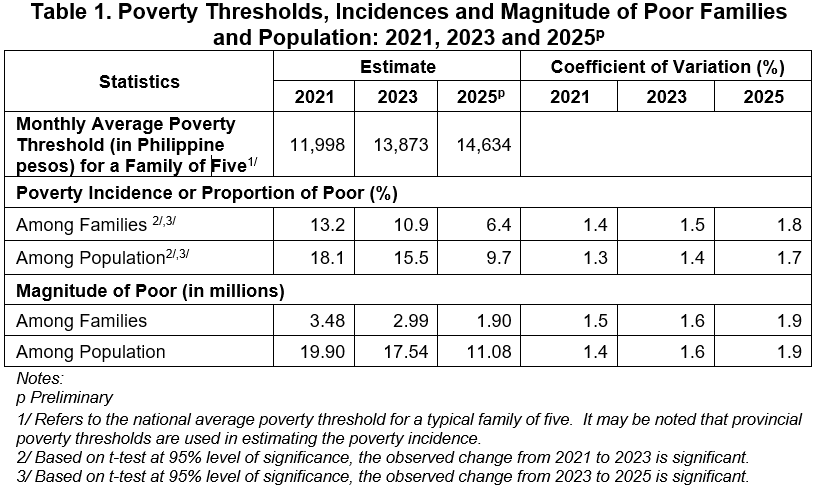
Image from PSA.

“For the first time, fewer than one in 10 Filipinos is living below the poverty line,” Arsenio Balisacan, the country’s chief economist, said. “Reaching this milestone ahead of schedule demonstrates that expanding economic opportunities, complemented by effective social protection, can make a meaningful difference in people’s lives.”


Poverty rate hits record low 9.7%, but millions are one crisis from sliding back

While it’s indeed a milestone worth celebrating, keep in mind that “non-poor” is a statistical classification, not a guarantee of a comfortable life. 

The PSA defines the poverty threshold as the minimum income or expenditure needed to meet basic food and non-food needs, including housing, utilities, health, education, clothing, and transport. In 2025, the Philippine Statistics Authority placed the national poverty threshold at just P35,121 per person a year, or about P2,927 a month. For a family of five, that works out to roughly P14,634 a month. A family earning only slightly more than that would no longer be considered poor, even if that means little room for savings, emergencies, or a good quality of life.
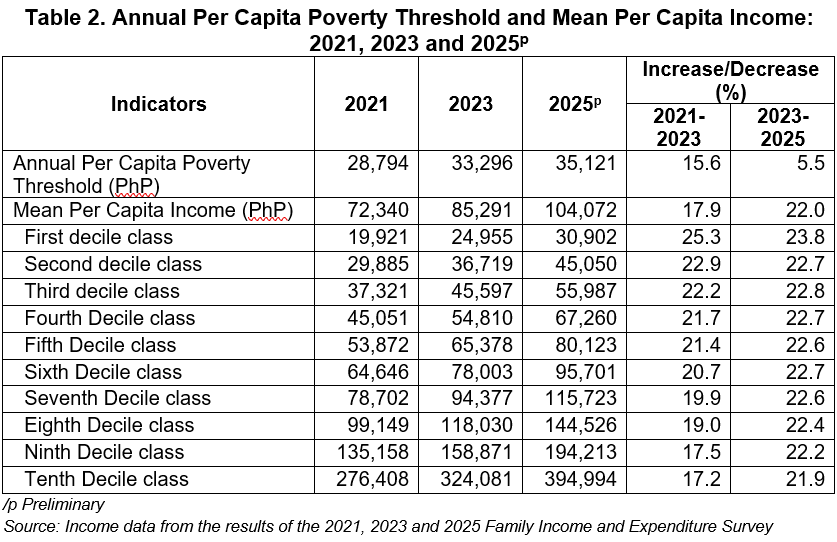
Image from PSA.

The World Bank estimates that around 28% of Filipinos live just above the poverty line, which leaves many vulnerable to price spikes, job losses, disasters, and other shocks. The bottom 30% of households are more sensitive to this year’s energy price shock because food, utilities, and transport take up a larger share of their budgets, though fortunately targeted measures such as 4Ps and UPLIFT have helped cushion the blow. 

“Our overall assessment is that this has been a sound response helping to shield millions from poverty. In fact, we estimate that without intervention, almost 2 million people are vulnerable from this shock of falling into poverty. So this intervention really is very critical,” World Bank senior country economist Jaffar Al-Rikabi said during the launch of the Philippines Economic Update on August 3.

Balisacan also acknowledged the risk that many Filipinos crossing the poverty threshold remain “very close” to it, meaning a serious flood or another external shock could push them back. The task, he said, is to make those gains resilient.

Balisacan said government must keep inflation under control, protect poor and near-poor households, invest in health and education, create better jobs, and restore investment. But he also argued that the country needs to change the structure of growth itself.

The Philippines has long relied heavily on household consumption, remittances, and jumped straight into services. By contrast, its neighbors built stronger export and manufacturing bases.

“We have not invested sufficiently in developing our industry and particularly our manufacturing sector,” Balisacan told reporters back in July.

That’s already being tested in 2026. Inflation has surged on higher food, fuel, and electricity costs, while GDP growth has slowed sharply, especially in Q2. (READ: [In This Economy] The Philippine economy is stuck in a rut)

Only weeks after the World Bank formally announced that the Philippines had become an upper-middle-income economy, economic managers also slashed their growth target to just 3.5% to 4.5% for 2026 and 5% to 6% from 2027 to 2030. – Rappler.com


Must Watch

The Philippines is now upper-middle income. Really?


The Philippines is now upper-middle income. Really?

Similar Posts

  • | | |

    PSX rallies over 5,000 points as regional tensions…

    The Pakistan Stock Exchange started the week with a strong rally on Monday. The benchmark KSE-100 Index gained more than 5,000 points during intraday trading. The sharp rise came as investors welcomed the pause in fighting between the United States and Iran. The index opened with strong buying activity. By 9:50am, it had risen 4,501 points to reach 175,522.53 points. The previous close was 171,021.20 points. The upward movement continued during the morning session. By 10:30am, the index had gained 5,069 points and reached 176,090.08 points. The improved geopolitical situation boosted investor confidence. The United States and Iran have paused their military strikes. The development has raised hopes for renewed diplomatic efforts. Investors also expect the easing of tensions to support shipping activity through the Strait of Hormuz. The waterway is important for global energy supplies. Any prolonged disruption can push oil prices higher and increase pressure on economies that depend on imported fuel. The latest development also affected global oil markets. Crude prices fell sharply as investors reacted to the temporary halt in hostilities. Brent crude briefly dropped below $90 per barrel. It fell more than 7% at one stage during early trading. US West Texas Intermediate crude also declined. The fall in international oil prices could provide some relief to Pakistan’s economy. Pakistan spends a significant amount on energy imports. Lower oil prices can therefore help reduce pressure on the country’s import bill and external account. Market analysts said the improvement in geopolitical conditions could also influence the State Bank of Pakistan’s monetary policy decision. Awais Ashraf, director of research at AKD Securities, said investors were expecting the central bank to maintain the policy rate. The State Bank is also expected to assess developments in the Middle East. The impact of recent floods on Pakistan’s economy will also remain under consideration. Analysts said the continuing decline in inflation and a relatively comfortable external account could support monetary easing in the coming months. However, economic activity and money supply trends remain important factors for policymakers. The strong rally follows a difficult week for the PSX. The KSE-100 Index had fallen by around 2.7% last week. The index lost 4,782 points and closed at 171,021.20 points. Rising tensions between the United States and Iran had increased uncertainty in financial markets. Higher international oil prices also added pressure. Investors had remained cautious because of concerns that the conflict could expand across the region. Monday’s sharp recovery shows how quickly market sentiment can change when geopolitical risks decline. Despite the strong gains, analysts remain cautious about the outlook. Further developments between Washington and Tehran will remain important. Global oil prices will also influence investor sentiment. The State Bank’s monetary policy decision is another key factor for the market.

  • | | |

    Punjab fixes wheat release price at Rs3,800 per ma…

    The Punjab government has fixed the new wheat release price at Rs3,800 per maund following approval from the provincial cabinet. According to a spokesperson for the Punjab Food Safety and Consumer Protection Department, a formal notification has been issued to implement the decision. The spokesperson said the federal government has directed Punjab to immediately procure wheat from the Pakistan Agricultural Storage and Services Corporation (PASSCO). The province has been approved to receive 300,000 metric tons of wheat under the arrangement. The department has already received 200,000 metric tons of wheat, while PASSCO has set its wheat price at Rs4,150 per maund. Officials said the move aims to ensure an uninterrupted supply of wheat and flour across the province while maintaining price stability in the market. The Punjab government also reiterated its commitment to ensuring that bread (roti) remains available to the public at Rs15 per piece. According to the spokesperson, Punjab had requested 800,000 metric tons of wheat, but only 533,440 metric tons have been allocated. Meanwhile, the Ministry of National Food Security has instructed the Punjab government to promptly submit its wheat procurement schedule along with the required advance payment to complete the purchase process.

Leave a Reply

Your email address will not be published. Required fields are marked *