asean opens progressbased
| | | |

ASEAN opens ‘progress-based’ path for Myanmar’s return, but keeps restrictions

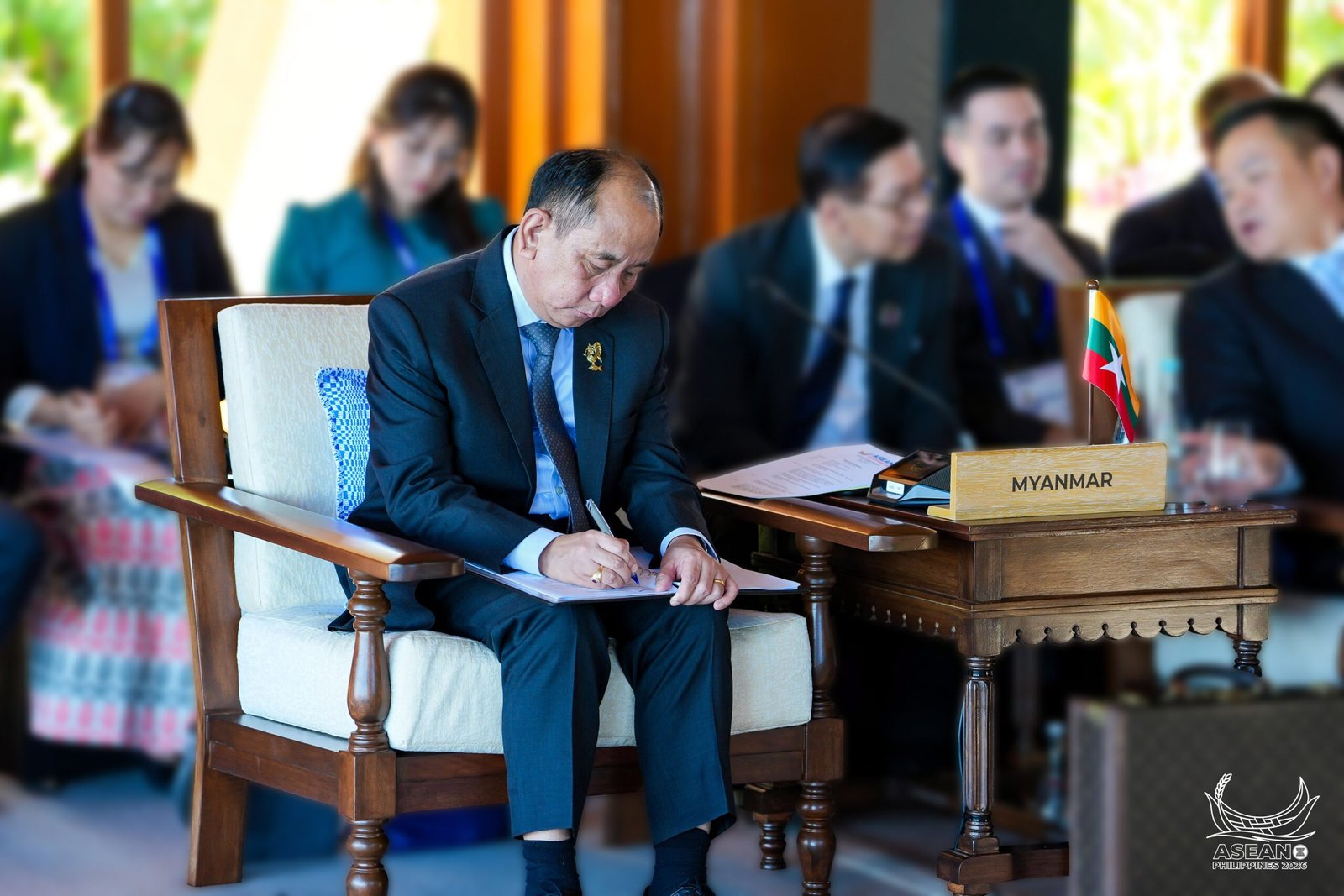
MANILA, Philippines – Leaders of the Association of Southeast Asian Nations (ASEAN) have opened a path to a possible “step-by-step” return of Myanmar’s political representatives to high-level meetings, although this remains conditional on Myanmar demonstrating concrete progress in implementing the bloc’s peace plan.

In their review and decision on the implementation of the Five-Point Consensus (5PC), ASEAN leaders agreed to pursue “calibrated engagement” with Myanmar through a “phased and progress-based approach.”

“Subject to sustained and concrete progress in the implementation of the 5PC by Myanmar, ASEAN may consider the gradual restoration of Myanmar’s full political representation,” said the document adopted on Sunday, November 15, the first day of the 49th ASEAN Summit and Related Summits in Manila.

In the same document, ASEAN leaders also reitered their “deep concern over the insufficient progress in the implementation of the 5PC.”

The regional bloc has previously left the door open for Myanmar’s political return. But the decision makes the possibility of a gradual restoration more explicit, even as leaders maintained existing restrictions. 

In 2021, Myanmar’s military launched a coup that ousted the elected government of Aung San Suu Kyi and plunged the country into a bloody civil war. Since then, ASEAN has barred Myanmar’s political leaders from attending ASEAN summits and foreign ministers’ meetings, allowing only non-political representatives to participate.

Must Watch

Rappler Recap: Myanmar, South China Sea among issues as 49th ASEAN Summit opens


Rappler Recap: Myanmar, South China Sea among issues as 49th ASEAN Summit opens

The decision comes amid calls from some member countries, particularly Thailand, to re-engage Myanmar’s military-backed government following elections held under military rule. The elections remain contentious, however, with ASEAN leaders only saying they “noted the conclusion of the three phases of Myanmar’s general elections,” without explicitly endorsing its validity.

Philippine Foreign Secretary Maria Theresa Lazaro, who also serves as ASEAN’s special envoy on Myanmar, explained that the step-by-step approach would depend on whether Myanmar follows the peace plan.

“The step-by-step approach is adherence to the Five-Point Consensus. So, for example, the first one is cessation of hostilities,” Lazaro said in a press briefing on Sunday evening.

“We want to see how Myanmar responds to that because right now, there’s still certain bombings and displacement of Myanmar people. So step-by-step, we give it to them, how they’re going to tackle this issue, and we monitor that,” she added. – Rappler.com
Similar Posts

  • | |

    Police officer took his own life after leading dou…

    An investigation has found that a police officer who died by suicide in May carried out a series of rapes and attempted murders targeting women over a period of at least fourteen years while serving as an officer. PC Alan Greer’s earliest known victim was a woman he raped inside her own home in Glasgow in 2012, shortly after she had contacted police to report an unrelated crime. The woman came forward late last year to report the assault, a disclosure that triggered one of the largest anti corruption investigations in Police Scotland’s history. Detectives have since identified eight additional victims, five of them sex workers who were attacked while Greer was off duty. Investigators have also established that Greer paid for sex from hundreds of women throughout his career and expect further victims to come forward as the inquiry continues. Assistant Chief Constable Lynn Ratcliff, who is leading the investigation, described the findings as deeply disturbing. She said the officer had abused his position of authority by returning to target a woman he had first encountered through his police duties. Ratcliff said the woman’s decision to come forward and speak with investigators became the catalyst that launched the wider inquiry. Her confirmation of the investigation followed months of reporting into Greer’s conduct. A source close to the case said the scale and nature of the case draws comparisons to the conviction of Wayne Couzens, the London police officer sentenced for the rape and murder of Sarah Everard five years ago, suggesting the Greer case could represent a similarly significant reckoning for Police Scotland. Greer was born in Australia in 1978 and moved to the United Kingdom at age six. He joined Strathclyde Police in 2009, and continued serving after the force merged into Police Scotland in 2013, building what appeared to be an unblemished seventeen year career. He initially worked as a uniformed response officer in Glasgow before moving into an officer safety training role based in Coatbridge around 2016, a position that involved training probationary officers and refreshing the skills of more experienced colleagues. Greer was 47 years old when he died in May, and was married with a child. Those close to him, including his family and police colleagues, are understood to have had no knowledge of his pattern of violence. Senior officers have said there were no clear opportunities that would have allowed the force to identify his offending earlier. The investigation traces back to a woman in her late thirties who walked into a Glasgow police station late last year to report the assault. She described how, in 2012, she had called officers to her home after a disturbance, only for one of the responding officers to later attack her. Cases involving police officers who abuse their positions of trust to target victims, particularly vulnerable women and sex workers, have prompted broader scrutiny of vetting and oversight procedures within UK police forces in recent years. Investigations of this kind often expose gaps in how forces monitor off duty conduct and respond to complaints against serving officers, and they tend to renew public pressure for independent oversight mechanisms capable of identifying patterns of abuse before they escalate over many years. The investigation into Greer’s offending remains active, and Police Scotland has said it anticipates identifying more victims as the inquiry proceeds.

  • |

    Global chip market set to cross $1 trillion as AI demand surges

    The global semiconductor industry is on track to surpass $1 trillion in annual revenue in 2026, driven largely by the rapid expansion of artificial intelligence infrastructure. AI-related chips are reshaping the semiconductor business. Although advanced AI processors represent only a tiny share of total chip shipments, they are expected to generate almost half of the industry’s overall revenue this year. The surge reflects the enormous investment being made in AI data centres around the world. The five largest global technology hyperscalers have allocated more than $600 billion to AI data-centre infrastructure in 2026. The growing demand is also increasing the importance of advanced chip manufacturing. Producing a sophisticated 3-nanometre processor can take around six months, highlighting the complexity and limited capacity of the global supply chain. Taiwan Semiconductor Manufacturing Company (TSMC) remains central to the production of the world’s most advanced processors. The company manufactures an estimated 90% of the most sophisticated chips, making it a critical supplier for the rapidly expanding AI industry. This concentration has also raised concerns about supply-chain vulnerability. Any major disruption to advanced chip production could affect technology companies, AI developers and governments that are investing heavily in artificial intelligence. Nvidia has emerged as one of the biggest beneficiaries of the AI boom. The company reported revenue of $215.9 billion, strengthening its position as a leading supplier of processors used to train and operate advanced AI models. The chip industry’s challenges extend beyond processors. High-bandwidth memory (HBM), which is essential for AI computing, has become another major supply constraint. Much of the available HBM production capacity is already committed through 2026. The global memory market is also expected to generate substantial revenue, with estimates putting fiscal 2026 revenue at around $594.7 billion. The figures underline how quickly AI is transforming the global semiconductor industry. Demand is shifting toward fewer but far more valuable advanced chips, while manufacturers face pressure to expand capacity and secure critical components. As AI investment continues to grow, semiconductor production is increasingly becoming a strategic issue for technology companies and governments. The ability to manufacture advanced processors and memory at scale could determine how quickly the next phase of AI development progresses.

  • |

    Delhi court gives Tahir Hussain life sentence

    A court in New Delhi on Friday sentenced former Aam Aadmi Party (AAP) leader Tahir Hussain to life imprisonment for the murder of Intelligence Bureau (IB) officer Ankit Sharma during the 2020 Delhi riots. The verdict was delivered by Additional Sessions Judge Parveen Singh after the court found Hussain guilty in the high-profile murder case linked to the communal violence that erupted in northeast Delhi in February 2020. The court also awarded life imprisonment to four other convicts found guilty in the same case. All five were held responsible for the killing of Ankit Sharma, whose death became one of the most widely discussed incidents of the riots. According to the prosecution, Sharma was attacked and killed during the violence that broke out in northeast Delhi, where clashes between rival groups resulted in widespread destruction, loss of life and damage to public and private property. The 2020 Delhi riots lasted several days and claimed dozens of lives while leaving hundreds of people injured. The violence triggered multiple criminal investigations, with police registering several cases against individuals accused of involvement in killings, arson and rioting. Tahir Hussain was elected as a municipal councillor from northeast Delhi on an Aam Aadmi Party ticket in 2017. He was considered a prominent local political figure before the riots. Following his arrest in connection with multiple cases related to the 2020 violence, the Aam Aadmi Party suspended him from the party. Since then, Hussain has remained at the centre of several legal proceedings arising from the riots. Friday’s judgment marks a significant development in one of the most prominent cases linked to the 2020 Delhi violence. The court concluded that Hussain and the four co-convicts were responsible for the murder of IB officer Ankit Sharma and imposed life imprisonment as punishment. The ruling is expected to remain one of the most significant judicial decisions connected to the 2020 Delhi riots, which continue to have legal and political implications in India.

  • |

    Saudi, US officials discuss rising regional tensions

    Saudi Crown Prince Mohammed bin Salman and US Central Command chief Admiral Brad Cooper have discussed efforts to contain escalating tensions in the Middle East, with the two sides also reviewing defence cooperation and regional security. According to Saudi state media, the meeting focused on developments across the region and measures aimed at reducing tensions. Officials also discussed ways to strengthen security and stability amid the continuing US-Iran conflict and growing concerns over maritime traffic. The talks came as Saudi Arabia announced progress toward activating a multinational defensive maritime alliance. Representatives from 39 countries attended the alliance’s latest planning meeting in Jeddah, while 13 countries have joined the initiative. Saudi authorities described the meeting as an important step toward putting the maritime alliance into operation. The initiative comes as security concerns continue to grow around the Strait of Hormuz, one of the world’s most important energy routes. Tensions around the strategic waterway have intensified during the US-Iran conflict. Disruptions to shipping have raised concerns about global supplies of oil and liquefied natural gas, while diplomatic efforts to secure freedom of navigation remain uncertain. US Vice President JD Vance has said that keeping energy prices affordable for American consumers is currently Washington’s top priority in the conflict. Vance said the administration wanted to maintain lower oil and gas prices while also ensuring that Iran could not acquire a nuclear weapon. His remarks came as the prolonged conflict continued to affect energy markets and increase pressure on the US economy. Meanwhile, US Treasury Secretary Scott Bessent warned that Washington was preparing unprecedented economic measures against Tehran. He said the United States would combine intensified economic pressure with restrictions linked to Iran’s control of the Strait of Hormuz. US Defence Secretary Pete Hegseth also said Washington had the military capability to maintain its naval blockade of Iran for an extended period. He said American ships could be rotated to sustain the operation. The confrontation has severely affected Iran’s economy and disrupted its access to international trade. Tehran, meanwhile, has sought to use the Strait of Hormuz as leverage in negotiations with Washington. Iran has demanded the removal of economic sanctions and the release of frozen assets as part of conditions for restoring normal maritime traffic. Commercial traffic through the Strait has fallen sharply since the conflict began. The decline has heightened fears that a prolonged disruption could further affect global energy supplies. Two vessels linked to Abu Dhabi National Oil Company were reportedly attacked while passing through the waterway, prompting condemnation from the UAE. The situation has also kept oil markets volatile. Although crude prices declined recently amid concerns over weaker demand and rising US inventories, renewed attacks and threats of further escalation have continued to unsettle investors. The International Energy Agency has revised its forecast for global oil supply, projecting a larger decline than previously expected. Economists have warned that a prolonged conflict could weaken global economic growth and increase the risk of recession in some regions. US President Donald Trump has faced growing domestic pressure over the conflict, particularly as higher fuel costs weigh on American consumers. Washington has continued imposing sanctions on Iran, while efforts to bring Tehran back to negotiations have so far produced limited results.

Leave a Reply

Your email address will not be published. Required fields are marked *