punjab university staff
| |

Punjab University staff demand forensic audit, war…

Lahore: A joint platform representing teachers, officers, employees, and other stakeholders at the University of the Punjab has accused the university administration of driving the country’s oldest and largest public university into a deep financial, administrative, academic, and research crisis, while warning of a protest movement if their demands remain unaddressed within two weeks.
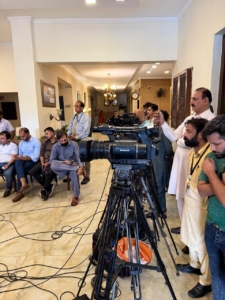
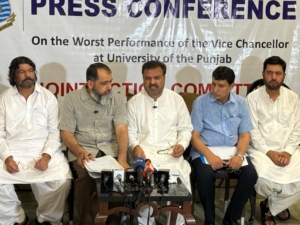
Addressing a press conference in Lahore, the Joint Action Committee (JAC) said its purpose was not to target individuals but to present what it described as documented concerns regarding the university’s governance, financial management, academic standards, and research environment. The committee appealed to the Chancellor of the University, the Governor of Punjab, and the provincial government to intervene immediately to safeguard the institution.


The committee alleged that reserve funds worth approximately Rs4.88 billion, accumulated over many years, had been utilized within just 14 months without approval from the Finance and Planning Committee. It claimed that the university’s 2025–26 budget reflected a deficit of Rs2.57 billion and argued that, when combined with the depletion of reserves, the institution was effectively facing a financial shortfall of nearly Rs8 billion. It also questioned expenditures allegedly made beyond approved budget limits and called for greater transparency in financial decision-making.

JAC further claimed that around Rs786 million belonging to various academic departments and institutes had been transferred to a central account under the One-Account Policy and later utilized, raising questions about whether the expenditures had received approval from the relevant statutory bodies. It also expressed concern over what it described as the first-ever financial deficit of nearly Rs350 million in the university’s self-supporting programmes.

The committee also pointed to an apparent discrepancy in financial reporting, claiming that while the Finance and Planning Committee was informed of a Rs2.57 billion budget deficit at the end of the financial year, a subsequent Syndicate meeting was told the deficit stood at Rs1.6 billion. According to the committee, the variation requires a transparent explanation.

Expressing concern over campus security, the committee referred to the killing of a student and the son of a university employee near the Vice Chancellor’s residence despite the presence of armed security personnel, arguing that the incident had raised serious questions about the effectiveness of the university’s security arrangements.

On governance, the committee alleged that key statutory bodies, including the Senate, Deans’ Committee, Chairpersons’ Committee, Syndicate, and Selection Boards, had met only infrequently during the current administration, resulting in delays in appointments, promotions, and major policy decisions. It further criticized what it described as an excessive concentration of administrative authority in the office of the Director General (Students, Estate and Security), saying such an arrangement was inconsistent with principles of transparency, institutional balance, and accountability. The committee also referred to pending complaints and inquiries involving the office-holder, questioning the wisdom of assigning additional responsibilities while such matters remain unresolved.

Highlighting academic concerns, JAC said the university had slipped from 542nd to 588th position in the QS World University Rankings and had also experienced a decline in the Higher Education Commission’s Office of Research, Innovation and Commercialization (ORIC) rankings. It alleged that faculty members were facing an atmosphere of insecurity and harassment, while research grants, travel support, and publication funding had effectively come to a halt.

The committee claimed that although research grants of up to Rs1 million had been announced, no faculty member had yet received financial assistance under the initiative. It further alleged that several researchers had been forced to abandon nationally and internationally funded projects because of inadequate institutional support, damaging both research output and the university’s reputation with funding agencies.

According to the committee, hostel accommodation remains unavailable for many students, including research scholars, while an increasing number of inquiry committees against faculty members and officers has created an atmosphere of fear and professional uncertainty. It also expressed concern over delays in permanent appointments to several senior administrative positions, saying the lack of regular appointments had weakened institutional efficiency.

The Joint Action Committee demanded an independent forensic audit of the university’s financial affairs, including the use of reserve funds, deficit budgets, the One-Account Policy, and the finances of self-supporting programmes. It also called for the immediate removal of the Director General (Students, Estate and Security) under the principle of “one person, one post,” an end to what it described as retaliatory inquiries, restoration of a secure and professional working environment, immediate advertisement and transparent appointment of a permanent Registrar, payment of outstanding financial dues and benefits to teachers and employees, and the restoration of regular meetings of all statutory bodies in accordance with the University Act.

The committee warned that if its demands are not addressed within two weeks, it will launch a phased protest campaign, including demonstrations outside the university, a sit-in outside the Punjab Assembly, publication of a white paper containing documentary evidence, and a boycott of classes that could ultimately disrupt academic activities at the historic institution.

The university administration had not issued an official response to the allegations at the time this report was filed.

Similar Posts

  • |

    UK brain drain? 246,000 Britons leave in a year

    The number of young and skilled people leaving the United Kingdom has increased significantly in recent years, raising concerns about the country’s ability to retain its talent. However, experts have cautioned against describing the trend as a complete “brain drain,” saying many people may eventually return to the UK. Official figures show that around 246,000 British citizens left the country last year, while the number of Britons returning was considerably lower. The gap between departures and returns has continued to widen since 2022. People under the age of 35 make up a significant proportion of those leaving the UK. Rising living costs, high taxes, expensive housing and increasing education costs are among the factors encouraging young people to consider opportunities abroad. The UK’s labour market has also become a concern for young graduates. Unemployment has reached 5.2 per cent, while the number of graduate-level job opportunities has reportedly fallen by around 45 per cent. London, in particular, has become increasingly expensive for young professionals. High rents and the overall cost of living are making it difficult for many people to establish themselves financially. Research suggests that the desire among young Britons to live and work abroad is growing. According to a British Council study, 72 per cent of Britons aged 18 to 30 are considering living and working overseas either temporarily or for a longer period. Canada and Australia are emerging as popular destinations for Britons seeking better career opportunities and a lower cost of living. The trend has sparked debate over whether Britain is becoming less attractive to skilled workers. Experts, however, say migration should not automatically be viewed as a permanent loss of talent. Many young professionals move abroad to gain international experience, improve their career prospects or seek better living conditions. Some may eventually return to Britain after gaining experience overseas. The growing number of departures nevertheless presents a challenge for the UK economy. Retaining young graduates and skilled professionals is increasingly important as the country faces pressure from rising living costs and a competitive global labour market.

  • | |

    Pakistan stock exchange holds steady in mid-day tr…

      KARACHI: The Pakistan Stock Exchange (PSX) traded in positive territory during Thursday’s mid-day session, although gains remained limited as investors continued to adopt a cautious approach. The benchmark KSE-100 Index stood at 174,533.28 points, registering an increase of 103.36 points, or 0.06 percent, compared to the previous closing level of 174,429.92 points. The market started the day on a stronger note, with buying interest pushing the benchmark index higher in early trading. During the session, the KSE-100 climbed to an intraday high of 175,237.59 points, reflecting initial optimism among market participants. However, the upward momentum was short-lived as investors began booking profits, causing the index to retreat from its peak. At one stage, the benchmark slipped to an intraday low of 174,144.11 points before recovering modestly. Despite the fluctuations, the overall market remained in positive territory, indicating a degree of resilience. Trading activity was moderate throughout the first half of the session. By mid-day, total trading volume had reached approximately 60.14 million shares, while the value of traded securities stood at around Rs3.52 billion. These figures suggested that although investors were active, trading lacked the intensity typically associated with a strong bullish rally. Market participants remained watchful as the trading session continued, with investors responding cautiously to mixed economic and market signals. Analysts noted that the benchmark index moved within a relatively narrow range following its early gains, reflecting uncertainty about the market’s short-term direction. Rather than witnessing broad-based buying across sectors, trading activity appeared selective, with investors focusing on specific stocks instead of making aggressive market-wide investments. According to market observers, institutional participation remained relatively subdued during the session. Large investors largely stayed on the sidelines, resulting in lower overall momentum despite the benchmark index maintaining positive territory. The absence of strong institutional buying limited the market’s ability to sustain its early advance. Brokers also pointed out that profit-taking emerged after the KSE-100 Index approached its intraday high. Investors who had benefited from recent market gains chose to lock in profits, leading to some downward pressure on the index. This selling activity prevented the market from extending its early rally and kept price movements within a limited range. Although the market showed signs of stability during the mid-day session, analysts believed that investor sentiment remained cautious. The performance of key sectors and any fresh developments during the remainder of the trading day were expected to influence the market’s closing direction. A stronger participation from institutional investors or renewed buying in heavyweight stocks could provide additional support, while continued profit-taking might limit further gains. Overall, the Pakistan Stock Exchange demonstrated resilience by holding on to modest gains despite intermittent selling pressure. However, with trading remaining range-bound and investor confidence still measured, market participants continued to monitor developments closely before making significant investment decisions.

  • | |

    Khawaja Asif accuses PTI of supporting PPP candida…

    Pakistan’s Defence Minister Khawaja Asif has claimed that the Pakistan Tehreek-e-Insaf (PTI) supported candidates of the Pakistan Peoples Party (PPP) during the recent elections. He alleged that in several constituencies, it appeared that both political parties had made joint efforts to influence the electoral outcome. Khawaja Asif stated that there were visible signs of cooperation between PTI and PPP in certain areas. According to him, the political activities and election strategies of both parties suggested that they were working together against other candidates. However, he did not provide specific evidence to support his claim. The Defence Minister said that he had been observing elections in Azad Kashmir for the past 55 years and had witnessed many political developments over different periods. He described the current election as significant, particularly because voter participation in urban areas was higher compared to previous elections. Khawaja Asif praised the efforts of his party’s workers, saying that they had worked hard during the election campaign. He claimed that the increased voter turnout in cities reflected greater public engagement and interest in the electoral process. He stated that urban areas recorded a turnout of more than 45 percent, describing it as an important achievement. According to Asif, the higher participation rate demonstrated that voters had actively participated in the democratic process and responded positively to his party’s campaign efforts. While discussing the performance of the Pakistan Peoples Party, Khawaja Asif claimed that the party’s popularity had declined among voters. He pointed out that the PPP had last won an election from the city in 1970, suggesting that the party had lost much of its previous political influence in the region. Asif argued that the current political landscape in Azad Kashmir was different from previous decades. He suggested that changing voter preferences and recent electoral trends indicated that political support for traditional parties had shifted over time. The Defence Minister’s remarks came amid political debate following the Azad Kashmir elections, where opposition parties raised concerns about the fairness of the electoral process. The PPP and other opposition groups have alleged irregularities, while government representatives have defended the transparency of the elections. Khawaja Asif maintained that his party’s success was the result of extensive political efforts and public support. He credited party workers for their dedication and said that the election outcome reflected the changing political dynamics of the region. The allegations regarding PTI’s support for PPP candidates have added another layer to the ongoing political discussions. Both PTI and PPP have their own positions regarding the election process, and any claims of coordination between them remain a subject of political debate. As the political situation develops, statements from different parties are expected to continue shaping discussions about the election results, voter trends, and the future direction of politics in Azad Kashmir.

  • |

    Manchester City bring back Argentina star Geronimo Rulli after nine years

    MANCHESTER: Manchester City have brought Argentina international goalkeeper Geronimo Rulli back to the Etihad Stadium, signing the 34-year-old from Marseille on a two-year contract. Rulli will arrive as City’s second-choice goalkeeper behind Italy international Gianluigi Donnarumma, adding experience and international pedigree to Pep Guardiola’s squad. The move is also a return to familiar territory for Rulli, who spent the 2016-17 season with Manchester City. His first spell, however, ended without a senior appearance, making his return a very different opportunity. “This is an amazing opportunity for me and one I had to grasp,” Rulli said after completing the move. The goalkeeper added that joining City was an opportunity he could not afford to overlook, praising the club’s long-standing success and demanding standards. Rulli has earned eight Argentina caps and was part of the squad that lifted the 2022 FIFA World Cup and 2024 Copa America. He also travelled with Argentina to last month’s World Cup final, where they suffered a 1-0 defeat to Spain. His career has taken him across several major European leagues. Before arriving at Marseille, Rulli represented Real Sociedad, Villarreal, Montpellier and Ajax, gaining extensive experience at both domestic and European level. One of the most memorable moments of his career came in the 2021 Europa League final, when Villarreal faced Manchester United. Rulli not only converted his penalty during the dramatic shootout but also saved David de Gea’s effort as Villarreal won 11-10. Now, years later, the Argentine goalkeeper returns to Manchester with a new role and a wealth of experience behind him. The transfer also provides financial relief for Marseille, who are under pressure to balance their books after being fined €10 million for failing to meet UEFA break-even requirements. Marseille’s fifth-place Ligue 1 finish in the 2025-26 campaign also means they will miss out on Champions League revenue, increasing the need for player sales during the summer. Rulli’s departure follows several other exits from the French club. Argentine defender Facundo Medina has moved to Bayer Leverkusen, while high-profile forwards Mason Greenwood and Pierre-Emerick Aubameyang have also left. For City, meanwhile, Rulli offers a reliable and experienced option between the posts. For Rulli himself, the move represents a second chance at a club where his first chapter never truly began.

  • |

    Rising fuel prices drive global surge in electric vehicle sales

    Global sales of electric vehicles rose sharply during the second quarter of 2026 as soaring fuel prices linked to the conflict in the Middle East encouraged more consumers to switch away from petrol and diesel powered cars, according to a new report by the International Energy Agency. The agency said electric vehicle sales increased by 35 percent between April and June compared with the first three months of the year. Record sales were reported across 50 countries despite a slowdown in the overall global automobile market. According to the IEA, the renewed interest in electric vehicles was largely driven by the sharp rise in oil prices following the conflict involving Iran, Israel, and the United States. The report said the resulting energy crisis reminded governments and consumers of the economic risks associated with dependence on imported oil. Oil prices climbed dramatically during the year after Iran effectively closed the Strait of Hormuz, one of the world’s busiest energy shipping routes, in response to military strikes carried out by Israel and the United States. Crude prices rose from around 60 dollars per barrel at the beginning of the year to nearly 120 dollars, increasing fuel costs around the world and putting additional pressure on households and businesses. The IEA said the situation has brought energy security back to the centre of government policy discussions. Since road transport accounts for nearly half of global oil consumption, the agency noted that expanding the use of electric vehicles can reduce reliance on imported fuel while protecting consumers from sudden increases in fuel prices. The report said electric vehicles are now being viewed as an important tool for improving national energy security, particularly in countries that rely heavily on imported oil. By reducing dependence on global oil markets, governments hope to make their economies more resilient during periods of international instability. Several countries in Southeast Asia that were particularly affected by rising fuel costs responded by introducing temporary tax incentives to encourage people to buy electric vehicles. Similar government support measures have also been expanded in parts of Latin America and Europe as officials seek to accelerate the transition to cleaner transport. Based on the strong performance in the second quarter and continued policy support in many regions, the IEA expects global electric vehicle sales to increase by around 10 percent over the full year. If that forecast is achieved, electric cars are expected to account for approximately 29 percent of all new vehicle sales worldwide in 2026. The agency also predicted that the overall global car market will shrink this year, meaning electric vehicles are continuing to gain market share even as total vehicle demand weakens. The report noted that the year began on a slower pace for the electric vehicle industry. Sales dropped during the first quarter, mainly because of weaker demand in China and the United States, the world’s two largest EV markets. In the United States, the removal of government subsidies reduced consumer demand, while China’s slowing economy and reductions in financial incentives also affected purchases. Because China represents the largest electric vehicle market in the world, weaker sales there had a significant impact on global figures despite healthy growth in many other regions. Europe recorded the strongest performance during the first half of the year. According to the IEA, electric vehicle sales across the continent rose by more than 30 percent as supportive government policies, expanding charging infrastructure, and higher fuel prices encouraged more drivers to choose electric cars over conventional vehicles. The agency believes these trends could continue if governments maintain incentives and energy prices remain elevated.

  • | |

    9 fall ill after eating sweets celebrating baby’…

    BAHAWALPUR: Nine people, including children, fell ill after consuming sweets purchased to celebrate the birth of a baby in Bahawalpur’s Head Rajkan area. According to family sources, the sweets were bought from a nearby shop as part of the celebrations. Shortly after eating them, several family members developed health problems and were taken to Bahawal Victoria Hospital for treatment. Four children received medical care at the hospital, while the other affected individuals were also treated by doctors. Hospital sources said the condition of all nine patients is stable and they are out of danger. Authorities have yet to confirm whether the sweets were contaminated or identify the exact cause of the illness.

Leave a Reply

Your email address will not be published. Required fields are marked *