rappereconomist cielo magno
| | |

Rapper-economist Cielo Magno confirms she will run for Senate

MANILA, Philippines – Twenty-five years after UP economist Solita “Winnie” Monsod’s failed bid for a Senate seat, another teacher of the UP School of Economics is giving the Senate a shot.

Economist Cielo Magno announced in a forum with Filipinos in Italy this week that she will run for senator in the 2028 elections. 


Rapper-economist Cielo Magno confirms she will run for Senate

“Yes, po, I’m running for senator in 2028,” said the 48-year-old academic in response to a question posed to her during the forum.

In a social media post on Thursday, October 15, Magno said: “Nasubukan n’yo na po ang nepo baby, dynasty, artista, trapo at corrupt. May bagong option na po kayo.” 

(You’ve already tried a nepo baby, dynasty, actor, traditional politician and corrupt ones. You now have a new option.)

Magno served as undersecretary for fiscal policy and monitoring group of the Department of Finance for over a year but was “terminated” by Malacañang in September 2023 after she indirectly questioned President Ferdinand Marcos Jr.’s policy to set a price ceiling on rice amid rising prices. 

Magno had posted on her personal social media account the chart on the law of supply and demand and said “I miss teaching,” in an apparent criticism of Marcos’ price cap on the basic staple via his Executive Order No. 39.

Magno’s immediate boss at the time, then-finance secretary Benjamin Diokno, had backed the price controls on rice. 

Days after she left the department, Magno said: “It is our responsibility as civil servants to say if a policy is flawed. It’s very dangerous to just say ‘yes’ because we don’t want to offend the boss. Policies have real consequences on people’s lives. They have to be well thought out.”

Magno returned to her alma mater, the UP School of Economics (UPSE), to teach. She finished her Bachelor of Science in Business Economics and her Master of Arts in Economics from the state university. She has since been active in pushing for socio-economic reforms such as budget transparency, and political reforms such as a law against political dynasties. She was also among those who lobbied against defunding PhilHealth, in a petition that was won in the Supreme Court in December 2025.

Digital creator

Since leaving government two years ago, Magno has become a digital creator and has built a respectable following on social media. She now has over 204k followers on Facebook; 107k followers on YouTube; and 141k followers on TikTok. 


Rapper-economist Cielo Magno confirms she will run for Senate

Magno is also a musician: she sings, raps, and plays the saxophone. She composed with Jake Regala the now-famous anti-corruption song, “Tax ng Ina Mo, Bantayan Mo,” which she has performed in various protest activities on the flood control corruption scandal, including the Trillion Peso March at the People Power Monument on November 30, 2025. 


Rapper-economist Cielo Magno confirms she will run for Senate

On her YouTube account, the “Tax ng Ina Mo” video has at least 105k views. The karaoke version of the video on her account has 4,700 views, but many others have posted their own renditions of the song.

In a bid to reach out to the younger generation, Magno has uploaded a rap video series titled “Unrap da Kurap: Bugtong raps,” with critical lyrics about fugitive Senator Bato dela Rosa, convicted preacher Apollo Quiboloy, and Vice President Sara Duterte, among others.


Rapper-economist Cielo Magno confirms she will run for Senate

She has received several recognitions since leaving government including The Outstanding Women in the Nation’s Service or TOWNS award in 2025 for her contributions to financial accountability and good governance. 

It is rare for academics with no political pedigree to join the Senate race. Graduates of the UP School of Economics are usually tapped to become technocrats and serve in offices such as the Department of Economy, Planning, and Development (formerly NEDA) or the Department of Finance.

Monsod, now professor emeritus of the UP School of Economics, tried in 2001 when she ran as a candidate of Aksyon Demokratiko in the People Power Coalition of then-newly installed president Gloria Macapagal-Arroyo but didn’t make it. Back then, she was a television personality known as “Mareng Winnie.” She has had a number of public affairs shows on GMA Network through the years, and has also served on the board of Rappler.

Sought by Rappler for comment on his colleague’s Senate bid, Rappler’s resident economist JC Punongbayan said Magno would “bring a wealth of policy experience, wisdom, and integrity” to the upper house. 

“Part of me doesn’t want her to run, because we might lose an excellent professor among our ranks in the UPSE faculty. But I truly believe she has the makings of a great senator, and that her credentials and concrete policy recommendations (on budget reform, mining issues, and good governance in general) are on much more solid footing than the average senatorial aspirant,” Punongbayan said. 

Uphill climb

Magno will have to overcome her comparatively low awareness among the masses who comprise the majority of the Filipino electorate. 

Filipino voters typically choose incumbents or returning senators for the Senate and since there are only 12 seats up for grabs, the chances of new candidates winning are quite low as dozens of candidates fight for the last few slots.

In the latest publicly available Pulse Asia survey on the 2028 senatorial race conducted from September 17 to 24, 2026, only 12% of survey respondents were aware of Magno. With 66 names on the list, she would have placed anywhere from 48th to 66th if the elections were held last month, with only 0.7% of respondents voting for her.
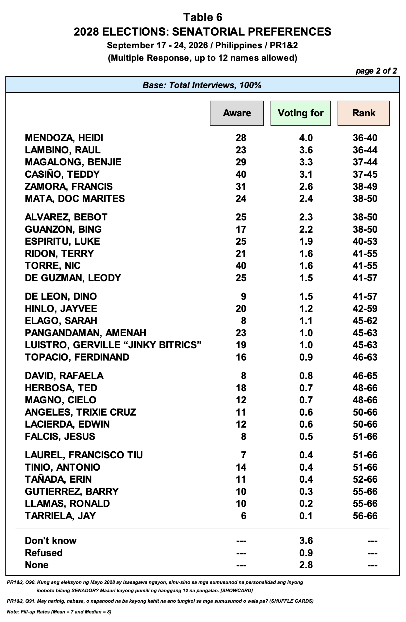
Image from Pulse Asia’s October 12, 2026 media release.

Magno, however, has some strong points. She is from the vote-rich region of Central Luzon, with Nueva Ecija as her home province. 

She will likely be backed by the left-leaning citizens’ party Akbayan, which pulled a surprise in the 2025 elections by topping the party-list race and winning 3 seats. If her low awareness rating doesn’t improve, she could follow the footsteps of Akbayan Representative Chel Diokno, who iniitially planned a third bid for a Senate seat (after two tries) in 2025 but opted instead to join the party-list race as first nominee of Akbayan.  

Being a musician and rapper, Magno may be able to connect with young voters who make up the majority of the electorate. She will, however, have to do a lot more work in improving her awareness rating via traditional and new media.

Asked in Italy what she’ll focus on if she wins, Magno said she will continue her advocacy of reforming the national budget, especially with respect to health care, and pushing for industrial policy.

“Ang tinututukan ko talaga sa budget ay yung health care… So sa akin po, napakahalaga ng health care system,” she said.

(My focus on the budget is health care… In my view, the healthcare system is very important.)

COUPLE. Economics Professor Cielo Magno with husband Dante “Dan” Gatmaytan, a faculty member of the UP College of Law, during the TOWNS awarding ceremony in October 2025. Cielo Magno Facebook.

Magno is married to UP College of Law Professor Dante Gatmaytan. They have three children: Daniel, Samuel, and Andrea. – Rappler.com

Similar Posts

  • |

    GIDC Amendment Bill to unlock Rs400bn stuck dues

    ISLAMABAD: The National Assembly is expected to consider the Gas Infrastructure Development Cess (Amendment) Bill, 2026, a proposed legal change aimed at resolving more than Rs400 billion in disputed and outstanding Gas Infrastructure Development Cess (GIDC) payments currently tied up in litigation. The proposed legislation seeks to amend the Gas Infrastructure Development Cess Act, 2015, and comes after years of legal disputes between the government and major gas consumers, including industrial, fertiliser and CNG sectors. The Cabinet Committee for Disposal of Legislative Cases (CCLC) approved the proposed amendments in principle earlier this year, paving the way for the government to move forward with the legislative process. The GIDC was originally introduced to generate funds for major gas infrastructure projects, including the Iran-Pakistan (IP) gas pipeline, the Turkmenistan-Afghanistan-Pakistan-India (TAPI) pipeline, LNG-related projects and other associated infrastructure. However, progress on several of these projects has remained slow, while the collection and utilisation of the cess became the subject of prolonged litigation. Legal history of GIDC According to a briefing provided by the Petroleum Division to the CCLC, the original Gas Infrastructure Development Cess Act, 2011, and the GIDC Ordinance, 2014 were struck down by the Supreme Court in 2014. The government subsequently enacted the GIDC Act, 2015, in May that year. The new legislation also provided retrospective legal cover to the cess that had been charged and collected under the 2011 Act and the 2014 ordinance. Section 4(1) of the 2015 law specifies that the cess is to be utilised by the federal government for infrastructure development related to the IP pipeline, TAPI pipeline, LNG projects and other ancillary schemes. The constitutional validity of the 2015 legislation was subsequently challenged by consumers from the industrial, fertiliser and CNG sectors before different high courts. The disputes eventually reached the Supreme Court. In its judgment of August 13, 2020, the Supreme Court dismissed the civil appeals and connected petitions and upheld the constitutionality of the GIDC Act, 2015, including its retrospective application. The court, however, did not permit the government to impose a fresh cess under the disputed arrangements. Instead, it allowed recovery of outstanding arrears through instalments. Supreme Court links cess to infrastructure projects A significant aspect of the Supreme Court’s ruling was its observation that GIDC constituted a fee rather than a conventional tax. As a fee, the court noted, there must be a corresponding benefit or service associated with the amount collected. The infrastructure projects identified under Section 4 of the Act therefore formed an important basis for the continuation and utilisation of the cess. The court also observed that failure to pursue the specified gas infrastructure projects could undermine the purpose for which the cess had been imposed. Despite the Supreme Court judgment, the dispute did not come to an immediate end, as consumers continued pursuing related matters before the high courts. This resulted in a substantial amount of GIDC remaining locked in prolonged litigation. Government forms high-powered committee In an attempt to find a solution, Prime Minister Shehbaz Sharif constituted a high-powered GIDC Committee on November 8, 2022, to examine the issue of outstanding amounts exceeding Rs400 billion. The committee held several meetings following its formation, but progress remained limited because of continuing litigation in different high courts. The matter was again taken up on March 19, 2025, when the committee met under the chairmanship of the federal Minister for Finance and Revenue. The meeting was attended by the Minister for Petroleum Division, the Attorney General for Pakistan and senior officials from the Petroleum, Finance and Law divisions. During the meeting, participants agreed in principle that Section 4 of the GIDC Act, 2015 should be amended to help address the long-running legal disputes. Following the committee’s recommendations, the Petroleum Division prepared a proposal for amendments and submitted a summary seeking approval of the draft GIDC (Amendment) Act, 2025. First amendment proposal rejected The initial proposal, however, was not approved by the CCLC at its meeting on September 3, 2025. The committee directed the Petroleum Division to revisit the draft and ensure that the proposed changes remained within the original scope and objectives of the GIDC Act, 2015. The Petroleum Division subsequently revised the draft after consultations with the relevant government departments. The amended draft was sent to the Law and Justice Division for legal scrutiny, which gave its concurrence on December 15, 2025. The Petroleum Division then sought formal approval of the revised GIDC amendment bill under the relevant provisions of the Rules of Business, 1973. The Finance Division had also been consulted during the process and conveyed that it had no objection to the proposal contained in the summary submitted to the CCLC. CCLC gives approval to revised proposal The CCLC considered a Petroleum Division summary dated January 1, 2026 concerning amendments to the GIDC Act, 2015. The committee approved the proposal, subject to the incorporation of amendments recommended by the CCLC into the draft legislation by the Law and Justice Division before the bill was submitted to the federal Cabinet. The approval represents another attempt by the government to break the deadlock surrounding billions of rupees in GIDC dues and bring a degree of finality to disputes that have continued for more than a decade. TAPI project remains slow The government’s original justification for GIDC included financing major regional gas infrastructure projects. However, the implementation of these projects has remained challenging. The TAPI pipeline, envisioned to transport natural gas from Turkmenistan through Afghanistan and Pakistan to India, has faced repeated delays because of financial, security and geopolitical challenges. Although work has reportedly begun on an initial 153-kilometre section extending from Serhetabat on the Turkmenistan-Afghanistan border towards Herat in western Afghanistan, the broader project remains far from completion. The slow progress of the pipeline and other proposed infrastructure projects has also remained relevant to the broader debate over the purpose and utilisation of GIDC collections. The proposed amendment is therefore being viewed as an effort to address both the legal complications surrounding outstanding dues and the government’s

Leave a Reply

Your email address will not be published. Required fields are marked *