saudius talks focus
| |

Saudi-US talks focus on easing regional tensions, …

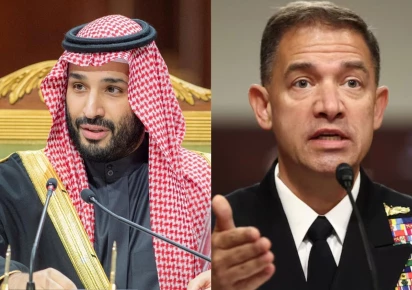
Saudi Crown Prince Mohammed bin Salman and US Central Command chief Admiral Brad Cooper have held talks on regional security and efforts to ease tensions, as the conflict involving Iran continues to threaten stability and global energy supplies.

According to Saudi state media, the two officials discussed defence cooperation between Riyadh and Washington, developments across the region and diplomatic efforts aimed at reducing tensions and strengthening security.

The meeting came as concerns surrounding the Strait of Hormuz intensified. The strategic waterway remains a major route for global oil and liquefied natural gas shipments, and disruptions caused by the conflict have raised fears of further pressure on international energy markets.

Saudi Arabia also announced the launch of a multinational defensive maritime alliance, with 13 countries joining the initiative. Representatives from 39 countries attended a planning meeting held at the Western Fleet Command in Jeddah, which Saudi authorities described as an important step towards putting the alliance into operation.

Meanwhile, Washington has signalled that its economic and military pressure on Tehran could intensify. US Treasury Secretary Scott Bessent said the United States was preparing measures against Iran on a scale not previously seen in efforts to economically isolate a country.

Bessent said the strategy would combine tougher economic restrictions with continued pressure surrounding the Strait of Hormuz. He indicated that further announcements could come next week as Washington seeks to increase pressure on Tehran.

US Defence Secretary Pete Hegseth also said the US Navy could maintain a blockade of Iranian ports and shipping routes for an indefinite period, arguing that American forces had sufficient capacity to rotate vessels and sustain the operation.

The standoff has already severely affected shipping through the Strait of Hormuz. Traffic has fallen sharply compared with levels recorded before the conflict, when roughly 130 to 140 vessels passed through the waterway each day. The decline has raised concerns about disruptions to international energy supplies.

Tensions escalated further after two vessels operated by Abu Dhabi National Oil Company were reportedly attacked while travelling through the strait. The UAE condemned the incident and blamed Iran for the attacks.

Iran has rejected US claims over control of the waterway and has indicated that normal shipping will not resume until its demands are addressed. Tehran has called for the removal of economic sanctions and the release of frozen Iranian assets.

The conflict is also putting increasing pressure on global oil markets. The International Energy Agency has revised its estimate for the decline in global oil supply, projecting a reduction of about 4.3 million barrels per day this year, equivalent to around 4% of global supply.

Although oil prices fell by more than 2% on Thursday amid concerns over weaker demand and rising US crude inventories, renewed reports of attacks linked to Iran-backed forces have continued to fuel uncertainty in energy markets.

The economic consequences are spreading beyond the region, with economists warning that a prolonged conflict could significantly weaken global growth and increase the risk of recession in some economies.

US President Donald Trump has faced growing domestic pressure to bring the conflict to an end as higher fuel prices weigh on American consumers and threaten his political standing ahead of November’s midterm elections.

While Trump has repeatedly warned that military action against Iran could escalate, he has so far avoided deploying ground troops or launching attacks against some of the region’s most sensitive strategic targets. More recently, he has indicated a greater reliance on economic pressure.

Hegseth, meanwhile, said Washington’s priority remained preventing Iran from acquiring a nuclear weapon and declined to comment on whether previous ceasefire decisions had been mistakes.

With diplomatic efforts struggling and tensions around the Strait of Hormuz continuing, Saudi-US security coordination is emerging as a key factor in attempts to contain the wider regional crisis and protect vital international shipping routes.

Similar Posts

  • | |

    Aramco profit soars 44% despite Houthi attack thre…

    Riyadh: Saudi oil giant Aramco has reported a 44% increase in profits, with company officials saying recent attacks by Yemen’s Houthi rebels failed to disrupt its production or operations. Aramco President and CEO Amin H. Nasser said attempts to target the company’s facilities, including sites near the Red Sea, had no significant impact on its oil output or operational capacity. He credited the company’s strong security measures and operational planning for ensuring uninterrupted production and energy supplies. Speaking to reporters, Nasser said Aramco continued to operate normally despite heightened regional tensions, demonstrating the resilience of its infrastructure and workforce. He added that the company’s strong financial performance reflects its ability to maintain stable energy production while reinforcing its position as a leading global supplier. Energy analysts say Aramco’s ability to keep production steady despite ongoing security risks is crucial for maintaining stability in global oil markets. They also believe the company’s latest results highlight investor confidence and the resilience of Saudi Arabia’s energy sector amid continued regional uncertainty.

  • |

    Climate summit calls for stronger action to curb global warming

    ‘As global temperature increases approach 1.5C and we face strong El Nino conditions, we reiterate that every fraction of a degree of warming accelerates the impacts of climate change and increases the risk of irreversible loss and damage for climate vulnerable communities,’ ministers say ahead of the UN’s COP31 summit

  • |

    Communal violence kills three in Nepal

    Nepal’s Prime Minister Balendra Shah has appealed for peace and restraint after deadly clashes between Hindu and Muslim communities in the country’s southern region left three people dead and prompted authorities to impose curfews in several districts. In his first major national address since taking office in March, Shah urged citizens to remain calm and reject violence, calling on political leaders, religious groups, civil society and the media to work together to preserve national unity. “I appeal to everyone to exercise patience and help restore peace, harmony and brotherhood,” the prime minister said, while assuring the public that the government would conduct a fair and transparent investigation into the violence. The unrest began earlier this week in Sunsari district near the Indian border after a dispute reportedly erupted during a Hindu religious procession. The disagreement centered on loud music and the display of religious flags, which escalated into violent clashes between members of the Hindu and Muslim communities. Police intervened to disperse the crowds and opened fire during the confrontation. Two people were killed in the initial violence, according to officials. A third person later died during a protest in the neighbouring Siraha district despite a curfew being in force. Following the violence, authorities imposed strict curfews in Sunsari and nearby districts to prevent further unrest. Security forces have been deployed across the affected areas, while police remain on high alert to protect public property and maintain law and order. Police officials said security personnel are attempting to restore normalcy while using the minimum level of force necessary to prevent additional clashes. Authorities also warned against the spread of misinformation that could further inflame tensions. The government has pledged to identify those responsible for the violence and bring them before the courts. Officials said the investigation would be conducted impartially and that anyone found involved in the unrest would face legal action.

  • | | |

    Daily petrol prices trigger Senate debate over tra…

    Islamabad: Pakistan’s new daily petroleum pricing system came under serious discussion in the Senate as lawmakers questioned whether the mechanism is providing relief to consumers or creating new challenges for the public and fuel dealers. The Senate Standing Committee on Petroleum reviewed the daily petrol price determination system and demanded clarity over why the government replaced the previous fortnightly price revision system with daily changes. The committee questioned the reasons behind the new policy and asked whether frequent price adjustments were helping ordinary citizens or increasing uncertainty in the fuel market. Federal Minister for Petroleum informed the committee that the government had removed political influence from the petroleum pricing process by giving the responsibility of setting prices to the Oil and Gas Regulatory Authority (OGRA), an independent regulator. He said the new system was introduced to make petroleum price decisions more transparent and based on market conditions. OGRA Chairman informed the committee that petrol prices are calculated through a seven day average of international Platts benchmark prices. He explained that instead of directly passing sudden changes in international oil markets to consumers, the seven day average spreads the impact over time. According to OGRA, the system helps reduce sudden price shocks, especially during international tensions and market uncertainty. Officials said the daily pricing mechanism also aims to discourage people from creating artificial shortages or making unfair profits through speculation. However, senators raised concerns about the effect of frequent price changes on citizens and businesses. The committee expressed concern over the high tax burden on petroleum products and questioned how increasing fuel costs affect the daily lives of ordinary people. Representatives of the Petroleum Dealers Association informed the committee that frequent price revisions were creating operational difficulties for fuel dealers. They said continuous price changes make business planning more difficult and require better coordination between authorities and dealers. The committee directed OGRA to consult all stakeholders, including petroleum dealers, and prepare practical recommendations to address their concerns. Members also stressed the need for greater use of technology in the petroleum supply chain to prevent fuel smuggling, adulteration and illegal storage. The committee said a stronger digital monitoring system could improve transparency and ensure consumers receive better quality fuel. Senator Umer Farooq chaired the meeting of the Senate Standing Committee on Petroleum, where members reviewed the new pricing system and related petroleum sector issues. The committee emphasized that petroleum pricing directly affects every citizen because fuel costs influence transportation, business expenses and prices of daily goods. Members said the government and regulators must ensure that any pricing system protects consumers while maintaining stability in the petroleum market. The committee directed OGRA to continue reviewing the mechanism and ensure that the interests of consumers remain the top priority.

  • | | | | |

    Crystal Meth and Meth Tablets Found in Phuket Courier Packages Valued at 25 Million Baht

    Phuket – On July 22nd, 2026, the Customs Department, through the Regional Customs Office 5, carried out a targeted inspection at a private courier company in Phuket. The operation was to prevent the spread of illegal substances in one of Thailand’s most prominent tourist destinations. Using X-ray screening and random checks on suspicious parcels, officers […]

  • |

    Uorfi Javed can not get over Arbaaz Khan’s ‘Lock Upp 2’ stunt for Sohail Khan

    Arbaaz Khan has found himself at the center of an unusual reality TV crossover. He appeared in a promo for Lock Upp 2, even though his brother Sohail Khan is currently competing on an entirely different show, Alliance. The odd connection between the two shows did not go unnoticed. It even caught the attention of Uorfi Javed, who could not resist reacting. In the promo, Arbaaz stepped in to defend Sohail. He responded to comments being made about his brother and made it clear he was not going to let negative remarks slide. He kept his response light and playful, showing off some comic timing in the process. Uorfi shared her thoughts on Instagram stories soon after watching the clip. She pointed out how strange yet interesting the situation was. Arbaaz was busy promoting Lock Upp, while Sohail was fighting his own battle on Alliance. She found the whole thing amusing and said so openly. She did not just stop at her stories either. Uorfi also praised the idea behind the promo directly in the comments section. She joked that whoever came up with the concept deserved a raise for pulling off something so clever. Her comment quickly picked up attention online, with many fans agreeing that the crossover was a smart marketing move. The promo video itself showed Arbaaz having some fun with the format. He mimicked several Lock Upp 2 contestants, including Ram Kapoor, Shreya Kalra, and Akanksha Choudhary. His impressions added an extra layer of humor to the clip. Filmmaker Farah Khan also joined in on the reactions. She laughed at how committed Arbaaz was to the bit, calling out his dramatic flair in her comment. Adding more excitement to the mix, reports have suggested that Salman Khan might make a special appearance on Alliance. The idea is that he could show up to support Sohail during his journey on the show. So far, though, neither Salman Khan nor the makers of Alliance have confirmed anything official about this rumored appearance. For now, fans can catch new episodes of Alliance streaming on Prime Video. Lock Upp 2, meanwhile, continues to air its episodes from Saturday through Thursday each week.

Leave a Reply

Your email address will not be published. Required fields are marked *