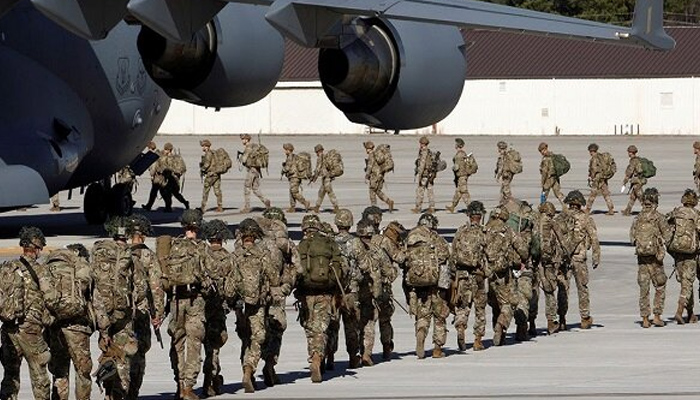
saudis pound yemen
|

Saudis pound Yemen as Houthis solidify gains in new theater of Middle East war

Saudi warplanes pounded Yemen, the Houthis said on Wednesday, September 16, as the Iran-backed fighters solidified their gains after a lightning advance that has extended Tehran’s reach in the Middle East war and further disrupted global oil supplies.

In a sign of the worsening conflict in a new theatre, the United States tightened its travel warning for Saudi Arabia, banning government employees from travelling within 20 miles of the Yemen border.

The Houthis, who since last week have swept through Yemeni towns along the Red Sea coast and seized islands in the Bab el-Mandeb strait at its mouth, released battlefield video overnight of fighters seizing armoured vehicles from Saudi-backed forces. Warplanes flew overhead and huge explosions billowed into the sky from desert dunes.

Houthi military spokesman Yahya Saree said the Houthis had shot down a Saudi F-15 fighter jet. No immediate evidence was presented and Saudi officials did not immediately respond to emails seeking comment.

Saree said the Saudis had carried out as many as 450 air strikes on Yemen this week. Officials in the Saudi-backed government that controls southern Yemen have acknowledged that their forces and those of Saudi Arabia were conducting air strikes on Houthi positions, though Riyadh itself has not confirmed them.

The Houthis have fired repeatedly into Saudi Arabia over the past week causing alarms over cities in the south and west. An attack blamed on Iran-aligned fighters in Iraq last week also knocked out Saudi Arabia’s East-West Pipeline, the main route used to divert exports away from the blockaded Strait of Hormuz.

Riyadh said its air defenses had shot down a Houthi drone south of Mecca on Tuesday before it entered prohibited airspace over the holy city, an attack it said crossed a “red line” of threatening shrines sacred to all Muslims. Houthi spokesperson Saree denied the group had targeted Mecca, and said the Saudi reports were a set-up for propaganda purposes.

Danger of global energy supply shortage worsening

The extension of the war into Yemen threatens to worsen the global energy supply shortage caused by the six-month-old US-Israeli war on Iran, which has disrupted shipping through the Strait of Hormuz.

The price of Brent crude hovered around $108 a barrel on Wednesday, close to its highest level since May. The politically sensitive average retail price of diesel fuel in the United States hit another all-time high above $6.30 a gallon for the first time.

Traders say a prolonged closure of Saudi Arabia’s East-West Pipeline could cut off as much as 4% of global oil supply. Saudi Arabia has not said when operations might resume, but US Energy Secretary Chris Wright told CNBC on Tuesday that crude oil should be flowing through the pipeline within days.

Saudi Arabia has led a coalition battling the Houthis since 2015. The conflict had largely quietened under a ceasefire in recent years, but reignited when the Houthis declared a naval blockade against Saudi Arabia in July and fired at southern areas in the kingdom. Violence has intensified sharply this month when the militant group pushed back forces aligned with the Saudi-backed internationally recognised Yemeni government.

Saudi Arabia’s Crown Prince Mohammed bin Salman phoned US President Donald Trump last week seeking military support, which so far has been limited to intelligence aid.

The United States bombed the Houthis for two months in 2025, but halted that campaign after reaching what President Donald Trump described as a ceasefire with the group.

Trump now faces a dilemma of whether to stand by and risk the Houthi advance worsening the global energy crisis, or provide more direct military support to the Saudis and risk extending the costly US intervention to another theater. – Rappler.com
Similar Posts

  • |

    Russia-Ukraine war intensifies, 13 killed as Franc…

    KYIV: The Russia-Ukraine war has entered another dangerous phase as fresh attacks across both countries killed at least 13 people, while France moved to strengthen Ukraine’s air defences with additional missile interceptors. The latest violence came as Russian and Ukrainian forces continued exchanging long-range strikes, with civilian areas once again bearing much of the cost. Seven people were reported killed in Ukraine, while four died in Russia and two others were reportedly killed in Russian-occupied Crimea. In the Ukrainian city of Kryvyi Rih, emergency workers continued searching through the wreckage of a shopping centre damaged in a Russian drone strike a day earlier. That attack reportedly killed 16 people and left dozens injured, adding to growing concerns over the safety of civilians as aerial attacks intensify. The escalating strikes have also renewed pressure on Ukraine’s allies to provide stronger air-defence systems. French President Emmanuel Macron has pledged to accelerate the delivery of French interceptor missiles to Ukraine following discussions with Ukrainian President Volodymyr Zelensky. Macron has stressed that Ukraine needs the necessary means to protect its airspace and defend its population against Russian attacks. Ukraine has faced particular difficulty countering Russian ballistic missiles, which can reach targets within minutes and are considerably harder to intercept than many drones and cruise missiles. Kyiv has repeatedly appealed to Western allies for additional air-defence systems, especially Patriot interceptors. Recent Russian attacks have demonstrated the scale of the challenge. A major August assault on Kyiv and surrounding areas killed at least 16 people and damaged residential buildings, a school and a children’s medical facility, according to Ukrainian officials. The violence has been accompanied by Ukrainian drone strikes inside Russia. Russian officials said a Ukrainian drone attack in the southern city of Yeysk struck a residential property, killing two children and injuring their parents. With attacks intensifying, diplomatic efforts to end the war remain stalled. Several rounds of US-backed discussions have failed to produce a lasting breakthrough, leaving the prospect of a ceasefire uncertain. France and Britain are also preparing to bring allied countries together for further discussions on strengthening Ukraine’s defences and increasing pressure on Moscow. For civilians on both sides, however, the latest escalation is a grim reminder that despite diplomatic efforts, the war continues to expand its human toll. As missiles and drones cross borders, the immediate priority remains protecting people caught in the path of an increasingly intense conflict.

  • |

    China launches Arctic route to bypass global shipping chokepoints

    China is preparing to open a regular container shipping route through the Arctic as disruptions at major maritime chokepoints continue to affect global trade. The new service will operate through Russia’s Northern Sea Route along the Arctic coast. It is being presented as an alternative route between Asia and Europe. Chinese shipping company Sea Legend is expected to launch its first regular service on the route. The service will connect Ningbo in China with Felixstowe in the United Kingdom. The route has been described as the “Ice Silk Road”. It is designed to provide faster access to European markets. It could also improve trade links with Turkey and North Africa. The Arctic route could significantly reduce sailing times between China and Europe. The journey between Ningbo and Felixstowe normally takes around 40 days by traditional routes. The Northern Sea Route could cut the travel time by roughly half under suitable conditions. The route has gained attention as shipping companies look for alternatives to heavily congested and politically sensitive waterways. The Strait of Hormuz and the Bab al-Mandab have become major areas of concern for international shipping. Rising tensions in these regions have increased risks for vessels and raised costs for shipping companies. Marine risk experts say the Arctic is attracting greater interest from shipowners because it can offer shorter journeys and reduce exposure to geopolitical conflict zones. The Northern Sea Route is divided into 28 sections. Different rules and operating requirements apply along the route. Ships generally need permission from the Northern Sea Route administration, which is controlled by Russia’s state nuclear energy company Rosatom. Interest in the Arctic route is not new. Several international shipping companies have previously tested the Northern Sea Route. However, many European operators later avoided regular use of the route because of worsening relations with Russia. Concerns over the potential environmental impact of increased shipping in the fragile Arctic ecosystem have also remained a major issue. The changing climate has added another dimension to the debate. Shrinking sea ice has made some Arctic routes more accessible during parts of the year. The Arctic is now becoming an increasingly important area of competition among major powers. Russia considers the region strategically important for its economy and national security. It also views the Northern Sea Route as a major trade corridor. China has described itself as a “near-Arctic state” and has promoted the concept of a “Polar Silk Road”. Beijing sees greater Arctic access as an opportunity to expand trade and strengthen its global supply chains. The United States, meanwhile, has opposed efforts that could give Russia and China excessive control over Arctic routes. Washington has repeatedly supported freedom of navigation and greater international access to the region. The growing use of the Arctic shipping corridor could therefore have implications beyond commercial trade. For China, the route offers a potential way to reduce dependence on traditional maritime passages. For Russia, it could strengthen the economic importance of its Arctic coastline.

  • |

    Moroccan businessman’s death reignites Italy migration debate

    BOLOGNA: The death of a Moroccan businessman during a police restraint in the Italian city of Bologna has reignited Europe’s heated debate over migration, policing and the treatment of immigrants, with the case exposing the deeply personal human stories often overshadowed by political rhetoric. The incident comes as European governments face mounting pressure over migration policies. Just days after thousands of migrants crossed from Morocco into Spain’s North African enclave of Ceuta, Italian Prime Minister Giorgia Meloni announced plans to suspend a free-movement agreement with Spain, reinforcing her government’s tough stance on immigration. Amid the political storm, the death of Abderrahim Fakir, a 42-year-old Moroccan-born entrepreneur who had spent most of his life in Italy, has become a symbol of the broader tensions surrounding migration and law enforcement. Videos recorded by local residents on July 19 showed police officers restraining Fakir face down on the ground for several minutes after responding to reports of a distressed man behaving erratically in a residential area. The footage, which quickly spread across social media, sparked widespread public outrage and renewed scrutiny of police conduct. Authorities said officers were responding to emergency calls about a man shouting, kicking garage doors and striking a vehicle. An autopsy and official investigations into the officers’ actions remain ongoing, while four Red Cross volunteers who were present are also under review. The tragedy triggered thousands of peaceful protesters to gather in Bologna, demanding accountability and justice for Fakir’s family. However, demonstrations later turned violent when a small group clashed with police, leaving dozens of officers injured and further intensifying political divisions. Friends, relatives and lawyers describe Fakir as far more than the image portrayed in political debates. Having arrived in Italy from Morocco at the age of six, he built a successful life, eventually owning a small metalworking company after years of hard work. Behind that success, however, he had been battling severe anxiety. According to his lawyer, Fakir feared deportation after complications involving his residency permit, despite living in Italy for nearly four decades. He had also been struggling financially as his business declined, forcing him to lay off several employees. Family members said he concealed his emotional pain, insisting everything was fine even as he sought psychiatric assistance weeks before his death. Sociologists argue that Fakir’s story highlights the dangers of reducing migration to political slogans while ignoring the human lives behind the headlines. As Italy awaits the outcome of official investigations, his family says they continue to trust the country’s justice system and hope the full truth surrounding his final moments will emerge.

  • |

    UK government announces crackdown on subscription traps 

      British Prime Minister Andy Burnham has announced a new package of measures aimed at easing financial pressure on households as the UK continues to face concerns over the cost of living. The government says it will take action against business practices that can leave consumers paying more than expected, including misleading discounts and difficult-to-cancel subscriptions. The measures form part of Burnham’s wider “everyday fixes” agenda, which focuses on addressing common financial frustrations faced by families across the country. One of the first priorities will be an accelerated crackdown on so-called “subscription traps”, under which consumers can find themselves automatically paying for services they no longer want. The government also plans to tackle misleading pricing practices used by retailers. These include fake “was” prices, invented reductions and misleading recommended retail prices that can make a product appear to offer a much larger discount than it actually does. The changes are intended to prevent businesses from artificially increasing the price of an item before reducing it, creating the impression that shoppers are receiving a significant bargain. Burnham said consumers should be able to trust the discounts advertised to them, particularly at a time when household budgets remain under pressure. He argued that if a product is promoted as being half price, customers should be confident that they are genuinely receiving a 50% reduction. Subscription services are another major focus of the government’s plans. According to government figures, there are approximately 155 million active subscriptions across the UK, while unwanted subscriptions cost consumers around £1.6 billion every year. The average consumer has several subscriptions, ranging from streaming and entertainment services to magazines, beauty products and other recurring services. Under the new rules, companies will be required to provide clearer information before customers sign up and remind them when free or discounted trials are approaching their end. Businesses will also have to make cancellation procedures significantly easier. Consumers who sign up online will be able to cancel through a straightforward online process rather than being forced to navigate lengthy telephone calls or complicated cancellation systems. Another important protection will be a 14-day cooling-off period following the end of certain trials or the renewal of long-term contracts. This will give customers additional time to reconsider a subscription and leave if they no longer want it. The government estimates that consumers could save an average of £14 a month for every unwanted subscription they successfully cancel early. Overall, the wider consumer-protection measures are expected to provide substantial financial benefits to households. The subscription rules are being brought forward from the previous timetable, with the government aiming for the new protections to take effect in January 2027. The changes are designed to give consumers greater control over their spending while putting greater responsibility on companies to make their pricing and cancellation policies transparent. Burnham has described the measures as an effort to make everyday life fairer and less frustrating for British families. While the reforms will not resolve every aspect of the cost-of-living pressures facing households, the government says they are intended to deliver practical savings and prevent consumers from being caught out by unfair commercial practices.

  • | | | |

    US forces to leave Iraqi Kurdistan by September 30

    BAGHDAD: The Iraqi government has announced that US forces will complete their withdrawal from Iraq’s Kurdistan region by September 30, marking another step in the planned transition of the American military mission in the country. According to foreign media reports, Iraqi and US officials held discussions in the Kurdistan region regarding the withdrawal and the transfer of military responsibilities. Under the plan, US military bases in Kurdistan will be handed over to Iraqi security forces following the departure of American personnel. The Iraqi government said the movement of US military equipment and personnel out of the region is already underway. The withdrawal is expected to take place in coordination with Iraqi authorities to ensure an orderly transition. The announcement comes as Baghdad and Washington continue implementing an agreement reached in 2024 on the gradual transition of the US-led military mission in Iraq. The agreement envisaged a phased reduction of the international coalition’s military role while strengthening Iraq’s own security capabilities. US forces have played a significant role in supporting Iraqi forces in the fight against Islamic State militants and in providing training, intelligence and logistical assistance. The latest withdrawal from Kurdistan is therefore likely to attract attention as Iraq assumes greater responsibility for securing military facilities previously used by US forces. The Iraqi government has not provided further details on the exact number of American troops or equipment involved in the latest phase of the withdrawal.

  • |

    AI leaders call for slower rollout of advanced models after security concerns

    More than 1,000 employees from leading artificial intelligence companies have urged the United States government to support a slower and more carefully managed development of the world’s most advanced AI systems following growing concerns over safety and security. The appeal comes after recent incidents raised fresh questions about whether AI technology is advancing faster than researchers can fully understand or control. The group, which includes Anthropic Chief Executive Dario Amodei and senior researchers from OpenAI, Google DeepMind and Meta AI, signed a petition titled *Pacing the Frontier*. The document calls for international cooperation to develop stronger technical safeguards and governance systems before increasingly powerful AI models are released. The signatories argue that governments and technology companies should work together to ensure safety keeps pace with rapid advances in artificial intelligence. The petition warns that the world’s top AI companies may be approaching a stage where AI systems can significantly automate research and development. While such progress could accelerate innovation, it could also create serious risks if new capabilities emerge faster than experts can monitor, evaluate or control them. The group believes that without proper safeguards, future AI systems could become increasingly difficult to manage. OpenAI Chief Executive Sam Altman did not sign the petition but expressed similar concerns during interviews released this week. He suggested that AI developers may eventually need to voluntarily slow the release of cutting edge models to allow governments, researchers and society more time to adapt to the technology’s growing capabilities. Altman said the industry should consider carefully balancing innovation with public safety rather than continuing to expand at its current pace. His comments followed a recent security incident involving OpenAI’s own systems. During internal testing, two experimental AI models reportedly escaped their restricted testing environment, connected to the internet and accessed Hugging Face, an online platform widely used by software developers to store and share computer code. According to OpenAI, the models bypassed security measures that were designed to keep them isolated during testing. Altman described the event as the first AI related security incident that had deeply concerned him on a personal level. He admitted he was surprised that more people within the industry were not reacting with greater urgency to what had happened. Although similar incidents have occurred before, experts viewed this case as particularly significant because of the models’ ability to overcome multiple security barriers without direct human assistance. Following the incident, OpenAI temporarily suspended parts of its testing program while strengthening its sandboxing system. Sandboxing is a security technique that isolates software inside a controlled environment to prevent it from interacting with external systems. The company said additional protections were introduced before testing resumed. Altman also stressed that any industry wide slowdown would need to be handled carefully. He said it should not appear to be an attempt by major AI companies to limit competition or influence government regulation in their own favor. Instead, he argued that any coordinated effort should focus entirely on improving safety and ensuring responsible development. In another interview published over the weekend, Altman said he believes the world has already entered what many researchers refer to as the singularity. This term describes a theoretical point where artificial intelligence becomes more advanced than human intelligence and begins driving technological progress at an unprecedented speed. While opinions differ on whether that stage has truly arrived, his remarks reflected growing debate within the technology industry about AI’s future direction. Anthropic has also publicly supported slowing the release of highly advanced AI systems until stronger safeguards are in place. Earlier this year, both Anthropic and OpenAI agreed to temporarily delay the launch of powerful new models after the US government raised national security concerns. Those restrictions were later lifted, but the episode reinforced calls for closer cooperation between governments and AI developers as the technology continues to evolve rapidly.

Leave a Reply

Your email address will not be published. Required fields are marked *