forces leave iraqi
| | | |

US forces to leave Iraqi Kurdistan by September 30

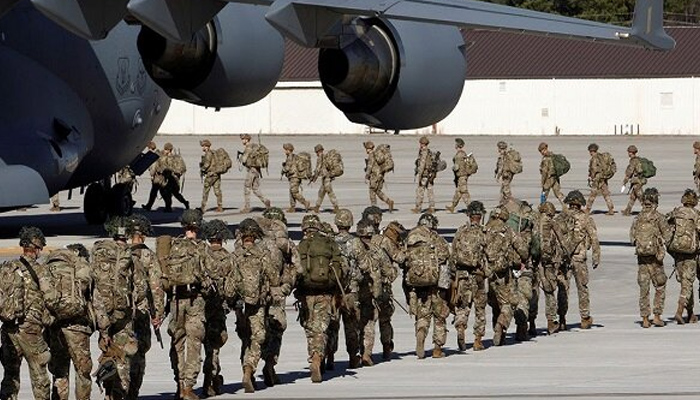
BAGHDAD: The Iraqi government has announced that US forces will complete their withdrawal from Iraq’s Kurdistan region by September 30, marking another step in the planned transition of the American military mission in the country.

According to foreign media reports, Iraqi and US officials held discussions in the Kurdistan region regarding the withdrawal and the transfer of military responsibilities.

Under the plan, US military bases in Kurdistan will be handed over to Iraqi security forces following the departure of American personnel.

The Iraqi government said the movement of US military equipment and personnel out of the region is already underway. The withdrawal is expected to take place in coordination with Iraqi authorities to ensure an orderly transition.

The announcement comes as Baghdad and Washington continue implementing an agreement reached in 2024 on the gradual transition of the US-led military mission in Iraq.

The agreement envisaged a phased reduction of the international coalition’s military role while strengthening Iraq’s own security capabilities.

US forces have played a significant role in supporting Iraqi forces in the fight against Islamic State militants and in providing training, intelligence and logistical assistance.

The latest withdrawal from Kurdistan is therefore likely to attract attention as Iraq assumes greater responsibility for securing military facilities previously used by US forces.

The Iraqi government has not provided further details on the exact number of American troops or equipment involved in the latest phase of the withdrawal.

Similar Posts

  • | |

    Israel claims Hamas commander killed in Central Ga…

    The Israeli military says it has killed a Hamas commander during an airstrike in central Gaza, as fighting in the territory continues despite ongoing international efforts to reduce hostilities. According to a statement issued by the Israeli military, the commander, identified as Hamam Eid, was targeted in central Gaza. Israel alleged that he was involved in developing Hamas’ drone capabilities and was working to rebuild the group’s aerial operations. The military further claimed that these activities violated the terms of the ceasefire arrangement, describing the operation as part of its ongoing campaign against Hamas’ military infrastructure. Separately, Palestinian officials reported that two members of Gaza’s internal security service were killed in another Israeli airstrike. According to local authorities, the victims were Colonel Wael Al-Lidawi, described as a regional head of the internal security service, and Major Ramez Abu Zuraiq. They were reportedly traveling through Deir al-Balah in central Gaza when their vehicle was struck. The reported deaths come as military operations continue across Gaza despite previous ceasefire efforts. Both Israeli and Palestinian authorities have continued to exchange accusations over violations of the truce, while humanitarian concerns remain high. The claims made by the Israeli military and Palestinian officials have not been independently verified, and the conflict continues to evolve with ongoing reports of casualties on both sides.

  • |

    Cuba plunges into darkness as national electric grid collapses

    Cuba’s state-owned grid operator, Union Electrica de Cuba, announced that the national electricity system collapsed late on Sunday night, leaving approximately 10 million residents without power. The widespread outage marks the fourth major blackout to hit the country in recent weeks following three similar grid failures recorded throughout July. The worsening energy crisis is driven by severe fuel shortages, which have left the nation’s ageing power generation facilities unable to meet basic electrical demand. Sanctions and geopolitical shifts have severely restricted the island’s ability to import crude oil. Following the ouster of Venezuelan President Nicolas Maduro in January, a US-imposed oil blockade cut off Cuba’s primary source of imported fuel, while alternative shipments from Mexico have also stopped under pressure from Washington. To mitigate the escalating power supply emergency, the Cuban government has initiated unprecedented reforms by allowing private businesses and foreign-backed entities into its domestic wholesale fuel market.

  • | | |

    Pakistan seeks strategic economic ties with Saudi …

    ISLAMABAD: Prime Minister Shehbaz Sharif has expressed Pakistan’s desire to transform its longstanding relationship with Saudi Arabia into a mutually beneficial strategic economic partnership, in line with the vision of Saudi Crown Prince and Prime Minister Mohammed bin Salman. The Prime Minister made the remarks during a meeting with a high-level Saudi business delegation headed by Prince Mansour bin Mohammad Al Saud, Chairman of the Saudi-Pak Joint Business Council, at the Prime Minister’s House in Islamabad. During the meeting, Prime Minister Shehbaz conveyed his regards to Saudi King Salman bin Abdulaziz Al Saud and Crown Prince Mohammed bin Salman. He highlighted the deep-rooted brotherly relations between the two countries and stressed the need to expand bilateral trade, investment and economic cooperation. The prime minister expressed hope that Prince Mansour’s latest visit would build upon earlier discussions and lead to the signing of memoranda of understanding and agreements in several sectors. He described the current period as an ideal opportunity to strengthen cooperation through both government-to-government and business-to-business partnerships. The Saudi delegation showed interest in investment opportunities across a wide range of sectors, including agriculture, ports, highways, airport outsourcing, real estate, energy, power distribution and information technology. Prime Minister Shehbaz welcomed the proposals and assured the delegation of Pakistan’s support for mutually beneficial investment ventures. Prince Mansour thanked the prime minister for the warm reception and reaffirmed the Saudi government’s and business community’s commitment to expanding business-to-business ties with Pakistan. During its visit, the delegation is also scheduled to hold meetings with senior government officials and representatives of the private sector. PM Condemns Pishin Terrorist Attack Meanwhile, Prime Minister Shehbaz Sharif strongly condemned the terrorist attack on labourers working on a road construction project in the Suranan area of Pishin district. The prime minister expressed sorrow over the loss of lives and extended condolences to the families of the victims. He denounced the targeting of hardworking citizens as a cowardly act and reaffirmed the government’s determination to combat terrorism. He stressed that the nation remained united against terrorism and that terrorists and their facilitators would not be permitted to undermine peace and stability in the country. The prime minister also prayed for the departed souls and for strength and patience for the bereaved families.

  • | |

    Oil surges above $83 as Strait of Hormuz tensions …

    Global oil prices continued their upward momentum on Friday, with Brent crude climbing above $83 per barrel as renewed tensions surrounding the Strait of Hormuz heightened concerns over potential disruptions to global energy supplies. Brent crude futures gained 1.1 percent to reach $83.48 per barrel, while US West Texas Intermediate (WTI) crude rose by 85 cents to $78.84 per barrel. The latest rally marks a sharp reversal from earlier this week, when crude prices had declined amid expectations that diplomatic efforts between Iran and Oman could ease regional tensions and pave the way for smoother maritime traffic through the Strait of Hormuz. However, investor sentiment shifted after reports that Iran, in coordination with Oman, proposed new restrictions on shipping through the strategic waterway. The proposal reportedly includes banning vessels belonging to countries considered hostile from passing through the strait and imposing substantial financial penalties on ships that violate the proposed regulations. The renewed uncertainty over one of the world’s most important oil transit routes has reignited fears of supply disruptions, prompting traders to push oil prices higher despite earlier forecasts predicting further declines. Analysts say developments in the Strait of Hormuz will remain a key factor influencing global energy markets in the coming days.

  • | |

    Iran says Oman deal nears completion but insists U…

    Iran said on Sunday that a deal with Oman establishing new shipping lanes through the Strait of Hormuz has entered its final stages, though Tehran maintained the critical waterway will remain closed until Washington satisfies a broader set of conditions tied to the ongoing standoff between the two countries. A US official told Reuters on Friday that an agreement between Iran and Oman appeared close and could soon lead to the reopening of the strait, a passage that carried roughly a fifth of global oil and liquefied natural gas shipments before Iran shut it down in response to American and Israeli military strikes earlier this year. Iranian Foreign Minister Abbas Araqchi confirmed on Sunday that negotiations over the strait, which sits between Iran and Oman, had reached their final stages. However, he repeated comments made a day earlier stressing that the waterway would not reopen unless additional conditions set by Tehran were met first. Iran’s Mehr news agency quoted Araqchi as saying the emerging agreement would establish the new shipping lanes to be used once the United States fulfils those conditions and the strait formally reopens. Araqchi said Iran and the United States are not currently engaged in direct talks and that Tehran has no plans to begin them as long as Washington continues to breach an interim agreement the two countries signed in June. He added that messages between the two sides are being exchanged through intermediaries rather than direct contact. Iran demands compensation and sanctions relief The United States launched air strikes against Iran in late February, saying the campaign aimed to prevent the Islamic Republic from acquiring nuclear weapons or using missiles and regional proxy forces to threaten the wider Middle East. Washington and Tehran agreed to a ceasefire in June, but the United States reimposed a blockade on Iranian shipping in the Gulf in July, a move Iran characterised as a violation of a truce that had already shown signs of collapse. A US official, speaking to Reuters on condition of anonymity, said the blockade on Iranian ports would lift once a deal restoring unimpeded commercial shipping is formally announced. The official added that any American actions would remain directly tied to Iran fulfilling its own commitments under the emerging agreement, pointing to a carefully sequenced approach that both sides appear to be navigating cautiously. The arrangement under discussion appeared, according to sources who previously spoke to Reuters, to grant Tehran a degree of control over vessels entering the Gulf through the strait, an arrangement that shipping industry sources have said would be difficult to implement in practice. The precise current status of the agreement remained unclear on Sunday, and Iran’s latest statements suggested several additional factors could still complicate its finalisation. Araqchi said the strait’s reopening would depend in part on the United States providing compensation to Iran for what Tehran describes as widespread attacks on its territory and interests. Mohammad Baqer Zolqadr, secretary of Iran’s top national security body, outlined a broader list of demands, including an end to US threats against Iran, a halt to what Tehran calls aggression against its allies in Lebanon, the Palestinian territories, Yemen and Iraq, the lifting of the shipping blockade and broader sanctions, and the release of frozen Iranian financial assets. Supreme Leader’s condition remains unclear Ultimate decision making authority in Iran rests with Supreme Leader Mojtaba Khamenei, who has not appeared in public since an air strike killed his father and predecessor on February 28, the first day of the joint US and Israeli air campaign against Iran. State media reported on Sunday that Iranian President Masoud Pezeshkian met with Khamenei in late July, and a paramilitary leader promised that footage of the supreme leader would soon be released publicly. Khamenei was reportedly injured in the same strike that killed his father, according to earlier reporting. Separately, the United Arab Emirates said on Saturday that Iran had attacked a vessel affiliated with its state oil company. Iran did not immediately respond to the allegation. The country’s powerful Revolutionary Guards have attacked commercial vessels in the past, arguing that ships transiting the strait without coordinating their passage with Iranian authorities are not protected from such action. Houthi attacks widen regional shipping crisis Iran’s strikes on shipping in the Strait of Hormuz have coincided with intensified attacks from its Yemen based allies, the Houthis, who have targeted vessels at a separate chokepoint located between the Red Sea and the Gulf of Aden on the opposite side of the Arabian Peninsula. The Houthis declared a naval blockade against Saudi Arabia in the Red Sea last month, framing the move as retaliation for what they described as a Saudi imposed siege in Yemen, an accusation the Saudi government has firmly denied. Riyadh continues to back Yemen’s internationally recognised government in the country’s ongoing conflict. The group claimed responsibility for an attack on Saudi Aramco’s Jazan refinery on Sunday, coming just two days after the kingdom signed a defence pact with fellow Sunni Muslim majority nations Turkey and Pakistan amid growing concern over regional instability stemming from the US and Israeli military campaign against Shiite led Iran. Saudi Arabia’s energy ministry confirmed that a fire broke out at the refinery following the attack but was later extinguished without causing any injuries, and that authorities were continuing to manage the aftermath of the incident. The ministry did not specify a cause for the blaze. Houthi military spokesperson Yahya Saree said on social media platform X that the group used a drone to strike the facility. The Houthis have targeted Aramco sites in Jazan before, a refinery that processes approximately 400,000 barrels of crude oil daily in southwestern Saudi Arabia. It remains unclear whether or to what extent Pakistan or Turkey would participate in any Saudi response to the latest attack. Turkish Foreign Minister Hakan Fidan said the newly formed alliance between the three countries was not directed against Iran or any other nation, describing it instead as a general commitment to

Leave a Reply

Your email address will not be published. Required fields are marked *