shaheen afridi gives
|

Shaheen Afridi gives cautious reply on Pakistan captaincy

Pakistan ODI captain Shaheen Shah Afridi has avoided giving a long-term commitment about his leadership ahead of the 2027 ICC World Cup, saying that he remains captain “for now”.

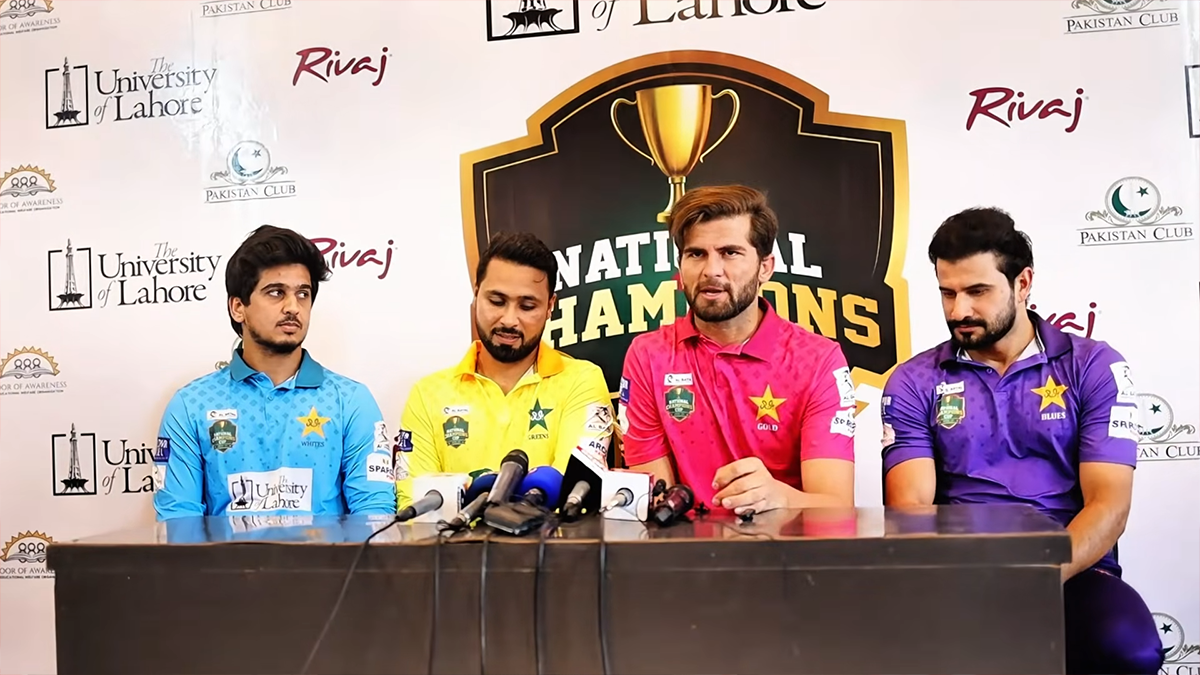
Speaking at a joint press conference with the captains of the teams participating in the National Champions Cup, Shaheen was asked whether he had received assurances that he would continue leading Pakistan until the World Cup.

His response was brief. “For now, I am the captain,” he said.

The left-arm fast bowler also stressed the importance of the Champions Cup in preparing Pakistan for the global tournament. He said the competition would help the national team build a wider pool of players and identify suitable replacements in case of injuries.

Shaheen pointed out that injuries have frequently affected Pakistan’s World Cup campaigns. He said having additional players ready would make it easier for the team management to deal with any fitness concerns before the 2027 tournament.

He added that the Champions Cup would allow players to perform in their preferred positions while competing against strong domestic opposition.

According to Shaheen, the tournament will be important not only for individual players but also for assessing the overall strength and fitness of the national squad. He said the performances of players during the competition would help selectors identify those capable of contributing to Pakistan’s World Cup plans.

“Our focus is on the World Cup,” Shaheen said, stressing that consistent performances and fitness would be key factors in selection.

The National Champions Cup is scheduled to begin on Tuesday at Multan Cricket Stadium. Four teams will participate in the competition: Pakistan Greens, Pakistan Whites, Pakistan Blues and Pakistan Gold.

Each team will face the others once during the league stage. The top two sides will qualify for the final, which is scheduled for August 18.

The tournament’s trophy unveiling ceremony was held earlier, with the captains of all four teams attending the event.

Shaheen Shah Afridi is leading Pakistan Gold, while Sahibzada Farhan is captaining Pakistan Blues and Saim Ayub is leading Pakistan Whites. Faheem Ashraf represented Pakistan Greens at the ceremony in place of their regular captain, Shadab Khan.
Similar Posts

  • | | |

    AJK reserved seats election: Polling set for Augus…

    The AJK reserved seats election will be held on August 24, with the Azad Jammu and Kashmir Election Commission announcing the schedule for polling in the Legislative Assembly. According to the notification, voting will take place at the AJK Assembly from 10am to 1pm. The reserved seats include five for women, one for Ulema-e-Deen or Mashaikh, one for Jammu and Kashmir state subjects living abroad, and one for technocrats and other professionals. Candidates will be able to submit their nomination papers on August 20 between 9am and 2pm. The returning officer will subsequently scrutinise the papers and publish the list of valid candidates. Appeals against decisions on nomination papers can be filed on August 21. The Chief Election Commissioner will hear the appeals on August 22, while candidates can withdraw their nominations before 2pm on August 23. The AJK Assembly has 53 members, including 45 directly elected members and eight members elected through reserved seats. However, polling on seven directly elected seats could not take place because of law and order concerns. As a result, the reserved-seat election will initially be conducted by the 38 directly elected members elected so far. The development comes as AJK’s three-phase electoral process continues amid political and security challenges.

  • |

    7 in 10 Afghan women report poor mental health

    Restrictions imposed on women and girls in Afghanistan have sharply reduced their participation in public life, with more than half of surveyed women saying they now leave their homes only once or twice a month, according to a new UN Women assessment. The findings were released as Afghanistan approaches the fifth anniversary of the Taliban’s return to power in August 2021. UN Women said Afghanistan remains the only country where girls are barred from secondary education and women are prohibited from attending universities. The agency said the restrictions have increasingly affected women’s freedom of movement, education, employment and access to public life. More than half of the women surveyed reported leaving home no more than twice a month. Nearly three-quarters said they did not feel safe going outside without a male guardian, commonly referred to as a mahram. UN Women said the restrictions have also contributed to growing concerns about women’s mental health. Around seven out of 10 women surveyed described their mental health as either “bad” or “very bad”. Respondents cited social isolation, reduced opportunities and limited access to support networks among the factors affecting their wellbeing. The UN agency said Taliban authorities have introduced more than 100 decrees affecting women and girls since returning to power. It described the measures as creating a system of discrimination and said Afghanistan had become an extreme global example of restrictions on women’s rights. The Taliban maintain that their policies respect women’s rights under their interpretation of Islamic law and Afghan culture. Education remains heavily restricted The restrictions on education have affected millions of Afghan girls. UNESCO estimated that about 2.4 million girls have been prevented from attending secondary school since the Taliban returned to power. Women and girls have also been excluded from university education, limiting their opportunities to pursue professional careers and higher education. UN Women said recent measures had further weakened legal protections available to women. According to the agency, rules introduced this year reduced legal equality between men and women, strengthened the authority of men within marriage and created additional difficulties for women seeking divorce. Women largely excluded from workforce Economic participation remains another major challenge. UN Women reported that only about 7% of Afghan women are employed, compared with approximately 84% of men. The agency said the restrictions on education and employment were limiting women’s ability to earn income, develop careers and contribute to the country’s economy. The findings were based on a door-to-door survey involving 2,190 people conducted between February and March 2025. The agency also conducted telephone interviews with 2,811 people between April and May 2025. UN Women warned that continued restrictions could further isolate women and deepen the social and economic consequences of excluding half of Afghanistan’s population from public life. The Taliban government has not immediately responded to requests for comment on the latest findings.

  • | | | |

    Iran ready to resist pressure as Hormuz talks near…

    TEHRAN: Iran is prepared to continue resisting mounting pressure, Foreign Minister Abbas Araghchi said, as Tehran and Oman move closer to an agreement on managing navigation through the strategically vital Strait of Hormuz. Araghchi said Iran would not forget what it described as the unjust bloodshed of its martyrs and would not forgive those responsible. His remarks come amid continuing tensions between Tehran and Washington and uncertainty over the future of negotiations. The Iranian foreign minister also warned that talks with the United States would not resume if Washington continued to violate the memorandum of understanding between the two countries. According to Araghchi, Iran and the United States are currently not engaged in direct negotiations. However, messages are being exchanged through intermediaries, keeping a narrow diplomatic channel open despite the broader standoff. The most immediate development concerns the Strait of Hormuz, a critical waterway for international energy shipments. Araghchi said negotiations between Iran and Oman over a new arrangement for maritime traffic were in their final stages. He stressed, however, that reaching an agreement with Oman would not automatically mean the strait would be fully reopened. Instead, the proposed arrangement would establish new maritime routes between Iran and Oman. The two countries have previously agreed to work together on future navigation management, shipping services and related arrangements while emphasizing safe passage and their sovereign rights over their territorial waters. The issue has become a major point of contention in wider diplomatic efforts, with Tehran insisting that US actions under the memorandum must be addressed before normal negotiations can resume. For now, the emerging Iran-Oman arrangement could offer a potential pathway for maritime traffic, but significant political hurdles remain. With Tehran maintaining its tough stance toward Washington, the next stage of diplomacy could determine whether the strategic waterway moves toward greater stability or remains at the center of regional tensions.

  • |

    Why did Zelensky sack his Army Chief?

    Ukrainian President Volodymyr Zelensky has removed the country’s top military commander, General Oleksandr Syrskyi, in a major change to Ukraine’s military leadership as the war with Russia enters its fifth year. The decision comes during a difficult period for Ukraine, where fighting continues on several front lines and pressure is mounting on the government to improve military performance. General Syrskyi had been serving as Commander-in-Chief of the Armed Forces of Ukraine. He was responsible for leading the country’s military operations against Russian forces. President Zelensky announced that General Mykhailo Drapatyi will replace him as the new army chief. In his statement, Zelensky thanked Syrskyi for his service and praised Ukrainian soldiers for defending the country. However, he said Ukraine now needs a “reset” in military leadership to strengthen operations, improve coordination among commanders and address challenges related to troop mobilisation and battlefield management. The leadership change comes only a few days after Zelensky removed Defence Minister Mykhailo Fedorov from office. That decision sparked public protests in the capital, Kyiv, with many people expressing concern about changes in the country’s defence leadership while the war is still ongoing. Who is Oleksandr Syrskyi? General Oleksandr Syrskyi is one of Ukraine’s most experienced military officers. He was born in Russia in 1965 when both Russia and Ukraine were part of the former Soviet Union. During his early military career, he served in Soviet forces before choosing to remain in Ukraine after it became an independent country in 1991. Over the years, Syrskyi rose through the ranks of the Ukrainian military. In 2014, he led Ukrainian forces during fighting against Russian-backed separatists in eastern Ukraine. When Russia launched its full-scale invasion of Ukraine in February 2022, Syrskyi became one of the country’s most important military commanders. He played a leading role in defending the capital, Kyiv, from Russian attacks during the early weeks of the war. His leadership was widely praised, and he later received Ukraine’s highest national honour, the title of “Hero of Ukraine.” He was also credited with planning Ukraine’s successful counteroffensive in the Kharkiv region in 2022. During that operation, Ukrainian forces regained control of several key cities that had been occupied by Russian troops. Why was he removed? President Zelensky has not accused Syrskyi of any wrongdoing. Instead, he said the leadership change is aimed at improving Ukraine’s military strategy as the war continues. Reports suggest there had been disagreements within Ukraine’s defence leadership over military reforms, mobilisation policies and battlefield planning. Former Defence Minister Mykhailo Fedorov had previously criticised Syrskyi, saying some reforms were progressing too slowly. The appointment of General Mykhailo Drapatyi is seen as an attempt to bring fresh leadership and improve cooperation between military commanders and government officials. Ukraine has changed several military leaders This is not the first time Ukraine has replaced senior defence officials since the war began. In September 2023, Defence Minister Oleksii Reznikov left office after corruption allegations involving the defence ministry. In February 2024, General Valerii Zaluzhnyi, who was one of Ukraine’s most popular military commanders, was replaced by Syrskyi as commander-in-chief. Several other senior officers have also been reassigned as Ukraine continues to adjust its military leadership during the conflict. Russia has also changed its commanders Russia has also replaced several top military officials since launching its invasion of Ukraine. The commander of Russia’s Black Sea Fleet was removed after the sinking of the warship Moskva in 2022. Major General Ivan Popov was dismissed after publicly criticising Russia’s military strategy. General Sergey Surovikin, who once commanded Russia’s aerospace forces, was also removed following the failed Wagner Group rebellion in 2023. Why does this matter? Military leadership plays a crucial role in any war. Commanders make important decisions about troop movements, battlefield tactics, defence planning and military operations. Ukraine hopes the appointment of General Drapatyi will strengthen its armed forces at a time when Russia continues to launch attacks across different regions. The change also reflects Kyiv’s effort to improve military efficiency and prepare for future operations

  • | |

    Supreme Court orders early hearing of Imran’s me…

    ISLAMABAD: The Supreme Court on Friday accepted a chamber appeal filed by former prime minister and Pakistan Tehreek-e-Insaf (PTI) founder Imran Khan. The court directed that his petition be fixed for hearing before a Supreme Court bench at the earliest. Imran Khan has requested the court to order his transfer from Adiala Jail to Islamabad’s Shifa International Hospital for medical treatment. He has also sought permission for regular meetings with his family members, personal physicians and legal counsel. In addition, he wants his medical reports to be shared with his family. The appeal challenged an earlier decision by the Supreme Court Registrar, who had returned the petitions after raising objections. The Registrar’s Office said the petitions were incomplete because they did not include a signed power of attorney. During Friday’s proceedings, Advocate Uzair Karamat Bhandari appeared before Chief Justice Yahya Afridi in chambers on behalf of Imran Khan. After hearing the arguments, the chief justice declared the Registrar’s objections ineffective and directed the legal team to submit a signed power of attorney. The Registrar’s Office was also instructed to assign a regular case number to the petition so it could be listed for hearing without unnecessary delay. The Supreme Court further ordered that a separate petition filed by Imran Khan’s sister, Dr Uzma Khan, should be heard together with his own case. In the appeal, Imran Khan argued that the Registrar had exceeded his administrative powers by deciding the maintainability of the petition. His legal team maintained that such questions should be decided by judges because they involve constitutional and legal interpretation rather than administrative scrutiny. The petition also requested that Imran Khan be examined by doctors of his own choice. The names included Dr Khurram Mirza, Dr Asim Yusuf, Dr Faisal Sultan and Dr Samina Niazi. It further asked the court to order his immediate transfer to Shifa International Hospital for a detailed medical examination and treatment. The petition also sought uninterrupted access to his personal doctors, family members and lawyers during his imprisonment and treatment. Dr Uzma Khan has also challenged an Islamabad High Court ruling that refused to order Imran Khan’s transfer to Shifa International Hospital. She also questioned the decision denying his family access to his medical information and visits by his personal physicians. In her petition, Dr Uzma said Imran Khan and his wife are currently imprisoned in Adiala Jail, while his two sons live abroad. She said she is his closest immediate family member in Pakistan and, as a medical doctor, is deeply concerned about his health. She argued that she has the legal standing to pursue the case on his behalf. Imran Khan has remained in custody since August 2023. He is serving a 14-year prison sentence in the £190 million Al-Qadir Trust corruption case. He is also receiving treatment for right central retinal vein occlusion (CRVO), an eye condition that was diagnosed earlier this year. His medical treatment has become a major political issue in recent months. Opposition leaders have repeatedly accused the government of failing to ensure proper medical care and denying him access to his personal doctors. They have also demanded his transfer to Shifa International Hospital

Leave a Reply

Your email address will not be published. Required fields are marked *