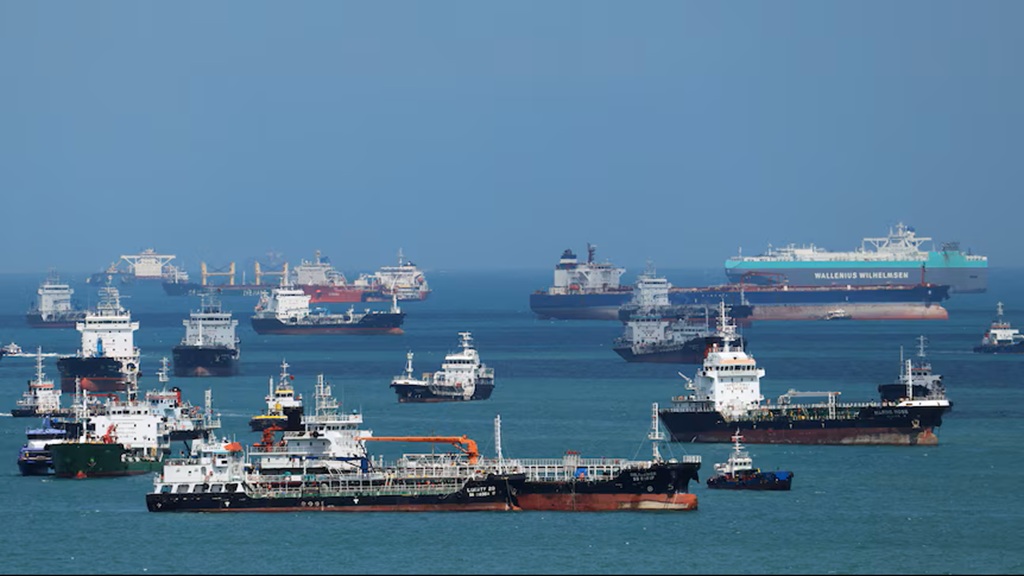
singapore oil stocks

Singapore Oil Stocks Bounce Back as Fuel Inventories See Major July Surge

BANGKOK – Singapore is witnessing a welcome shift in its critical energy markets this month. Recent data reveals that fuel oil inventories in the Asian trading hub have finally bounced back. Following several months of steady declines, onshore stockpiles surged by an impressive nine percent during July.

This much-needed rebound pushes the busy port’s total residual fuel oil stocks closer to 19 million barrels. The recent growth provides a bit of breathing room for a global market squeezed by ongoing shipping disruptions. However, total volumes still remain well below the peak levels recorded earlier this spring.

Keyways

  • Inventories climb higher: Singapore’s residual fuel oil stocks grew by nine percent in July, nearing 19 million barrels.
  • Import spike fuels the rebound: A massive 77 percent increase in net fuel imports was the primary driver of this recent growth.
  • Geopolitical tensions remain: Despite higher stocks, supply chain bottlenecks in the Middle East are causing longer lead times for ship refueling.

The primary engine behind this strong recovery is a sudden and significant spike in overseas purchases. According to Enterprise Singapore data, net fuel oil imports into the city-state skyrocketed by a stunning 77 percent in July. This represents a massive shift in trading momentum compared to the sluggish volumes seen earlier this summer.

Singapore successfully pulled in an extra 1.33 million barrels of fuel oil during the course of the month. At the same time, the amount of oil leaving the country as exports actually fell by about 225,000 barrels. Consequently, this combination created the perfect conditions for local storage tanks to fill up once again.

A few key international players supplied the bulk of these incoming fuel shipments. Brazil led the pack by providing a solid 16 percent of the total fuel oil imports for the month. Meanwhile, India and the United Arab Emirates followed closely, supplying 10 percent and 8 percent respectively.

Export Markets Hold Steady Despite Lower Volumes

While overall imports surged, Singapore’s export activity remained highly focused on a few core regional destinations. China maintained its steadfast position as the undisputed top buyer of the city-state’s fuel exports. In fact, Chinese buyers eagerly snapped up roughly 40 percent of all departing shipments in July.

Other Asian nations also continued to rely on Singapore for their critical daily energy needs. South Korea took in about 10 percent of the exports, while Bangladesh accounted for another nine percent. This steady regional demand clearly highlights Singapore’s vital ongoing role as a reliable energy distributor in Asia.

Furthermore, it is worth noting that residual fuel oil was not the only category to see positive momentum. Middle distillate inventories, which include essential everyday products like commercial diesel and aviation jet fuel, also increased during July. These specific vital stocks averaged nine percent higher than the volumes recorded back in June.

Supply Chain Strains and Geopolitical Headwinds

Despite the positive inventory numbers, the global shipping industry is still facing significant logistical headaches. The availability of Very Low Sulphur Fuel Oil (VLSFO) has actually tightened in Singapore recently. As a result, suppliers are now telling ships to expect long lead times of up to 20 days for refueling.

This lengthy delay is a notable increase from the 14 to 19 days quoted just a single week earlier. High Sulphur Fuel Oil (HSFO) supplies are facing similar harsh constraints, with wait times extending to roughly 15 days. Much of this delay stems directly from ongoing geopolitical conflicts negatively affecting major global shipping lanes.

Renewed international hostilities and rising tensions have severely disrupted vital vessel traffic through the critical Strait of Hormuz. Because of this dangerous bottleneck, cargo arrivals are delayed, and the port’s total inventories have not fully returned to pre-conflict norms. Global energy traders are watching these trade routes very closely.

Singapore Oil and Global Energy Markets

The global energy market remains highly sensitive to these unpredictable, fast-moving shipping risks. If tensions continue to flare in the Middle East, refinery production could face even more unexpected hurdles worldwide. For now, maritime buyers and sellers in Singapore are adapting to a new normal of extended wait times.

Interestingly, the supply of Low Sulphur Marine Gasoil (LSMGO) has completely bucked the recent tightening trend. Lead times for this specific fuel have actually improved, dropping down to between five and eight days. This small bright spot offers some welcome relief to shipping companies navigating the complex current market.

Ultimately, Singapore’s proven ability to rebuild its fuel stockpiles is a very promising sign for the industry. As recent reports frequently suggest, the dynamic city-state remains the secure anchor for Asia’s volatile marine fuel trade. Industry leaders will undoubtedly keep a very close eye on August inventory data to see if this growth continues.

Trending News:

Gas Shortages and High Prices Derail Southeast Asia’s Energy Plans

Singapore Court Fines Bloomberg $356,000 Over Luxury Real Estate Report

 

Similar Posts

  • | | |

    Pakistan’s solar capacity reaches 38,000MW: …

    ISLAMABAD: Federal Minister for Power Awais Leghari has said Pakistan’s solar energy capacity has reached 38,000 megawatts (MW), highlighting the country’s growing shift toward renewable energy and its commitment to reducing dependence on imported fuels. Speaking at the Battery Storage Flexibility 2026 Conference, the minister said the government aims to increase the share of clean energy in Pakistan’s electricity mix to 90% by 2035. He said expanding renewable energy and developing battery storage solutions are key to strengthening the country’s energy security and lowering the import bill for conventional fuels. Leghari said the government is promoting the development of a local battery energy storage industry, encouraging domestic engineering, system integration and battery management software. He added that the Ministry of Industries is finalizing a national policy to support local battery manufacturing. The minister announced that the government is also preparing a National Battery Energy Storage Framework, which will include safety standards, grid connection guidelines and investment regulations to support the growth of the sector. According to Leghari, clean energy now accounts for 55% of Pakistan’s total electricity generation, reflecting significant progress in the country’s transition toward sustainable energy sources. He said a National Steering Committee for Battery Energy Storage Systems has already been established, while technical and regulatory working groups have also been formed to guide policy development and implementation. Leghari further revealed that pilot battery energy storage projects have been approved for electricity distribution companies. The data collected from these projects will help shape future regulatory policies and improve the country’s energy planning. The minister said Pakistan has emerged as one of the world’s fastest-growing distributed energy markets and assured investors that the government will provide a clear, transparent and long-term regulatory framework to encourage investment.

  • |

    Pakistan reports major gas discovery in Sarani block

    ISLAMABAD: Pakistan has recorded a significant milestone in its hydrocarbon exploration sector with the discovery of high-quality gas from an exploration well in Sindh, marking the country’s first reported hydrocarbon find from the Jurassic-era Chiltan Formation of the Lower Indus Basin. Pakistan Petroleum Limited (PPL) announced that its exploration well Dolphin, drilled in the company-operated Sarani Block in District Sujawal, Sindh, has encountered a potentially commercially important gas accumulation. The company described the discovery as unique and strategically significant for Pakistan’s future exploration activities. According to PPL, the discovery confirms the existence of an active petroleum system in an area that had previously presented considerable exploration challenges. The find is particularly important because it demonstrates the hydrocarbon potential of the Jurassic-age Chiltan Formation, opening up new possibilities for further exploration in the region. The company said the Dolphin well has provided valuable geological evidence that could help redefine exploration prospects in the onshore swampy areas of the Lower Indus Basin, as well as their possible extensions into shallow marine zones. The discovery is being viewed as an important development for Pakistan, which continues to face a growing gap between domestic energy demand and local oil and gas production. New indigenous gas reserves could help reduce reliance on imported energy resources, although the commercial scale and recoverable reserves associated with the discovery would depend on further evaluation and development work. PPL’s latest find also highlights the potential of relatively underexplored geological formations in the country. The identification of hydrocarbons in the Chiltan Formation could encourage exploration companies to reassess nearby acreage and investigate similar geological structures. The Dolphin discovery is therefore significant not only because of the gas encountered but also because it may establish a new exploration play in the Lower Indus Basin. Further appraisal and technical studies will be required to determine the size, quality, production potential and commercial viability of the discovery. Industry experts have long emphasized the need for increased domestic exploration to strengthen Pakistan’s energy security. Successful discoveries such as Dolphin could support that objective by expanding the country’s indigenous resource base and creating opportunities for additional exploration and investment. PPL said the discovery has effectively opened a new exploration frontier, particularly in the swampy onshore terrain and potentially adjoining shallow marine areas. The company is expected to undertake further technical assessment to establish the full potential of the newly identified gas-bearing formation.

  • |

    Pakistan seeks $1.3 billion Chinese loan refinancing to strengthen forex reserves

    Pakistan has formally approached China to refinance a $1.3 billion commercial loan, as the government continues efforts to strengthen the country’s foreign exchange reserves and meet its external financing obligations. According to officials familiar with the matter, negotiations between Pakistani and Chinese authorities are currently in progress to finalise the terms and conditions of the refinancing arrangement. Once the discussions are completed, the funds are expected to be disbursed later this month. The anticipated inflow is expected to provide much-needed support to Pakistan’s foreign exchange reserves, which remain under pressure due to significant external debt repayments and ongoing financing requirements. The refinancing would also help ease short-term liquidity pressures while supporting the country’s broader macroeconomic stability. Sources revealed that Pakistan repaid approximately $2.2 billion in external debt during July, including the settlement of the $1.3 billion Chinese commercial loan. The government’s request for refinancing is aimed at replacing the repaid amount, ensuring that reserve levels remain stable without placing additional strain on the country’s external account. The move comes as Islamabad continues to pursue a strategy of securing rollover agreements and refinancing facilities from friendly countries and international partners to meet its debt servicing commitments. Maintaining adequate foreign exchange reserves has remained a key priority for economic managers as Pakistan seeks to strengthen investor confidence and sustain financial stability. Economic experts believe that successful refinancing of the Chinese loan would provide temporary relief to the country’s external financing position while allowing policymakers greater flexibility in managing upcoming debt obligations. Officials said talks with Chinese financial institutions are progressing positively, although the final timeline will depend on the completion of documentation and agreement on financing terms. The refinancing request also reflects Pakistan’s ongoing efforts to manage its external debt profile prudently amid global economic uncertainties and higher financing costs in international markets.

  • |

    Oil prices tumble to three-week low as Trump delays Iran strike

    LONDON: Global oil prices recorded their sharpest single-day decline in weeks on Monday, falling to a three-week low after US President Donald Trump stepped back from plans for a military strike against Iran, raising hopes that diplomatic efforts could ease tensions and prevent disruptions to energy supplies from the Gulf. International benchmark Brent crude dropped 7 percent, or $6.35, to settle at $83.77 per barrel, while US West Texas Intermediate (WTI) crude fell 5.1 percent, losing $4.33 to close at $80.34 per barrel. The decline marked Brent’s weakest closing level since mid-July. Market analysts said the drop was also influenced by the expiry of the higher-priced September Brent contract, with the less expensive October contract becoming the new front-month benchmark. Investor sentiment shifted sharply after Trump announced that he had postponed military action against Iran, saying he wanted to allow time for diplomacy aimed at reaching an agreement that could reduce regional tensions and potentially increase Iranian oil exports. The possibility of additional crude entering global markets eased concerns over supply shortages, prompting traders to sell oil futures and pushing prices lower. However, Tehran quickly dismissed suggestions that negotiations with Washington were underway. Iranian Foreign Ministry spokesman Esmail Baghaei said there were no talks taking place with the United States and no meetings had been scheduled. He added that Iran had no plans to host foreign delegations or send negotiators abroad in the coming days. Trump, meanwhile, maintained that discussions with Iran were in progress and warned Tehran of serious consequences if it failed to reach an agreement aimed at ending the ongoing confrontation. Analysts call market reaction excessive Energy analysts said oil markets appeared to react strongly to political rhetoric rather than confirmed developments. According to analysts at energy consultancy Ritterbusch and Associates, the steep decline in crude prices reflected what they described as an overreaction by investors to Trump’s comments suggesting that an agreement with Iran could be imminent. They noted that the US president has repeatedly made strong statements regarding Iran before later softening his position, creating significant volatility in energy markets. Analysts also observed that Trump’s public calls for lower fuel prices in the United States have frequently weighed on oil markets by reducing expectations of sustained price increases. During Monday’s trading session, US gasoline and diesel futures also declined by nearly 5 percent, reflecting broader weakness across the energy sector. Shipping routes remain under pressure Despite hopes for diplomacy, concerns over maritime security in the Middle East continued to influence market sentiment. Shipping data showed that six Saudi-flagged supertankers altered their routes in recent days, avoiding the Gulf of Aden and instead sailing around southern Africa after Yemen’s Iran-backed Houthi movement threatened to target Saudi vessels. At the same time, some oil tankers continued to transit the region. Two Saudi oil tankers successfully crossed the Bab el-Mandeb Strait over the weekend, while vessel movements through the Strait of Hormuz slowed following reports of attacks on commercial shipping. The Strait of Hormuz remains one of the world’s most strategically important energy chokepoints, carrying roughly one-fifth of global oil trade before hostilities between the United States, Israel and Iran escalated earlier this year. A Panama-flagged tanker transporting Russian naphtha also reportedly abandoned plans to pass through the Bab el-Mandeb, choosing the longer route around Africa due to security concerns. Russia boosts maritime security Russia announced on Monday that it was strengthening security measures for commercial shipping in the Azov-Black Sea region while working to expand alternative export routes, following increased attacks on vessels linked to the conflict in Ukraine. As one of the world’s largest crude producers and a leading member of the OPEC+ alliance, Russia remains a key player in global energy markets. Disruptions to exports from the Gulf, Russia and Kazakhstan have continued to limit global oil supplies throughout the year, preventing previously announced OPEC+ production increases from fully reaching international markets. In a separate development, OPEC+ approved a production quota increase of approximately 188,000 barrels per day beginning in September. Although the move is intended to gradually raise output, analysts believe geopolitical risks and transportation disruptions could continue to limit the actual flow of additional crude to global buyers.

  • |

    Pakistan explores digital assets, tokenisation to expand access to finance

    ISLAMABAD: Pakistan is examining the potential use of digital assets and tokenisation in areas including real estate and other investment instruments as part of broader efforts to accelerate digital transformation and expand access to financial services. The matter came under discussion during a meeting between Federal Minister for Finance and Revenue Senator Muhammad Aurangzeb and Pakistan Digital Authority (PDA) Chairperson Dr Sohail Munir on Thursday. The meeting focused on digital finance, technology-driven economic activity and measures aimed at making financial services more accessible and efficient. According to the Finance Division, the participants reviewed the emerging role of digital assets and tokenisation, particularly their possible application in real estate and other investment-related assets. The discussion also stressed the need for an appropriate regulatory and institutional framework to ensure that such technologies are adopted in a responsible and sustainable manner. Tokenisation generally involves representing ownership or economic rights in an asset through digital tokens. The approach has attracted growing international attention because it can potentially make certain investment opportunities easier to access, improve transaction efficiency and broaden participation in financial markets. The finance minister stressed that Pakistan’s regulatory and institutional arrangements must keep pace with rapid developments in digital technology and new business models. He emphasised that emerging technologies should be supported by clear rules and mechanisms that provide certainty to businesses, investors and financial institutions. The meeting also examined the need to create an enabling environment for electronic transactions and encourage the wider adoption of digital processes across trade and financial activities. Aurangzeb highlighted the importance of using technology to reduce procedural barriers and improve access to finance. In this regard, the participants discussed simplifying customer onboarding procedures, strengthening mechanisms for sharing financial data and improving interoperability among different financial systems. Greater connectivity between banks and capital markets was also identified as an important area for development. The participants considered how digital platforms and simplified account-opening procedures could encourage more people to participate in the capital market and gain access to a broader range of investment opportunities.   The finance minister also called for stronger integration of banking and capital-market systems, noting that better-connected digital infrastructure could help improve financial inclusion while making investment processes more convenient and efficient. Another key area discussed during the meeting was the use and interoperability of data across government institutions. Aurangzeb noted that better integration of government data could improve the quality and speed of policymaking, planning and decision-making. The meeting also considered the growing role of Artificial Intelligence (AI) and other digital technologies in strengthening government systems and improving the delivery of public and financial services. The participants reviewed opportunities to enhance Pakistan’s digital infrastructure so that government departments, financial institutions and businesses can operate through more efficient and interconnected systems. Aurangzeb appreciated the initiatives being undertaken by the Pakistan Digital Authority and stressed the need to prioritise practical projects capable of delivering measurable improvements in efficiency, financial access and digital capacity. He further emphasised continued coordination among government institutions, regulators, financial-sector stakeholders and technology organisations to ensure that digital initiatives translate into tangible economic benefits. The discussions form part of wider efforts to strengthen Pakistan’s digital economy by modernising financial processes, expanding technology-based services and creating an environment in which emerging financial technologies can develop within an appropriate regulatory framework. With digital assets, tokenisation, artificial intelligence and data-driven financial services developing rapidly worldwide, Pakistan’s efforts to establish suitable frameworks could play an important role in determining how effectively the country participates in the next phase of digital financial development.

  • | | | |

    Oil slips as higher supplies ease market fears

    Global oil prices declined on Friday as increased crude shipments through key maritime routes helped calm supply concerns, despite continued geopolitical tensions in the Middle East and limited progress in diplomatic talks between the United States and Iran. Brent crude futures dropped by $1.03, or 1.2%, to trade at $88 per barrel, while US West Texas Intermediate (WTI) crude fell $1.50, or 1.8%, to $82.09 per barrel. Even with the daily decline, both international benchmarks remained on track to post monthly gains of around 20%. Market analysts said the fall in prices was mainly driven by improving oil flows through the Strait of Hormuz, one of the world’s most important energy shipping routes. The increase in exports helped offset fears that the ongoing regional conflict could lead to major supply disruptions. The Strait of Hormuz normally carries nearly one-fifth of the world’s crude oil and liquefied natural gas shipments. The route has remained under close watch since tensions escalated following the conflict involving the United States, Israel and Iran. At the same time, Saudi Arabia is working with regional partners to strengthen maritime security in strategic waterways, including the Bab el-Mandeb Strait, the Red Sea and the Gulf of Aden. These routes play a vital role in global energy transportation. According to Saudi officials, 14 countries have expressed support for the proposed multinational maritime defence initiative, aimed at improving the safety of commercial shipping in the region. Meanwhile, the security situation remains uncertain after Yemen’s Houthi movement announced a naval blockade targeting Saudi Arabia, raising fresh concerns over the safety of Red Sea shipping lanes, which serve as an alternative route for oil exports. Although oil tankers continue to pass through both the Strait of Hormuz and the Red Sea, traders say higher security risks have pushed up shipping costs and insurance premiums. These additional expenses continue to keep a geopolitical risk premium built into global oil prices.

Leave a Reply

Your email address will not be published. Required fields are marked *