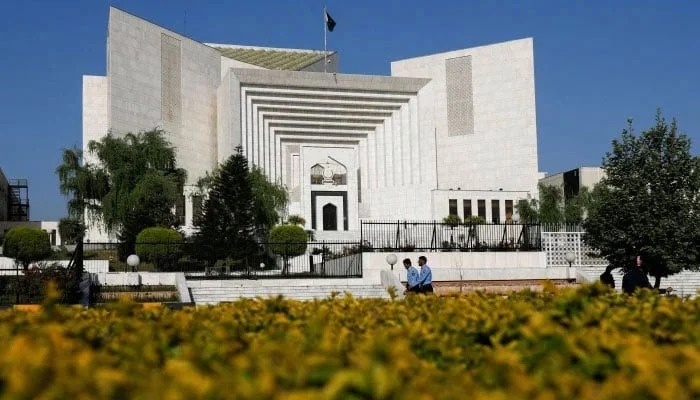
supreme court hear
| |

Supreme Court to hear Imran Khan meeting and treat…

The Supreme Court of Pakistan has scheduled hearings in cases concerning meetings with former Prime Minister and Pakistan Tehreek-e-Insaf (PTI) founder Imran Khan, as well as matters related to his medical treatment.

According to details, the cases will be heard on August 18 by a three-member bench of the Supreme Court. The bench will be headed by Justice Shahid Waheed and will include Justice Naeem Afghan and Justice Ishtiaq Ibrahim.

The Supreme Court Registrar’s Office has issued notices to the relevant parties and their lawyers regarding the upcoming hearing.

The scheduling of the cases comes amid continued attention surrounding issues related to access to Imran Khan, including meetings with party leaders, lawyers and other relevant individuals. His medical treatment and healthcare arrangements have also remained an important issue in proceedings concerning his detention.

The upcoming hearing is expected to bring the relevant legal arguments before the three-member bench. The court will consider the petitions and submissions presented by the concerned parties and their legal representatives.

The development is significant for PTI supporters and political circles because questions surrounding meetings with Imran Khan have remained a recurring issue. Any observations or directions issued by the Supreme Court during the hearing could attract considerable political and legal attention.

The registrar’s office has formally notified the concerned lawyers, meaning the matter is now set for proceedings before the apex court on August 18.

Further developments are expected after the hearing, when the Supreme Court may issue directions or pass orders concerning the matters before it.

For now, the key development is that the Imran Khan meeting and treatment cases have officially been fixed for hearing before a three-member Supreme Court bench.

The hearing on August 18 will therefore be closely watched, particularly by PTI supporters and legal observers following matters related to Imran Khan’s access to meetings and medical care.


Similar Posts

  • |

    South Korea to enshrine nuclear pledge in law

    SEOUL: South Korea is preparing legislation that would legally reaffirm its commitment to nuclear non-proliferation while it moves ahead with plans to develop nuclear-powered submarines. The proposed bill is expected to be released for public consultation by the Defence Ministry. It will set out five key principles governing the country’s nuclear-powered submarine programme. If approved, the legislation would formally establish in domestic law Seoul’s pledge not to develop, produce, possess or use nuclear weapons. The proposed law would also prevent the government from using nuclear materials specifically for weapons-related purposes. It would prohibit activities that could weaken the international nuclear non-proliferation system. The move is aimed at addressing concerns that South Korea’s submarine programme could eventually lead to a domestic nuclear weapons capability. The legislation would reaffirm Seoul’s commitments under the Nuclear Non-Proliferation Treaty. It would also require cooperation with international organisations during the development of the submarines. The proposed framework would include safeguards for public safety and environmental protection against radioactive materials. The government also wants to speed up the submarine programme. The proposed law would reportedly allow the project to bypass a preliminary feasibility study. South Korea’s nuclear-powered submarine project, known as Jang Bogo N, involves plans for attack submarines powered by low-enriched uranium. The programme is being developed with US approval. The two countries reached an agreement on the project during a leaders’ summit last October. Seoul plans to launch its first nuclear-powered submarine in the mid-2030s. The vessel is expected to enter operational service later in the decade. Defence authorities are reportedly considering three submarines weighing about 8,000 tonnes each. However, official technical details have not yet been released. South Korean Defence Minister Ahn Gyu-back has previously stressed that the country will continue to follow its international non-proliferation commitments. Seoul also plans to work closely with the International Atomic Energy Agency throughout the programme.

  • |

    Japan marks 81 years since Nagasaki bombing amid nuclear debate

    Japan commemorated the 81st anniversary of the atomic bombing of Nagasaki on August 9, 2026. The ceremony was held as the country faces renewed debate over its nuclear policy and security strategy. Thousands gathered at Nagasaki Peace Park to remember the victims of the 1945 attack. Participants observed a moment of silence at 11:02am. It marked the exact time when the United States dropped the atomic bomb on the city. The bombing killed an estimated 74,000 people. The attack came three days after the atomic bombing of Hiroshima, where about 140,000 people were estimated to have died. Japan surrendered on August 15, 1945. The surrender brought World War II to an end and marked a major turning point in Japan’s history. The anniversary has also become a focus of debate over Japan’s long-standing pacifist and non-nuclear policies. Prime Minister Sanae Takaichi attended the Nagasaki ceremony. She has opened discussion on Japan’s postwar non-nuclear principles at a time of growing security concerns in East Asia. The debate has intensified as China expands its military capabilities in the region. Questions have also emerged over the long-term reliability of the US security commitment to Japan. Takaichi has maintained that Japan should pursue a realistic and practical approach toward achieving a world without nuclear weapons. However, her position on all three of Japan’s non-nuclear principles remains unclear. Japan’s three principles have traditionally called for the country not to possess, produce or permit the introduction of nuclear weapons into its territory. Takaichi supports the principles against possessing and developing nuclear weapons. She has not given the same clear commitment regarding the third principle. Her position has sparked concern among pacifists and atomic bomb survivors. Critics fear that any change in Japan’s nuclear stance could weaken the country’s postwar commitment to nuclear disarmament. Nagasaki Mayor Shiro Suzuki strongly defended the city’s anti-nuclear position during the ceremony. Suzuki described nuclear weapons as an absolute evil. He rejected the argument that nuclear weapons could be considered a necessary evil for national security. He also urged the central government to uphold Japan’s war-renouncing Constitution. He called on Tokyo to maintain its non-nuclear principles and participate in the upcoming review conference of the Treaty on the Prohibition of Nuclear Weapons. The mayor’s remarks came as Japan considers changes to its defence policy. The government is seeking stronger military capabilities in response to growing regional security threats. The anniversary also highlighted concerns about atomic bomb survivors who have not been officially recognised as hibakusha. Some people exposed to radiation during the Nagasaki bombing remain outside the government’s official recognition criteria. Their exclusion is linked to their location at the time of the attack and the areas officially designated as part of the blast zone. Shigemitsu Tanaka, head of the Nagasaki Atomic Bomb Survivors Council, raised the issue directly with Takaichi. Tanaka urged the government to provide support to both officially recognised survivors and those who remain unrecognised. He said the survivors are aging and that time is running out for them. Takaichi responded that the government already provides medical expense subsidies to unrecognised survivors on a level comparable to assistance given to officially recognised hibakusha. She said the government would continue implementing such support. The Nagasaki anniversary therefore carried both historical and political significance this year. Survivors and peace advocates continue to call for stronger commitments to nuclear disarmament. At the same time, Japan’s government is balancing its pacifist traditions with growing concerns over regional military threats.

  • | |

    Oprah Winfrey reveals how Beyoncé appreciated her…

    Oprah Winfrey has shared a heartwarming story about Beyoncé that she says she will cherish forever. The media icon recently revealed that the global superstar surprised her with a thoughtful gift after receiving a heartfelt fan letter Oprah wrote following Beyoncé’s unforgettable Renaissance World Tour performance. During an appearance on the Are You Okay? web series, Winfrey recalled attending Beyoncé’s Renaissance concert and being completely overwhelmed by the experience. The 72-year-old television legend admitted that despite interviewing countless celebrities throughout her career, she found herself feeling like an ordinary fan after witnessing the Grammy-winning singer perform live.  “I went to the Beyoncé Renaissance concert. I was so blown away,” Oprah said. Inspired by the performance, she decided to write Beyoncé a personal fan letter expressing her admiration and gratitude. To Oprah’s surprise, the gesture did not go unnoticed. “She obviously liked the fan letter because she then sent me one of the hats from Renaissance,” Oprah revealed with excitement. “Beyoncé sent me a hat!” The unexpected gift quickly became one of Oprah’s most treasured keepsakes, highlighting the singer’s thoughtful and generous nature.  Oprah’s admiration for Beyoncé is nothing new. After attending the Renaissance Tour stop at New Jersey’s MetLife Stadium in 2023, she shared an enthusiastic Instagram post describing the concert as one of the most extraordinary experiences of her life. She praised Beyoncé’s remarkable talent, the production, the dancers and the overall artistry that brought the show to life. “I have never in my life experienced something as transcendent,” Oprah wrote at the time, adding that the performance reflected a level of creativity and excellence that deeply moved her.  The friendship between the two influential women has continued in recent years. Oprah also attended the opening night of Beyoncé’s Cowboy Carter Tour in 2025 alongside her longtime friend Gayle King. Both embraced the concert’s Western-inspired theme, wearing coordinated denim outfits while celebrating another milestone in Beyoncé’s career.  For Oprah, Beyoncé’s response to a simple fan letter demonstrated that genuine appreciation can create meaningful connections, regardless of fame. The thoughtful gift reminded her that even the world’s biggest stars value heartfelt words and authentic support. As fans continue to celebrate Beyoncé’s artistry, Oprah’s story offers a touching reminder that kindness and gratitude often leave the most lasting impressions. For the legendary broadcaster, receiving a signature Renaissance hat from Beyoncé is more than just a celebrity souvenir—it is a cherished memory that she says she will treasure for the rest of her life. 

  • | | |

    Russia, Pakistan advance Moscow-Karachi rail link

    Russia and Pakistan are working to launch a new freight railway service connecting Moscow with Pakistan, Russian Ambassador to Islamabad Albert P. Khorev has said. The proposed rail link is aimed at improving trade connectivity between the two countries and creating a more direct overland route for the movement of goods. In comments published by the Russian newspaper Izvestia on August 8, Khorev said Moscow and Islamabad were jointly working on launching freight railway services along the Moscow-Faisalabad and Moscow-Karachi corridors. The proposed routes would operate in both directions, allowing goods to be transported between Russia and Pakistan through a dedicated rail-based trade network. Khorev said the possibility of including Belarus in the project was also being examined. If the Belarusian side joins the initiative, the route could provide a wider connection across parts of Eastern Europe and South Asia. The project has faced delays because of changing geopolitical conditions in the region. According to the Russian ambassador, heightened geopolitical tensions during 2025 and early 2026 resulted in several postponements to the planned launch. Despite the delays, work on the project is continuing. Khorev said the countries involved are currently finalising a contract covering the required freight railway services. At the same time, officials are identifying companies in the countries along the proposed route that could use the railway network to transport commercial cargo. The identification of potential cargo owners is considered an important step before the service can begin. A stable volume of goods would be needed to make the railway corridor commercially viable. The Moscow-Karachi route could provide Pakistani and Russian businesses with another option for moving goods between the two markets. It could also reduce reliance on traditional maritime routes for certain types of cargo. The Moscow-Faisalabad corridor would provide a direct connection to one of Pakistan’s major industrial and commercial centres. Faisalabad is an important manufacturing hub, particularly for textiles and other export-oriented industries. For Russia, improved rail connectivity with Pakistan could open additional opportunities for trade with South Asia. Pakistani businesses could also gain access to wider markets through connections with Russia and potentially Belarus. The possible involvement of Belarus could further expand the corridor’s geographical reach. It may also strengthen transport cooperation among the countries involved. However, the project still requires the completion of commercial and logistical arrangements before the first freight service can be launched. The parties are therefore focusing on finalising the service contract and securing interest from companies that can provide regular cargo for the route. The proposed railway initiative is part of broader efforts by Russia and Pakistan to strengthen economic and transport cooperation.

  • KP youth affairs launch Digital Skills Training Programme for tribal youth

    PESHAWAR: The Directorate of Youth Affairs, Government of Khyber Pakhtunkhwa, in collaboration with TTSK, has launched a one-week Digital Skills Training Programme for youth from the Tribal Districts (Ex-FATA) to equip them with in-demand digital competencies and improve their employment prospects. The training programme provides practical instruction in Artificial Intelligence (AI), Graphic Designing, and Video Editing, enabling participants to develop market-oriented skills, strengthen their creativity, and explore opportunities in freelancing, entrepreneurship, and the digital economy. Director Youth Affairs Khyber Pakhtunkhwa Abbas Khan Afridi said the initiative reflects the provincial government’s commitment to investing in the potential of young people and preparing them for the evolving demands of the digital age. “Our objective is to ensure that the youth of the Tribal Districts have access to modern skills that can help them secure sustainable livelihoods and compete in national and international markets. Digital empowerment is essential for building a prosperous and self-reliant generation,” he said. He said the Directorate of Youth Affairs would continue collaborating with partner organisations to expand access to quality training programmes and create meaningful opportunities for youth across Khyber Pakhtunkhwa. The Directorate said the programme forms part of its ongoing efforts to promote innovation, digital literacy, and skills development, enabling young people to play a greater role in the province’s economic and social development.

  • |

    Bangladesh MP defends controversial second marriage

    A controversy has erupted in Bangladesh after a member of parliament from Jamaat-e-Islami, Ghazi Nazrul Islam, became the center of public debate over his alleged second marriage following the circulation of a viral video on social media. According to Bangladeshi media reports, the video showed Ghazi Nazrul Islam with a young woman whom he later identified as his second wife. The footage quickly spread online, prompting widespread discussion and speculation. A fact-checking organization examined the video and stated that it found no evidence suggesting it had been generated using artificial intelligence or digitally manipulated. Following that assessment, public attention shifted from the authenticity of the video to the identity of the woman and the nature of her relationship with the lawmaker. In a statement, Ghazi Nazrul Islam confirmed that the woman is his second wife. He said the marriage took place on June 17 with the consent of both families and the approval of his first wife. The lawmaker alleged that the viral video had been secretly recorded and later released as part of an extortion attempt and a politically motivated campaign to damage his reputation. His first wife also released a video supporting his account. She confirmed that her husband had married Maryam Begum as his second wife and said the marriage had taken place with her knowledge and consent. Maryam Begum also appeared in a separate video, identifying herself as Ghazi Nazrul Islam’s wife. She said the marriage ceremony was held on June 17 in the presence of both families and the lawmaker’s first wife. Despite these public statements, Bangladeshi media reported that documents related to Maryam Begum later surfaced on social media. The authenticity of those documents has not been independently verified, and neither the lawmaker nor Maryam Begum or her family has publicly addressed the apparent inconsistencies contained in them. According to the documents, Maryam Begum’s marital status was listed as “unmarried.” The papers also reportedly included a recommendation signed by Ghazi Nazrul Islam on June 22—five days after the claimed marriage—in support of her application for a government job. Reports said Maryam Begum had applied for public sector employment and that the MP had endorsed her application. Ghazi Nazrul Islam rejected all allegations arising from the documents. He claimed that on July 13 he visited an office in Dhaka’s Moghbazar area, where both of his wives were present. He alleged that his driver, his second wife’s uncle and several unidentified individuals held him captive, extorted 100,000 taka, demanded additional money and secretly recorded a private video, which was later circulated on social media. Meanwhile, Jamaat-e-Islami Bangladesh said it is gathering information about the incident and will decide on any organizational action once all facts have been established. Assistant Secretary General Ehsanul Haque Mahbub Zubair said the party is reviewing media reports as well as statements from the member of parliament, his two wives and the woman’s father before reaching any conclusion.

Leave a Reply

Your email address will not be published. Required fields are marked *