syria russia redefine
|

Syria and Russia redefine military ties

Syria and Russia have reached a new agreement regarding the future of two strategically important Mediterranean military sites, marking a major shift in Moscow’s role in the country after years of close military cooperation with the former Syrian government.

According to Syria’s Foreign Ministry, the agreement will bring changes to the way Russia operates at the Hmeimim air base near Latakia and the Tartus naval facility on Syria’s Mediterranean coast. Both locations served as key Russian military positions during the rule of former President Bashar Assad, who relied heavily on Moscow’s political and military support throughout Syria’s long civil war from 2011 to 2024.

The Hmeimim air base became one of Russia’s most important overseas military installations, supporting Russian air operations in Syria and strengthening Moscow’s influence in the eastern Mediterranean. Meanwhile, the naval base at Tartus provided Russia with its only major naval facility outside the former Soviet Union, allowing it to maintain a strategic presence in the region.

Under the newly announced arrangement, Syria will assume control of the Hmeimim air base and the commercial section of Tartus port as part of its civilian administration. The remaining military areas at both locations will reportedly be transformed into joint training and qualification centers rather than serving as traditional Russian military outposts.

Syria’s Foreign Ministry described the agreement as a “reorganization of the Russian presence” along the country’s coastline. The ministry said the deal represents the most significant step forward in negotiations that have continued for around 18 months and could open the door to a new stage in Syrian-Russian relations.

Russia has not yet issued an official public response to the announcement. However, Moscow’s position in Syria has changed significantly since the fall of Assad’s government. During the uprising and subsequent conflict, Russia was one of Assad’s strongest supporters, providing military assistance that helped his government remain in power. After Assad was removed from office, Russia allowed him and his family to seek asylum, while many remaining Russian forces gradually withdrew from Syria.

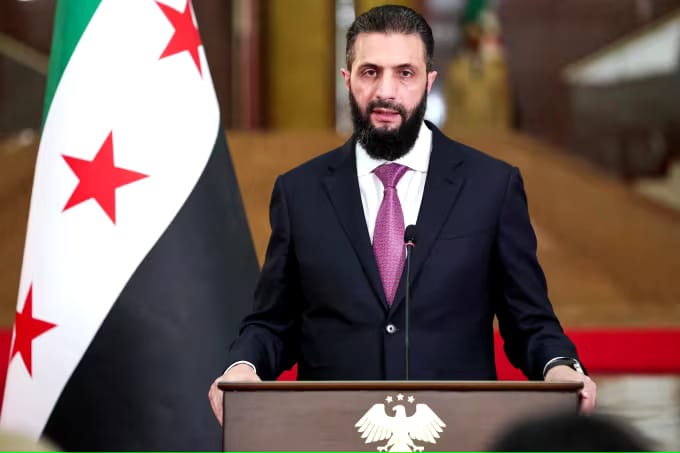
Despite these changes, Syria’s new leadership has attempted to maintain diplomatic relations with Moscow. Interim President Ahmad al-Sharaa has met Russian President Vladimir Putin in Moscow on two occasions since taking office, with the future of the Mediterranean bases being one of the main issues discussed during their talks.

At the same time, Syria has expanded its diplomatic engagement with Western nations and regional Arab countries. Several states that had distanced themselves from Damascus during Assad’s crackdown on opposition movements have begun rebuilding relations with the new Syrian authorities.

The United States has also removed many of the sanctions that had severely affected Syria’s economy, while European countries have increased diplomatic contacts. French President Emmanuel Macron’s visit to Syria in July marked another important step, with both countries announcing plans to appoint ambassadors for the first time in 14 years.

The agreement over Hmeimim and Tartus reflects the changing balance of international influence in Syria. While Russia remains an important partner, the country’s new government appears to be pursuing broader relationships with multiple global and regional powers as it seeks to redefine Syria’s future after years of conflict.

Similar Posts

  • |

    Houston hosts major Muharram haleem feast

      HOUSTON: Friends of Karachi Houston, a prominent Pakistani-American community organization, hosted a grand Haleem feast on August 2, 2026, to mark Muharram-ul-Haram, continuing a tradition that has brought the community together for the past 12 years. More than 2,000 people attended the annual community gathering, making it one of the largest Muharram-related Haleem events held in Texas, according to the organizers. The event attracted a diverse cross-section of the Pakistani-American community, including former federal and provincial ministers, former members of the National and Provincial Assemblies, political leaders, social workers, business figures and community representatives. Members of the US Congress also attended the gathering, along with representatives and office-bearers from both the Republican and Democratic parties. Their participation highlighted the event’s growing importance as a platform for community engagement and cultural connection. The gathering also brought together Pakistanis from different schools of thought and backgrounds, reflecting the spirit of unity and brotherhood associated with Muharram. Families, community members and guests gathered to enjoy traditional Pakistani Haleem while reconnecting with their cultural roots. Guests praised the organizers for the event’s arrangements and the authentic taste of the Haleem. Many attendees said the gathering gave them a strong sense of connection with Pakistan and made them feel as though they had briefly returned to their homeland. The annual feast has become a much-anticipated event for the Pakistani community in Houston. Over the years, it has provided an opportunity for people to come together, celebrate their shared cultural heritage and strengthen relationships within the wider community. At the conclusion of the event, the Friends of Karachi Houston administration thanked all guests, volunteers and supporters whose contributions helped make the gathering successful. The organizers also reaffirmed their commitment to continuing the tradition in the coming years and bringing the community together with the same spirit of service, solidarity and brotherhood during Muharram.

  • |

    Powerful 7.4 magnitude earthquake hits western Colombia, killing at least 111

    A powerful 7.4 magnitude earthquake struck western Colombia on Monday, killing at least 111 people and injuring dozens more in what authorities have confirmed is the country’s strongest earthquake of the 21st century. The massive tremor struck at a depth of 107 kilometres, with its epicentre located near Chocó. Despite occurring deep beneath the Earth’s crust, the intense seismic shock waves triggered widespread destruction across densely populated urban valleys throughout western Colombia and the primary coffee-growing regions. In Pereira, a four-story building collapsed into rubble, while video footage from Manizales captured the catastrophic collapse of one of the side towers of the city’s historic neo-Gothic cathedral. Severe building collapses and casualties were also reported in Cali, where local residents formed human chains alongside emergency responders to shovel away fallen concrete and pull survivors from trapped spaces. Thrusting the administration into its first major crisis just days after his inauguration, President Abelardo De La Espriella declared a national state of emergency. In a live television address, De La Espriella announced that all available state and military resources were being deployed to western Colombia, confirming that the national government’s immediate priority remains the location and rescue of victims trapped beneath collapsed structures. Severe regional communications outages initially delayed casualty reporting from rural zones near the epicentre in Chocó, where Governor Nubia Carolina Córdoba confirmed at least 12 fatalities and scores of injuries. Meanwhile, Colombia’s civil aviation authority halted flight operations across key regional airports, including facilities in Pereira, Manizales, Quibdó, Armenia, Cartago, and Buenaventura, while structural engineers assess airfield and terminal safety. The Colombian Geological Service recorded over 20 aftershocks following the initial quake and warned that additional tremors remain likely. Sitting directly along the seismically active Pacific Ring of Fire, western Colombia previously suffered a devastating magnitude 6.2 earthquake in 1999 that claimed more than 1,000 lives across the same region.

  • | |

    Oil prices climb as Hormuz tensions rekindle suppl…

    Global oil prices moved higher on Friday as renewed uncertainty surrounding the Strait of Hormuz fueled concerns over potential disruptions to one of the world’s most critical energy shipping routes. Brent crude futures rose 80 cents, or nearly 1%, to $83.29 per barrel, while US West Texas Intermediate (WTI) crude gained 64 cents to reach $77.93 per barrel. The increase followed a sharp rally in the previous session, when prices surged by more than $3 after reports that Iran was considering new restrictions on maritime traffic through the strategic waterway. Market sentiment shifted after Iranian officials proposed measures that could prohibit US and Israeli-linked vessels from transiting the Strait of Hormuz, while imposing significant financial penalties on ships from countries deemed hostile. The proposal, reportedly being reviewed by Iran’s parliament, has raised fresh concerns about the future of global energy supplies. Analysts said the latest developments indicate that tensions between Iran and the United States remain unresolved, despite recent hopes of diplomatic progress. They noted that the market is now pricing in the possibility of a tightly managed transit system rather than a return to unrestricted shipping through the strait. Reports also suggest that Iran is seeking transit fees ranging from 5% to 7% of cargo values, while Oman has proposed lower charges. However, industry experts believe any agreement would face significant hurdles because of US sanctions and insurance restrictions affecting international shipping. Although crude benchmarks are still on track to post weekly losses after earlier declines driven by optimism over a possible breakthrough in the regional conflict, the renewed geopolitical uncertainty has restored upward pressure on prices. Adding to market jitters, Yemen’s Houthi movement claimed missile and drone attacks targeting Saudi positions in Marib and Hadramout, further highlighting the fragile security situation in the region. Meanwhile, US President Donald Trump expressed optimism that the conflict could end soon, but investors remain cautious as uncertainty continues to dominate the global oil market.

  • |

    Death toll rises to 254 after powerful Colombia earthquake

    The death toll from a powerful earthquake that struck western Colombia on Monday has risen to 254, according to foreign media reports, as rescue teams continue searching through devastated areas for survivors. The 7.4-magnitude earthquake caused widespread destruction across the affected region, with dozens of buildings collapsing and significant damage reported to infrastructure. Several communities remain without electricity and access to essential services, making rescue and relief operations increasingly difficult. Colombian authorities have warned that the full scale of the disaster may not become clear for several days. Rescue workers are still assessing damaged areas, while officials are working to determine the exact number of casualties and the extent of property damage. The earthquake also disrupted basic services in several affected communities, leaving residents struggling to access electricity and other necessities. Emergency teams have been deployed to assist victims, search damaged buildings and provide immediate relief to people who have lost their homes. Officials expect the death toll and damage estimates to change as rescue crews reach areas that remain difficult to access. Authorities have urged residents to remain cautious and follow emergency instructions as assessments and relief efforts continue. The 7.4-magnitude tremor stands among the most destructive earthquakes to hit western Colombia in recent years, causing severe damage and a major humanitarian challenge for local authorities.

  • |

    Escalating clashes in northern Ethiopia spark mass displacement across Sudanese border

    Hundreds of displaced Ethiopian citizens from the Tigray region have fled into neighboring Sudan following intense military engagements between regional forces and the Ethiopian national army, raising international concerns over a potential resurgence of full-scale civil war. The recent outbreak of violence centered around Shererina, a strategically sensitive locality near the border with Sudan, marking the most severe military confrontation in the region since the conclusion of the 2020–2022 conflict. Eyewitnesses and regional representatives reported sustained exchanges involving heavy artillery shelling and aerial drone strikes across the weekend. The renewed hostilites follow growing instability surrounding the incomplete execution of the 2022 African Union-mediated peace agreement, alongside the Tigray People’s Liberation Front (TPLF) regaining control over regional administrative institutions. Regional analysts have also expressed concern that the border area could become entangled in the wider Sudanese conflict through external proxy alignments. Both sides have traded blame for initiating the offensive. Officials representing the Tigray regional administration accused federal forces of launching an unprovoked military assault aimed at suppressing the region. Conversely, federal minister Abraham Belay accused TPLF leadership of instigating the skirmishes, warning of severe repercussions while urging both parties to seek a negotiated diplomatic resolution to prevent further devastation. While formal casualty figures remain unconfirmed, Sudanese medical teams and local authorities verified that civilians alongside wounded combatants continue to seek asylum across the border.

  • | |

    Female UEFA officials lead pushback against Infantino amid FIFA turmoil

    Two women sitting on UEFA’s executive committee have become the most visible faces of opposition to FIFA President Gianni Infantino as he confronts the toughest test of his ten years leading world football’s governing body, raising fresh questions about whether the sport is ready for female leadership at the top. Laura McAllister of Wales and Lise Klaveness of Norway, the only two women on UEFA’s executive committee, have taken outspoken public stances against Infantino during a crisis triggered by the collapse of his plan to push through a private equity backed venture called FIFA Football Enterprises. The backlash against that failed proposal has opened up a broader conversation about whether football, an industry historically run by men, could realistically be led by a woman. McAllister, who serves as a UEFA vice president, told a foreign news agency that seeing a woman elected FIFA president would be a welcome development, though she cautioned that the path there remains complicated. “I’d like to think we’re not far off having a female president,” she said, adding that she worries football still lags behind broader social progress on gender. The conversation gained additional traction after former FIFA President Sepp Blatter publicly said this week that the time had come for a woman to lead the organization, singling out Klaveness for praise. McAllister welcomed the sentiment but pushed back on the idea that installing a female president would be straightforward. She said a woman could well be the strongest candidate available, but stressed that FIFA’s global politics do not operate as a simple meritocracy. Her comments follow the unraveling of Infantino’s FFE plan, which fell apart after UEFA and several other regional federations mounted fierce resistance. Wales became the first national association to publicly withdraw its backing for Infantino’s re election bid, and opposition quickly spread through other parts of FIFA’s membership. Infantino was scheduled to hold an emergency meeting in Morocco on Wednesday as the fallout continued. McAllister, whose call for national associations to boycott FIFA events won unanimous backing at UEFA’s emergency meeting last week, said the current unrest points to governance failures that run deeper than any single controversy. She said the organization appears to be approaching a genuine crisis point, if it has not reached one already. She cited a string of episodes that have chipped away at confidence in Infantino’s leadership, including FIFA’s connections to the failed European Super League proposal, political controversies tied to the World Cup, and the federation’s decision to overturn a red card issued to American forward Folarin Balogun after President Donald Trump publicly urged Infantino to revisit the call. McAllister said these incidents collectively point to serious flaws in how FIFA governs itself. She framed the standoff as a fight to preserve football’s core principles, tracing her outlook and Klaveness’s back to their shared history as international players for their respective countries before they moved into administrative careers, Klaveness as a lawyer and McAllister as a political scientist. She said both are driven by a strong sense of values, warning that football risks losing its essential character if those values slip away. She added that women in the sport sometimes bring a clearer focus on football’s fundamental purpose rather than getting absorbed in its business side, arguing the game belongs to everyone, from grassroots participants to elite professionals, spanning wealthy and poor countries alike, and should remain free from private capital control or political interference. Only 10 of FIFA’s 211 member associations currently have a woman at the helm, Klaveness among them. Any serious bid for the FIFA presidency would require support stretching well beyond Europe, and McAllister urged patience rather than a rushed push for female leadership. She said building momentum gradually often proves more effective than trying to force rapid change. Michael Payne, a former marketing director at the International Olympic Committee, said football’s governing bodies have historically trailed other sports when it comes to advancing women into leadership positions. He drew a contrast with the IOC, now led by Kirsty Coventry, noting that the Olympic movement has spent roughly two decades pursuing gender equity and has reached full parity between male and female athletes at the Games, a benchmark football’s World Cup has yet to meet. The dispute over FIFA’s direction reflects broader tensions playing out across international sports governance, where longstanding institutions face growing pressure to modernize leadership structures and diversify decision making bodies that have remained largely unchanged for decades. As football’s global profile continues to expand, the question of who holds power at its highest levels, and how that power gets exercised, appears likely to remain a central point of contention well beyond the current crisis surrounding Infantino’s leadership.

Leave a Reply

Your email address will not be published. Required fields are marked *