

#airspace

  • Black holes are real

    In 1915, Albert Einstein published his ground-breaking theory of general relativity, radically altering humanity’s understanding of gravity. Rather than treating gravity as an invisible pulling force between masses, Einstein demonstrated that heavy objects warp the very fabric of space and time. Soon after, physicists realized that Einstein’s field equations contained a dramatic prediction. If enough mass were compressed into a small enough region, space-time would curve so intensely that nothing, not even light, could escape. However, Einstein himself remained deeply skeptical of these mysterious cosmic objects, which would later be named black holes. He believed that such extreme entities were merely theoretical mathematical artifacts products of idealized, perfectly symmetrical equations that could never exist in the chaotic reality of the actual universe. Einstein argued that real collapsing stars, possessing natural asymmetries and rotational forces, would scatter or bounce rather than implode into a point of infinite density. The Breakthrough of 1965 Ten years after Einstein’s death in 1955, a British mathematician and physicist named Roger Penrose forever settled the debate. In a revolutionary 1965 paper, Penrose provided the first rigorous mathematical proof that black holes are not merely theoretical curiosities, but robust and inevitable consequences of general relativity. Penrose realized that traditional analytical methods were insufficient to tackle the messy reality of stellar collapse. Instead, he introduced novel geometrical and topological concepts to physics, most notably the concept of a trapped surface. A trapped surface is a two-dimensional closed boundary where all light rays, regardless of whether they are directed inward or outward, are forced to converge toward the center. Once a collapsing star forms a trapped surface, an event horizon is established, creating a point of no return. Penrose proved that as long as gravity remains attractive and energy remains positive, the collapse cannot be stopped by any physical force or asymmetrical shape. The collapsing matter is driven relentlessly toward a singularity: a central region where density and space-time curvature become infinite, and where classical physics breaks down entirely. Transforming Astrophysics and Modern Cosmology Penrose’s singularity theorem fundamentally altered how scientists viewed the cosmos. It proved that black hole formation is a robust phenomenon that regularly occurs across the universe whenever massive stars exhaust their nuclear fuel and collapse under their own gravitational weight. Furthermore, Penrose’s mathematical techniques opened completely new avenues of theoretical research: The Big Bang Origin: Inspired by Penrose’s methods, a young Stephen Hawking applied similar topological techniques in reverse to show that the entire universe must have originated from an initial space-time singularity at the moment of the Big Bang. Penrose Diagrams: Penrose introduced conformal visual diagrams that allowed physicists to map out the infinite causal structures of space-time on manageable two-dimensional surfaces. The Information Paradox: Defining the strict causal properties of black hole event horizons laid the groundwork for decades of theoretical inquiry into how quantum mechanics interacts with extreme gravity. From Theoretical Paper to Nobel Prize For decades, Penrose’s work remained largely theoretical because observational technology could not directly detect black holes. However, in the 21st century, astrophysics caught up with Penrose’s mathematics. Ground-breaking discoveries—such as the detection of gravitational waves from colliding black holes by LIGO in 2015 and the Event Horizon Telescope’s first direct image of a black hole’s shadow in 2019—provided unequivocal empirical evidence supporting his theory.   Recognizing the immense impact of his 1965 breakthrough, the Royal Swedish Academy of Sciences awarded Roger Penrose half of the 2020 Nobel Prize in Physics. More than half a century after its publication, Penrose’s paper stands as the single most critical contribution to general relativity since Einstein’s original masterpiece, proving that the most extreme objects in the universe are a tangible reality.
  • | |

    Echoes from the Interstellar Dark

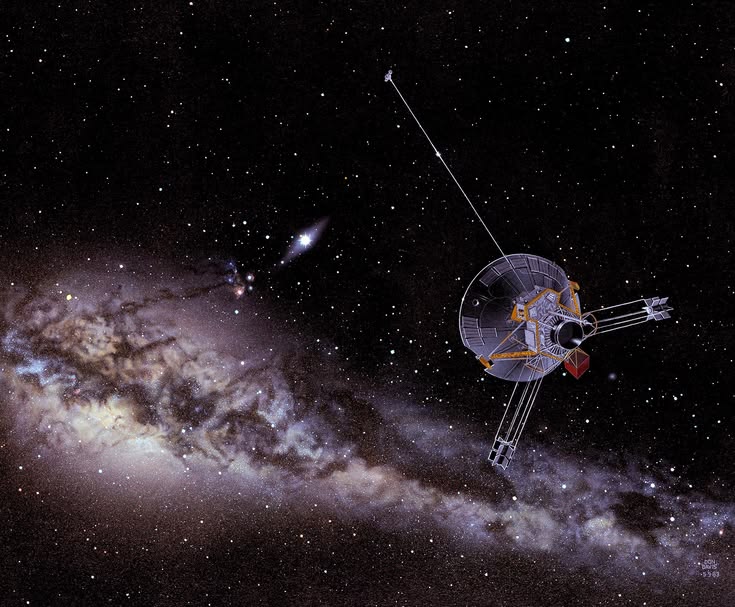
    NASA’s Voyager 1 probe was designed to explore the outer giant planets and send back photographs of Jupiter and Saturn. It was launched in 1977. More than eleven billion miles from Earth, floating through the icy void beyond our solar system, a tiny scrap of 1970s human ingenuity continues its lonely journey. Decades after its primary mission ended, the craft crossed the heliopause. The boundary where the sun’s protective magnetic bubble ends and true interstellar space begins. ​In recent months, engineers faced a daunting crisis. Voyager 1 began transmitting a repeating, meaningless gibberish loop of ones and zeros back to Mission Control. For a moment, scientists feared that after nearly half a century of unbroken operation, the farthest human artifact had finally succumbed to cosmic radiation and cold degradation. Yet through meticulous diagnostic work, engineers isolated a corrupt microchip. They rerouted its memory code across ancient hardware.  Hence, they successfully restored intelligible science data across the vast distance. ​Voyager 1’s survival is not just an engineering miracle; it is a profound testament to humanity’s desire to touch the unknown. ​A spindle of wire, a heart made of bronze, It drifts through the night where the quiet responds. Beyond the sun’s breath and the cradle of red, It whispers the secrets of worlds overhead. ​A Message in a Bottle Across Cosmic Waves ​Carried on the hull of Voyager 1 is the Golden Record, a gold-plated copper phonograph disc containing sounds of Earth, greetings in fifty-five languages, musical compositions from Bach to Chuck Berry, and encoded images of terrestrial life. It serves as an interstellar time capsule, intended to outlast our civilization and tell any distant intelligence who we were. ​We carved our desire on golden veneer, To prove in the darkness that someone was here. A chorus of ocean, a child’s brief greeting, Sent out to outlive every mortal heart’s beating. ​As the probe glides through the cosmic dust, its radio signal traveling at the speed of light takes over twenty-two hours to reach dish antennas on Earth. Every line of telemetry received is a faint echo from an environment no human eye will ever witness firsthand. The spacecraft operates on a diminishing power supply provided by its decaying plutonium generators. Year by year, NASA engineers shut down non-essential instruments to conserve every milliwatt of power, prioritizing the magnetometers and cosmic ray sensors that measure the interstellar medium. ​The Final Quiet Crossing ​The remaining active instruments will inevitably power down as the thermal generators fade entirely by the end of this decade. Voyager 1 will then become a silent voyager, drifting along its galactic orbit around the center of the Milky Way, unbothered by atmospheric drag or gravitational interference, lasting for millions of years. ​When the last power flickers and warmth slips away, It will glide through the night till the dawn of no day. No longer a transmitter, no longer a thread, Just a monument floating where gods used to tread. ​The triumph of retrieving clear data from Voyager 1 reminds us why we look up. Science and art stem from the same original impulse: the refusal to remain quiet in the vastness of the dark, and the drive to leave something meaningful behind before the power fades.

  • |

    An alien planet

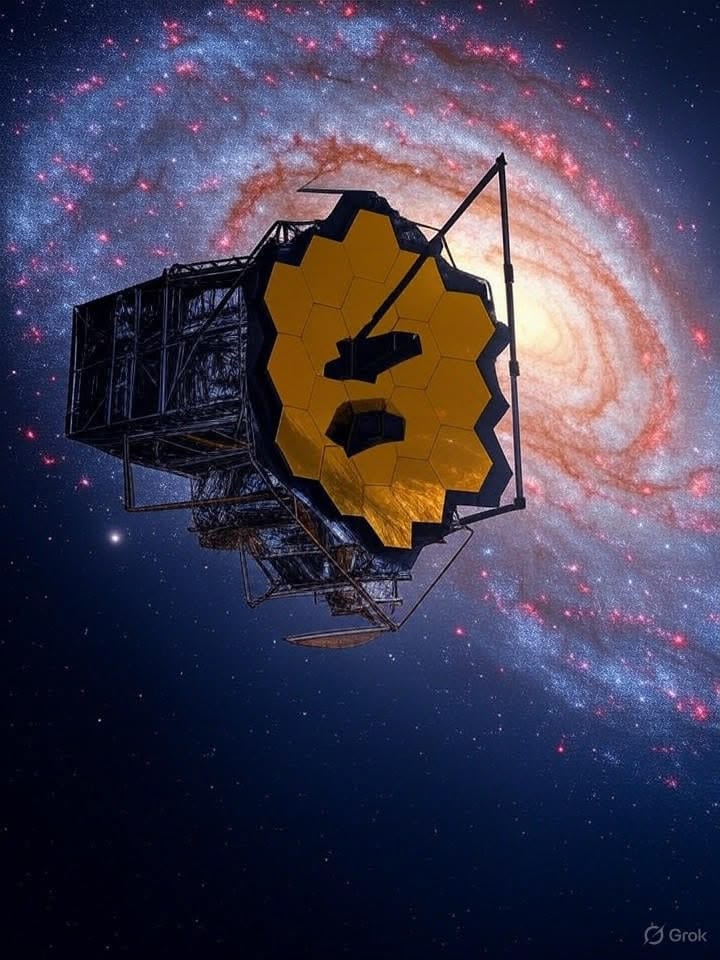
    Imagine living on a world where the start of the day and the end of the day aren’t just different times, but entirely different environments. On one horizon, morning arrives in a chilly mist where vaporized rocks might condense into glittering, mineral clouds. On the opposite horizon, evening sets in as a roaring, hyper-heated furnace hot enough to shred water molecules into raw hydrogen and oxygen. This isn’t sci-fi world-building, it is the reality of WASP-121 b, an extreme exoplanet located roughly 850 light-years from Earth. Astronomers analyzing data from NASA’s James Webb Space Telescope (JWST) have uncovered unprecedented details about this distant world, proving for the first time that its morning and evening twilight zones are fundamentally different from one another. A World Locked in Perpetual Extremes WASP-121 b belongs to a class of cosmic objects known as hot Jupiters: giant gas planets that orbit extraordinarily close to their parent stars. Because of this extreme proximity, the planet is tidally locked. Just as the Moon always presents the same face to Earth, WASP-121 b always presents the exact same hemisphere to its star. One side endures an unrelenting, eternal day with scorching temperatures topping 2,500 degrees Celsius (4,500 degrees Fahrenheit). The opposite side faces permanent night, staring into cold space. For years, astrophysicists hypothesized that the narrow transition zones between day and night. The planet’s terminators might harbor complex, asymmetrical weather patterns. However, confirming this required measuring subtle variations in starlight as the planet passed in front of its star. How Jet Streams Reshape Alien Skies Using JWST’s Near-Infrared Spectrograph (NIRSpec), researchers tracked how starlight filtered through different parts of WASP-121 b’s atmosphere. The findings revealed a dramatic contrast between the morning transition and the evening transition. The driver behind this strange weather is a planetary-scale jet stream. Superheated air on the dayside doesn’t stay still; it rushes toward the cooler nightside at extreme speeds. Because the planet rotates toward the east, these violent winds carry thermal energy around the globe and dump the bulk of that heat directly into the evening region. As a result, WASP-121 b’s evening atmosphere grows significantly hotter than its morning counterpart. Heat causes gases to expand, puffing up the evening sky like a inflated balloon. When starlight filters through this swollen atmospheric layer, it reveals an environment so fierce that water molecules cannot survive intact. Clouds of Metal and Torn Molecules In the searing furnace of the evening sky, chemical bonds break. Water vapor brought in from the dayside is torn apart by the heat, leaving behind a sky depleted of chemical stability. As those same winds continue their journey around the cold nightside, the atmosphere gradually cools down. By the time the air sweeps around to form the morning twilight, the story flips. Here, temperatures drop enough for chemical compounds to reassemble. Scientists suspect that in this cooler morning zone, minerals such as silicates condense out of the gas phase. Instead of water clouds like those on Earth, WASP-121 b’s morning sky likely features reflective clouds made of liquid rock or iron droplets. These metallic clouds block radiation from deeper layers, making the morning side appear even cooler to space observatories. A New Era of Exoplanet Meteorology Until recently, studying alien worlds meant treating entire planets as single, uniform points of light. This discovery demonstrates that modern space telescopes can resolve climate dynamics across distinct regions of a world hundreds of light-years away.   By capturing the contrast between a planet’s morning and evening, astronomers are moving from simply discovering exoplanets to mapping their active weather systems. WASP-121 b may be far too hostile for life as we know it, but understanding its violent atmospheric currents brings us one step closer to reading the skies of smaller, cooler, and potentially habitable worlds in the future.