echoes interstellar dark
| |

Echoes from the Interstellar Dark

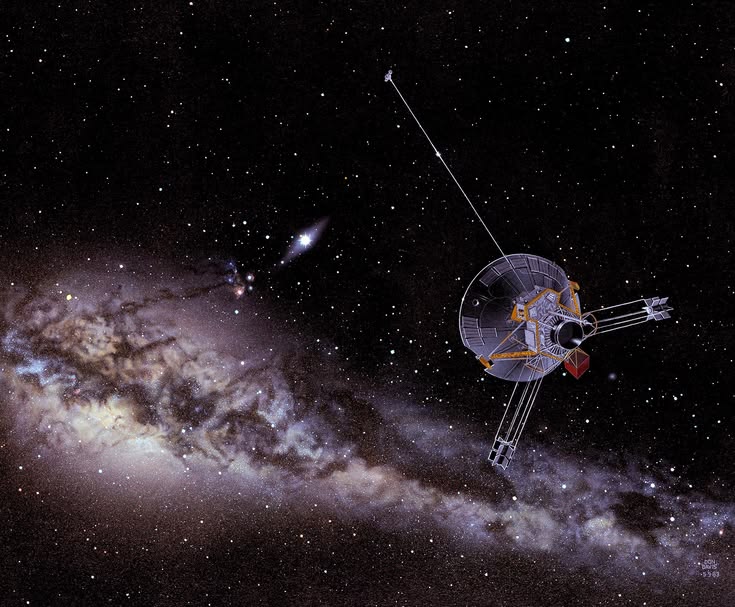
NASA’s Voyager 1 probe was designed to explore the outer giant planets and send back photographs of Jupiter and Saturn. It was launched in 1977. More than eleven billion miles from Earth, floating through the icy void beyond our solar system, a tiny scrap of 1970s human ingenuity continues its lonely journey. Decades after its primary mission ended, the craft crossed the heliopause. The boundary where the sun’s protective magnetic bubble ends and true interstellar space begins.

​In recent months, engineers faced a daunting crisis. Voyager 1 began transmitting a repeating, meaningless gibberish loop of ones and zeros back to Mission Control. For a moment, scientists feared that after nearly half a century of unbroken operation, the farthest human artifact had finally succumbed to cosmic radiation and cold degradation. Yet through meticulous diagnostic work, engineers isolated a corrupt microchip. They rerouted its memory code across ancient hardware.  Hence, they successfully restored intelligible science data across the vast distance.

​Voyager 1’s survival is not just an engineering miracle; it is a profound testament to humanity’s desire to touch the unknown.

A spindle of wire, a heart made of bronze,

It drifts through the night where the quiet responds.

Beyond the sun’s breath and the cradle of red,

It whispers the secrets of worlds overhead.

​A Message in a Bottle Across Cosmic Waves

​Carried on the hull of Voyager 1 is the Golden Record, a gold-plated copper phonograph disc containing sounds of Earth, greetings in fifty-five languages, musical compositions from Bach to Chuck Berry, and encoded images of terrestrial life. It serves as an interstellar time capsule, intended to outlast our civilization and tell any distant intelligence who we were.

We carved our desire on golden veneer,

To prove in the darkness that someone was here.

A chorus of ocean, a child’s brief greeting,

Sent out to outlive every mortal heart’s beating.

​As the probe glides through the cosmic dust, its radio signal traveling at the speed of light takes over twenty-two hours to reach dish antennas on Earth. Every line of telemetry received is a faint echo from an environment no human eye will ever witness firsthand. The spacecraft operates on a diminishing power supply provided by its decaying plutonium generators. Year by year, NASA engineers shut down non-essential instruments to conserve every milliwatt of power, prioritizing the magnetometers and cosmic ray sensors that measure the interstellar medium.

​The Final Quiet Crossing

​The remaining active instruments will inevitably power down as the thermal generators fade entirely by the end of this decade. Voyager 1 will then become a silent voyager, drifting along its galactic orbit around the center of the Milky Way, unbothered by atmospheric drag or gravitational interference, lasting for millions of years.

When the last power flickers and warmth slips away,

It will glide through the night till the dawn of no day.

No longer a transmitter, no longer a thread,

Just a monument floating where gods used to tread.

​The triumph of retrieving clear data from Voyager 1 reminds us why we look up. Science and art stem from the same original impulse: the refusal to remain quiet in the vastness of the dark, and the drive to leave something meaningful behind before the power fades.


Similar Posts

  • |

    August 12 total solar eclipse, will it be visible in Pakistan?

    Islamabad – A rare total solar eclipse will occur on August 12, 2026 attracting the attention of astronomy enthusiasts around the world. However, will it be visible in Pakistan? The solar eclipse will not be visible in Pakistan as it will be nighttime in the country during the key phases of the eclipse. According to Pakistan Standard Time, the partial eclipse will begin at 8:34 PM on August 12 while the total eclipse will begin at 9:58 PM. The eclipse will reach its peak at 10:46 PM and the total eclipse will end at 11:34 PM. Where will solar eclipse be visible? On August 12, the Moon will pass between the Earth and the Sun causing a total solar eclipse to be visible in Greenland, Iceland, northern Russia and parts of Spain and Portugal. A partial solar eclipse will be visible across various parts of North America, Canada, most of Europe and northwestern Africa. According to NASA, the Sun will set during the eclipse in western parts of Europe and Africa creating a unique spectacle in which the solar eclipse will coincide with sunset. How can solar eclipse be watched live? NASA will also provide an online live broadcast of this astronomical event which can be watched online from Pakistan on the night of August 12. Astronomers have warned people in areas where the eclipse will be visible never to look directly at the Sun without specially designed solar-viewing glasses as doing so can cause severe damage to the eyes.

  • |

    China’s Chang’e-7 Moon mission to launch on August 24

    China is preparing to launch a complex, multi-spacecraft mission to the Moon. The mission will land near the Moon’s south pole and search for evidence of water and ice. The mission is scheduled to launch on August 24 from the Wenchang Satellite Launch Center on China’s Hainan Island. According to a statement issued by the China Manned Space Agency, the Chang’e-7 mission will be launched aboard a Long March 5 rocket. The mission will focus on the Moon’s south pole and attempt to determine whether water and ice are present inside the craters as well as their quantity and other related details. Water vapour has previously been detected in this region of the Moon through remote sensing but scientists have not yet been able to measure it directly or obtain samples. Chang’e-7 will also help lay the technological groundwork for China’s crewed lunar mission planned for 2030. The mission will consist of an orbiter, lander, rover and hopper spacecraft. Five days after launch, the spacecraft is expected to enter lunar orbit. The orbiter will then identify and determine the target landing area. Chinese authorities have not yet announced the exact landing date and the landing is expected to take place several months after launch. The hopper spacecraft will make multiple flights over the permanently dark craters near the Moon’s south pole. It will also be equipped with landing legs to allow it to land and analyze the surface of the selected locations. The mission will also carry scientific payloads from several countries. China’s Chang’e-5 mission in 2020 and Chang’e-6 mission in 2024 successfully collected lunar samples and returned them to Earth.

  • Video games may improve memory

    Video games are often seen as just a form of entertainment but a new scientific review suggests they may also benefit the brain. A research review covering 20 years found that people who play video games may perform better in some mental skills especially memory. Researchers examined the results of many previous studies to understand how video games affect the brain. Their goal was to find out whether gaming can improve thinking and learning abilities. The review found a small but statistically significant link between playing video games and better cognitive performance. The strongest improvement was seen in memory. People who played video games generally scored higher in memory-related tests than those who did not. Experts say this may be because many games require players to remember information follow different events make quick decisions and plan strategies. Repeating these tasks can act as a form of mental exercise that helps strengthen memory. Some games also require players to focus on several things at once keeping the brain active. The research also looked at other mental abilities including spatial skills visual attention cognitive control and intelligence. Gamers showed slightly better performance in these areas as well but the biggest and most consistent benefit was found in memory. Researchers noted that not all video games have the same effects. The studies included different types of games such as action games and brain training games as well as participants of different ages.  These differences may explain why the results were not exactly the same across all studies. The researchers also cautioned that it is still too early to say that video games can greatly improve all mental abilities in daily life. More long term studies are needed to understand how long these benefits last and how useful they are in everyday activities. Health experts say playing video games in moderation may support brain health but it should be combined with a balanced diet regular exercise enough sleep and healthy screen time habits. When enjoyed as part of a balanced lifestyle video games can offer both entertainment and potential mental benefits.

  • |

    How fiction brain-trains compassion

    Empathy is the capacity to understand and share the feelings of another. It’s not merely an inherent personality trait; it is a cognitive muscle that requires exercise. While there are many ways to practice compassion in daily life, neuroscientists and psychological researchers have uncovered a uniquely powerful tool for training this mental capacity: reading deep, character-driven fiction. For decades, society viewed reading literature as a purely intellectual or escapist hobby. However, recent scientific studies using functional magnetic resonance imaging (fMRI) have revealed that when we read a story, our brains process the experience in ways remarkably similar to real-world social interaction. When an author describes a character running through a dark forest, struggling with heartbreak, or feeling a sharp pang of injustice, the sensory and emotional centers in the reader’s brain light up as if the reader were experiencing those events directly. This neural simulation allows us to step entirely out of our own shoes and temporarily inhabit the subjective reality of someone else. Psychologists often refer to this ability as theory of mind. It’s the cognitive skill that enables human beings to attribute mental states (beliefs, intents, desires, emotions, and knowledge) to themselves and others. Life only permits us to live a single, localized existence defined by our specific background, culture, and circumstance. Literary fiction breaks through those physical and social barriers. Through the pages of a novel, a reader living in a quiet suburban town can intimately experience the internal struggles of an immigrant navigating a new city, an incarcerated individual fighting for dignity, or a historic figure facing a agonizing moral dilemma. Crucially, fiction tells us what people do. Also, it exposes why they do it. It grants us unprecedented access to the secret thoughts, doubts, and vulnerabilities that real people rarely reveal in public. By witnessing a character’s internal contradictions, readers learn that human behavior is rarely black-and-white. We develop a tolerance for ambiguity and a healthier skepticism toward snap judgments. When we close the book, that expanded perspective lingers in our conscious mind, subtly altering how we interact with co-workers, strangers, and loved ones. Furthermore, reading fiction builds emotional stamina. It asks us to sit quietly with uncomfortable emotions like grief, fear, longing, and regret without fleeing into digital distractions. In doing so, it expands our capacity to hold space for others when they undergo difficult seasons in real life. Literary fiction, therefore, is far more than entertainment. It is a quiet, radical act of bridge-building. Every time we turn a page and immerse ourselves in a stranger’s story, we perform a vital neurological exercise that softens our defenses, broadens our horizons, and reminds us of our shared humanity.  

  • How many people can you spot?

    This interesting visual puzzl is a great way to test your observation skills. Look closely at the picture above and try to figure out how many real people are in the scene. The image shows an art gallery with several paintings hanging on the walls. A number of visitors are looking at the artwork and there is also a statue of a woman inside the gallery. Can you find the correct number? At first glance you may think there are 14 people in the picture.  However that answer is incorrect because the people shown in paintings and the statue are not real people so they should not be counted. If you counted six people that answer is also wrong. There is actually one more person hiding in the picture. Where is the hidden person? The correct answer is seven. To find the hidden person look carefully at the painting in the right corner. Pay close attention to the eyes in the painting. You may notice that a person is cleverly hiding behind it.

  • Drill free treatment for children’s tooth decay

    A major study in the United States has found that silver diamine fluoride (SDF) is a safe low cost and effective way to treat tooth decay in young children. The treatment could help thousands of children avoid painful dental drilling and general anesthesia. The study found that a 38% silver diamine fluoride solution can be applied to the affected tooth in just a few seconds.  The liquid helps stop tooth decay from getting worse without the need for injections drilling or surgery. The Phase 3 clinical trial was led by the University of Michigan and included 830 children under the age of six. Researchers from universities in New York and Iowa also took part in the study. The findings were published in the medical journal JAMA Pediatrics. Researchers discovered that applying SDF every six months successfully stopped tooth decay in more than half of the affected baby teeth. Unlike traditional dental treatment this method does not require removing part of the tooth or placing a filling. Instead the liquid is simply painted onto the decayed area. Professor Margarita Fontana from the University of Michigan School of Dentistry who led the research said the treatment was found to be safe and effective even for children as young as one year old. Experts believe that if SDF receives full approval as a standard treatment for tooth decay it could make dental care easier less expensive and far less stressful for young children and their families.

Leave a Reply

Your email address will not be published. Required fields are marked *