terrorism case registered
| |

Terrorism case registered after clash at MQM-P hea…

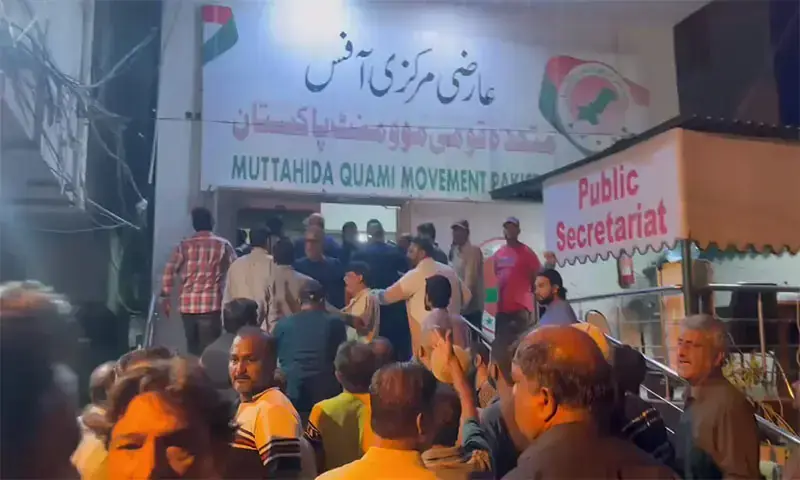
Karachi police have registered a case under the Anti-Terrorism Act following a violent clash between rival groups at the Muttahida Qaumi Movement-Pakistan (MQM-P) headquarters in Bahadurabad that left several people injured and spread panic in the surrounding area.

According to the First Information Report (FIR), the case has been registered by the state at New Town Police Station under multiple sections of the Pakistan Penal Code, including rioting, attempted murder, causing injuries and unlawful assembly, along with Section 7 of the Anti-Terrorism Act.

Police have nominated two suspects, identified as Azhar alias Lumba and Zeeshan Habib, while 20 to 25 unidentified individuals have also been named in the case.

Investigators said police received reports on the evening of August 2 that two groups had clashed near Choti Market in Bahadurabad. During the violence, a man identified as Amir sustained a bullet injury to his arm, while two others, Asad and Kashir Ali, were also injured. All three were shifted to Abbasi Shaheed Hospital for treatment.

The FIR states that both groups allegedly exchanged gunfire and fired into the air, creating fear among residents and disrupting public order. Authorities also noted that Section 144 was in force at the time, prohibiting the display of weapons and public disorder.

Police said the suspects fled the scene before law enforcement personnel arrived.

The incident reportedly occurred during a party meeting at MQM-P’s central office. According to police, tensions escalated after the meeting ended, leading to a confrontation between supporters of different party factions.

Officials said workers belonging to one faction allegedly assaulted members of the rival group and forced them out of the party headquarters. Heavy gunfire was also reported from inside the premises, causing alarm among nearby residents.

Similar Posts

  • | | |

    Iran defied plan to become ‘Venezuela’, says P…

    TEHRAN: Iranian President Masoud Pezeshkian has said his country is facing a difficult economic and military situation but has remained resilient, arguing that national unity prevented what he described as an attempt by Iran’s enemies to push the country towards a Venezuela-like crisis. Speaking at a ceremony, Pezeshkian said Iran was operating under what he called illegal wartime conditions while continuing efforts to provide services and support to its people. The president portrayed the country as facing simultaneous economic and security challenges, but said the Iranian public had remained united despite the pressure. According to Pezeshkian, Iran’s opponents wanted to see the country weakened and destabilised. He argued that the unity of the Iranian people had instead helped Iran emerge as a stronger force. “Today, we are in a state of economic and military war,” Pezeshkian said, while stressing that the government was continuing to work for citizens despite the difficult circumstances. His comments came as Tehran has faced intense pressure over its economic situation and wider confrontation with the United States and its allies. Pezeshkian said Iran’s adversaries had intended to turn the country into “Venezuela”, apparently referring to the severe economic and political difficulties that have affected Venezuela over the past decade. He claimed that the plan had failed because Iranians had maintained a united position in the face of the challenges. The president also referred to a memorandum of understanding reached amid the difficult circumstances. He said the agreement had been shaped by the country’s determination to protect its interests while seeking a way forward through diplomacy. According to Pezeshkian, experts had described the memorandum as being based on “prudence, dignity and wisdom”. He argued that those criticising the agreement did not fully understand the circumstances surrounding it. The remarks suggest that Iran’s leadership is attempting to present the agreement as a strategic decision rather than a concession under pressure. Pezeshkian’s comments also come against the backdrop of signals that Tehran may be seeking a way to end its confrontation with Washington from a position it considers strong. Iranian officials have repeatedly stressed that any diplomatic arrangement must protect the country’s national interests and sovereignty. For Pezeshkian, domestic unity remains central to navigating the crisis. He argued that despite economic hardship and military pressure, the country had avoided the collapse that its opponents allegedly expected. The president’s message was therefore aimed not only at Iran’s external rivals but also at domestic critics of the memorandum. As pressure on Iran continues, Tehran faces the difficult task of managing economic challenges while maintaining political cohesion and determining whether diplomacy can reduce tensions. Pezeshkian’s latest remarks underline his argument that Iran’s resilience, rather than isolation, will shape the next phase of the country’s confrontation with its adversaries.

  • Librarians’ Day observed at UoG’s Quaid-e-Azam Central Library

    GUJRAT: Librarians’ Day was observed at the Quaid-e-Azam Central Library of the University of Gujrat (UoG) with a seminar and panel discussion focusing on the evolving role of libraries, academic research and information professionals in the digital age. The event was organised to commemorate the birth anniversary of Dr S.R. Ranganathan, regarded as the father of library science in South Asia. August 12 is observed as Librarians’ Day in recognition of his contribution to the development of library science and his five laws of library science. Speaking during the panel discussion, Senior Librarian Rameeza Mushtaq said that a central library was the intellectual hub of any university and that the role of librarians had changed significantly with the expansion of digital resources. She said modern librarians were no longer limited to maintaining books and records but were increasingly helping students and researchers identify, access and use reliable academic material. Senior Librarian Liaquat Ali said the growing use of digital media had not reduced the importance of printed books and physical archives. He said libraries continued to provide researchers with access to authentic and preserved sources of knowledge. Librarian Khadija Munawar highlighted the impact of technology on library services and said librarians had increasingly become information navigators, helping students and researchers locate relevant digital resources in an increasingly complex information environment. In his presidential address, Chief Librarian A.R. Sheikh said academic libraries played a central role in strengthening research and intellectual development. “A library is neither a mere structure of bricks and mortar nor a repository of silent shelves; it is the fundamental engine of a nation’s intellectual sovereignty,” he said. Mr Sheikh said the rapid spread of unverified information through digital platforms had created new challenges for librarians and researchers. He said ensuring access to authentic and credible academic information was now among the key responsibilities of library professionals. He said the Quaid-e-Azam Central Library was providing students and researchers access to HEC digital resources, international peer-reviewed journals and the Online Public Access Catalogue (OPAC). The library also has dedicated research facilities for MPhil and PhD scholars and provides services related to academic research and similarity checking, he added. The speakers stressed the need for universities to further strengthen library infrastructure and equip libraries with modern digital resources to support research and higher education. The event concluded with a cake-cutting ceremony attended by Chief Librarian A.R. Sheikh and senior members of the library staff.

  • |

    UN extends Volker Turk’s term as Rights Chief

    The United Nations General Assembly has approved a second four-year term for UN High Commissioner for Human Rights Volker Turk. The decision was made despite strong opposition from the United States, Russia and Israel. The 193-member General Assembly voted overwhelmingly in favour of the extension. A total of 144 countries voted for the proposal. Ten opposed it, while 13 abstained. UN Secretary-General Antonio Guterres had proposed Turk for another full term. His current term is due to end in October. The vote came amid growing tensions between Washington and the United Nations. The US administration has reduced funding for several UN agencies. It has also withdrawn from a number of UN bodies. Washington had asked the General Assembly to delay the vote. US officials said more time was needed for consultations and review. The United States also warned that it could reconsider its relationship with the UN if the proposal was approved. US Representative for UN Management and Reform Jeff Bartos criticised the process before the vote. He said the decision did not allow enough time for discussion and oversight by member states. Bartos warned that the US could reassess its engagement, participation and funding of the United Nations. Despite the warning, most member states supported Turk. The European Union backed the extension. Several African and Latin American countries also voted in favour. China supported the proposal as well. Russia strongly opposed Turk’s reappointment. Russian Deputy Ambassador to the UN Dmitry Chumakov accused the rights chief of bias against Moscow. He also criticised Turk for making what Russia described as unfounded allegations against the country. Russia had proposed a shorter extension for Turk. Its plan would have kept him in the position only until the end of 2026. The General Assembly rejected that proposal by a large majority. Israel also opposed the decision. The Israeli Foreign Ministry criticised Guterres’ proposal and said the decision should have been left to the next UN secretary-general. Turk has faced criticism from several powerful countries because of his strong position on human rights issues. He has criticised Russia’s war in Ukraine. He has also raised concerns about Israel’s actions in Gaza. Turk has further called for investigations into deaths involving people held in US immigration custody. Human rights organisations have defended his position. They say the UN human rights chief must be able to challenge powerful countries when fundamental freedoms are threatened. The position has become increasingly important as conflicts and restrictions on civil liberties continue in different parts of the world. Turk is an Austrian lawyer. He has worked with the United Nations for decades. His UN career has included senior positions in Geneva. He has also served in field locations, including Kosovo. With the General Assembly’s latest decision, Turk will become the first UN human rights chief to serve two complete four-year terms. His reappointment is likely to keep human rights at the centre of international debate. It may also further test relations between the United Nations and countries that have opposed his approach.

  • |

    Samar Jafri’s emotional noha recitation in Karbala wins hearts

    Young Pakistani singer and actor Samar Jafri continues to earn admiration not only for his performances on screen but also for his deep spiritual values. After winning audiences over with his memorable roles in Mayi Ri and Parwarish, the talented star has built a reputation as someone who openly embraces his faith and shares meaningful moments from his spiritual journey with fans. Samar has never shied away from expressing the importance of religion in his life. Over the years, he has posted about significant occasions, including his pilgrimage to Makkah for Umrah. He has also been seen observing Muharram with great respect and devotion, often sharing messages that reflect remembrance, grief, and reverence during Ashura. This year, the actor is spending the holy month of Safar in Karbala, one of the most sacred destinations for millions of Muslims around the world. During his visit, Samar participated in a religious gathering where he recited a heartfelt noha, a form of elegiac poetry that commemorates the sacrifices of Imam Hussain (AS) and the martyrs of Karbala. A video from the gathering has quickly spread across social media platforms. In the clip, Samar can be seen standing on the mimbar as he delivers the noha with sincerity and emotion. His soulful voice and composed presence created a touching atmosphere, leaving many viewers impressed by his devotion and respect for the occasion. The opportunity to recite from the mimbar in Karbala is considered a special honor by many believers. Fans appreciated the moment, describing it as both spiritually uplifting and deeply moving. Many noted that Samar’s humility and emotional delivery made the recitation even more impactful. Social media users have responded warmly to the viral video. Comment sections have been filled with prayers, words of encouragement, and messages praising the young star for using his talent in a meaningful way. Several fans expressed how fortunate he was to receive such an opportunity, while others simply shared heart emojis and prayers for his continued success. Many supporters also highlighted that it is refreshing to see a young celebrity openly embracing spirituality while maintaining a successful career in the entertainment industry. They praised Samar for balancing his professional achievements with his personal beliefs and for inspiring others through his actions. Samar Jafri has steadily become one of Pakistan’s most promising young entertainers. Whether through his acting, singing, or public appearances, he continues to connect with audiences from different walks of life. His latest recitation from Karbala has once again showcased another side of his personality—one rooted in faith, humility, and respect for religious traditions. As the video continues to circulate online, fans are celebrating not only his beautiful voice but also the sincerity with which he participated in the sacred gathering, making the moment memorable for admirers across social media.

  • | |

    Search teams recover body of American climber following fatal avalanche on Broad Peak

    Search and rescue teams in northern Pakistan have recovered the body of 39-year-old American mountaineer Mallory Geis following a massive avalanche on Broad Peak, the world’s 12th-highest mountain. The disaster struck a 10-member international expedition led by renowned British-Nepali climber Nirmal “Nims Dai” Purja at an altitude of approximately 7,000 metres in the Karakoram range. Pakistani military helicopters and ground units deployed to the site have secured the remains of three victims so far, including Geis, Omani climber Nadhira Ahmed Abdullah Al Harthy, and Nepali guide Pur Bahadur Gurung. The Alpine Club of Pakistan confirmed that bad weather and hazardous high-altitude conditions have severely complicated ongoing search efforts for the remaining missing team members. Aerial drone footage spotted several other expedition members swept nearly 1,000 metres downhill by the slide, though ground teams have yet to reach them due to the extreme terrain. Local authorities in Gilgit-Baltistan stated that recovered victims were transported to regional medical facilities for official identification procedures, while military helicopters remain on standby for further retrieval operations as weather permits.

  • | |

    PTI holds nationwide protests to mark three years

      Supporters of Pakistan Tehreek-e-Insaf (PTI) staged demonstrations across Pakistan on Wednesday to mark three years since former prime minister Imran Khan was first taken into custody. One of the largest gatherings was held outside Lahore’s Aiwan-e-Adl, where members of the Insaf Lawyers Forum, along with party leaders, lawyers and supporters, demanded Khan’s release and called for an end to the legal cases against him. The Lahore protest took place on Upper Mall, outside the court complex, where participants waved party flags and chanted slogans in support of the jailed PTI founder. Demonstrators maintained that the cases filed against Imran Khan were politically motivated and urged authorities to withdraw all charges. They insisted that the legal proceedings were intended to prevent him from participating in politics, an allegation that both the government and state institutions have consistently denied, maintaining that the judicial process is independent and conducted in accordance with the law. Several senior PTI leaders, including Salman Akram Raja, Ali Aijaz Butta, Rehan Dar and Shaukat Basra, addressed the gathering. During their speeches, they called for Imran Khan’s immediate release and vowed that the party would continue its campaign until he was freed and all cases against him were resolved. Protesters repeatedly chanted slogans demanding his release and described the demonstrations as peaceful expressions of public support. The Lahore rally formed part of a nationwide protest campaign announced by PTI to coincide with the anniversary of Khan’s imprisonment. Similar demonstrations were organised in different cities across Pakistan, while overseas PTI supporters also held rallies in several countries to express solidarity with the former prime minister and draw attention to his continued detention. Imran Khan has remained in prison since August 2023, when he was convicted in a corruption case. Since then, he has faced several additional prosecutions and convictions, including cases involving corruption allegations, the disclosure of official secrets and marriage-related legal matters. Khan and his party have consistently rejected all accusations, describing them as politically driven. The government, however, maintains that the cases are being handled through an independent legal process and rejects claims of political interference. Wednesday’s demonstrations were the latest in a series of protests organised by PTI following Khan’s arrest. The party has repeatedly demanded his release and called for fresh general elections. Previous protests have at times faced restrictions imposed by authorities, while some demonstrations have also witnessed incidents of violence and clashes. Separately, PTI leader Shaukat Basra alleged that journalist Natiq Rehan was assaulted by Punjab Police while reporting on the Lahore protest. According to Basra, the journalist was attacked despite performing his professional duties. Punjab Police did not immediately issue a response to the allegation. A day before the nationwide protests, Amnesty International issued a statement urging Pakistani authorities to safeguard Imran Khan’s fundamental rights as his detention entered its third year. Isabelle Lassee, the organisation’s Acting Regional Director for South Asia, expressed concern over what Amnesty described as the denial of a fair trial, prolonged solitary confinement, and restrictions on family visits, legal representation and medical care. The human rights organisation also called on the authorities to respect the right to peaceful assembly and avoid arbitrary action against demonstrators. It further urged that Imran Khan and his wife, Bushra Bibi, be granted regular access to their families, legal counsel and appropriate medical treatment in accordance with international human rights standards.

Leave a Reply

Your email address will not be published. Required fields are marked *