bigger bank broader
| | | | | |

Bigger bank, broader base: TG Limcaoco’s BPI years

After five years at the helm of the 175-year-old Bank of the Philippine Islands (BPI), Jose Teodoro “TG” Limcaoco is ready to say goodbye to the country’s oldest bank.

Limcaoco will step down as president and chief executive officer in April 2027, making way for consumer banking chief Maria Cristina “Ginbee” Go, BPI’s first female CEO. He will remain on the board and take on other senior roles within the Ayala Group.

Five years is a short chapter for a bank that has survived colonial governments, wars, and economic crises. But Limcaoco was hardly new to BPI or the Ayalas when he took the helm in 2021. He had been president of BPI Capital and BPI Family Savings Bank, then spent six years as Ayala Corporation’s chief financial officer.

The bank he inherited from Cezar “Bong” Consing was already one of the country’s largest. The one he will leave behind is considerably bigger.

BPI’s annual net income rose from P23.88 billion in 2021 to P66.62 billion in 2025, while assets grew from P2.42 trillion at end-2021 to P3.9 trillion by September 2026. Its customer base more than doubled to over 19 million, helped in part by the 2024 merger with Robinsons Bank.

But enough of the numbers, and back to the man of the hour. Limcaoco isn’t your typical banker who shies away from the media. He’s frank, sometimes even blunt, and always ready to break down a tough banking topic with an example or two.

Ask him about bank secrecy, and he’ll point out that few countries have laws as restrictive as the Philippines’. Ask about reserve requirements, and he’ll explain why he prefers interest rates as a monetary policy tool.

When Rappler asked last July why BPI made transfers free, he explained that under new central bank rules, it could charge only around P1.50. Why bother customers over that amount?

“You’re just needling the customer,” he said.

BPI became one of the first major commercial banks to permanently waive InstaPay and PESONet fees, with others following with cuts of their own. There was a business case, too. Free transfers could keep customers using BPI and perhaps bring in more business.

Much the same thinking has gone into the bank’s expansion into agency banking under Limcaoco. Customers can now open accounts, deposit, and withdraw money at participating supermarkets and convenience stores — often for free — while BPI avoids some of the costs of branches and ATMs.

In a March interview with McKinsey, Limcaoco summed it up: “Our philosophy is, if you cannot come to the bank, we will bring the bank to you.”

Bangko Sentral ng Pilipinas Deputy Governor Bernadette Romulo-Puyat, who has taken a particular interest in the program, had some rather warm words for Limcaoco.

“Ang galing ni TG (TG’s great),” she told Rappler in a recent chat about financial inclusion. “My experience with him, he was really looking for ways to help give everybody a bank account. He’s made it so simple.”

Must Read

[Vantage Point] The bank Ginbee Go will inherit


[Vantage Point] The bank Ginbee Go will inherit

Unfinished business

At BPI’s 175th anniversary gala in October, chairman Jaime Augusto Zobel de Ayala credited Limcaoco with bringing “real dynamism” to the bank, while welcoming to its next chapter under Go.

Limcaoco, meanwhile, spent much of his own speech looking beyond his time at the bank. He wondered aloud what banking might look like 25 years from now, when BPI celebrates its 200th anniversary.

“I don’t think any of us can predict exactly what banking will look like by then,” he said. 

Yet he was clear on one unfinished job: “Millions of Filipinos still have limited access to formal financial services.”
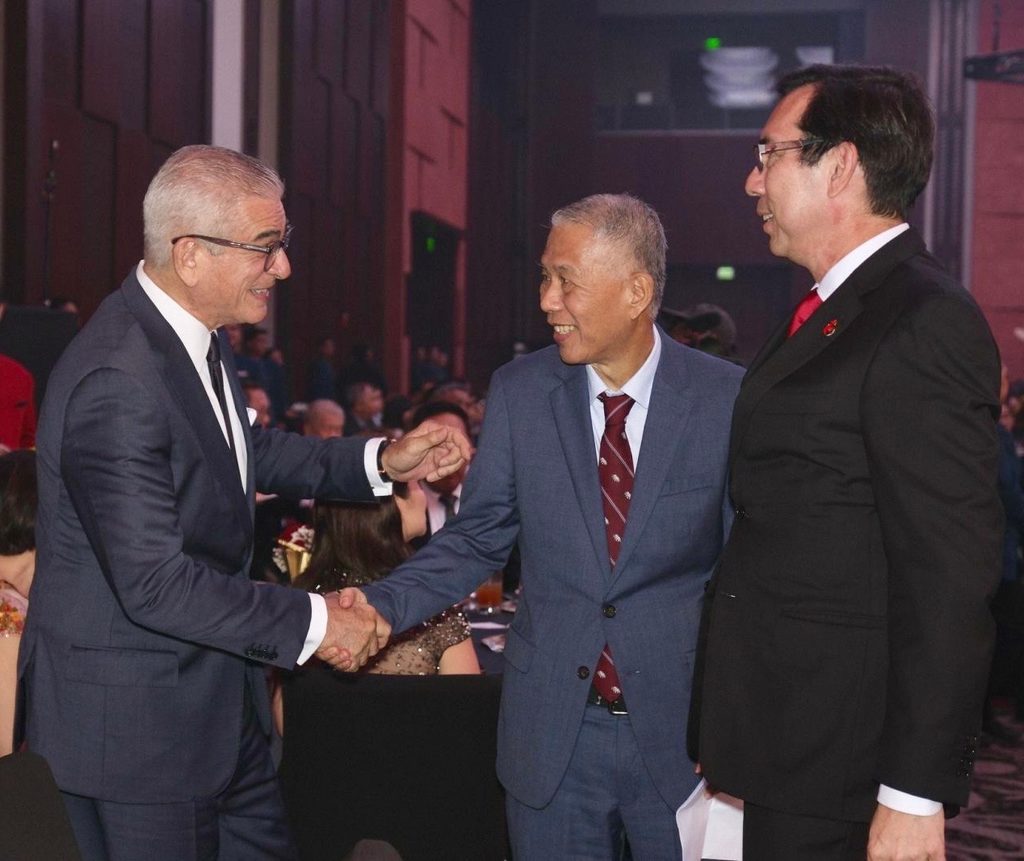
GALA. BPI president and CEO TG Limcaoco (right) looks on as BPI chairman Jaime Augusto Zobel de Ayala congratulates writer Roel Landingin. BPI

But Limcaoco isn’t always dressed up to the nines. A rather different side of him was on display two months earlier, on August 1, BPI’s actual birthday, when the bank launched a Disney-themed savings account for children.

After a morning of golf, Limcaoco, a grandfather himself, was at Glorietta — an Ayala mall, of course — talking to children about setting aside part of their allowance. As he often does, he brought the idea down to their level. Compound interest might mean little to a child, but saving for a bicycle or a dog was easy enough to understand.

“Maybe a kid puts P100 a month,” he told Rappler afterward. “The magic of interest, even though it’s small, really is meaningful.”

Meanwhile Go, then still a few months away from being officially announced as his successor, took the chance to tease her boss, joking during her remarks about whether the children should call him “Lolo TG.” 

For that morning, at least, the man running one of the country’s biggest banks was simply Lolo TG, talking to kids about what they could do for their future. – Rappler.com

Must Read

[Finterest] Want kids to save early? Here’s what BPI’s ‘Lolo’ TG Limcaoco has to say


[Finterest] Want kids to save early? Here’s what BPI’s ‘Lolo’ TG Limcaoco has to say

Similar Posts

  • | |

    Trump hints at sanctions on Chinese banks over Ira…

    WASHINGTON: US President Donald Trump has hinted that Chinese banks dealing with Iran could face American sanctions, raising fresh concerns over the future of one of the most important financial channels supporting Iran’s oil trade. Speaking to reporters in the Oval Office, Trump was asked whether his administration could target Chinese banks involved in transactions with Iran. Rather than ruling out such action, he responded by questioning why anyone would assume the United States would not impose sanctions. Trump also suggested that Washington does not necessarily reveal its plans before taking action, leaving open the possibility that the administration could expand its pressure campaign against Iranian trade and the financial institutions that facilitate it. The warning comes at a sensitive time for relations between Washington and Beijing. China is Iran’s largest trading partner, while Iranian crude oil remains an important component of their economic relationship. Chinese companies and financial institutions play a significant role in processing payments connected to Iranian oil and other commercial transactions. Any direct sanctions against major Chinese banks could therefore have consequences far beyond Iran. Financial institutions with significant exposure to the US banking system could face a difficult choice between maintaining business with Iran and protecting their access to American financial markets. For Tehran, the impact could be substantial. Restrictions on Chinese banks could make it harder for Iranian businesses to receive payments, settle international transactions and maintain oil revenues. Such measures could further isolate Iran from the global financial system and increase pressure on its already restricted economy. Washington has previously imposed sanctions on Chinese companies and entities accused of supporting Iran or facilitating transactions that the United States considers prohibited. However, major Chinese banks have so far largely avoided direct sanctions of the kind now being suggested. Targeting a major Chinese financial institution would represent a significant escalation. It could also add another layer of tension to an already complicated US-China economic relationship, particularly as both countries remain engaged in disputes over trade, technology and strategic competition. For now, the Trump administration has not announced sanctions against any major Chinese bank over dealings with Iran. The president’s remarks remain an indication rather than a formal policy announcement. Still, the message from Washington is clear: Chinese financial institutions involved in Iran-related trade could increasingly find themselves under scrutiny. The uncertainty is likely to be closely watched by oil traders, banks and governments across the region, as any major disruption to Iran-China financial channels could affect both Iranian oil exports and wider energy markets.

  • | | |

    OGDCL confirms Pakistan’s first lithium disc…

    Oil and Gas Development Company Limited (OGDCL) has announced a major scientific breakthrough by confirming the presence of lithium in underground geothermal formation water, also known as brine. The discovery is the first of its kind in Pakistan and is being seen as an important step towards exploring new sources of critical minerals needed for clean energy technologies. The discovery was made under OGDCL’s pilot geothermal programme. According to officials, advanced geochemical testing was carried out on formation water collected from a successfully tested high-temperature geothermal well. The analysis confirmed the presence of lithium in concentrations comparable to those found in some of the world’s well-known lithium-bearing geothermal brine resources. Senior OGDCL officials said this is the first confirmed lithium discovery from geothermal brine in Pakistan. They described the development as a significant achievement for the country’s energy and mineral exploration sector. The finding places Pakistan among a growing group of countries investigating geothermal resources as a potential source of lithium. Lithium has become one of the world’s most sought-after minerals due to the rapid expansion of clean energy technologies. It is a key component in rechargeable batteries used in electric vehicles, energy storage systems, smartphones, laptops and many other electronic devices. Global demand for lithium has increased sharply as countries move towards renewable energy and low-carbon transportation. Experts say geothermal brine is emerging as an alternative source of lithium in several parts of the world. Unlike traditional mining, lithium extraction from geothermal water has the potential to combine energy production with mineral recovery, although commercial development requires extensive research and investment. Officials stressed that the latest discovery does not mean commercial production will begin immediately. Further geological studies, laboratory testing and feasibility assessments will be required to determine the size of the lithium resource, the concentration of the mineral and whether extraction would be commercially viable. The discovery is expected to encourage more investment in Pakistan’s geothermal and mineral exploration sectors. Researchers believe additional exploration could identify other areas with similar geological conditions and expand the country’s knowledge of its underground mineral resources.

  • | | |

    Goods transport strike enters fourth day

    The nationwide strike by the All Pakistan Goods Transport Alliance has entered its fourth consecutive day. The continued suspension of freight services has raised concerns about possible disruptions to the supply of essential goods. Transporters say there has been no major breakthrough in talks with the government. They have therefore decided to continue their protest. Goods Transport Alliance President Malik Shehzad Awan said the government must take serious steps to end the deadlock. He said transporters were still willing to negotiate. However, he stressed that talks alone would not be enough. The transporters want clear progress on their demands before ending the strike. The ongoing protest has created uncertainty for businesses and traders. Goods transport vehicles play a key role in moving food, fuel and other essential items between cities. A prolonged strike could affect the movement of supplies. It could also create difficulties for wholesalers, retailers and consumers. There are concerns that shortages in some markets may push up prices. Food items could become more expensive if supplies remain disrupted for an extended period. The transporters launched the protest over rising petroleum prices. They are also opposing the government’s policy of changing petroleum prices on a daily basis. The alliance has demanded action on the issues affecting the transport sector. Transporters argue that frequent changes in fuel prices make it difficult for them to manage operating costs. They have called for serious engagement from the government. They want their concerns to be addressed through negotiations. Malik Shehzad Awan said the transporters had not closed the door to dialogue. However, he maintained that the government must demonstrate meaningful progress. The strike is affecting freight movement at a time when businesses depend heavily on road transport. Goods vehicles are used to supply markets across the country. If the deadlock continues, the impact could become more visible in local markets. Traders may face delays in receiving supplies, while consumers could face higher prices. The transporters have not announced a deadline for ending the strike. They are waiting for further government action and progress on their demands.

  • Bangkok Property Market Shifts to High-Value Homes Amid Economic Slowdown

    BANGKOK –  The Bangkok residential real estate market is undergoing a significant transformation in 2026. Developers are shifting their focus toward higher-priced homes while reducing the total number of new properties entering the market. According to data released by the Agency for Real Estate Affairs, residential properties remain the core driver of Thai real estate. […]

Leave a Reply

Your email address will not be published. Required fields are marked *