crude oil reserves
|

U.S. Crude oil reserves fall to 45-year low amid rising tensions with Iran


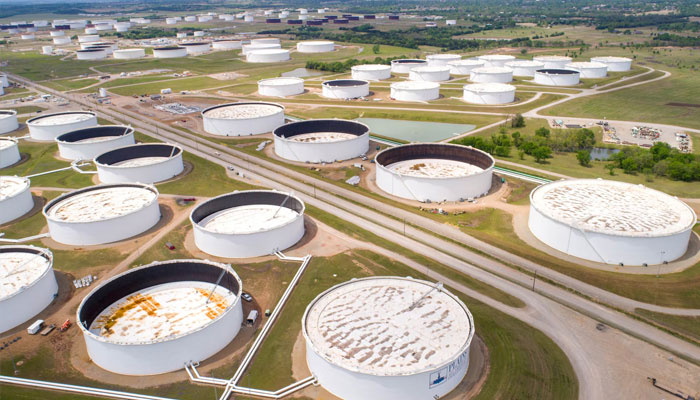
The United States’ crude oil reserves have declined sharply since tensions with Iran began escalating, reaching their lowest level in approximately 45 years, according to recent data. The significant reduction in oil stockpiles has raised concerns among energy experts and policymakers about the country’s energy security and its ability to respond to potential supply disruptions in the future.

According to a chart released by Bank of America, the United States currently has enough crude oil supplies to meet approximately 43 days of demand. This marks the lowest level since July 1983, highlighting a substantial decline in available reserves. Analysts consider this an important indicator of the country’s energy preparedness, particularly at a time of heightened geopolitical uncertainty in the Middle East.

The decline in reserves comes amid ongoing tensions involving Iran, a key player in global energy markets. Any instability in the region has the potential to affect international oil supplies and prices, making reserve levels an important measure of a country’s ability to withstand disruptions. As geopolitical risks continue to rise, the shrinking U.S. oil inventory has drawn increased attention from financial institutions and energy analysts.

Recent figures released by the U.S. Energy Information Administration (EIA) confirm that both commercial and strategic crude oil reserves have remained under sustained pressure. As of July 10, the country’s commercial crude oil inventories stood at approximately 409.7 million barrels. This represents a level that is nearly 6 percent below the five-year average, indicating that inventories remain significantly lower than what is typically considered normal for this time of year.

Commercial oil inventories play a vital role in meeting the daily energy demands of industries, transportation, and consumers. Lower-than-average stockpiles may leave the market more vulnerable to unexpected supply disruptions, refinery outages, or sharp increases in demand, particularly during periods of economic growth or geopolitical instability.

In addition to commercial reserves, the Strategic Petroleum Reserve (SPR)—the United States’ emergency oil stockpile maintained for national security purposes—has also declined substantially. According to the latest data, the SPR fell to approximately 316.5 million barrels as of July 18, marking its lowest level since April 1983. The Strategic Petroleum Reserve is designed to provide emergency supplies during severe energy crises, natural disasters, or major disruptions in global oil markets.

The continued reduction in the SPR has prompted discussions among energy experts regarding the need to replenish the reserve and strengthen the country’s emergency preparedness. While portions of the reserve have been released in recent years to help stabilize fuel prices and address supply concerns, rebuilding these stockpiles has become an increasingly important policy consideration.

When commercial inventories and the Strategic Petroleum Reserve are combined, the United States’ total crude oil reserves currently stand at approximately 730.8 million barrels. This places overall U.S. oil stockpiles among their lowest levels in more than four decades, underscoring the long-term decline in available reserves.

Energy analysts note that reserve levels alone do not necessarily indicate an immediate shortage, as the United States remains one of the world’s largest oil producers. However, lower inventories reduce the country’s flexibility in responding to unexpected supply shocks or prolonged geopolitical crises.

The sharp decline in U.S. oil reserves serves as a significant reminder of the challenges facing global energy markets. With geopolitical tensions, fluctuating production levels, and evolving energy policies continuing to shape the industry, maintaining adequate strategic and commercial reserves remains a key priority for ensuring long-term energy security and economic stability in the United States.

Similar Posts

  • |

    Mysterious Cat cutouts installed to scare rare Owls in Florida

        A strange wildlife-related incident has emerged from Cape Coral, Florida, where cat cutouts have reportedly been installed on two vacant plots of land in an apparent attempt to scare away rare burrowing owls. Wildlife experts believe the unusual measure may have been taken to prevent the owls from settling on the properties before construction work begins. The incident has drawn attention because burrowing owls are a protected species in Florida and are considered an important part of the state’s wildlife ecosystem. According to local volunteers, six fake cat cutouts were placed on one of the vacant plots near a burrowing owl’s nest. The life-sized images appear to have been positioned deliberately to create the impression that cats are present in the area. The two plots were recently sold, and wildlife advocates believe the new owners may have adopted the unusual tactic in an effort to discourage additional owls from establishing burrows on the properties. The owners are reportedly preparing the land for future construction, making the presence of protected birds a potential concern. Burrowing owls live underground and are known for making their homes in burrows rather than trees. Unlike many other owl species, they spend considerable time on the ground and around their burrows. Their unusual lifestyle makes them particularly vulnerable to predators, human activity and changes to their habitat. Cats are among the major predators of burrowing owls. As a result, wildlife experts believe the cat cutouts may have been placed on the plots to make the birds feel threatened and encourage them to leave the area. However, the unusual method has raised concerns among wildlife conservationists. In Florida, burrowing owls receive special protection under federal law. Interfering with their burrows, disturbing the birds or attempting to remove them without the required authorization can be illegal. Wildlife conservation volunteers have expressed concern that property owners are taking extreme measures to protect their land from protected species instead of working with relevant authorities and wildlife experts. Conservation groups have emphasized that landowners should seek appropriate guidance before carrying out construction or other activities in areas occupied by burrowing owls. Since the species is legally protected, property owners may be required to obtain permission before disturbing their habitat or taking actions that could affect the birds. The incident has also highlighted the broader challenges faced by wildlife in rapidly developing areas. As vacant plots are sold and developed, animals that have established habitats on the land can come into conflict with construction plans. Conservationists say that protecting wildlife requires balancing development with legal and environmental responsibilities. Volunteers working for wildlife protection organizations have urged residents to take greater responsibility for safeguarding the rare birds. They have specifically appealed to residents to keep their pet cats indoors so that they do not pose a threat to burrowing owls and other vulnerable wildlife. The unusual sight of fake cats on vacant plots has therefore become more than a curious local incident. It has drawn attention to the continuing struggle between property development and wildlife conservation in Florida. Wildlife advocates hope that greater public awareness, responsible pet ownership and cooperation with conservation authorities can help protect burrowing owls and ensure that the rare species continues to survive in its natural habitat.

  • | | |

    Quaid-i-Azam’s statue unveiled at Pakistan Embas…

    WASHINGTON: A statue of Pakistan’s founder, Quaid-i-Azam Mohammad Ali Jinnah, has been unveiled at the Pakistan Embassy in Washington as part of the country’s Independence Day celebrations. Pakistan’s Ambassador to the United States Rizwan Saeed Sheikh inaugurated the statue during a ceremony attended by members of the Pakistani-American community, diplomats and media representatives. The statue was donated by the Quaid-i-Azam Foundation of Houston and will remain permanently installed at the embassy. The unveiling comes as Pakistan prepares to commemorate Jinnah’s 150th birth anniversary later this year, adding historical significance to the Independence Day event. Addressing the gathering, Ambassador Sheikh paid tribute to Jinnah’s constitutional struggle and leadership, saying his efforts transformed the vision of Pakistan into reality. He urged Pakistanis, particularly those living abroad, to follow the founder’s guiding principles of “Unity, Faith and Discipline.” The ceremony opened with the hoisting of Pakistan’s national flag and the national anthem, followed by Quranic recitation and the reading of messages from Pakistan’s president, prime minister and deputy prime minister. The ambassador also highlighted Pakistan’s growing importance in its relationship with the United States. His remarks came alongside a message from US Secretary of State Marco Rubio, who noted cooperation between the two countries in areas including regional mediation, critical minerals, energy, counterterrorism, cultural heritage, trade and investment. Pakistan’s role in regional diplomacy has gained particular attention amid efforts to ease tensions between the United States and Iran, with Islamabad seeking to use its ties with both countries to encourage dialogue. The event also featured an investiture ceremony for Waqar Ali Khan, who received the President’s Award for Pride of Performance in recognition of his long-standing contribution as a community leader and cultural ambassador in the United States.

  • |

    Nepal flood disaster deepens as new threat emerges

    KATHMANDU: Rescue teams in Nepal are digging through thick layers of mud and debris in search of survivors two days after a devastating flash flood swept through Himalayan communities, killing at least 469 people and leaving nearly 1,000 others missing in Nepal and neighbouring Tibet. The scale of the destruction has left entire villages cut off, roads and bridges destroyed and families desperately waiting for news of loved ones. With the possibility of another major flood looming, authorities are also racing to prevent a second disaster. The catastrophe began on Wednesday morning after a glacier collapse sent a massive torrent of water, rocks, ice and mud rushing through mountain river systems. The sudden surge tore through settlements along a major route connecting Nepal’s capital Kathmandu with Lhasa in Tibet. The affected region is also popular with trekkers and pilgrims, adding to concerns over the fate of foreign nationals caught in the disaster. Authorities said almost 1,000 people remained missing on both sides of the border. At least 540 of those reported missing are foreigners, according to officials. Rescue teams battle destroyed roads Nepalese rescue workers have been using heavy machinery, helicopters and sniffer dogs to search damaged areas. Helicopters have also been delivering emergency supplies to people stranded in remote towns and valleys where roads have disappeared beneath mud and debris. Rescue operations have been particularly difficult in the mountainous terrain, where landslides and damaged infrastructure have restricted access. In one of the most heartbreaking accounts from the disaster, Dibga Tamang was among the final people rescued from the badly affected town of Rasuwa on Thursday. He was airlifted with three others to an army camp in Nuwakot. Tamang described the devastation in deeply personal terms, saying that his community had been destroyed and that he had lost everyone who mattered to him. His account reflected the grief of hundreds of families still waiting for information about relatives who disappeared when the floodwaters swept through their communities. New flood threat raises alarm Even as rescuers continue searching for survivors, authorities are facing a dangerous new threat. Nepal’s disaster management authorities warned that a debris blockage had created a lake on the Bhotekoshi River. The water level is continuing to rise, raising fears that the natural barrier could collapse and unleash another destructive flood downstream. Across the border, Chinese authorities are also monitoring a rapidly filling barrier lake in Tibet. Chinese officials said around three million cubic metres of water could flow into the already dammed lake over the next three days. That volume is roughly equivalent to 1,200 Olympic-sized swimming pools. The situation could become particularly dangerous around September 1, when officials expect the water flow to reach its peak. Chinese state media reported that authorities had deployed an eight-member engineering team to carry out aerial surveys and three-dimensional modelling of the barrier lake. Engineers are studying whether a drainage channel can be constructed through the natural dam to lower the lake’s water level. However, the operation is complicated by steep cliffs and unstable terrain created by the glacier collapse. Engineer Chen Hanxiao told Chinese state broadcaster CCTV that experts needed precise calculations of the lake’s filling rate and the speed at which water could pass through a proposed drainage channel. Teams are also expected to monitor the lake floor, collect additional data and keep a close watch on weather conditions in the coming days. Gyirong border crossing badly damaged On the Chinese side, the Gyirong border crossing has emerged as one of the worst-hit locations. Chinese rescue teams had yet to reach the most severely affected area by Thursday evening, with crews concentrating on clearing debris from the road leading to Gyirong Port. Dramatic footage from the disaster showed huge torrents of muddy water and debris racing through the border crossing within seconds. Structures were engulfed while people scrambled to escape. Authorities said 558 people were missing in Gyirong County, including 260 foreign nationals. Three deaths had been confirmed on the Chinese side at the time of the report. The seriousness of the disaster was underscored by the visit of Chinese Premier Li Qiang to Gyirong on Thursday. His presence signalled the high priority Beijing has placed on the rescue and relief operation. Families wait desperately for news Far from the disaster zone, relatives of missing people have been searching for answers. Sneha Sudhir, from Chantilly, Virginia, is among those desperately waiting for news. Her husband was part of a group of 10 men from northern Virginia who travelled from Nepal towards Tibet’s Mount Kailash when the disaster struck. Several Americans are believed to be among those still missing. Sudhir said families were supporting one another while contacting officials, politicians, friends and relatives in the United States and India in an effort to locate their loved ones. Her account captured the painful uncertainty facing families who do not know whether their relatives survived. US President Donald Trump said the United States had offered assistance to Nepal following the disaster. “Nobody’s ever seen anything quite like that,” Trump said, describing the destruction and promising American support. Bodies recovered hundreds of kilometres away The force of the flood was so immense that bodies were carried far from the areas initially hit by the torrent. Ganesh Aryal, administrator of Nepal’s Chitwan district, said authorities had recovered 103 bodies from the river system in his district. Chitwan lies around 100 kilometres from the worst-hit areas around Trishuli, highlighting the extraordinary reach of the floodwaters. Local hospitals have struggled to accommodate the large number of bodies recovered. Authorities have therefore been preparing tents and other facilities where families can identify and claim the remains of their relatives. Government faces major test Nepal’s Prime Minister Balendra Shah visited flood-hit Nuwakot on Thursday and acknowledged the severity of the situation. He said government agencies were operating at full capacity, with the immediate priorities being the rescue of missing people, treatment of the injured and delivery of emergency assistance to affected families. The disaster presents a

  • |

    South Korea pushes for US-North Korea talks after Trump cuts drills

    South Korea has called for renewed dialogue between the United States and North Korea after US President Donald Trump ordered a reduction in annual military exercises with Seoul. The South Korean government said it hopes Trump’s relationship with North Korean leader Kim Jong Un can help restart diplomatic engagement between Washington and Pyongyang. President Lee Jae Myung’s office said Seoul was ready to take diplomatic steps to encourage meaningful discussions. The goal, according to the presidential office, is to reduce tensions and promote peace and stability on the Korean Peninsula. The statement followed Trump’s decision to scale back US military exercises with South Korea. Trump said his decision was influenced by his relationship with Kim. In a social media statement, Trump argued that the exercises were expensive and could send an inappropriate or hostile message to North Korea. Trump also referred to the situation involving Iran while explaining his decision. He said he had recently asked the South Korean president whether Seoul wanted to participate in efforts concerning the denuclearisation of Iran, but that South Korea had declined. North Korea had not immediately issued a response to Trump’s announcement. Pyongyang has repeatedly criticised joint US-South Korean military exercises. North Korean authorities have previously described the drills as preparations for a potential invasion and warned that they could trigger a strong response. The latest developments come after President Lee proposed direct discussions with North Korea on Saturday. Lee called for both sides to abandon threats and begin talks aimed at formally ending the long-running conflict on the Korean Peninsula. He said discussions between the directly involved parties could also create an opportunity to explore measures aimed at stopping the expansion of North Korea’s nuclear capabilities. South Korea has long sought greater diplomatic engagement to reduce military tensions with its northern neighbour. However, negotiations between Washington and Pyongyang have remained stalled. Trump and Kim previously held high-level meetings, raising hopes of progress on North Korea’s nuclear programme. Those efforts ultimately failed to produce a lasting agreement. Analysts believe Trump’s latest decision could be intended to create conditions for renewed negotiations. However, they warn that North Korea may demand significant concessions before returning to the negotiating table. Leif-Eric Easley, a professor at Ewha University in Seoul, said Trump’s recent comments about Kim indicated a possible willingness to re-engage with North Korea. Easley also cautioned that Pyongyang has been strengthening its military capabilities while benefiting from its relationship with Russia during the war in Ukraine. He warned that reducing US-South Korean military exercises could create challenges for the alliance. It could also affect coordination between the two militaries and slow South Korea’s efforts to assume greater responsibility for its own defence. The professor further argued that a reduction in military preparedness could weaken deterrence against potential conflicts in the wider Asian region. South Korea now faces the challenge of balancing diplomacy with military preparedness. Seoul wants to use the current opening for dialogue while maintaining security cooperation with Washington.

  • |

    US issuing final opportunity for nuclear agreement with Tehran before extreme military action

    US President Donald Trump has issued a final ultimatum to Iran, stating that Tehran has one last opportunity to negotiate a diplomatic resolution with Washington before facing severe military force, which he referred to as decapitation. Speaking from the Oval Office, the American leader confirmed he had paused planned air strikes following direct requests from Persian Gulf nations, including Saudi Arabia, Qatar, and the United Arab Emirates, who urged Washington to allow diplomacy one final window. The framework for the proposed negotiations relies on a two-stage approach, with the initial phase requiring the immediate and unconditional reopening of the Strait of Hormuz to international shipping. The subsequent phase will address the complete denuclearisation of Iran, referencing commitments previously outlined in a joint memorandum signed in June. Trump further dismissed any personal domestic political considerations regarding the timeline, emphasising that his decision to delay military action was driven by a desire to prevent widespread loss of life while pursuing a durable diplomatic outcome.

  • |

    Idaho restaurant shooting leaves three dead

    IDAHO: A shooting at a busy fast-food restaurant in the US state of Idaho left three people dead, including the suspected gunman, and injured seven others, authorities said. The attack occurred at an In-N-Out Burger restaurant in Twin Falls on Saturday, triggering a major emergency response as police, paramedics and other first responders rushed to the scene. According to local police, the suspect opened fire inside or near the restaurant before the incident came to an end. Officials later confirmed that the gunman was among those killed. The identities of the victims have not yet been released as authorities continue notifying their families. Police Chief Matthew Hicks said officers believe there was only one attacker and assured residents that there is no ongoing threat to the community. Investigators are working to establish the motive behind the shooting and determine the sequence of events that led to the violence. Witnesses described scenes of panic as gunfire erupted. One eyewitness said he saw an armed man carrying a rifle before shots were exchanged. Restaurant employees also rushed to help injured victims, with one worker reportedly pulling a wounded woman to safety while waiting for emergency medical teams. Seven injured people were transported to nearby hospitals for treatment. Officials have not yet released updates on their conditions. Law enforcement agencies have secured the area and launched a full investigation. Detectives are examining evidence, reviewing surveillance footage and interviewing witnesses to understand what triggered the deadly attack. Public officials praised the swift response of emergency services, saying their actions helped secure the scene and prevent further casualties. Authorities have urged anyone with additional information or video footage to assist investigators as the inquiry continues.

Leave a Reply

Your email address will not be published. Required fields are marked *